Tonelify
Reviewed

Artist

The Rolling Stones amp settings and guitar tones

2 songs, each with a starting point and the rig from its sources

What amp settings do you need for The Rolling Stones?

Tonelify's library has 2 The Rolling Stones songs, each with the rig reported in interviews and articles and a reference starting point on a generic five-knob amp. There is no single The Rolling Stones setting. Paint It Black starts at Gain 2 and Satisfaction at Gain 5, so set the amp for the song, not for the artist.

The numbers below are the same ones each song page gives. The rig for each song is on its own page with the sources it comes from.

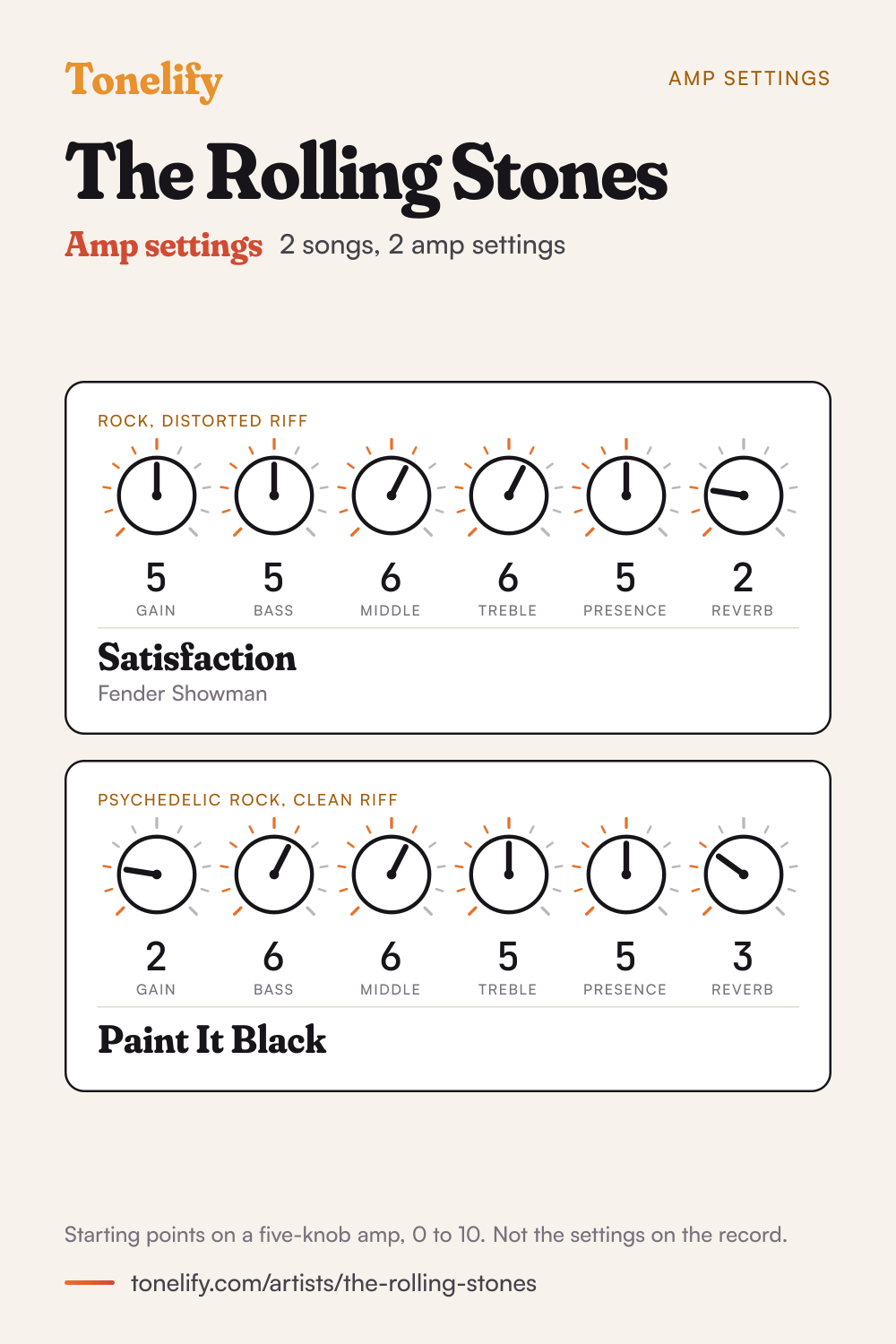
The Rolling Stones amp settings on one sheet, 2 songs, 2 amp settings: Satisfaction and Paint It Black

The Rolling Stones amp settings on one sheet

Every song on this page, grouped by the starting point it shares, with the same numbers as the song pages. Open it full size to print, or save it for later.

The Rolling Stones songs and their starting points

Satisfaction by The Rolling Stones album artwork

Satisfaction

DistortedRiff1960s

A fuzz-drenched riff that was meant to stand in for a horn section.

Start at Gain 5, Bass 5, Middle 6, Treble 6, Presence 5, Reverb 2, with the bridge pickup.

Guitar
Gibson Firebird, per people at the session (other accounts: an Epiphone or a 1959 Les Paul)
Amp
Fender Showman, per Richards' autobiography as Ground Guitar cites it
Satisfaction: full settings, rig and sources →
Paint It Black by The Rolling Stones album artwork

Paint It Black

CleanRiff1960s

A droning, Eastern-sounding riff played on sitar over a double-time organ bass line.

Start at Gain 2, Bass 6, Middle 6, Treble 5, Presence 5, Reverb 3, with the neck or middle position.

Guitar
Not named in the sources read (Keith Richards on electric and acoustic guitars; the riff is Brian Jones' sitar)
Amp
Not documented
Paint It Black: full settings, rig and sources →

These are positions on a generic five-knob amp with gain, bass, middle, treble and presence, each running 0 to 10. They are a starting point, not the settings used on the record, and they will not transfer unchanged to an amp with a different gain structure or EQ voicing.

What gear did The Rolling Stones use?

SongGuitar and amp
SatisfactionGibson Firebird, per people at the session (other accounts: an Epiphone or a 1959 Les Paul)Fender Showman, per Richards' autobiography as Ground Guitar cites it
Paint It BlackNot named in the sources read (Keith Richards on electric and acoustic guitars; the riff is Brian Jones' sitar)Not documented

Tonelify reads each of these chains and translates it to the amp and guitar you already own. Adapt one in the tone matcher →

The Rolling Stones tone questions

What amp settings do you need for The Rolling Stones?

It depends on the song. On a generic five-knob amp, Satisfaction starts at Gain 5, Bass 5, Middle 6, Treble 6, Presence 5, Reverb 2; Paint It Black starts at Gain 2, Bass 6, Middle 6, Treble 5, Presence 5, Reverb 3. These are starting points, not the settings used on the records.

What gear did The Rolling Stones use on these songs?

Satisfaction: Gibson Firebird, per people at the session (other accounts: an Epiphone or a 1959 Les Paul); Fender Showman, per Richards' autobiography as Ground Guitar cites it. Paint It Black: Not named in the sources read (Keith Richards on electric and acoustic guitars; the riff is Brian Jones' sitar); Not documented. Each song page lists the sources behind its rig.

Can you get the The Rolling Stones tone without the original gear?

Yes. What carries these sounds is the gain structure, the EQ curve, the pickup position and the order of the effects, and all four can be rebuilt on other equipment. Tonelify rewrites each starting point for the amp and guitar you own.

More artists