
505
A spaghetti western guitar part over pulsing organ that erupts into chiming distortion.
What is the 505 guitar tone?
The 505 guitar tone is a spaghetti western guitar part over pulsing organ that erupts into chiming distortion, heard on Arctic Monkeys' 2000s indie rock recording. It is a clean riff tone, and Arctic Monkeys reportedly tracked it with the two guitar parts of Jamie Cook and Miles Kane, on instruments and amps that no source read here names: the personnel list on Wikipedia credits Cook with guitar and Kane, then of the Rascals and later of the Last Shadow Puppets, with additional guitar, while Alex Turner is credited with vocals and Hammond organ rather than guitar; Wikipedia says the organ at the start replicates Ennio Morricone's music for The Good, the Bad and the Ugly, where Angel Eyes enters before the final standoff, and Radio X says the song is led by that organ sound, with Kane's guitar alongside it; PopMatters hears a moody first half of pulsating organ and spaghetti western guitar before the song erupts in desperation with banging cymbals and chiming distortion; Matt Helders plays variations of a motorik beat at 140 BPM, and Turner called it the band's first proper love song; produced by James Ford and Mike Crossey and recorded at Miloco Studios in East London, it closes Favourite Worst Nightmare, released on 23 April 2007, and was a sleeper hit, reaching number 74 in the UK in 2007 before TikTok made it one of the band's most streamed songs in 2022. Here the guitar sits under an organ line in the first half and only turns to chiming distortion when the song erupts, so the clean part wants space and a little reverb rather than any drive.
You do not need that exact gear to land in the same place. What carries this sound is the gain structure, the EQ curve, the pickup choice and the order of the effects, and all four can be rebuilt on equipment that costs a fraction of the original. The numbers change from amp to amp, because a clean channel on a modelling combo and a small practice amp reach the same voicing from different knob positions. That translation is what Tonelify works out for the rig you actually own.
505 amp settings: a starting point
On a generic five-knob amp, start at Gain 2, Bass 4, Middle 6, Treble 7, Presence 6, Reverb 3 for the moody first half, with the neck or middle position. There is a second setting for the loud second half below.
- Gain 2
- Bass 4
- Middle 6
- Treble 7
- Presence 6
- Reverb 3
- Signal chain
- None documented
- The control that matters most
- Holding back for the second half. The first half is organ and a spaghetti western guitar line, and PopMatters hears the song erupt into chiming distortion later, so keep the opening part clean with a little reverb and save the drive for the loud section.
These positions are free and they are a starting point. A Katana, a Spark and a valve head reach this voicing from different knob positions, so Tonelify rewrites every value above for the amp and guitar you own. A first plan starts with 7 days free, $0 today.
Adapt these to my amp- Pickup
- Neck or middle position
These are positions on a generic five-knob amp with gain, bass, middle, treble and presence, each running 0 to 10. They are a starting point, not the settings used on the record, and they will not transfer unchanged to an amp with a different gain structure or EQ voicing. If you tell Tonelify which amp you own, it rewrites every value above for the controls that amp actually has.
Second sound
505 amp settings for the loud second half
For the loud second half, start at Gain 5, Bass 4, Middle 6, Treble 7, Presence 6, Reverb 2, with the bridge pickup.
- Gain 5
- Bass 4
- Middle 6
- Treble 7
- Presence 6
- Reverb 2
- Signal chain
- None documented
- Where the song switches
- PopMatters hears a moody first half of pulsating organ and spaghetti western guitar, then the song erupting in desperation with banging cymbals and chiming distortion.
- Pickup
- Bridge pickup
The same reference as the panel above: positions on a generic five-knob amp, a starting point rather than the settings on the record.
Does the 505 tone sound off on your amp?
Pick what you hear. You get the knobs to turn from the starting point above, and how far. It works from the setting for the moody first half.
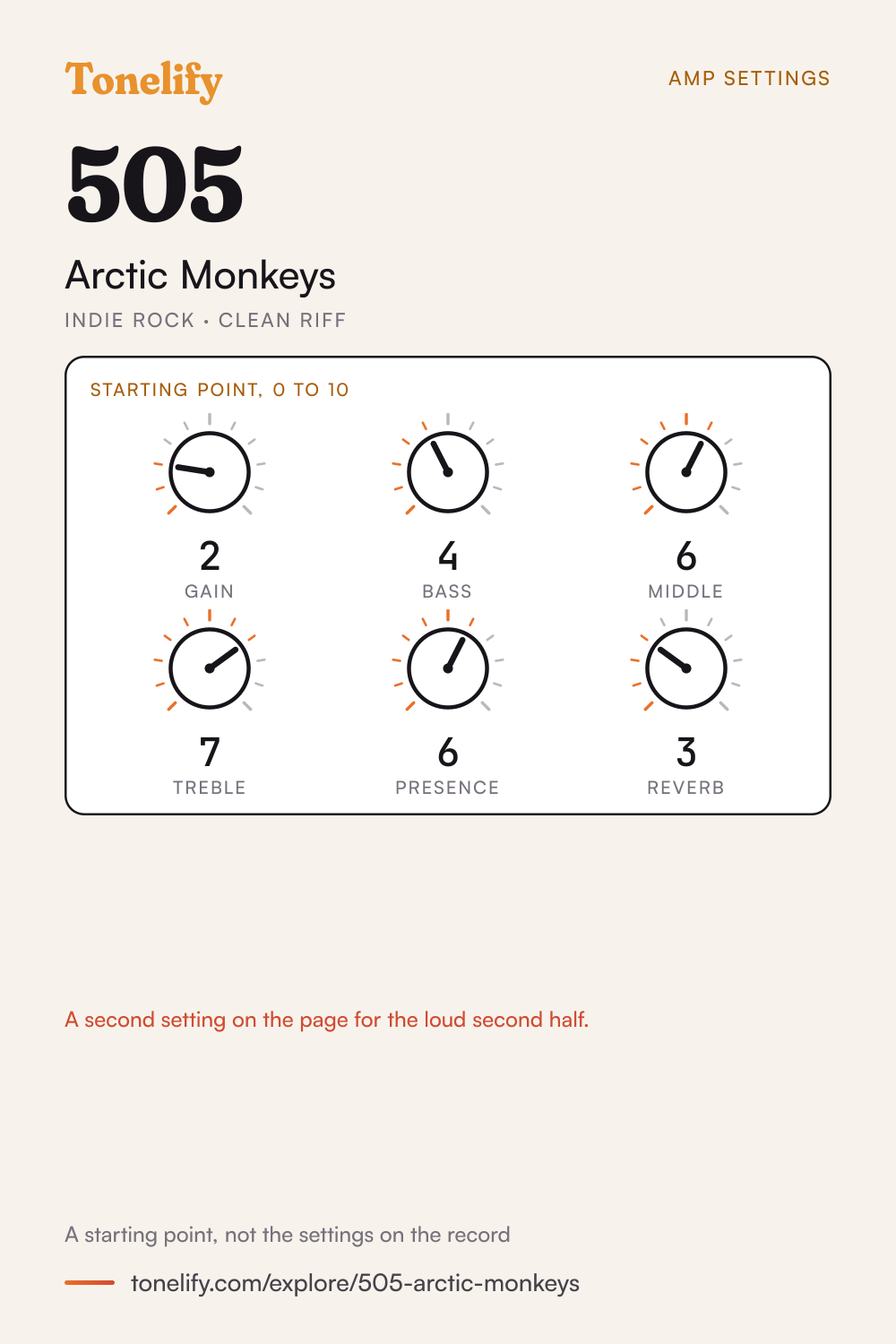
505 amp settings on one sheet
The starting point above and the rig below on one printable page, the same numbers as this page. Open it full size to print, or save it for later.
What gear did Arctic Monkeys use on 505?
The two guitar parts of Jamie Cook and Miles Kane, on instruments and amps that no source read here names: the personnel list on Wikipedia credits Cook with guitar and Kane, then of the Rascals and later of the Last Shadow Puppets, with additional guitar, while Alex Turner is credited with vocals and Hammond organ rather than guitar; Wikipedia says the organ at the start replicates Ennio Morricone's music for The Good, the Bad and the Ugly, where Angel Eyes enters before the final standoff, and Radio X says the song is led by that organ sound, with Kane's guitar alongside it; PopMatters hears a moody first half of pulsating organ and spaghetti western guitar before the song erupts in desperation with banging cymbals and chiming distortion; Matt Helders plays variations of a motorik beat at 140 BPM, and Turner called it the band's first proper love song; produced by James Ford and Mike Crossey and recorded at Miloco Studios in East London, it closes Favourite Worst Nightmare, released on 23 April 2007, and was a sleeper hit, reaching number 74 in the UK in 2007 before TikTok made it one of the band's most streamed songs in 2022.
Sources: Wikipedia: 505 (song), Wikipedia: Favourite Worst Nightmare, Radio X: where is 505 in the Arctic Monkeys song?, PopMatters: Arctic Monkeys, Favourite Worst Nightmare
Tonelify's tone matcher reads that chain and translates it to the amp and guitar you already own, returning gain, bass, mids, treble and presence values along with a pickup position.
How do you get the 505 tone on your own amp?
Tell us your guitar, amp, and pedals
AI researches the original tone of 505
Get exact knob settings adapted to your rig
505 tone questions
What amp settings do you need for 505?
On a generic five-knob amp, start at Gain 2, Bass 4, Middle 6, Treble 7, Presence 6, Reverb 3 for the moody first half, with the neck or middle position, and at Gain 5, Bass 4, Middle 6, Treble 7, Presence 6, Reverb 2 for the loud second half, with the bridge pickup. These are positions on a generic five-knob amp with gain, bass, middle, treble and presence, each running 0 to 10. They are a starting point, not the settings used on the record, and they will not transfer unchanged to an amp with a different gain structure or EQ voicing. Tonelify rewrites the same values for the specific amp and guitar you own, because a high-gain head and a small solid-state combo reach the same spaghetti western guitar part over pulsing organ that erupts into chiming distortion from different positions.
Does 505 use one amp setting or two?
Two. PopMatters hears a moody first half of pulsating organ and spaghetti western guitar, then the song erupting in desperation with banging cymbals and chiming distortion. On a generic five-knob amp, start at Gain 2, Bass 4, Middle 6, Treble 7, Presence 6, Reverb 3 for the moody first half, and at Gain 5, Bass 4, Middle 6, Treble 7, Presence 6, Reverb 2 for the loud second half.
What amp did Jamie Cook and Miles Kane use on 505?
Amp: Not documented. Guitar: Not named in the sources read (Jamie Cook on guitar, Miles Kane on additional guitar). Sources: Wikipedia, Radio X and PopMatters.
What were Jamie Cook and Miles Kane's amp settings on 505?
None of the sources cited on this page gives Jamie Cook and Miles Kane's full amp settings on 505. The numbers here are a starting point for that kind of part, not the settings from the session, and Tonelify rewrites them for the amp and guitar you own.
How do you get Jamie Cook and Miles Kane's tone on 505?
Holding back for the second half. The first half is organ and a spaghetti western guitar line, and PopMatters hears the song erupt into chiming distortion later, so keep the opening part clean with a little reverb and save the drive for the loud section. Play it with the neck or middle position.
Can you get the 505 tone without the original gear?
Yes. The parts that define the sound are the gain structure, the EQ curve, the pickup position and the effects order, and those translate to other equipment. Tonelify's adaptation step works them out for the amp and guitar you own.
Does Tonelify cost anything to try?
A match for your own gear takes a plan, and a first plan starts with 7 days free with nothing charged that day: Stage is $6.99 a month for 20 matches, Headliner is $10.99 a month for unlimited matching within a fair use limit of 150 new matches a day, and yearly billing works out cheaper on both. Reading this page and the rest of the library costs nothing and needs no account.


