Gear data
Which amps and guitars recorded the most famous guitar tones?
Updated 7 min read22 sources
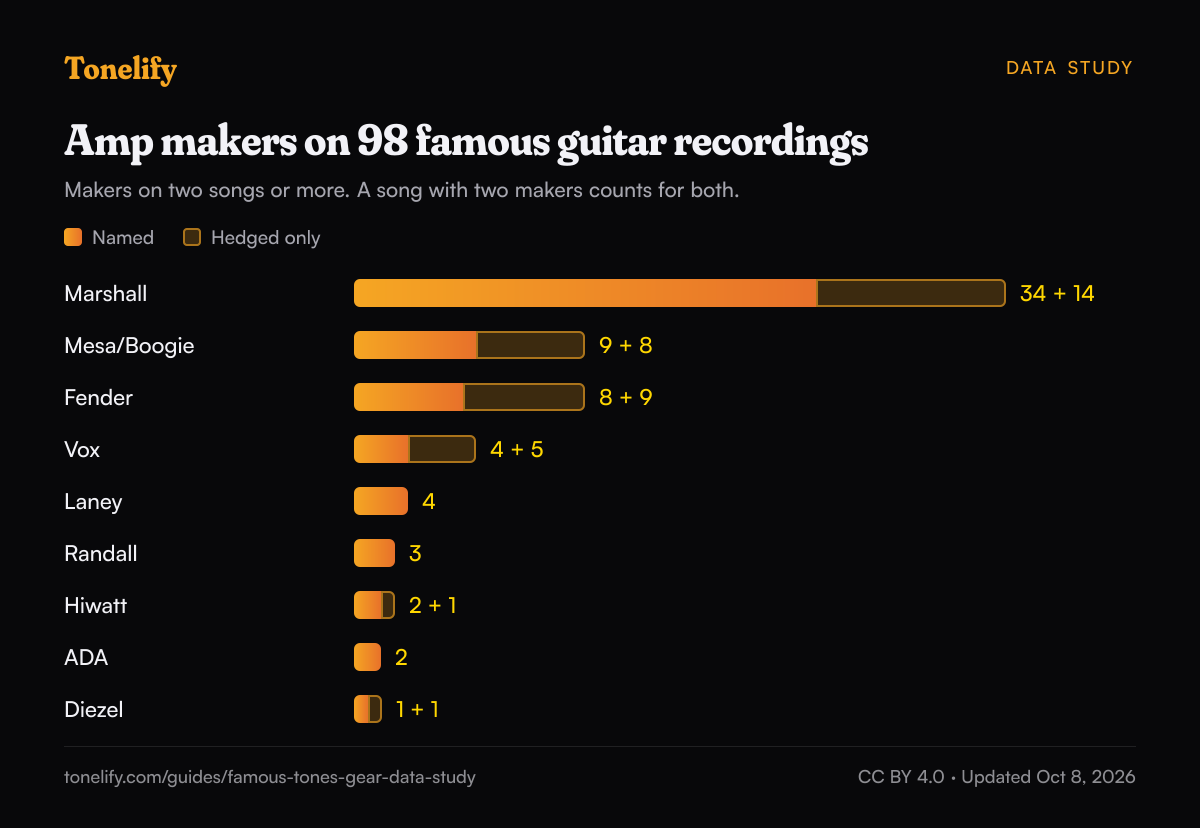
Marshall amps are named on 34 of the 98 famous recordings in Tonelify's sourced tone library, 35%, more than three times as many as the next maker, Mesa/Boogie, on 9. Les Paul-family guitars appear on 18 songs and Stratocasters on 20. For 34 songs the sources cannot pin down a single amp, and only 8 have knob positions a named source printed.
Every song in the library links at least two sources for its rig. This study codes each one by hand, prints the rules, and offers the full table as a free CSV under CC BY 4.0.
Which amp makers appear most often
Marshall is named on 34 of the 98 recordings and hedged on 14 more. Mesa/Boogie comes next on 9, then Fender on 8, Vox on 4 and Laney on 4. Named on one song each: Hartley Thompson, Orange, Park, Roland, Schecter, Silvertone, Tech 21 and VHT. Named only with a hedge: Bogner, Bradshaw, Dumble, Garnet, Peavey, Rickenbacker, Sunn, Supro and Two-Rock.
Read the lead with the library in mind. It covers famous rock and metal recordings from the 1960s to the 2010s, and 33 of the 98 are metal of some kind. A library of jazz or country records would give a different order, so this is a picture of famous rock guitar recordings, not of guitar amps in general.
| Maker | Named | Hedged only | Total |
|---|---|---|---|
| Marshall | 34 | 14 | 48 |
| Mesa/Boogie | 9 | 8 | 17 |
| Fender | 8 | 9 | 17 |
| Vox | 4 | 5 | 9 |
| Laney | 4 | 0 | 4 |
| Randall | 3 | 0 | 3 |
| Hiwatt | 2 | 1 | 3 |
| ADA | 2 | 0 | 2 |
| Diezel | 1 | 1 | 2 |
What amp did they use? The players people search for
Google's suggestions for "what amp did" and "what amps did", checked in English on 3 October 2026, name 14 players and bands. The library covers 10 of them; Stevie Ray Vaughan, B.B. King, Chuck Schuldiner and the Beatles are not in it yet. For the 10, this is what the sources name on each recorded song.
| Player | Songs | Amps the sources name |
|---|---|---|
| Kurt Cobain | Smells Like Teen Spirit, Come As You Are, Heart-Shaped Box, In Bloom, Drain You, About a Girl | Tech 21 SansAmp, Mesa/Boogie, Fender Bassman, Fender Twin Reverb (Endino's, modded); hedged: Vox AC30 |
| Dimebag Darrell | Floods, Cowboys from Hell, Walk | Randall RG-100, Randall RG100ES, Randall Century 200 |
| Jimi Hendrix | Purple Haze, Little Wing, Voodoo Child (Slight Return) | Marshall Super 100; no amp named on two songs |
| Jimmy Page | Stairway to Heaven, Whole Lotta Love | Vox Super Beatle; hedged: Supro combo, Marshall |
| David Gilmour | Comfortably Numb, Wish You Were Here, Time, Shine On You Crazy Diamond | Hiwatt 100-watt head, Hiwatt DR103; hedged: Fender Dual Showman; acoustic on one song |
| Eddie Van Halen | Eruption, Panama, Ain't Talkin' 'bout Love | Marshall 1959 Super Lead, Marshall head |
| Tony Iommi | Iron Man, Paranoid, War Pigs, Into the Void | Laney, Laney 100-watt, Laney Supergroup |
| Metallica | Master of Puppets, Enter Sandman, Nothing Else Matters, Seek & Destroy, One, For Whom the Bell Tolls, Fade to Black, Orion, The Unforgiven, Ride the Lightning | Mesa/Boogie Mark IIC+, Marshall heads, Mesa/Boogie Mark IIC++, Marshall (modded), Marshall Super Lead (modded), Marshall JMP 2203; hedged: Bradshaw preamp, Marshall (borrowed in Copenhagen); no amp named on one song |
| Lynyrd Skynyrd | Sweet Home Alabama, Free Bird | Fender Twin, Marshall; no amp named on one song |
| Prince | Purple Rain | Mesa/Boogie Mark IIB |
Les Paul or Stratocaster?
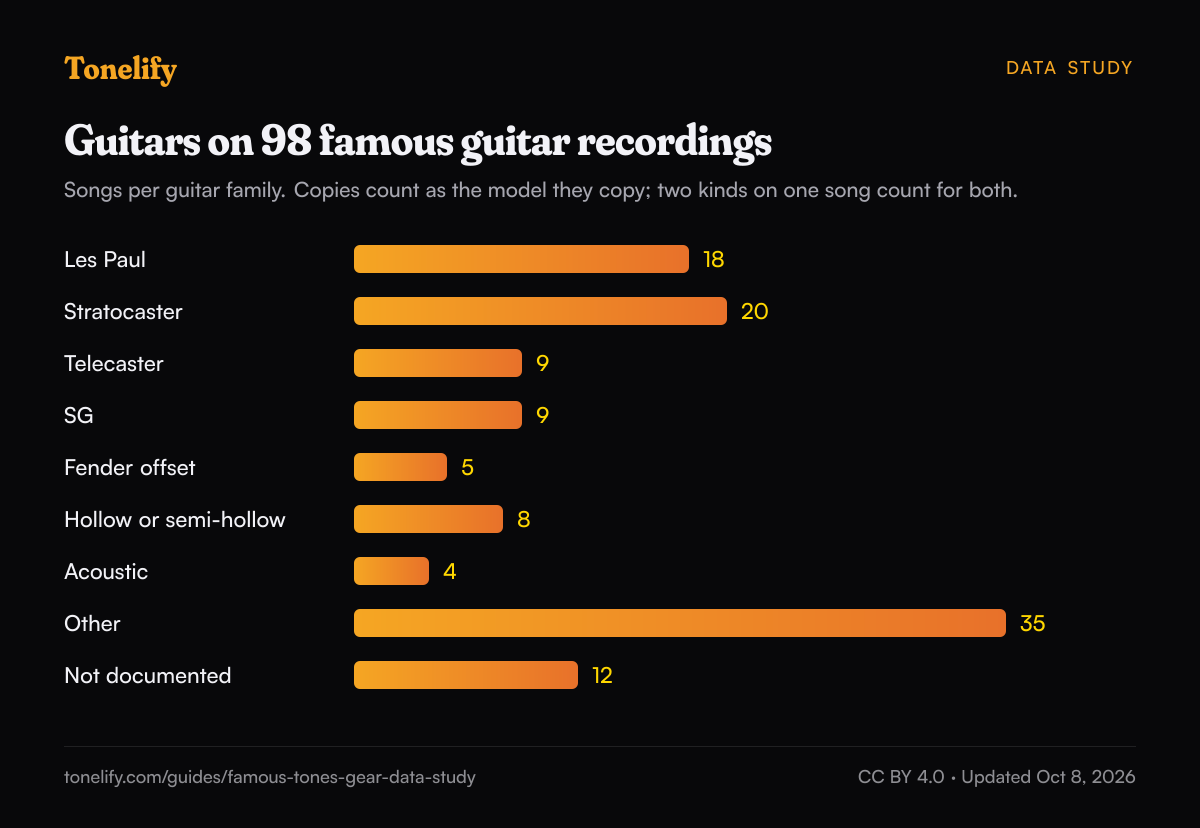
Les Paul-family guitars are on 18 of the 98 songs and Stratocasters on 20, with Telecasters on 9 and SGs on 9. 35 songs use something outside those families, from Explorer and V shapes to Dimebag Darrell's Dean and Washburn guitars and Eddie Van Halen's Frankenstrat.
The amps lean one way and the guitars do not. Marshall leads the amp count by a wide margin, while the Les Paul and the Stratocaster split the songs almost evenly, so the same amps were fed by Gibson and Fender guitars alike.
| Guitar | Songs |
|---|---|
| Les Paul | 18 |
| Stratocaster | 20 |
| Telecaster | 9 |
| SG | 9 |
| Fender offset | 5 |
| Hollow or semi-hollow | 8 |
| Acoustic | 4 |
| Other | 35 |
| Not documented | 12 |
How often the sources cannot say which amp
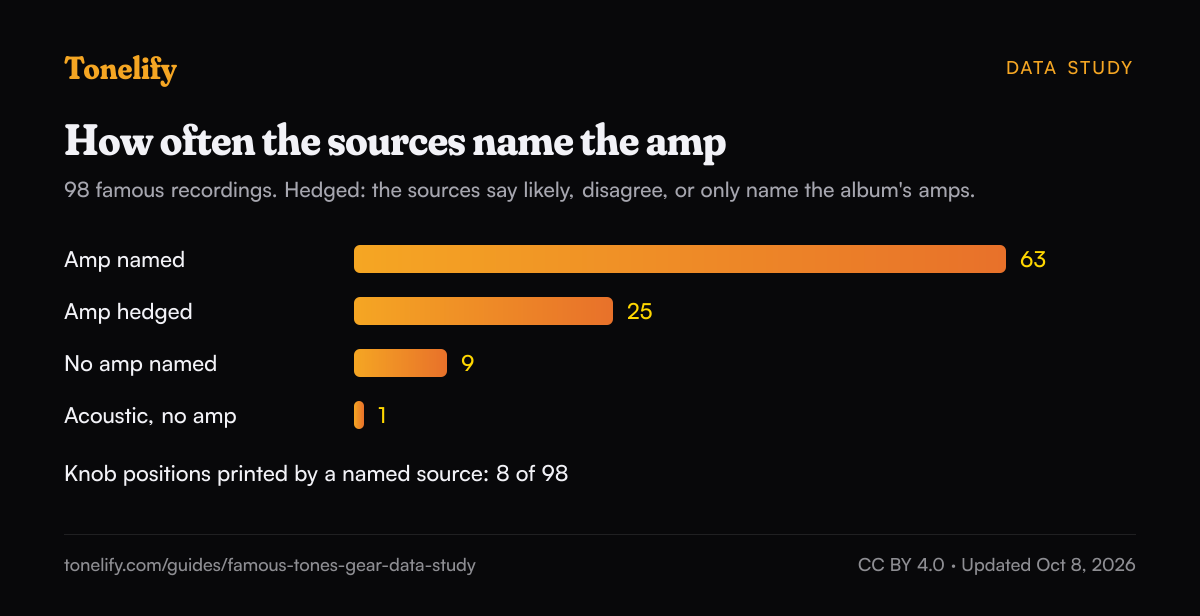
For 25 songs the amp is only hedged: Smells Like Teen Spirit, Slow Dancing in a Burning Room, Stairway to Heaven, Come As You Are, Layla, Californication, Creep, Mississippi Queen, Where Is My Mind, Faint, Orion, The Unforgiven, Nightmare, Killer Queen, Undone, Buddy Holly, Do I Wanna Know, Ride the Lightning, Alive, Yellow Ledbetter, Shine On You Crazy Diamond, Smoke on the Water, The Trooper, Kickstart My Heart and Chop Suey. For 9 more no source names the amp at all: Unholy Confessions, Little Wing, Nothing Else Matters, Wicked Game, Voodoo Child (Slight Return), Nutshell, R U Mine, Free Bird and Blind. Wish You Were Here is acoustic, so it has no amp to find.
Together that is 34 of 98, 35%. It is the ceiling on any page that promises a famous song's exact settings: when the sources cannot settle which amp was used, the positions of its knobs cannot be known either.
Famous tones that were not made the way you might assume
Tonelify's own Money for Nothing page named a Laney amp until October 2026. Guitar World's 2025 account, quoting Mark Knopfler and the people around him, puts the sound on his guitar tech Ron Eve's Marshall JTM45, with the Laney as the studio's 4x12 cabinet.
Jimmy Page says Whole Lotta Love went through Vox Super Beatle heads and Rickenbacker Transonic cabinets, a solid-state rig. The sources describe the amp as solid-state on 5 of the 98 songs: Floods, Cowboys from Hell, Walk, Whole Lotta Love and Every Breath You Take.
Leslie West's Mississippi Queen came out of a Sunn Coliseum, a PA head that arrived when he was expecting Marshalls, though in another account he names a 50-watt Marshall into a Sunn cabinet instead, which is why the study counts it as hedged.
Purple Rain's solo was a Boss DS-1 into a Mesa/Boogie Mark IIB, according to Guitar.com and MusicRadar. The Mark IIC+ that Prince is also linked with came later: Wikipedia dates his use of it to the 1984 Purple Rain tour, after the August 1983 recording.
Published knob settings are rare
Only 8 of the 98 songs have knob positions that a named source printed, and they come from five documents: a 1974 Guitar Player interview with Tony Iommi that covers his amp settings of that era rather than one session, shown on Iron Man, Paranoid, War Pigs and Into the Void; Eddie Van Halen describing where he set his MXR Phase 90, a pedal setting rather than an amp one, shown on Eruption; a Guitar World settings box for No More Tears that does not say where its numbers came from; Brian May saying how far he turns up his Vox AC30, the only number in a 2021 interview about Bohemian Rhapsody; and a 2017 Guitar World reconstruction of Shine On You Crazy Diamond that its writer built from interviews and photos and dialled in on his own gear.
Any other numbers for these songs, Tonelify's own starting points included, are estimates rather than documented settings unless they cite a source. Tonelify's song pages label theirs as starting points on a generic five-knob amp and keep the published ones in a separate section.
Eras, clean or distorted, riff or solo
80 of the 98 tones are distorted and 18 clean, and 79 are riffs against 19 solos. By decade the library runs from the 1960s to the 2010s, with the most songs from the 1990s.
| Decade | Songs | Share |
|---|---|---|
| 1960s | 4 | 4% |
| 1970s | 21 | 21% |
| 1980s | 23 | 23% |
| 1990s | 34 | 35% |
| 2000s | 12 | 12% |
| 2010s | 4 | 4% |
Where the rig information comes from
The 98 songs link 299 sources across 35 sites. Wikipedia is linked most, 108 times, then Guitar World 49 and Guitar.com 33. Every song page lists its sources under the rig, so each count here can be traced back to the articles behind it.
| Site | Links |
|---|---|
| Wikipedia | 108 |
| Guitar World | 49 |
| Guitar.com | 33 |
| Guitar Player | 19 |
| MusicRadar | 18 |
| Ground Guitar | 16 |
| Louder | 9 |
| Mixdown | 6 |
| gilmourish.com | 5 |
| 26 other sites | 36 |
How the songs were coded
The study covers every song in Tonelify's free tone library on 2026-10-08: 98 famous recordings, each with at least two linked sources for its rig. Each was coded by hand from the rig as its sources describe it.
An amp counts as named when the sources state it. It counts as hedged when they say likely, probably or possibly, give an either/or, disagree with each other, or describe only the amps used across the album without placing one on the song. A maker counts once per song, however many of its amps were used.
Cabinets, wireless units, rotating speakers and pedals are not counted as amps. A separate preamp and power amp both count, and so does a Tech 21 SansAmp where it did the amp's job on the record. Guitars count by family, copies and replicas as the model they copy, and a song played on two kinds of guitar counts once for each.
The table is rebuilt from the library whenever a song is added, so the figures on this page and the CSV always match. It is free to reuse under CC BY 4.0: chart it, quote it or build on it, and credit Tonelify with a link to this page.
Open data
Famous guitar tones: the coded gear table
One row per song in Tonelify's tone library (98 famous recordings): the amps its sources name, hedged or not, amp makers, whether the amp is solid-state, guitar families, whether published knob settings exist, and every source URL.
Songs discussed in this study



Common questions
What is the most common amp on famous guitar recordings?
Marshall. In Tonelify's sourced library of 98 famous recordings it is named on 34, 35%, against 9 for Mesa/Boogie. The library leans towards rock and metal, which favours Marshall, so the figure describes famous rock recordings rather than every genre.
Did famous guitarists use Les Pauls or Stratocasters more?
Close to even. Les Paul-family guitars are on 18 of 98 famous recordings in the study and Stratocasters on 20, counting copies as the model they copy and counting a song once for each kind of guitar played on it.
Do we know the exact amp settings used on famous records?
Rarely. Of 98 famous recordings, only 8 have knob positions printed by a named source, and for 34 the sources cannot pin down a single amp. Numbers published for the rest are estimates.
Can I use this data?
Yes. The coded table is a free CSV under CC BY 4.0. Reuse it, chart it or build on it, and credit Tonelify with a link to this page.
Sources
- Guitar Player: Classic Tones, Money for Nothing
- Songfacts: Money for Nothing
- Wikipedia: Money for Nothing (song)
- Guitar World: Brothers in Arms, Knopfler and his inner circle on its creation
- Guitar World: Jimmy Page on the amp behind Whole Lotta Love
- Guitar.com: the gear Jimmy Page used on Led Zeppelin II
- Wikipedia: Whole Lotta Love
- Guitar Player: Leslie West decodes his Mississippi Queen tone
- MusicRadar: Leslie West on Mississippi Queen
- Wikipedia: Mississippi Queen
- Guitar.com: the genius of Purple Rain
- MusicRadar: how Prince played the Purple Rain solo
- Guitar.com: the guitars Prince used on Purple Rain
- Wikipedia: Purple Rain (song)
- Wikipedia: Mesa/Boogie Mark IIC+
- Blabbermouth: IK Multimedia models Dimebag's Cowboys from Hell rig
- Wikipedia: Dimebag Darrell
- Guitar Player: Tony Iommi's 1974 interview on the SG and Laney amps
- Guitar World: Eddie Van Halen on his MXR Phase 90 and Flanger
- Guitar World: the secrets behind Zakk Wylde's tone on No More Tears
- Guitar World: Brian May goes deep on Bohemian Rhapsody
- Guitar World: Tonal Recall on Shine On You Crazy Diamond
Gear in this guide
Settings for your own amp
This guide covers what is true of every rig. For a specific song on a specific amp, Tonelify reads the documented chain behind the recording and returns gain, bass, middle, treble and presence values for the controls your amp actually has. Free for 7 days, no charge until the trial ends.