
Ampeg SVT Classic settings
⚡ Match a tone on this amp- Gain
- Bass
- Midrange
- Midrange frequency
- Treble
- Master
- Ultra Lo
- Ultra Hi
How do you dial in a specific tone on an Ampeg SVT Classic?
A bass amp's EQ points sit where a guitar amp's do not, so a bass tone written against guitar advice fights the cabinet. Settings for the Ampeg SVT Classic use this amp's own controls and the frequency ranges they actually cover.
Name the song you are chasing in the tone matcher and Tonelify returns the settings for this exact bass amp, not the settings the original artist used. Those are two different things: the recording was made on gear most players do not own.
Settings for this amp only ever use controls it actually has, because its front panel is stored in our gear database. You will not be told to set a knob that is not on the amp.
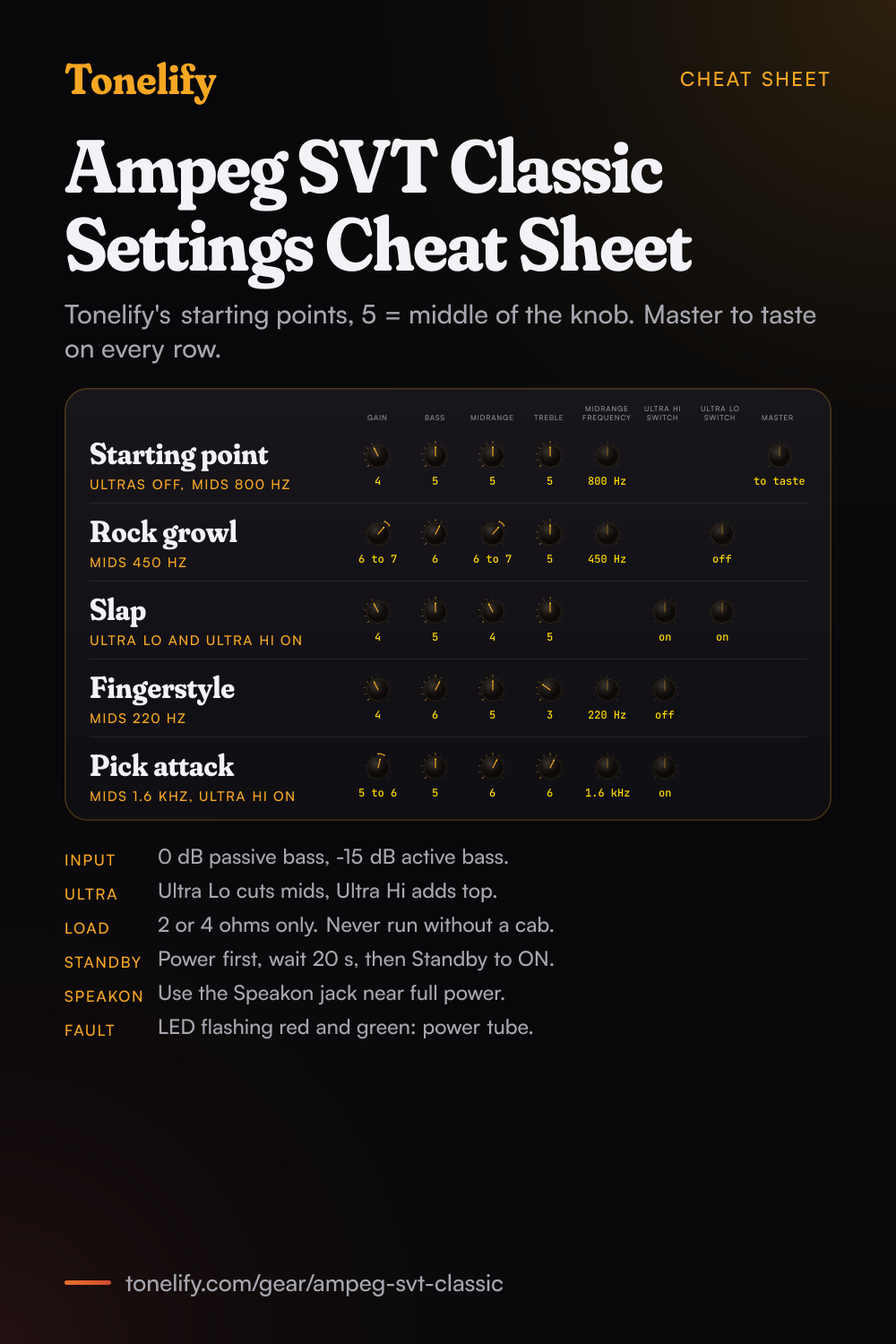
Free download
Printable cheat sheet: PDF and PNG
The starting point, rock growl, slap, fingerstyle and pick attack settings from this page, together on one sheet with short tips. The PDF prints on white; the PNG is the dark version for your phone.
Starting settings on the Ampeg SVT Classic
Positions on a 0 to 10 scale, with 5 at twelve o'clock. They are where to begin, not Ampeg's numbers: move one control at a time from here.
Starting point
Gain 4, Bass 5, Midrange 5, Midrange frequency 800 Hz, Treble 5, Ultra Lo switch off, Ultra Hi switch off, Master to taste. Ampeg's manual gives Bass, Midrange and Treble as cut or boost controls, so 5 is the middle of each one's range. Gain sets the level in the preamp and Master the overall volume, so set the sound with Gain first and the loudness with Master. Use the 0 dB input for a passive bass and the -15 dB input for an active one. These values are Tonelify's starting point, not Ampeg's.
- Gain 4
- Bass 5
- Midrange 5
- Midrange frequency 800 Hz
- Treble 5
- Master to taste
Ultra Lo and Ultra Hi off. Tonelify's values.
Classic rock growl
Gain 6 to 7, Bass 6, Midrange 6 to 7, Midrange frequency 450 Hz, Treble 5, Ultra Lo switch off, Master to taste. More Gain drives the preamp harder for grit, and the mids at 450 Hz push the bass forward in a loud band. Ampeg's manual says the Midrange gives 10 dB of boost or 20 dB of cut at the frequency you pick. Leave Ultra Lo off here: Ampeg says it cuts the mids. Tonelify's values, not Ampeg's.
- Gain 6 to 7
- Bass 6
- Midrange 6 to 7
- Midrange frequency 450 Hz
- Treble 5
- Ultra Lo switch off
Mids up to cut through. Tonelify's values.
Scooped slap
Ultra Lo switch on, Ultra Hi switch on, Gain 4, Bass 5, Midrange 4, Treble 5, Master to taste. Ampeg's manual gives Ultra Lo as +2 dB at 40 Hz and -10 dB at 500 Hz, so it adds low end and takes out the mids, and Ultra Hi as +9 dB at 8 kHz. Together they give the bright, scooped sound for slap and pop; keep Gain low so it stays clean. Tonelify's values, not Ampeg's.
- Ultra Lo switch on
- Ultra Hi switch on
- Gain 4
- Bass 5
- Midrange 4
- Treble 5
Both Ultra switches on. Tonelify's values.
Round fingerstyle
Gain 4, Bass 6, Midrange 5, Midrange frequency 220 Hz, Treble 3, Ultra Hi switch off, Master to taste. Treble down and the low mid voice at 220 Hz give a warm, round note for soul and old-school fingerstyle. Ampeg's manual says Bass works at 40 Hz with 12 dB of cut or boost, and Treble at 4 kHz with 20 dB of cut or 15 dB of boost. Tonelify's values, not Ampeg's.
- Gain 4
- Bass 6
- Midrange 5
- Midrange frequency 220 Hz
- Treble 3
- Ultra Hi switch off
Warm and round. Tonelify's values.
Pick attack
Gain 5 to 6, Bass 5, Midrange 6, Midrange frequency 1.6 kHz, Treble 6, Ultra Hi switch on, Master to taste. The upper mid voice at 1.6 kHz and Ultra Hi bring out the click of a pick for punk and hard rock. If it turns harsh, try the 800 Hz position before cutting Treble. Ampeg's manual lists the five midrange frequencies, left to right, as 220 Hz, 450 Hz, 800 Hz, 1.6 kHz and 3 kHz. Tonelify's values, not Ampeg's.
- Gain 5 to 6
- Bass 5
- Midrange 6
- Midrange frequency 1.6 kHz
- Treble 6
- Ultra Hi switch on
Upper mids for the pick. Tonelify's values.
Chasing one song? Name it and the matcher writes that song's settings for the Ampeg SVT Classic.
What controls does the Ampeg SVT Classic have?
The Ampeg SVT Classic has 8 controls on its front panel: Gain, Bass, Midrange, Midrange frequency, Treble, Master, Ultra Lo switch and Ultra Hi switch.
Ampeg SVT Classic specifications
- Power
- 300W head
- Front panel
- Gain, Bass, Midrange, Midrange frequency, Treble, Master, Ultra Lo switch, Ultra Hi switch
What the Ampeg SVT Classic panel means when you dial it in
300W head. There is enough headroom to hold a clean setting at band volume, so the gain control does the driving rather than the master. There is no presence control on this panel, so everything above the treble band has to come from the treble control and the guitar's own tone knob. A setting copied from an amp with presence has to be rebalanced here. Gain and master volume are separate, so the preamp can be driven hard at a volume that is liveable. Where a tone sits between the two is part of the answer, not a detail.
Ampeg SVT Classic questions
What do the Ultra Lo and Ultra Hi switches do on the SVT Classic?
Ampeg's manual says Ultra Lo adds emphasis to the low end by boosting the low frequencies and selectively cutting the mids, and gives it as +2 dB at 40 Hz and -10 dB at 500 Hz. Ultra Hi boosts the high frequencies, +9 dB at 8 kHz.
What does the Frequency selector do on the SVT-CL?
It picks the center frequency for the Midrange knob. Ampeg's manual says it gives five voices for the Midrange, from left to right 220 Hz, 450 Hz, 800 Hz, 1.6 kHz and 3 kHz, and that the Midrange knob gives 20 dB of cut or 10 dB of boost there.
Which input should I use on the Ampeg SVT-CL?
Ampeg's manual says the 0 dB input is for a passive instrument and the -15 dB input for an active one, which the manual calls perfect for active basses.
Can I turn on the SVT-CL without a speaker cabinet?
No. Ampeg's SVT-CL FAQ says you cannot run it out of Standby without a load or speaker cab, because it will damage the tubes and transformers.
Can I use an 8 ohm cabinet with the SVT Classic?
Not on its own. Ampeg's FAQ says the SVT-CL can only run at a 2 or 4 ohm load, and that an 8 ohm load will damage the amp. Ampeg's manual says two 8 ohm cabinets give a total of 4 ohms, and four give 2 ohms; set the Impedance selector to match.
How do I use the Standby switch on the SVT-CL?
Ampeg's manual says to turn on Power first with Standby off, let the amp warm up for 20 seconds, then switch Standby to on. Standby lets the tubes warm or stay warm without high voltage, which extends tube life, so use it during short breaks.
Why is the light on my SVT-CL flashing red and green?
Ampeg's manual says the LED flashes between red and green when the amp detects a fault in the power tube circuit and turns off the high voltage, which usually means a bad power tube. The amp stays that way until you turn it off, and the Power switch must be turned off to reset it.
What tubes are in the Ampeg SVT Classic?
Ampeg lists two 12AX7 preamp tubes, one 12AX7 and two 12AU7 driver tubes, and six 6550 power tubes. Its manual says to replace the power tubes all at the same time with a matched or balanced set.
Do I need to bias the SVT-CL after changing tubes?
Yes. Ampeg's FAQ says to bias it after replacing the tubes, using the two Bias controls and LEDs on the back. Ampeg's manual says to warm it up for at least 20 minutes and, with no signal, set each control so only its green LED is lit. No LED lit means over-biased and a thin sound; green and red lit means under-biased, a big full sound but shorter power tube life.
Should I bias my SVT-CL for tone or tube life?
Ampeg's FAQ says that setting it just as the green LED lights gives a poorer tone but longer tube life, and setting it just as the red LED lights gives a better tone but shorter tube life. It is normal for the red LEDs to light while you play.
Does the SVT-CL have a DI out?
Yes, an XLR Balanced Out. Ampeg's manual says it carries the signal at the power amp input, so it includes anything in the Preamp Out and Power Amp In loop, and can feed a mixing console or house PA.
Should I use the Speakon or the 1/4 inch speaker jacks?
Ampeg's manual says the two 1/4 inch jacks and the Speakon jack are wired in parallel, and recommends the Speakon jack at or near full power because it handles more current. Use speaker cables, never shielded instrument cables.
How powerful and heavy is the Ampeg SVT Classic?
Ampeg's manual rates it at 300 watts RMS into 2 or 4 ohms, and gives its weight as about 80 lb (36.3 kg) and its size as 11.5 by 24.0 by 13.0 inches with feet.
Does Tonelify support the Ampeg SVT Classic?
Yes, and its front panel is stored, so settings only ever reference controls this bass amp has: Gain, Bass, Midrange, Midrange frequency, Treble, Master, Ultra Lo switch, Ultra Hi switch. You will not be told to set a knob that is not there.
Sources
Panel, specifications and dates checked against these on .
More Ampeg gear
Similar bass amps from other makers
Settings for the song you are chasing
Name a song and Tonelify reads the documented rig behind the recording, then writes the settings for the controls the Ampeg SVT Classic has. A first plan starts with 7 days free, $0 today.