Amp cheat sheets
Bass amp settings: EQ, rock, slap and warm tones explained
Updated 10 min read4 knob panels4 sources
Start every bass amp flat: Bass, Mid and Treble at 12 o'clock, any shape buttons off, and the volume up slowly with the bass's own volume at full. For rock, raise the Bass and Mid a little, to about 1:00, so the notes push through the guitars. For slap, cut the Mid to about 10:00 and raise the Bass and Treble. For a warm, Motown or reggae sound, boost the Bass slightly and take the Treble down, which is Hartke's own suggestion.
Ampeg and Hartke describe the middle of their tone knobs as flat, and Fender gives each Rumble band as a boost or cut either side of it, so 12 o'clock is the place to begin. Their manuals give no other positions, so every setting on this page is Tonelify's starting point. Change one knob at a time, and cut before you boost: Hartke warns that too much low boost can cause overload distortion.
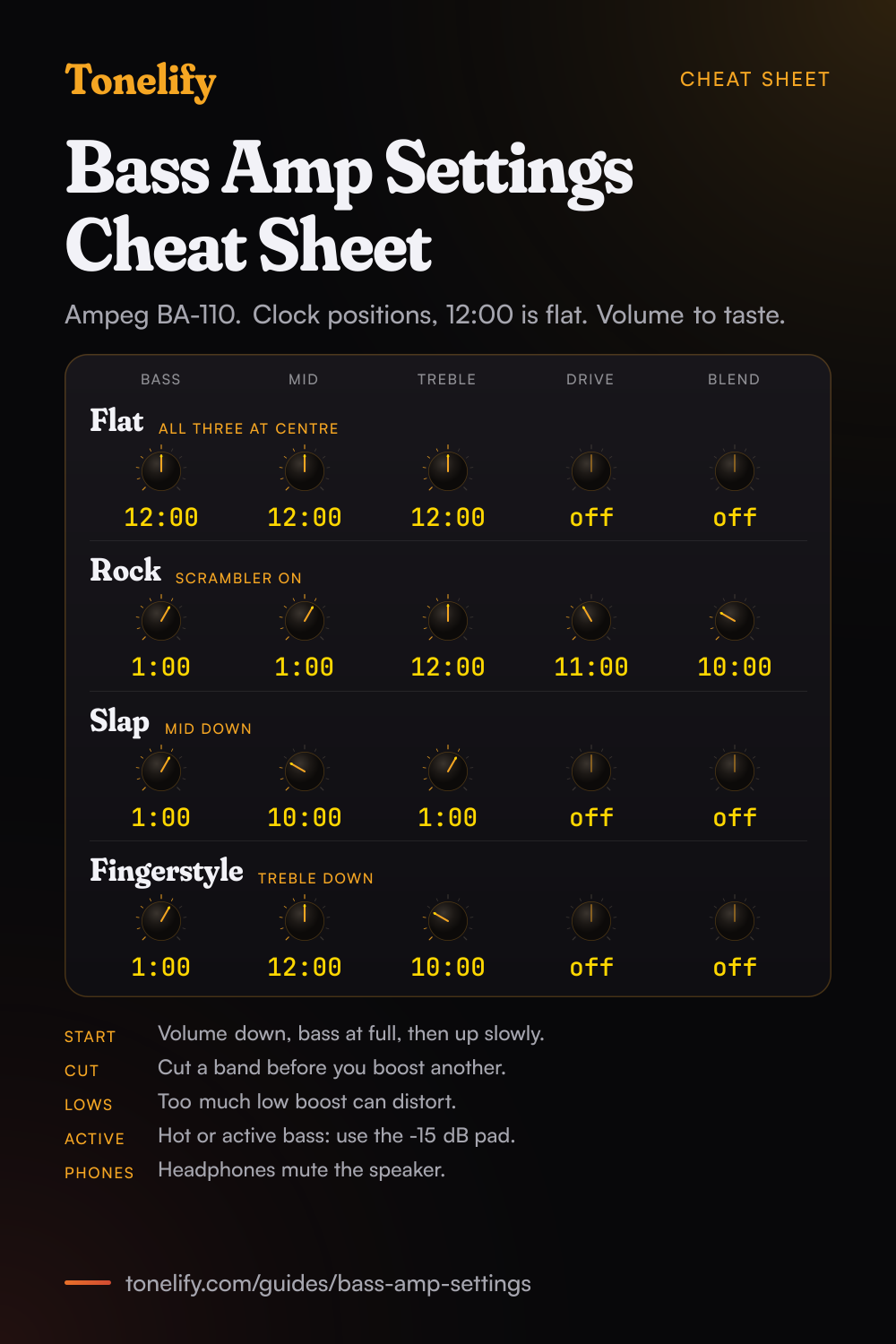
Free download
Printable cheat sheet: PDF and PNG
The flat, rock, slap and fingerstyle settings from this guide, together on one sheet with short tips. The PDF prints on white; the PNG is the dark version for your phone.
Which bass amp do you have?
This guide covers the four bass amps in Tonelify's catalog. Two are small combos for practice and rehearsal, the Ampeg BA-110 with one 10 inch speaker[1] and the Hartke HD75 with one 12 inch speaker. The Fender Rumble 100 is a 100 watt combo with a 12 inch Eminence speaker and a four-band EQ.[2] The Ampeg SVT Classic is a 300 watt valve head[3] that needs a separate cabinet.
The ideas are the same on all four: set the level from the bass into the amp, start the tone knobs flat, then move one band at a time. What changes is where each knob works, so the next section lists every band's frequency.
| Amp | Power | Speaker | Tone controls | Drive |
|---|---|---|---|---|
| Ampeg BA-110 | 40 W at 4 ohms | 1 x 10 inch | Bass, Mid, Treble | Bass Scrambler with Drive and Blend |
| Fender Rumble 100 | 100 W into 8 ohms | 1 x 12 inch Eminence | Bass, Low Mid, High Mid, Treble, plus Bright, Contour and Vintage buttons | Overdrive with Drive and Level |
| Ampeg SVT Classic | 300 W, valve head | Separate cabinet | Bass, Midrange with a 5-way frequency selector, Treble, plus Ultra Lo and Ultra Hi | Gain |
| Hartke HD75 | 75 W | 1 x 12 inch HyDrive | Bass, Mid, Treble, plus a 7-band graphic EQ | None |
Bass amp EQ settings explained
Each maker puts its bands in a different place, which is why the same knob position sounds different from amp to amp. Ampeg says the BA-110's Bass, Mid and Treble are each flat at the centre position.[1] Hartke says the HD75's Bass and Treble are shelving EQs that boost clockwise from the centre and cut counterclockwise, and that its Mid is a peaking EQ.[4] Fender gives each Rumble band as a boost or cut of up to 12 or 15 dB.[2]
Hartke's advice works on any of them: think first about which frequency areas you need to cut rather than which to boost. Boosting a band also raises the overall signal, and Hartke says too much Low EQ boost can cause overload distortion or even harm the speaker.[4] If the low notes blur, take the Bass down before you add anything else.
| Amp | Bass | Mid | Treble | Extra |
|---|---|---|---|---|
| Ampeg BA-110 | 40 Hz, +14/-20 dB | 500 Hz, +15/-10 dB | 4 kHz, +12/-16 dB | Bass Scrambler overdrive |
| Fender Rumble 100 | 80 Hz, 15 dB either way | Low Mid 280 Hz and High Mid 1.2 kHz, 12 dB either way | 10 kHz, 15 dB either way | Bright +13 dB at 10 kHz; Contour -13 dB at 670 Hz |
| Ampeg SVT Classic | 40 Hz, 12 dB either way | 220 Hz, 450 Hz, 800 Hz, 1.6 kHz or 3 kHz, +10/-20 dB | 4 kHz, +15/-20 dB | Ultra Lo +2 dB at 40 Hz and -10 dB at 500 Hz; Ultra Hi +9 dB at 8 kHz |
| Hartke HD75 | 50 Hz, shelving | 700 Hz, peaking | 10 kHz, shelving | 7 sliders from 63 Hz to 5 kHz |
Gain, Volume and Master on a bass amp
On the Rumble and the SVT Classic, one knob sets how hard the signal from the bass hits the preamp and another sets how loud the amp plays. Fender says the Rumble's Gain optimises the preamp level for a variety of basses and also sets how much distortion and compression you get with Vintage or Overdrive on.[2] Its Master sets the overall volume, and Fender says a higher Master or harder playing gives more compression and sustain from its Delta-Comp limiter.[2]
The BA-110 and HD75 have a single Volume. Hartke's quick start is a good routine on any amp: Volume at minimum, tone knobs at 12 o'clock, the bass's own output at maximum, then turn the Volume up slowly while you play.[4] For an active bass or hot pickups, use the pad: the BA-110 has a -15 dB switch and the SVT Classic a -15 dB input, which Ampeg calls perfect for active basses.[3] On the Rumble, Fender says to turn the Gain down if a hot bass distorts.[2]
Best Ampeg BA-110 settings
Flat: Bass 12:00, Mid 12:00, Treble 12:00, with the Scrambler switch out, so Drive off and Blend off. Rock with grit: Bass 1:00, Mid 1:00, Treble 12:00, Scrambler on, Drive 11:00 and Blend 10:00. Contoured slap: Bass 1:00, Mid 10:00, Treble 1:00, Drive off, Blend off. Warm fingerstyle: Bass 1:00, Mid 12:00, Treble 10:00, Drive off, Blend off. Set the Volume to taste on each.
Ampeg says turning the Mid counterclockwise gives a contoured sound, more distant with less midrange, and clockwise a sound which really cuts through,[1] which is why the rock setting raises it. Drive sets the amount of Scrambler overdrive and Blend mixes it with the clean signal,[1] so a low Blend keeps most of the clean note under the grit. The BA-110 has no Ultra Lo or Ultra Hi switch; Ampeg fits those to the BA-112, BA-115 and BA-210.[1] These are Tonelify's starting points.
- Bass 12:00
- Mid 12:00
- Treble 12:00
- Drive off
- Blend off
Ampeg: flat at the centre position.
- Bass 1:00
- Mid 1:00
- Treble 12:00
- Drive 11:00
- Blend 10:00
Low Blend keeps the clean note under the grit.
- Bass 1:00
- Mid 10:00
- Treble 1:00
- Drive off
- Blend off
Mid counterclockwise for a contoured sound.
- Bass 1:00
- Mid 12:00
- Treble 10:00
- Drive off
- Blend off
Play over the neck end of the pickups.
Best Fender Rumble 100 settings
The Rumble has four EQ bands and three shape buttons, so it can do most of the work with the knobs left near 12 o'clock. Fender says Contour is a mid cut with low and high boosts that gives a fat tone useful for slap, low-volume practice or with the Overdrive,[2] and Vintage a dark tone rich with harmonics and some natural compression.[2] Bright adds presence and shimmer in the upper frequencies.[2]
Drive and Level only work with Overdrive on: Drive sets the amount of distortion and Level balances it against the clean sound. These are Tonelify's starting points, with the Gain lower for an active bass and the Master to taste.
| Sound | Gain | Buttons | Bass | Low Mid | High Mid | Treble | Overdrive |
|---|---|---|---|---|---|---|---|
| Flat | 12:00 | All off | 12:00 | 12:00 | 12:00 | 12:00 | Off |
| Rock with grit | 12:00 | All off | 1:00 | 12:00 | 1:00 | 12:00 | On, Drive 10:00, Level to match the clean |
| Slap | 12:00 | Contour on | 12:00 | 12:00 | 12:00 | 12:00 | Off |
| Warm, old-school | 12:00 | Vintage on | 12:00 | 12:00 | 12:00 | 11:00 | Off |
Best Ampeg SVT Classic settings
The SVT Classic's Midrange works at whichever of five frequencies the selector picks, so the selector matters as much as the knob. For rock growl, push the Gain to 6 to 7 and the Midrange to 6 to 7 at 450 Hz. For slap, switch Ultra Lo and Ultra Hi on: Ampeg says Ultra Lo boosts the low frequencies while selectively cutting the mid frequencies,[3] and Ultra Hi adds 9 dB at 8 kHz.
These rows are Tonelify's starting points, the same as on our SVT Classic page, on its 0 to 10 scale with 5 at the middle.
| Sound | Gain | Bass | Midrange | Frequency | Treble | Ultra Lo | Ultra Hi |
|---|---|---|---|---|---|---|---|
| Starting point | 4 | 5 | 5 | 800 Hz | 5 | off | off |
| Classic rock growl | 6 to 7 | 6 | 6 to 7 | 450 Hz | 5 | off | your choice |
| Scooped slap | 4 | 5 | 4 | your choice | 5 | on | on |
| Round fingerstyle | 4 | 6 | 5 | 220 Hz | 3 | your choice | off |
| Pick attack | 5 to 6 | 5 | 6 | 1.6 kHz | 6 | your choice | on |
Best Hartke HD75 settings
Hartke's manual gives three directions. For a reggae or Motown sound, boost the Bass slightly while cutting the Treble.[4] To remove boxiness and sound more hi-fi, cut the Mid. For a twangy sound that cuts, boost the Treble and roll off the Bass slightly.[4] The clock positions below are Tonelify's, the same as on our HD75 page.
The 7-band graphic EQ does nothing with its sliders at the centre detent, so leave it there until the three knobs are set. For rock with a pick, take the 63 Hz slider slightly down and the 1.25 kHz slider slightly up.
| Sound | Bass | Mid | Treble | Graphic EQ |
|---|---|---|---|---|
| Flat start | 12:00 | 12:00 | 12:00 | All sliders at the centre detent |
| Reggae and Motown | 1:00 | 12:00 | 10:00 | All sliders at the centre detent |
| Hi-fi, less boxy | 12:00 | 10:00 | 12:00 | All sliders at the centre detent |
| Twangy and cutting | 11:00 | 12:00 | 2:00 | All sliders at the centre detent |
| Rock with a pick | 12:00 | 1:00 | 1:00 | 63 Hz slightly down, 1.25 kHz slightly up |
Headphones and playing along
Three of the four amps have a headphone output; the SVT Classic, a valve head, does not. On the BA-110, Ampeg says the speakers are muted when headphones are plugged in,[1] and Hartke says the same of the HD75's Phones jack. Turn the Volume down before you plug in, because the headphone level follows it.
The BA-110 and HD75 also have an aux input for a phone or MP3 player. On the HD75, Hartke says to set the balance between the track and the bass with the player's own volume;[4] the BA-110 has its own Aux Level knob.
Common questions
What are the best bass amp settings?
Start flat: Bass, Mid and Treble at 12 o'clock, any shape buttons off, and the volume up slowly with the bass's own volume at full. Ampeg and Hartke describe the middle of their tone knobs as flat. Then move one band at a time, and cut a band that bothers you before you boost another.
How do I set the EQ on a bass amp?
Set every tone knob to 12 o'clock, play, and change one band at a time. Hartke's manual says to think first about which frequency areas to cut rather than which to boost, because a boost also raises the overall signal. The bands sit in different places on each amp: the BA-110's Mid works at 500 Hz, the HD75's at 700 Hz.
What are good bass amp settings for rock?
Raise the Bass and Mid a little from flat so the notes push through the guitars. On a BA-110, Bass 1:00, Mid 1:00, Treble 12:00, with the Scrambler on at Drive 11:00 and Blend 10:00. On an SVT Classic, Gain 6 to 7 and Midrange 6 to 7 at 450 Hz. These are Tonelify's starting points.
What bass amp settings are best for slap?
Cut the mids and lift the lows and highs. On a Rumble 100, press Contour, which Fender describes as a mid cut with low and high boosts useful for slap. On an SVT Classic, switch Ultra Lo and Ultra Hi on. On a BA-110, Bass 1:00, Mid 10:00 and Treble 1:00.
What bass amp settings give a Motown or reggae sound?
Boost the Bass slightly and take the Treble down, which is Hartke's own suggestion for a reggae or Motown sound. On an HD75, Tonelify starts at Bass 1:00, Mid 12:00 and Treble 10:00. Play with your fingers over the neck end of the pickups and roll the bass's tone back a little.
Should I turn the bass up on a bass amp?
Only a little. Hartke warns that too much Low EQ boost can cause overload distortion or even harm the speaker, and every boost raises the overall level. If the low notes blur or the amp distorts, bring the Bass back towards 12 o'clock and raise the Volume instead.
What is the difference between Gain and Master on a bass amp?
Gain sets how hard the signal from your bass drives the preamp, and Master sets how loud the amp plays. Fender says the Rumble's Gain also changes how much distortion and compression you get with Vintage or Overdrive on, and that a higher Master gives more compression and sustain from its Delta-Comp limiter.
What does the -15 dB switch do on a bass amp?
It lowers the signal coming in by 15 dB. Ampeg says it suits basses with active electronics or high-output pickups, which can overload the input otherwise. The BA-110 has it as a switch and the SVT Classic as a separate -15 dB input. On a Rumble, turn the Gain down instead.
What does the Contour button do on a Fender Rumble?
Fender describes Contour as a mid-frequency cut combined with low and high boosts, giving a fat tone that is useful for slap, low-volume practice or alongside the Overdrive. Its specification puts the cut at 13 dB at 670 Hz, with 1 dB of boost at 80 Hz and 2 dB at 8 kHz.
What does the Vintage button do on a Fender Rumble?
Fender says Vintage creates a dark tone rich with harmonics and some natural compression. Its specification describes it as dynamic compression of up to 9 dB with a low-pass filter at 400 Hz. Because Gain affects it, raise the Gain for more of the effect.
How do I get overdrive from a bass amp?
On a BA-110, press the Scrambler switch and set Drive for the amount of grit and Blend to mix it with the clean signal; a low Blend keeps the clean note underneath. On a Rumble 100, press Overdrive On, then set Drive for the distortion and Level to match the clean sound. On an SVT Classic, raise the Gain.
Does the Ampeg BA-110 have Ultra Lo and Ultra Hi?
No. Ampeg's BA manual lists the Ultra Lo and Ultra Hi switches for the BA-112, BA-115 and BA-210 only. On a BA-110, cut the Mid towards 10:00 for a similar scooped sound. The SVT Classic has both switches.
Why does my bass amp sound muddy?
Usually too much low end or low mids. Bring the Bass back to 12 o'clock first, then try a little more Mid rather than more Bass so the note has a front to it. On an HD75, pull the 63 Hz slider down slightly. Hartke's manual suggests cutting the problem area before boosting anything.
Can I use headphones with a bass amp?
On the BA-110, HD75 and Rumble 100, yes. Ampeg says the BA-110's speakers are muted when headphones are plugged in, and Hartke says the HD75's Phones jack disconnects the speaker. Turn the Volume down first. The SVT Classic is a valve head with no headphone output.
Is there a printable bass amp settings cheat sheet?
Yes. The cheat sheet on this page puts the four Ampeg BA-110 settings, flat, rock, slap and fingerstyle, on one page with five controls each. Download the PDF to print on white, or save the PNG to your phone. The SVT Classic and HD75 have their own sheets on their gear pages.
Sources
The numbers in brackets in the text point to this list.
Gear in this guide
Settings for your own amp
This guide covers what is true of every rig. For a specific song on a specific amp, Tonelify reads the documented chain behind the recording and returns gain, bass, middle, treble and presence values for the controls your amp actually has. A first plan starts with 7 days free, $0 today.