
Boss ME-90 presets and settings
Floor unit with a knob for every setting, 30 in all, eight footswitches and an expression pedal with a toe switch. Eleven AIRD preamps, a send/return loop and three slots for your own speaker IRs; it runs on four AA batteries.
⚡ Match a tone on this gearHow do you dial in a specific tone on a Boss ME-90?
A multi-effects unit gives you the whole chain in one box, which means the order of the blocks is as much of the answer as the values inside them. Settings for the Boss ME-90 name the amp model, the block order and the parameters together, rather than handing you numbers with no chain to put them in.
Name the song you are chasing in the tone matcher and Tonelify returns the settings for this exact multi-effects unit, not the settings the original artist used. Those are two different things: the recording was made on gear most players do not own.
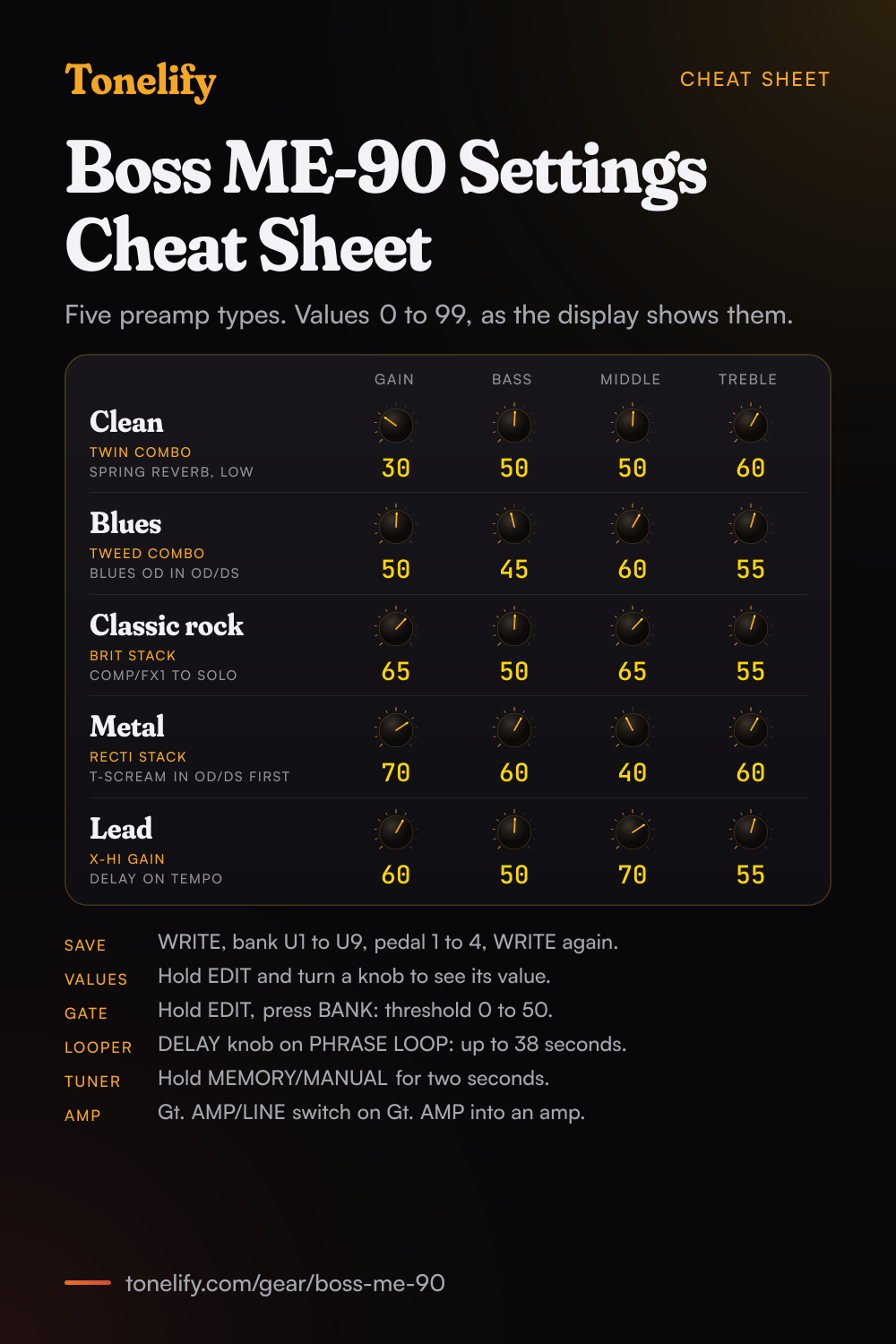
Free download
Printable cheat sheet: PDF and PNG
The clean, blues, classic rock, metal and lead settings from this page, together on one sheet with short tips. The PDF prints on white; the PNG is the dark version for your phone.
Starting settings on the Boss ME-90
Values as the unit's screen shows them, on its own scale; each drawn knob shows that value's share of the range. They are where to begin, not Boss's numbers: pick the amp model first, then move one control at a time from here.
Clean
TWIN COMBO preamp type, which BOSS says models a Fender Twin Reverb. Gain 30, Bass 50, Middle 50, Treble 60, and the preamp's Level to set how loud the patch is. Every knob on the ME-90 runs from 0 to 99, and holding EDIT while you turn one shows its value in the display. The REVERB knob picks the type and the amount in one: turn it into SPRING and keep the level low, as BOSS gives each reverb type a level from 0 to 49. For a wider clean, set EQ/FX2 to CHORUS with its MODE knob on 2, STEREO, or 3, CE-1, the chorus of BOSS's CE-1. NATURAL is the type BOSS describes as an unembellished clean that minimizes an amp's trebly character and boomy low end, and JC-120, its model of the Roland JC-120, can be put on the PREAMP knob from BOSS TONE STUDIO.
- Gain 30
- Bass 50
- Middle 50
- Treble 60
SPRING reverb kept low, CHORUS in EQ/FX2 for width.
Edge of breakup and blues
TWEED COMBO, BOSS's model of a Fender Bassman 4x10 combo. Gain 50, Bass 45, Middle 60, Treble 55. Dig in for grit and play lighter to clean up. For more push, switch on OD/DS with BLUES OD, BOSS's BD-2 sound, or CENTA OD, its model of a Klon Centaur, at DRIVE 20 and LEVEL 70, so the pedal pushes the preamp rather than taking it over. DIAMOND, BOSS's model of a VOX AC30, is the other vintage combo on the knob, and DELUXE COMBO, a Fender Deluxe Reverb, is one of the five types BOSS TONE STUDIO adds. Preset P2-2 BLUES LEAD is BOSS's own blues patch to compare against.
- Gain 50
- Bass 45
- Middle 60
- Treble 55
BLUES OD in OD/DS, DRIVE 20 and LEVEL 70, for more push.
Classic rock
BRIT STACK, which BOSS says models a Marshall 1959. Gain 65, Bass 50, Middle 65, Treble 55. Keep the mids up: rock guitar sits in the midrange, and scooping it is the usual reason a patch sounds thin next to a band. MAXIMUM is BOSS's own amp in the same family: the response and tone of a vintage Marshall with even higher gain, in BOSS's words. For a solo, turn COMP/FX1 to SOLO, which BOSS says to combine with OD/DS or the preamp for a sound that suits solos. Preset P3-2 70s HARD ROCK is the matching factory patch.
- Gain 65
- Bass 50
- Middle 65
- Treble 55
Metal
RECTI STACK, BOSS's model of the Channel 2 Modern mode of a MESA/Boogie Dual Rectifier. Gain 70, Bass 60, Middle 40, Treble 60. JUGGERNAUT is BOSS's own large stack, tweaked in pursuit of the ultimate metal sound, and X-MODDED keeps the sound defined even at extreme gain. For tighter palm mutes, switch on OD/DS with T-SCREAM, BOSS's model of the Ibanez TS-808, or BOOST, at DRIVE 10 and LEVEL 80, and take the preamp's Gain down a step. The noise suppressor has no knob: hold EDIT and press the BANK pedals to set it from 0 to 50, and raise it only until the hiss between chords goes, since BOSS warns that too high a setting can leave no sound when you play quietly. RECTI STACK is the knob's last type, the place BOSS TONE STUDIO can fill with another preamp, so a patch made in the app may hold a different type there. Presets P1-2 METAL AMP and P2-4 METAL RIFF are BOSS's metal patches.
- Gain 70
- Bass 60
- Middle 40
- Treble 60
T-SCREAM in OD/DS first, or BOOST, before you raise the Gain.
Lead
X-HI GAIN, BOSS's high-gain type built on its MDP processing for a wide range and, in BOSS's words, a great-feeling sense of separation. Gain 60, Bass 50, Middle 70, Treble 55: more Middle than the rhythm sounds so the solo cuts through. Set the CTL pedal to bring the solo in: in Memory mode, press the CTL button, press the pedals of the effects to switch together, such as OD/DS and DELAY, and save with WRITE. For a delay in time with the song, turn the DELAY knob to TEMPO, set TIME to the dotted eighth or the quarter note, and press the DELAY pedal two or more times in time with it; in Memory mode, press the number pedal of the current patch instead.
- Gain 60
- Bass 50
- Middle 70
- Treble 55
CTL pedal set to OD/DS and DELAY, DELAY on TEMPO.
Acoustic guitar
Two routes, both in BOSS's documents. With an electro-acoustic guitar, put TRANSPARENT on the PREAMP knob from BOSS TONE STUDIO: BOSS calls it an amp with a broad frequency range and an extremely flat response, good for acoustic guitar. With an electric guitar, turn COMP/FX1 to AC SIM, which BOSS says makes an electric guitar sound like an acoustic, and shape it with its LOW and HIGH knobs; preset P8-4, E.gtr to A.gtr, is BOSS's own version of that patch. Keep OD/DS off and the reverb low.
Boss ME-90 amp list
The PREAMP section's TYPE knob has eleven AIRD preamp types, and BOSS TONE STUDIO for ME-90 can put one of five more in the knob's last place, RECTI STACK's, a different one in each patch. Every type has the same five knobs: Gain, Bass, Middle, Treble and Level, each from 0 to 99. BOSS says seven of the sixteen model a real amp.
| Preamp type | Where to pick it | What BOSS says it is |
|---|---|---|
| NATURAL | TYPE knob, 1 | An unembellished, clean sound that minimizes the amp's idiosyncrasies, such as its trebly character and boomy low end |
| X-CRUNCH | TYPE knob, 2 | Crunch sound that uses MDP to deliver a crisp tone from all strings |
| X-HI GAIN | TYPE knob, 3 | High-gain sound that uses MDP to obtain high-gain sound with a wide range and a great-feeling sense of separation |
| MAXIMUM | TYPE knob, 4 | An amp that delivers the distinctively great response and tone of a vintage Marshall, while making it even higher gain |
| JUGGERNAUT | TYPE knob, 5 | A large stack sound that has been tweaked extensively in the pursuit of the ultimate metal sound |
| X-MODDED | TYPE knob, 6 | Core sound that uses MDP to preserve the definition of the sound even with extreme gain |
| TWIN COMBO | TYPE knob, 7 | Models a Fender Twin Reverb |
| TWEED COMBO | TYPE knob, 8 | Models a Fender Bassman 4x10 Combo |
| DIAMOND | TYPE knob, 9 | Models a VOX AC30 |
| BRIT STACK | TYPE knob, 10 | Models a Marshall 1959 |
| RECTI STACK | TYPE knob, 11 | Models the sound of the Channel 2 MODERN mode on the MESA/Boogie DUAL Rectifier |
| TRANSPARENT | BOSS TONE STUDIO, in place of RECTI STACK | An amp with a broad frequency range and an extremely flat response. Good for acoustic guitar |
| BOUTIQUE | BOSS TONE STUDIO, in place of RECTI STACK | Crunch sound that allows the nuances of your picking to be expressed even more faithfully than on conventional combo amps |
| SUPREME | BOSS TONE STUDIO, in place of RECTI STACK | Great-feeling crunch sound that responds to the nuances of your picking while taking advantage of the distinctive character of a 4x12 speaker cabinet |
| JC-120 | BOSS TONE STUDIO, in place of RECTI STACK | Models the sound of the Roland JC-120 |
| DELUXE COMBO | BOSS TONE STUDIO, in place of RECTI STACK | Models a Fender Deluxe Reverb |
Boss ME-90 effects list
Seven effect sections and the pedal effects, each with a knob that picks its type. In COMP/FX1, OD/DS, MOD and DELAY the knob's last type, and EQ in EQ/FX2, can be swapped in BOSS TONE STUDIO for one of the types marked (app), a different one in each patch. The signal runs PEDAL FX, COMP/FX1, OD/DS, SEND/RETURN, PREAMP, NS, FOOT VOLUME, MOD, EQ/FX2, DELAY, REVERB; BOSS says the chain is optimized to match the types selected, and the SEND/RETURN can go after the preamp. Where BOSS names the pedal or effect a type models, it is in brackets.
- COMP/FX1 (11, and 6 in the app)
- COMP, T.WAH UP, SLOW GEAR, DEFRETTER (fretless guitar), OCTAVE (one and two octaves down), HUMANIZER, FEEDBACKER, AC SIM (electric to acoustic), SOLO, TUNE DOWN, S-BEND, D-COMP (MXR DynaComp) (app), RING MOD (app), POLY OCTAVE (app), T.WAH DOWN (app), Single > Hum (app), Hum > Single (app)
- OD/DS (11, and 7 in the app)
- BOOST, OVERDRIVE (BOSS SD-1), T-SCREAM (Ibanez TS-808), CENTA OD (Klon Centaur), BLUES OD (BOSS BD-2), DISTORTION (BOSS DS-1), TURBO DS (BOSS DS-2, Turbo on), RAT DS (Proco RAT), METAL DS (BOSS MT-2 Metal Zone), CORE (BOSS ML-2), MUFF FUZZ (Electro-Harmonix Big Muff Pi), CLEAN BOOST (app), TREBLE BOOST (app), OD-1 (BOSS OD-1) (app), TURBO OD (BOSS OD-2, Turbo on) (app), GUV DS (Marshall Guv'nor) (app), '60S FUZZ (Fuzz Face) (app), OCT FUZZ (Octavia) (app)
- MOD (11, and 4 in the app)
- PHASER, FLANGER, TREMOLO, CHORUS, VIBRATO, PITCH SHIFT, HARMONIST, ROTARY, UNI-V (Uni-Vibe), DELAY (10 to 800 ms), OVERTONE, SCRIPT PHASER (MXR Phase 90) (app), STEREO CHORUS (app), CE-1 CHORUS (BOSS CE-1) (app), AUTO WAH (app)
- EQ/FX2 (6, with a MODE knob, and 7 in the app)
- PHASER (NORMAL, SCRIPT: MXR Phase 90), TREM/PAN (TREMOLO, PAN), BOOST (MID, CLEAN, TREBLE), DELAY (STANDARD, ANALOG, TAPE), CHORUS (MONO, STEREO, CE-1: BOSS CE-1), EQ (3-band), FLANGER (app), VIBRATO (app), PITCH SHIFT (app), HARMONIST (app), ROTARY (app), UNI-V (app), OVERTONE (app)
- DELAY (11, and 4 in the app)
- STANDARD (10 to 800 ms), ANALOG, TAPE, WARM, MODULATE, REVERSE, TEMPO (tap tempo), TERA ECHO, SHIMMER, PHRASE LOOP (38 seconds), +REVERB, CHO+DELAY (app), WARP (app), TWIST (app), GLITCH (app)
- REVERB (3)
- ROOM, HALL, SPRING
- PEDAL FX (11)
- WAH, VOICE, +1 OCT, +2 OCT, -1 OCT, -2 OCT, FREEZE, OSC DELAY, OD/DS (drive), MOD RATE, DELAY LEVEL
Boss ME-90 preset list
The 36 presets sit in banks P1 to P9, four to a bank, and cannot be overwritten; save your own changes to one of the 36 user patches in banks U1 to U9. The CTL pedal switches the listed effects on and off together. The last column is BOSS's entry for the expression pedal: the pedal's toe switch turns the pedal effect on and off, and while it is off the pedal works as a volume pedal.
| Preset | Name | CTL pedal switches | Expression pedal |
|---|---|---|---|
| 1-1 | ROCK LEAD | OD/DS, MOD | Foot Volume (WAH) |
| 1-2 | METAL AMP | COMP/FX1 | Foot Volume (+1 OCT) |
| 1-3 | FUZZ ECHO | OD/DS, EQ/FX2, MOD, DELAY | Foot Volume (+1 OCT) |
| 1-4 | SPACE CLEAN | MOD | Foot Volume (DELAY LEVEL) |
| 2-1 | OVERTONE DIST | MOD | Foot Volume (DELAY LEVEL) |
| 2-2 | BLUES LEAD | OD/DS | Foot Volume (WAH) |
| 2-3 | DS DRIVE | COMP/FX1, DELAY | Foot Volume (WAH) |
| 2-4 | METAL RIFF | EQ/FX2, MOD | Foot Volume (+1 OCT) |
| 3-1 | 60s FUZZ | MOD | Foot Volume (OD/DS) |
| 3-2 | 70s HARD ROCK | COMP/FX1, DELAY | Foot Volume (WAH) |
| 3-3 | 80s METAL | OD/DS, MOD | Foot Volume (-1 OCT) |
| 3-4 | 90s ALTERNATIVE | COMP/FX1, OD/DS, EQ/FX2 | Foot Volume (VOICE) |
| 4-1 | PHASE LEAD | EQ/FX2 | Foot Volume (OSC DELAY) |
| 4-2 | VO CRUNCH | OD/DS, DELAY | Foot Volume (WAH) |
| 4-3 | CTL TUNE DOWN | COMP/FX1 | Foot Volume (WAH) |
| 4-4 | S-BEND | OD/DS, MOD | Foot Volume (WAH) |
| 5-1 | SURF TREMOLO | COMP/FX1 | Foot Volume (WAH) |
| 5-2 | COUNTRY ECHO | OD/DS | Foot Volume (WAH) |
| 5-3 | T-WAH FUNK | OD/DS, MOD, DELAY | Foot Volume (VOICE) |
| 5-4 | SD OVERDRIVE | EQ/FX2, DELAY | Foot Volume (WAH) |
| 6-1 | WAH LEAD | MOD | WAH |
| 6-2 | CENTA DRIVE | COMP/FX1, EQ/FX2 | Foot Volume (WAH) |
| 6-3 | +REV DEEP CLEAN | OD/DS, MOD | Foot Volume (DELAY LEVEL) |
| 6-4 | WARM LEAD | COMP/FX1 | Foot Volume (DELAY LEVEL) |
| 7-1 | SHIMMER | MOD | Foot Volume (WAH) |
| 7-2 | PEDAL BEND | MOD | +2 OCT |
| 7-3 | ROTARY CRUNCH | OD/DS | MOD RATE |
| 7-4 | TALK PEDAL | DELAY, REVERB | VOICE |
| 8-1 | LATIN LEAD | COMP/FX1, OD/DS, PREAMP, MOD | DELAY LEVEL |
| 8-2 | FEEDBACKER | OD/DS | Foot Volume (WAH) |
| 8-3 | HUMANIZER | EQ/FX2, MOD | Foot Volume (WAH) |
| 8-4 | E.gtr to A.gtr | MOD | Foot Volume (WAH) |
| 9-1 | Am/C TWIN LEAD | EQ/FX2, MOD | Foot Volume (WAH) |
| 9-2 | SYNTHY LEAD | MOD | Foot Volume (WAH) |
| 9-3 | DEFRETTER | EQ/FX2 | Foot Volume (+1 OCT) |
| 9-4 | FREEZE | COMP/FX1, OD/DS | Foot Volume (FREEZE) |
Boss ME-90 specifications
- Released
- 2023
Boss ME-90 questions
What amps are in the Boss ME-90?
Eleven AIRD preamp types on the PREAMP section's TYPE knob, and five more that BOSS TONE STUDIO can put in the knob's last place, a different one in each patch. BOSS says seven of them model a real amp: TWIN COMBO a Fender Twin Reverb, TWEED COMBO a Fender Bassman 4x10 combo, DIAMOND a VOX AC30, BRIT STACK a Marshall 1959, RECTI STACK the Channel 2 Modern mode of a MESA/Boogie Dual Rectifier, and, from the app, JC-120 a Roland JC-120 and DELUXE COMBO a Fender Deluxe Reverb. NATURAL, X-CRUNCH, X-HI GAIN, MAXIMUM, JUGGERNAUT and X-MODDED are BOSS's own, as are TRANSPARENT, BOUTIQUE and SUPREME in the app. BOSS says the amp models are ported from its GT-1000. The full table is below.
Which drive pedals does the ME-90 model?
OD/DS has eleven types on its knob: BOOST, OVERDRIVE (the BOSS SD-1), T-SCREAM (Ibanez TS-808), CENTA OD (Klon Centaur), BLUES OD (BOSS BD-2), DISTORTION (BOSS DS-1), TURBO DS (BOSS DS-2 with Turbo on), RAT DS (Proco RAT), METAL DS (BOSS MT-2 Metal Zone), CORE (BOSS ML-2) and MUFF FUZZ (Electro-Harmonix Big Muff Pi). BOSS TONE STUDIO can put one of seven more in MUFF FUZZ's place: CLEAN BOOST, TREBLE BOOST, OD-1, TURBO OD, GUV DS (a Marshall Guv'nor), '60S FUZZ (a Fuzz Face) and OCT FUZZ (the Octavia). Every type has the same three knobs, DRIVE, TONE and LEVEL.
How many effects does the Boss ME-90 have?
BOSS counts 60 effect types, with access to over 20 more through BOSS TONE STUDIO, and its specifications give 97 types in all. They sit in what BOSS calls a dedicated amp section plus seven simultaneous effect categories, each with a knob that picks its type, and eleven PEDAL FX for the expression pedal. The full list, with the app-only types marked, is below.
What presets come with the Boss ME-90?
36 presets in banks P1 to P9, four to a bank, from P1-1 ROCK LEAD to P9-4 FREEZE, beside 36 user patches in banks U1 to U9. The presets cannot be overwritten: edit one and save it to a user patch. BOSS's preset list gives each one's CTL pedal assignment and what its expression pedal does, and it is reproduced below. More patches can be downloaded from BOSS Tone Exchange through BOSS TONE STUDIO.
How do you save a patch on the ME-90?
Press WRITE, pick a user bank, U1 to U9, with the BANK pedals and a patch with number pedals 1 to 4, then press WRITE again. Everything except OUTPUT LEVEL is saved, and the unit switches to Memory mode. To copy a patch, recall it and write it to another place. An edit you do not save is lost when you change patch or switch off.
Why doesn't the ME-90 sound like its knobs show?
In Memory mode a patch loads its own values, so the knobs may not point where the patch is set. Hold EDIT and turn a knob to see its real value in the display; the tuning guides on both sides light when the knob's position matches it. The Knob motion system setting decides what turning a knob does then: n0, the factory setting, changes the value at once, while n1 waits until the knob reaches the stored value. To edit a patch, press EDIT for Memory edit mode first, as plain Memory mode cannot turn effects on and off.
What does BOSS TONE STUDIO do for the ME-90?
BOSS TONE STUDIO for ME-90, for Windows and macOS, with BTS for ME-90 on iOS and Android, edits and names the user patches, reorders them, backs up the patches and system settings, and downloads patches. It also holds the types the panel cannot pick: the last place on the COMP/FX1, OD/DS, MOD, DELAY and PREAMP knobs, and EQ in EQ/FX2, can each take an alternative, set per patch. It needs ME-90 system program 1.03 or later.
Can you load your own IRs into the ME-90?
Yes, three. BOSS's ME-90 IR Loader for Windows and macOS puts IR data into USER 1 to USER 3. Hold EDIT and press number pedal 1 for the built-in speaker simulator, which BOSS tunes to each preamp type, or 2, 3 or 4 for USER 1, 2 or 3; the choice is saved with each patch. The three user slots are empty when the unit leaves the factory.
How do you set the noise gate on the ME-90?
Its noise suppressor has no knob: hold EDIT and press the BANK pedals to set the threshold from 0 to 50, higher for noisier pickups. A value of 0 turns it off. BOSS warns that a setting higher than needed can leave no sound when you play quietly.
Does the Boss ME-90 have a looper?
Yes, as a delay type: turn the DELAY knob to PHRASE LOOP and press the DELAY pedal to record, again to play, and again to overdub, for up to 38 seconds in mono. Press it twice within a second to stop, and hold it to clear. The loop is erased when you move the type knob or switch off, and BOSS says it cannot be saved.
Can you use the ME-90 with headphones or straight into a PA?
Yes. The rear Gt. AMP/LINE switch sets the outputs: Gt. AMP for a guitar amp, LINE for a mixer, powered speakers or headphones, and BOSS says to use LINE with the PHONES jack, a stereo mini jack. Each amp includes a dedicated cab sound for a PA or recording, in BOSS's words. Into a guitar amp, the OUTPUT SELECT system setting picks one of twelve amp types: INPUT and RETURN versions for a 2x12 or 1x12 valve combo, a 4x12 valve stack, the Roland JC-120 and the BOSS Katana-100 and Katana-100/212.
Does the Boss ME-90 have Bluetooth?
Not by itself. The BT-DUAL adaptor, sold separately, fits a jack on the rear panel; with it you can play music from a phone or tablet through the ME-90 and edit it from the BTS for ME-90 app. BOSS's EV-1-WL wireless expression pedal and FS-1-WL wireless footswitch, also sold separately, can be connected as well.
Can the Boss ME-90 run on batteries?
Yes: four AA batteries, which come in the box and which BOSS rates at about 6.5 hours of continuous use with alkalines, or a BOSS PSA-S series adaptor, sold separately. It draws 190 mA. BOSS suggests keeping batteries in even on the adaptor, so the sound carries on if the cable is pulled out. The unit weighs 2.9 kg with batteries and measures 443 by 220 mm, 67 mm high.
Can the ME-90 be used as an audio interface?
Yes, over its USB-C port once BOSS's ME-90 driver is installed: it records its sound into a computer and plays the computer's sound through its outputs. USB LEVEL sets how loud the computer's audio is, USB DIRECT MONITOR whether you hear the ME-90 directly, and USB LOOPBACK whether the computer's audio goes back out over USB. Over MIDI it changes patch on a program change, and the expression pedal, its toe switch and the CTL pedal use CC#11, CC#82 and CC#80.
How is the ME-90 different from the ME-80?
Going by BOSS's manuals for both, the ME-90 has eleven AIRD preamp types on its knob and five more in BOSS TONE STUDIO, where the ME-80 has nine COSM types. The ME-90 adds a send/return loop for external pedals, three slots for speaker IRs and a jack for the BT-DUAL Bluetooth adaptor, and it runs on four AA batteries where the ME-80 takes six. BOSS says the ME-90 is lighter than the previous model and its expression pedal is redesigned. Both have 36 presets, 36 user patches and a 38 second phrase loop.
What are the best Boss ME-90 settings for metal?
Start with RECTI STACK at Gain 70, Bass 60, Middle 40 and Treble 60, with T-SCREAM or BOOST in OD/DS in front and the noise suppressor on. These are starting points rather than BOSS's numbers. If it fizzes, lower Gain first and Treble second.
When did the Boss ME-90 come out?
BOSS announced it on 6 July 2023 at $349.99 in the US, as the most advanced ME model to date, with amp models and effects derived from its flagship GT-1000. System program 1.03, of July 2023, added support for BOSS TONE STUDIO and the IR Loader; the latest, 1.04 of May 2025, fixes the CTL pedal's light not showing correctly after a patch change.
How do you build a patch on the Boss ME-90?
Pick the amp model first, then set its controls, then add the blocks in signal-chain order: drive before the amp, time and modulation after it. A patch built the other way around ends up compensating for the wrong stage. Tonelify returns the model, the order and the parameters together.
Does Tonelify support the Boss ME-90?
Yes. Name it in the tone matcher along with the song you are chasing and the settings come back adapted to it. Gear does not need to be in the catalog for a match to run.
Sources
Panel, specifications and dates checked against these on .