
Fender Mustang Micro Plus settings
Fender's pocket headphone amp of 2024 that plugs straight into the guitar: 25 guitar and 10 bass amp models, 25 effects and 100 preset slots, with the amp knobs set in the Fender Tone app.
⚡ Match a tone on this amp- Gain (Tone app)
- Volume (Tone app)
- Treble (Tone app)
- Middle (Tone app)
- Bass (Tone app)
- EQ buttons
- Modify buttons
- Preset buttons
- Tap/Tuner
- Save
- Master Volume
How do you dial in a specific tone on a Fender Mustang Micro Plus?
The Fender Mustang Micro Plus is a modelling amp, so a tone match here has two halves: which model or voicing to select, and where to set the controls once it is selected. Getting the second right on the wrong model gets you nowhere. Tonelify picks the voicing first and writes the knob positions against it, using the front panel this unit actually has.
Name the song you are chasing in the tone matcher and Tonelify returns the settings for this exact guitar amp, not the settings the original artist used. Those are two different things: the recording was made on gear most players do not own.
Settings for this amp only ever use controls it actually has, because its front panel is stored in our gear database. You will not be told to set a knob that is not on the amp.
Free download
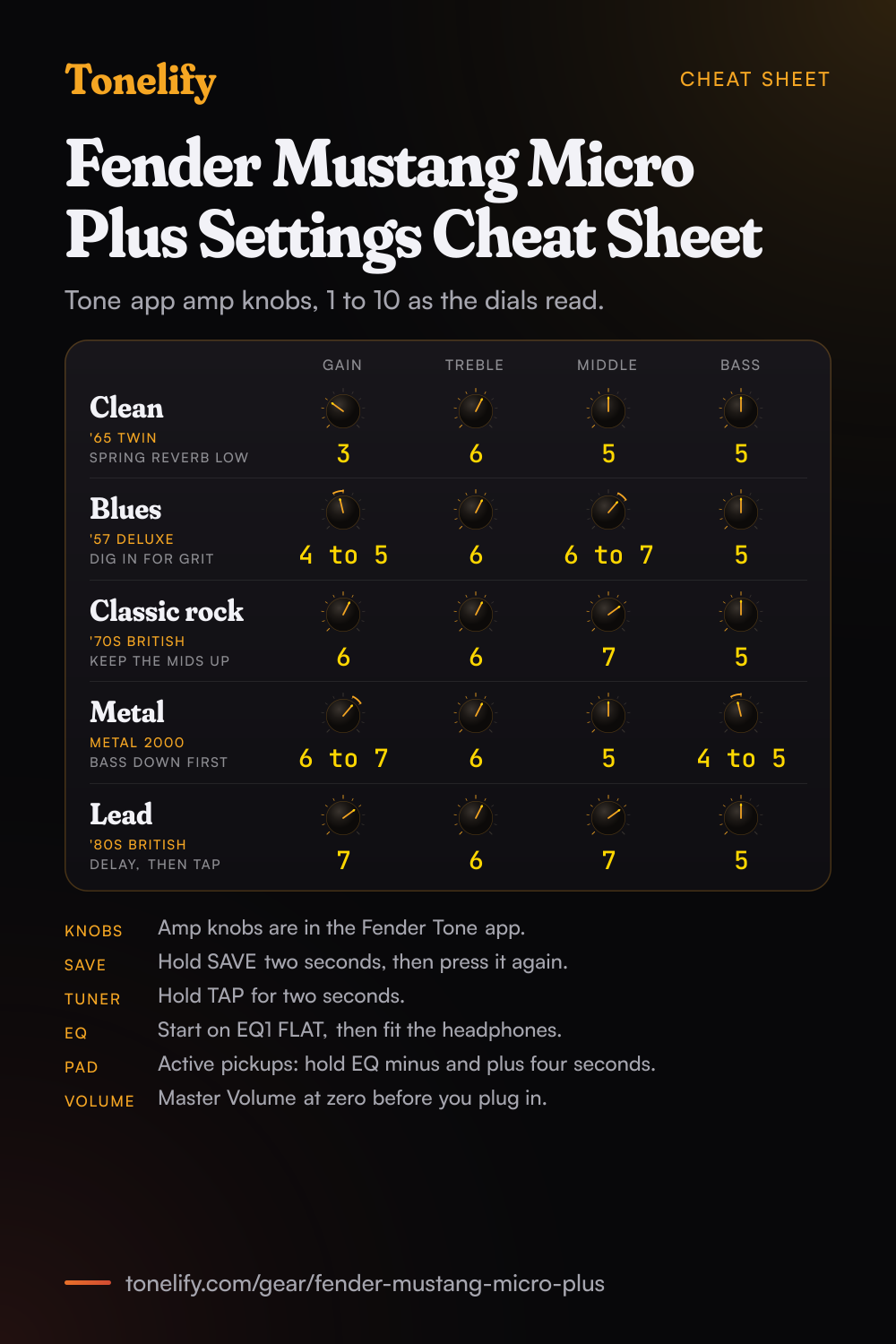
Printable cheat sheet: PDF and PNG
The clean, blues, classic rock, metal and lead settings from this page, together on one sheet with short tips. The PDF prints on white; the PNG is the dark version for your phone.
Starting settings on the Fender Mustang Micro Plus
Positions on a 0 to 10 scale, with 5 at twelve o'clock. They are where to begin, not Fender's numbers: pick the amp type first, then move one control at a time from here.
Where the settings are
The Mustang Micro Plus itself has a Master Volume control and five sets of buttons: PRESET, EQ and MODIFY, each with minus and plus, TAP/TUNER and SAVE. The amp's own knobs, Gain, Volume, Treble, Middle and Bass, are in the Fender Tone app for iOS and Android. Turn the unit on, open Tone with Bluetooth on and touch CONNECT when it finds the Micro Plus; Fender says no Bluetooth step is needed on the Micro Plus itself. Touch the amp in the signal path and swipe a knob up or down, or touch it once for a fine slider with + and - buttons; AMP SETTINGS holds the amp's additional settings. The panels below are positions on a dial numbered 1 to 10, the way the Tone app draws the '65 Deluxe's knobs in Fender's user guide. These are starting points, not Fender's numbers.
Clean
'65 TWIN, which Fender describes as an indispensable mid-'60s stage-and-studio favorite prized for producing the Fender clean tone, or '65 PRINCETON, a mid-'60s Fender studio favorite with the snappy tone of a single 10-inch speaker. Gain 3, Treble 6, Middle 5, Bass 5, with SPRING REVERB in the reverb block at a low level. Keep Gain low and get loudness from Master Volume, which sets the overall level of the guitar and of Bluetooth audio. Fender's manual says to switch on with Master Volume at zero and bring it up gradually.
- Gain 3
- Treble 6
- Middle 5
- Bass 5
SPRING REVERB low in the reverb block.
Edge of breakup and blues
'57 DELUXE, which Fender calls a medium-power late-'50s Fender tweed classic known for thick, compressed overdrive, or '59 BASSMAN, one of Fender's greatest tweed amps, which began life as a bass amp. Gain 4 to 5, Treble 6, Middle 6 to 7, Bass 5. Set Gain where light picking stays clean and digging in breaks up. For a solo, add GREENBOX, Fender's overdrive inspired by the Ibanez TS808 Tube Screamer, in the stompbox block before the amp, the way Fender's own Driven Deluxe preset is laid out in its Tone guide.
- Gain 4 to 5
- Treble 6
- Middle 6 to 7
- Bass 5
GREENBOX before the amp for a solo.
Classic rock
'70S BRITISH, inspired by a late-'60s/early-'70s Marshall Super Lead, the amp Fender says powered the dawn of hard rock. Gain 6, Treble 6, Middle 7, Bass 5. Keep Middle up: classic rock lives in the midrange, and a scooped sound thins out fast in headphones. For the jangle of the British Invasion, '60S BRITISH is Fender's model inspired by the Vox AC30, at a little less Gain.
- Gain 6
- Treble 6
- Middle 7
- Bass 5
Metal
METAL 2000, which Fender calls modern high-gain scorch based on the EVH 5150III, '90S AMERICAN, based on the Mesa Dual Rectifier, or UBER, inspired by the super-high-gain lead channel of the Bogner Uberschall. Gain 6 to 7, Treble 6, Middle 5, Bass 4 to 5. If palm mutes get woolly, take Bass down before you scoop Middle. For tighter palm mutes, put GREENBOX or OVERDRIVE in the stompbox block before the amp rather than raising Gain further.
- Gain 6 to 7
- Treble 6
- Middle 5
- Bass 4 to 5
A drive before the amp tightens it more than extra Gain.
Lead
'80S BRITISH, inspired by the Marshall JCM800, which Fender says produced quintessential '80s metal tone. Gain 7, Treble 6, Middle 7, Bass 5, with MONO DELAY or TAPE DELAY in the delay block. Press TAP two or more times in time with the song to set the delay; the display shows the BPM. Then, in the Tone app, touch MODIFY CONTROL, pick the delay block and assign its level, so the MODIFY buttons on the unit bring the repeats up for a solo.
- Gain 7
- Treble 6
- Middle 7
- Bass 5
Delay time from TAP, delay level on MODIFY.
The EQ buttons
EQ minus and plus step through nine profiles for the whole sound: EQ1 FLAT, EQ2 BRIGHT CUT 1, EQ3 BRIGHT CUT 2, EQ4 LOW CUT 1, EQ5 LOW CUT 2, EQ6 BRIGHT BOOST 1, EQ7 BRIGHT BOOST 2, EQ8 BASS BOOST 1 and EQ9 BASS BOOST 2. Fender calls it an adjustable global EQ, and the unit returns to the EQ you were on when you switch it back on. Set the amp knobs on EQ1 FLAT first, then use the EQ to fit the headphones: a BRIGHT CUT for harsh earbuds, a BASS BOOST for thin ones, a LOW CUT when the low end booms.
Saving, MODIFY and your own presets
On the unit, only changes to the MODIFY parameter and the TAP tempo are saved; the preset's name, its slot and everything else are edited in the Tone app. Hold SAVE for two seconds for the save prompt, then press SAVE again, and PRESET SAVED shows for two seconds. A preset number in black text on a white box means there are unsaved changes. MODIFY works on one modulation, delay or reverb parameter per preset, assigned in the app under MODIFY CONTROL. Of the 100 slots, Fender fills 80 and leaves 20 empty, and a presets reset puts back slots 1 to 80 while leaving 81 to 100 alone, so those are the safe place for your own.
Bass on the Micro Plus
Firmware 1.1.11, released on 14 January 2026, added ten bass amp models from Fender's Rumble Stage and Studio amps, a 9 dB input pad for high-output and active instruments and a way to turn off input muting for some high-impedance and piezo pickups. The bass factory presets do not arrive with the update: switch off, hold TAP and SAVE while switching on, and wait while the display shows PRESETS RESET PLEASE WAIT. Fender's support page warns that this returns all presets to their factory state, while its manual says slots 81 to 100 are unaffected, so upload any you want to keep to the cloud first. Fender's notes list one known issue: presets uploaded to the cloud that contain a bass amp model are not visible.
Fender Mustang Micro Plus amp models
35 amp models: 25 for guitar and, since firmware 1.1.11 of January 2026, 10 for bass from Fender's Rumble Stage and Studio amps. Fender's Micro Plus manual lists the names only; the descriptions are the ones Fender gives the models of the same name in its Mustang GTX and Rumble manuals.
| Model | Type | Fender's description |
|---|---|---|
| '57 Champ | Guitar | Small but mighty late-'50s Fender recording great |
| '57 Deluxe | Guitar | Medium-power late-'50s Fender tweed classic known for thick, compressed overdrive |
| '57 Twin | Guitar | Original-era 2x12-inch tweed classic prized for clean-to-dirty versatility |
| '59 Bassman | Guitar | One of Fender's greatest tweed amps, which began life as a bass amp before being adopted by countless guitarists |
| '65 Princeton | Guitar | Mid-'60s Fender studio favorite with the snappy tone of a single 10-inch speaker |
| '65 Deluxe | Guitar | Highly popular mid-'60s Fender with great tone whether clean or dirty, cranked in countless clubs |
| '65 Twin | Guitar | An indispensable mid-'60s stage-and-studio favorite prized for producing the Fender clean tone |
| '60s British | Guitar | Inspired by the Vox AC30, which powered the British Invasion and produced remarkable clean and dirty tone |
| British Watts | Guitar | Inspired by the original 100-watt Hiwatt DR103, the classic cleaner-tone British stack |
| '70s British | Guitar | Inspired by a late-'60s/early-'70s Marshall Super Lead, the amp that powered the dawn of hard rock |
| '80s British | Guitar | Inspired by the Marshall JCM800, which produced quintessential '80s metal tone |
| '90s American | Guitar | Based on the Mesa Dual Rectifier, whose distinctive distortion shaped the nu-metal sound |
| British Colour | Guitar | Inspired by the sludgy majesty of the Orange OR120 |
| BB15 Low Gain | Guitar | Based on the low gain structure setting of the Bassbreaker 15 |
| BB15 Mid Gain | Guitar | Based on the medium gain structure setting of the Bassbreaker 15 |
| BB15 High Gain | Guitar | Based on the high gain structure setting of the Bassbreaker 15 |
| Super-Sonic | Guitar | Modern Fender amp with two cascading preamp gain stages for pronounced sustain |
| FBE-100 | Guitar | Inspired by both lead channels (BE and HBE) of the Friedman BE-100 |
| Metal 2000 | Guitar | Modern high-gain scorch based on the EVH 5150III |
| Uber | Guitar | For heavy, aggressive music, inspired by the super-high-gain lead channel of the Bogner Uberschall head |
| '60s Thrift | Guitar | Inspired by the garage-classic 1960s Sears Silvertone prized by retro/alternative players |
| Excelsior | Guitar | An elegantly eccentric modern-day Fender model with the distinctive thump of a 15-inch speaker |
| Studio Preamp | Guitar | Direct-to-mixing-desk studio purity with clean, uncolored tonal response |
| Tube Preamp | Guitar | Direct-to-mixing-desk studio purity with increased tube console-like harmonic coloration |
| Acoustic Sim | Guitar | For piezo-equipped electric/acoustic guitars, based on the preamp of Fender's Acoustasonic amps |
| Super Bassman | Bass | Based on the Vintage channel of Fender's present-day flagship bass amp |
| Rumble V3 2x10 | Bass | Fender's Rumble V3 model is based on the clean-to-gritty tone of its best-selling bass amps; its 2x10 Rumble V3 cab on the Rumble 500 Combo |
| Showman 2x15 | Bass | Fender's Dual Showman model is based on the '60s/'70s all-tube Fender classic used on big stages everywhere; its 2x15 D130 cab on the Fender Showman cab |
| Rumble V2 1x15 | Bass | Fender's Rumble V2 model is based on its popular Rumble V2 series of 2010-2014 |
| Bassman TV | Bass | Based on the original-era boom of Fender's vintage TV-Front Bassman |
| Rockin' Peg | Bass | Inspired by the seismic all-tube sound of the Ampeg SVT |
| '66 Flip Top | Bass | Based on the beloved mid-'60s Ampeg B-15NF |
| Redhead | Bass | Inspired by the full-range high-end 1990s indispensability of the SWR Redhead |
| KGB 800 | Bass | Based on the '80s/'90s-era power and clarity of the Gallien-Krueger 800RB |
| Monster | Bass | High-gain all-tube boutique guitar amp model re-imagined for bass |
Fender Mustang Micro Plus effects list
25 effects in four blocks: 11 stompbox, 6 modulation, 4 delay and 4 reverb. Every preset has an amp block and four effect blocks, and in the Fender Tone app any of them can be dragged to another place in the signal path.
| Effect | Block | Fender's description |
|---|---|---|
| Overdrive | Stompbox | A versatile Fender overdrive |
| Greenbox | Stompbox | Overdrive inspired by the original late-'70s Ibanez TS808 Tube Screamer |
| Mythic Drive | Stompbox | Inspired by the '90s-era Klon Centaur germanium-diode overdrive |
| Blackbox | Stompbox | Distortion inspired by the Pro Co RAT |
| Fuzz | Stompbox | A versatile Fender fuzz with added octave |
| Big Fuzz | Stompbox | Distortion inspired by the Electro-Harmonix Big Muff |
| Octobot | Stompbox | Synth-like combination of octave-down effect plus octave-up fuzz |
| Compressor | Stompbox | In the GTX, Fender's MXR Dyna Comp-inspired compressor with added gain, threshold, attack and release controls |
| Sustain | Stompbox | Inspired by the MXR M-163 Sustain, a rare 1980s compressor with a particularly strong effect and a short attack time |
| 5-Band EQ | Stompbox | A five-band equalizer |
| Envelope Filter | Stompbox | Inspired by the 1970s Mu-Tron III |
| Sine Chorus | Modulation | Smoothly rounded chorus that uses a sine wave for modulation |
| Triangle Flanger | Modulation | Distinctive flanging that uses a triangle wave for modulation |
| Phaser | Modulation | The jetliner whoosh heard on countless recordings |
| Vibratone | Modulation | Classic late-'60s/early-'70s Fender effect with a rotating speaker baffle |
| Sine Tremolo | Modulation | Smoothly pulsating tube bias tremolo, as heard in amps such as the Fender Princeton Reverb |
| Harmonic Tremolo | Modulation | Based on the distinctive effect built into certain early-'60s Fender amps |
| Mono Delay | Delay | Clean, simple and pristine signal repetition |
| Tape Delay | Delay | Based on a classic analog tape echo unit with imperfections that created distinctive wow and flutter |
| 2290 Delay | Delay | Inspired by the TC Electronic TC 2290, a 1980s studio-standard digital delay |
| Reverse Delay | Delay | Reverses the shape of notes for the classic backwards guitar effect |
| Large Hall | Reverb | Strong, bright reverb simulating a major performance hall and other large, cavernous spaces |
| Small Room | Reverb | Warmer, less echo-y reverb typical of smaller spaces and classic echo chambers |
| Spring Reverb | Reverb | Drawn as the '65 Spring Reverb, the Fender reverb built into classic mid-'60s Fender amps, with Level, Decay, Dwell, Diffuse and Tone |
| Mod. Large Hall | Reverb | Fender's Large Hall with modulation added to its internal structure |
What controls does the Fender Mustang Micro Plus have?
The Fender Mustang Micro Plus has 11 controls on its front panel: Gain (Tone app), Volume (Tone app), Treble (Tone app), Middle (Tone app), Bass (Tone app), EQ buttons, Modify buttons, Preset buttons, Tap/Tuner button, Save button and Master Volume.
Fender Mustang Micro Plus specifications
- Voicings
- '57 CHAMP, '57 DELUXE, '57 TWIN, '59 BASSMAN, '65 PRINCETON, '65 DELUXE, '65 TWIN, '60S BRITISH, BRITISH WATTS, '70S BRITISH, '80S BRITISH, '90S AMERICAN, BRITISH COLOUR, BB15 LOW GAIN, BB15 MID GAIN, BB15 HIGH GAIN, SUPER-SONIC, FBE-100, METAL 2000, UBER, '60S THRIFT, EXCELSIOR, STUDIO PREAMP, TUBE PREAMP, ACOUSTIC SIM
- Front panel
- Gain (Tone app), Volume (Tone app), Treble (Tone app), Middle (Tone app), Bass (Tone app), EQ buttons, Modify buttons, Preset buttons, Tap/Tuner button, Save button, Master Volume
- Released
- 2024
What the Fender Mustang Micro Plus panel means when you dial it in
There is no presence control on this panel, so everything above the treble band has to come from the treble control and the guitar's own tone knob. A setting copied from an amp with presence has to be rebalanced here. Gain and master volume are separate, so the preamp can be driven hard at a volume that is liveable. Where a tone sits between the two is part of the answer, not a detail. The selectable voicings are '57 CHAMP, '57 DELUXE, '57 TWIN, '59 BASSMAN, '65 PRINCETON, '65 DELUXE, '65 TWIN, '60S BRITISH, BRITISH WATTS, '70S BRITISH, '80S BRITISH, '90S AMERICAN, BRITISH COLOUR, BB15 LOW GAIN, BB15 MID GAIN, BB15 HIGH GAIN, SUPER-SONIC, FBE-100, METAL 2000, UBER, '60S THRIFT, EXCELSIOR, STUDIO PREAMP, TUBE PREAMP and ACOUSTIC SIM. Picking the voicing comes before the knob positions, because the same numbers land somewhere else on each one.
Fender Mustang Micro Plus questions
What amp models are on the Fender Mustang Micro Plus?
35 after firmware 1.1.11: 25 for guitar and 10 for bass. The guitar models run from '57 CHAMP and '65 TWIN to '60S BRITISH, inspired by the Vox AC30, '70S BRITISH and '80S BRITISH, inspired by a Marshall Super Lead and the JCM800, '90S AMERICAN, based on the Mesa Dual Rectifier, METAL 2000, based on the EVH 5150III, and UBER, inspired by the Bogner Uberschall, plus STUDIO PREAMP, TUBE PREAMP and ACOUSTIC SIM. The bass models include SUPER BASSMAN, ROCKIN' PEG, inspired by the Ampeg SVT, and KGB 800, based on the Gallien-Krueger 800RB. The full list is in the table on this page.
What effects does the Mustang Micro Plus have?
25, in four blocks: 11 stompbox, among them GREENBOX, inspired by the Ibanez TS808, MYTHIC DRIVE, inspired by the Klon Centaur, BLACKBOX, inspired by the Pro Co RAT, and OCTOBOT; 6 modulation, from SINE CHORUS to HARMONIC TREMOLO; 4 delays, MONO, TAPE, 2290 and REVERSE; and 4 reverbs, LARGE HALL, SMALL ROOM, SPRING REVERB and MOD. LARGE HALL. Each preset has an amp block and four effect blocks.
Can you change the amp settings on the Mustang Micro Plus without the app?
No. The unit has Master Volume, the nine EQ profiles, the MODIFY buttons for one assigned effect parameter, PRESET, TAP/TUNER and SAVE. Fender's manual says amp and effect parameters are adjusted in the Fender Tone app, and that only changes to the MODIFY parameter and the tap tempo are saved on the unit itself. Without a phone, you choose between the presets and shape them with the EQ.
What is the difference between the Mustang Micro and the Mustang Micro Plus?
Fender lists the Mustang Micro with 12 amp models, 12 effect combinations, an adjustable EQ and 4 hours of continuous play. The Micro Plus has 25 guitar amp models, 10 bass models since the 2026 update, 25 effects, 100 preset slots, a display with a chromatic tuner and editing in the Fender Tone app. In October 2026 Fender's US store listed the Micro at $99.99 and the Micro Plus at $129.99. Both stream Bluetooth audio with audio and video sync, record over USB and have a rotating input plug.
How many presets does the Mustang Micro Plus have?
100 slots. Fender's current manual counts 80 factory presets and 20 empty slots, and a presets reset restores slots 1 to 80. Fender's product page and the preset section of its manual still give the earlier count, 70 factory presets and 30 empty slots; the difference is the bass presets Fender added with firmware 1.1.11. Hold either PRESET button to scroll through them.
Does the Mustang Micro Plus have a tuner?
Yes. Hold the TAP button for two seconds: the display shows the target note and a needle, and the note lights up in a white box when it is in tune. The guitar and any Bluetooth audio are muted while the tuner is on, and any button closes it. The Tone app can also switch the tuner on from its settings menu.
How do you connect the Mustang Micro Plus to the Fender Tone app?
Turn the Micro Plus on, open the Fender Tone app on an iOS or Android phone with Bluetooth enabled, and touch CONNECT when the app finds it. Fender's Tone guide says the Bluetooth step on the device that its larger amps need is not necessary for the Micro Plus. The app then edits the amp, the effects, their order, the MODIFY assignment and the preset names, and backs up presets to the cloud.
How do you play music through the Mustang Micro Plus over Bluetooth?
Push the power switch to the far left and hold it for two seconds; the LED flashes blue for up to two minutes while it pairs, and the unit shows up as Mustang Micro Plus on the phone. It reconnects to the last device by itself. Master Volume sets the guitar and the overall level, and the balance between the guitar and the music is set with the phone's own volume.
Can you record with the Mustang Micro Plus over USB?
Yes. Fender's manual calls the USB-C port bidirectional for recording software on a Mac or PC. A Mac needs no driver; for Windows, Fender's product page offers its Universal ASIO driver. The Tone app's settings menu has a USB audio gain level for the recording level.
How long does the Mustang Micro Plus battery last?
Fender's specifications give 4 hours at high volume and up to 6 hours at low volume from the built-in lithium-ion battery. It charges over USB-C, with a solid yellow LED while charging. Running on battery, the LED flashes green once every five seconds above 50 percent, yellow between 20 and 50 percent and red below 20 percent.
Can you use the Mustang Micro Plus with a bass?
Yes. The rotating plug fits basses as well as guitars, and firmware 1.1.11 of January 2026 added ten bass amp models from Fender's Rumble amps, including SUPER BASSMAN, ROCKIN' PEG, '66 FLIP TOP, REDHEAD and KGB 800. Load the bass factory presets with a presets reset, holding TAP and SAVE while you switch on, after saving your own presets to the cloud.
Does the Mustang Micro Plus work with active pickups?
Yes, with the input pad on. It lowers the input by 9 dB for active and high-output instruments: hold EQ minus and plus together for four seconds, or switch it on in the Tone app's settings. The pad came with firmware 1.1.11, which also lets you disable input mute detection for some high-impedance and piezo pickups.
What headphones work with the Mustang Micro Plus?
Any wired pair on the 1/8-inch stereo jack with an impedance of 16 ohms or more, per Fender's specifications, which rate the output at 30 mW per channel. Fender's product page talks of wired earbuds or headphones. Put them on only after plugging in, or with Master Volume at zero, since plugging in or touching the plug can cause a loud noise.
How do you update the Mustang Micro Plus firmware?
Install Fender Device Manager on a Mac or Windows computer and connect the Micro Plus over USB-C. Switch it off, hold PRESET minus while switching on, and the LED flashes green; then click Update in Device Manager and wait for the message that the firmware has been updated before you unplug. The installed version shows under About in the Tone app's settings.
How do you factory reset the Mustang Micro Plus?
Hold MODIFY minus and SAVE while you switch it on, for two seconds. The display shows FACTORY RESET PLEASE WAIT and the unit returns to normal when it is done. It returns the Micro Plus to its factory settings and clears the list of paired Bluetooth devices. To restore only Fender's presets, use a presets reset instead: TAP and SAVE while switching on.
When did the Mustang Micro Plus come out and what does it cost?
Fender launched it on 5 September 2024 at $149.99, £149 or €169, with firmware 1.0.29 as the first release. Fender's US store listed it at $129.99 in October 2026, and the bass update, firmware 1.1.11, followed on 14 January 2026.
Does Tonelify support the Fender Mustang Micro Plus?
Yes, and its front panel is stored, so settings only ever reference controls this guitar amp has: Gain (Tone app), Volume (Tone app), Treble (Tone app), Middle (Tone app), Bass (Tone app), EQ buttons, Modify buttons, Preset buttons, Tap/Tuner button, Save button, Master Volume. You will not be told to set a knob that is not there.
Sources
Panel, specifications and dates checked against these on .
- Fender: Mustang Micro Plus owner's manual (PDF)
- Fender: Tone user guide, app 5.1.x (PDF)
- Fender support: Mustang Micro Plus firmware update instructions and release notes
- Fender: Mustang Micro Plus product page
- Fender: Mustang Micro product page
- Fender: Mustang GTX expanded owner's manual (PDF)
- Fender: Rumble Studio 40 / Stage 800 owner's manual (PDF)
- Fender press release: Fender introduces the Mustang Micro Plus (5 September 2024)
fender.com's product pages returned errors and rate limits on 7 November 2026, so the Mustang Micro Plus and Mustang Micro pages were read from Internet Archive copies of 11 October 2026. The Micro Plus manual names the models without describing them; Fender's launch release says they come straight from the Mustang Series amps, so the descriptions are Fender's own for the models of the same name in its Mustang GTX and Rumble manuals.