
Fender '65 Princeton Reverb Reissue settings
Two tone controls and nothing else. Anything asking for mids, presence or a master volume does not apply to this amp.
⚡ Match a tone on this amp- Volume
- Treble
- Bass
- Reverb
- Speed
- Intensity
How do you dial in a specific tone on a Fender '65 Princeton Reverb Reissue?
A valve amp does not respond to a knob the way a number on a page suggests. Where the Fender '65 Princeton Reverb Reissue sits in its own gain range changes what every other control does: the same treble setting is bright at low volume and harsh once the power section is working. That is why copying an artist's numbers onto this amp gives the wrong answer, and why the settings here are written against this amp's behaviour rather than the one the record was cut on.
Name the song you are chasing in the tone matcher and Tonelify returns the settings for this exact guitar amp, not the settings the original artist used. Those are two different things: the recording was made on gear most players do not own.
Settings for this amp only ever use controls it actually has, because its front panel is stored in our gear database. You will not be told to set a knob that is not on the amp.
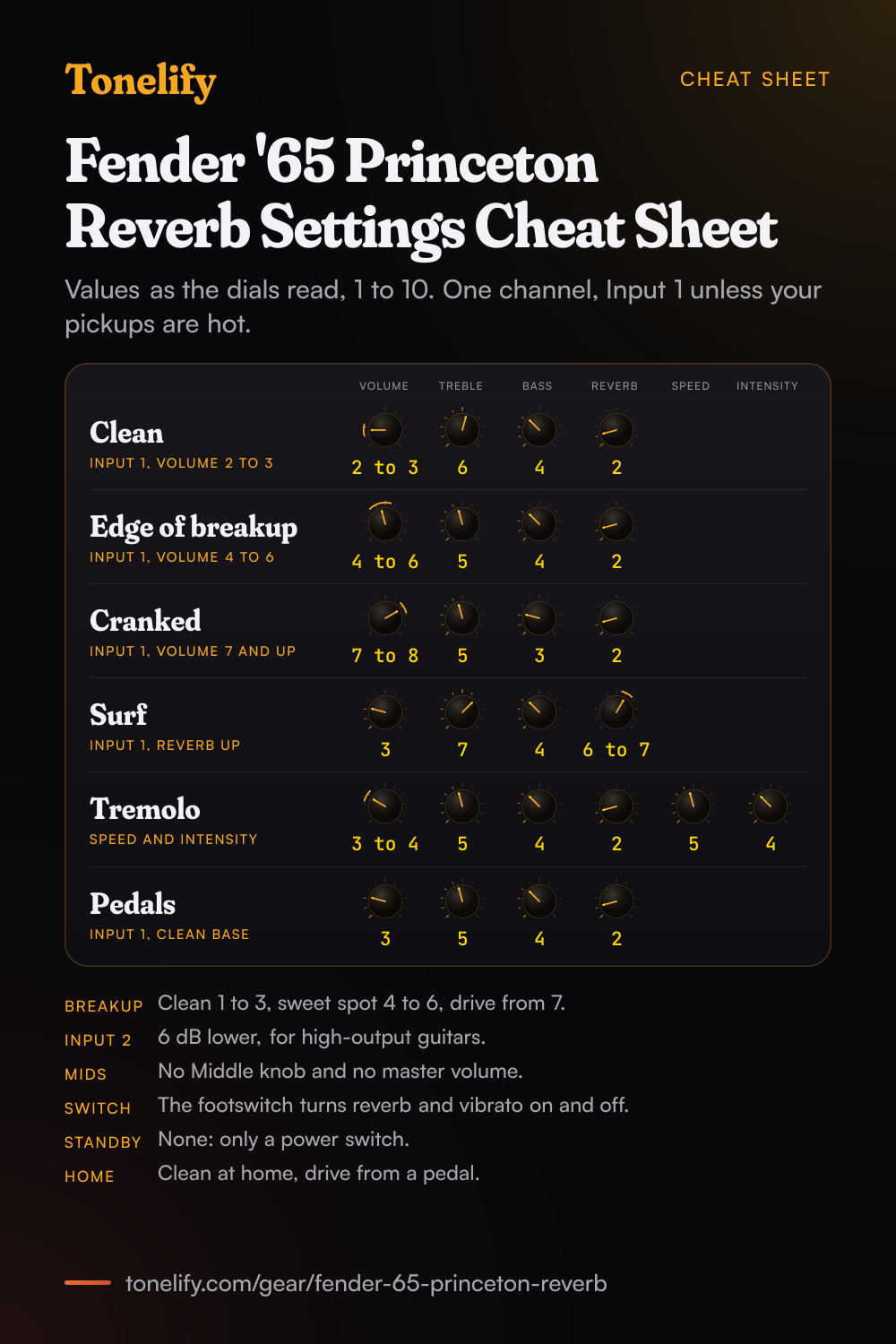
Free download
Printable cheat sheet: PDF and PNG
The clean, edge of breakup, cranked, surf, tremolo and pedals settings from this page, together on one sheet with short tips. The PDF prints on white; the PNG is the dark version for your phone.
Starting settings on the Fender '65 Princeton Reverb Reissue
Values as the numbers on the knobs, which run from 1, fully counter-clockwise, to 10. They are where to begin, not Fender's numbers: move one control at a time from here.
Clean
Plug into Input 1, which Fender's manual calls the full sensitivity input for most guitars. Volume 2 to 3, Treble 6, Bass 4, Reverb 2. American Songwriter's review found incredible cleans from 1 to 3 that are still reasonably audible. There is no Middle knob and no master volume: the panel is Volume, Treble, Bass, Reverb, Speed and Intensity, so Volume sets both the level and how hard the amp is driven.
- Volume 2 to 3
- Treble 6
- Bass 4
- Reverb 2
No Middle knob and no master volume.
Edge of breakup
Volume 4 to 6, Treble 5, Bass 4, Reverb 2. American Songwriter's review calls about 4 to 6 the sweet spot, with incredible sensitivity and dynamics, so pick harder for grit and lighter to clean it up, and roll the guitar's volume back to clean up a chord without touching the amp. Where it starts to break up depends on the pickups: a hot humbucker gets there sooner, and Fender's manual offers Input 2, 6 dB lower, to give high-output guitars a cleaner response.
- Volume 4 to 6
- Treble 5
- Bass 4
- Reverb 2
Pick harder for grit, lighter to clean up.
Cranked
Volume 7 to 8, Treble 5, Bass 3, Reverb 2. American Songwriter's review heard killer tube distortion from about 7 onwards. Bass sits lower than in the clean setting so the low end stays tight as the amp compresses. This is the amp's own overdrive, so it only comes loud: Fender's manual says the 12 watts provide enough output for small gigs and rehearsals, and there is no master volume to tame it at home.
- Volume 7 to 8
- Treble 5
- Bass 3
- Reverb 2
Loud: the drive comes with the volume.
Surf reverb
Keep Volume low so the reverb stays clean, and pick near the bridge. Volume 3, Treble 7, Bass 4, Reverb 6 to 7. Fender's manual describes a genuine Fender tube-driven spring Reverb by Accutronics, and its back panel shows the RCA jacks that send the signal to and from the reverb tank, so spring reverb is the only type. The footswitch turns it on and off.
- Volume 3
- Treble 7
- Bass 4
- Reverb 6 to 7
Spring reverb is the only type.
Tremolo
Volume 3 to 4, Treble 5, Bass 4, Reverb 2, Speed 5, Intensity 4. Speed sets the rate and Intensity the depth. Fender's manual lists the effect as a genuine Fender tube tremolo, with vibrato in quotes, and calls it vibrato everywhere else. Switch it on and off from the included two-button footswitch, which also switches the reverb.
- Volume 3 to 4
- Treble 5
- Bass 4
- Reverb 2
- Speed 5
- Intensity 4
Switch it on and off from the footswitch.
With pedals
Set a clean base and let the pedals do the rest: Volume 3, Treble 5, Bass 4, Reverb 2. Fender's manual says countless guitarists have chosen the Princeton as a studio amp, crafting signature sounds with a stomp box or two feeding a simple mic-ed-up Princeton, and American Songwriter's review calls it a great pedal platform at lower volumes. With Volume at 3 the amp stays clean, so the drive comes from the pedal; push Volume toward 5 and the pedal and the amp break up together.
- Volume 3
- Treble 5
- Bass 4
- Reverb 2
Volume toward 5 and the amp joins in.
Playing at home
With no master volume, the clean settings are the ones that suit a room at home: American Songwriter's review found the cleans from 1 to 3 reasonably audible, and said the amp works at home in some cases, namely if you don't share any walls. For overdrive at a low level, use the clean setting with a drive pedal in front rather than turning Volume past 6. There is no headphone socket or line output, so recording means a microphone on the speaker, the way the manual describes it.
Chasing one song? Name it and the matcher writes that song's settings for the Fender '65 Princeton Reverb Reissue.
What controls does the Fender '65 Princeton Reverb Reissue have?
The Fender '65 Princeton Reverb Reissue has 6 controls on its front panel: Volume, Treble, Bass, Reverb, Speed and Intensity.
Fender '65 Princeton Reverb Reissue specifications
- Power
- 12W
- Speaker
- 1x10" Jensen C-10R
- Front panel
- Volume, Treble, Bass, Reverb, Speed, Intensity
- Released
- 2008
What the Fender '65 Princeton Reverb Reissue panel means when you dial it in
12W through a 1x10" Jensen C-10R. At that rating the power section starts working early, so the loudness knob is part of the tone setting rather than separate from it. There is no presence control on this panel, so everything above the treble band has to come from the treble control and the guitar's own tone knob. A setting copied from an amp with presence has to be rebalanced here. The EQ has no middle control, so the midrange is fixed by the amp's own voicing and can only be shaped around with bass and treble, or in front of the amp with a pedal. There is no master volume: how loud the amp is and how driven it sounds move together, which is the main thing to plan around when a setting written for a master-volume amp is carried over. Reverb is onboard, so a tone that needs it does not need a pedal in the chain.
Fender '65 Princeton Reverb Reissue questions
Does the '65 Princeton Reverb have a master volume?
No. The front panel is Volume, Treble, Bass, Reverb, Speed and Intensity, with two inputs and the power jewel, as Fender's manual draws it. Volume sets how loud the amp is and how hard it is driven at once, so the amp's own overdrive only comes when it is loud. There is no Middle knob either.
Which input should I use on a Princeton Reverb, 1 or 2?
Input 1 for most guitars: Fender's manual calls it the full sensitivity input. Input 2 is a lower sensitivity input, 6 dB down, to give high-output guitars a cleaner response. The manual adds that both inputs become equal in sensitivity when used at the same time. The input impedance is 1 megohm.
At what volume does the '65 Princeton Reverb break up?
American Songwriter's review heard incredible cleans from 1 to 3, a sweet spot with incredible sensitivity and dynamics from about 4 to 6, and killer tube distortion from about 7 onwards. The point moves with the guitar: hotter pickups break it up sooner, and Input 2 gives them 6 dB less to work with.
Is the '65 Princeton Reverb 12 or 15 watts?
Fender has printed both. The current manual gives 12 watts into 8 ohms at under 5% distortion, and calls the amp a 12-watt platform. An earlier edition of the manual gave 15 watts into 8 ohms at under 10% distortion. The two figures are measured at different amounts of distortion, and both editions list the same tubes.
Does the '65 Princeton Reverb have a standby switch?
No. Fender's manual lists the back panel as the power cord socket, the fuse, the power switch, the internal and external speaker jacks, the footswitch jack and the reverb jacks, with no standby switch. The power jewel on the front shows when the amp is on.
What does the Princeton Reverb footswitch do?
It switches the effects. Fender's manual says the included two-button footswitch enables remote switching of the reverb and vibrato effects, one button each, and it plugs into the footswitch jack on the back. There are no channels to switch: the Princeton has one.
Can you connect an extension cabinet to the '65 Princeton Reverb?
Yes, with care over the load. Fender's manual says the external speaker jack is wired in parallel with the internal speaker jack and to use 8 ohms minimum in total. To use it, disconnect the internal speaker first, then connect a 16 ohm load to each of the two jacks. A speaker must always be connected at the internal speaker jack when the amp is on.
Can you use headphones or record direct with the Princeton Reverb?
No. The back panel has no headphone socket and no line output. The manual pictures the Princeton the way studios have used it: a stomp box or two feeding a simple mic-ed-up amp, so record it with a microphone on the speaker.
What tubes and speaker does the '65 Princeton Reverb use?
Fender's manual lists two Groove Tubes 6V6 output tubes, three 12AX7 preamp tubes, one 12AT7 and a 5AR4 rectifier. Left to right at the rear they sit as 5AR4, 6V6GT, 6V6GT, 12AX7A, 12AX7A, 12AT7, 12AX7A. The speaker is one 8 ohm, 10-inch Jensen Special Design C-10R, part number 0069347000. When replacing output tubes, Fender asks you to match the markings on the tubes the amp came with.
How big and heavy is the '65 Princeton Reverb?
Fender's manual gives 16 inches high, 19 7/8 inches wide and 9 1/2 inches deep (40.6 by 50.5 by 24.1 cm), and 34 lb (15.42 kg). American Songwriter's review calls it a tube combo you can carry reliably with one hand.
What is the difference between the '65 Princeton Reverb and the '65 Deluxe Reverb?
The Princeton has one channel, 12 watts and a 10-inch speaker; Fender's Deluxe Reverb manual gives the Deluxe two channels, Normal and Vibrato, 22 watts and a 12-inch speaker. Both have Volume, Treble and Bass with no Middle knob or master volume, and both have spring reverb and tube vibrato. On the Deluxe those effects work only on the Vibrato channel; on the Princeton they are on its one channel.
When did the '65 Princeton Reverb reissue come out?
Fender reissued the Princeton Reverb in 2008, and the amp is still in production. Fender's manual calls it a reissue of the 1965 Princeton Reverb circuit with all-tube circuitry, and says original Princeton Reverb amps are now prized collectibles that are becoming harder to find.
Is there a printable '65 Princeton Reverb settings cheat sheet?
Yes. The cheat sheet on this page puts all six starting settings on one page, from clean to tremolo, with short tips under them. Download the PDF to print it on white, or save the PNG to your phone.
Does Tonelify support the Fender '65 Princeton Reverb Reissue?
Yes, and its front panel is stored, so settings only ever reference controls this guitar amp has: Volume, Treble, Bass, Reverb, Speed, Intensity. You will not be told to set a knob that is not there.
Sources
Panel, specifications and dates checked against these on .
- Fender: '65 Princeton Reverb owner's manual, 2020 edition (PDF)
- Fender: '65 Princeton Reverb owner's manual, earlier edition (PDF, archived)
- American Songwriter: Fender '65 Princeton Reverb review
- Fender: '65 Deluxe Reverb owner's manual, for the comparison (PDF)
- Wikipedia: Fender Princeton, for the 2008 reissue date
More Fender gear
Similar amps from other makers
Settings for the song you are chasing
Name a song and Tonelify reads the documented rig behind the recording, then writes the settings for the controls the Fender '65 Princeton Reverb Reissue has. A first plan starts with 7 days free, $0 today.