
Hughes & Kettner TubeMeister 18 settings
Each channel has its own Gain and Master. The Lead Boost switch re-voices the Lead channel for a modern high-gain sound. Bass, Mid and Treble are shared, though each channel's EQ circuit is voiced differently.
⚡ Match a tone on this amp- Clean Gain
- Clean Master
- Lead Gain
- Lead Master
- Lead Boost
- Bass
- Mid
- Treble
How do you dial in a specific tone on a Hughes & Kettner TubeMeister 18?
A valve amp does not respond to a knob the way a number on a page suggests. Where the Hughes & Kettner TubeMeister 18 sits in its own gain range changes what every other control does: the same treble setting is bright at low volume and harsh once the power section is working. That is why copying an artist's numbers onto this amp gives the wrong answer, and why the settings here are written against this amp's behaviour rather than the one the record was cut on.
Name the song you are chasing in the tone matcher and Tonelify returns the settings for this exact guitar amp, not the settings the original artist used. Those are two different things: the recording was made on gear most players do not own.
Settings for this amp only ever use controls it actually has, because its front panel is stored in our gear database. You will not be told to set a knob that is not on the amp.
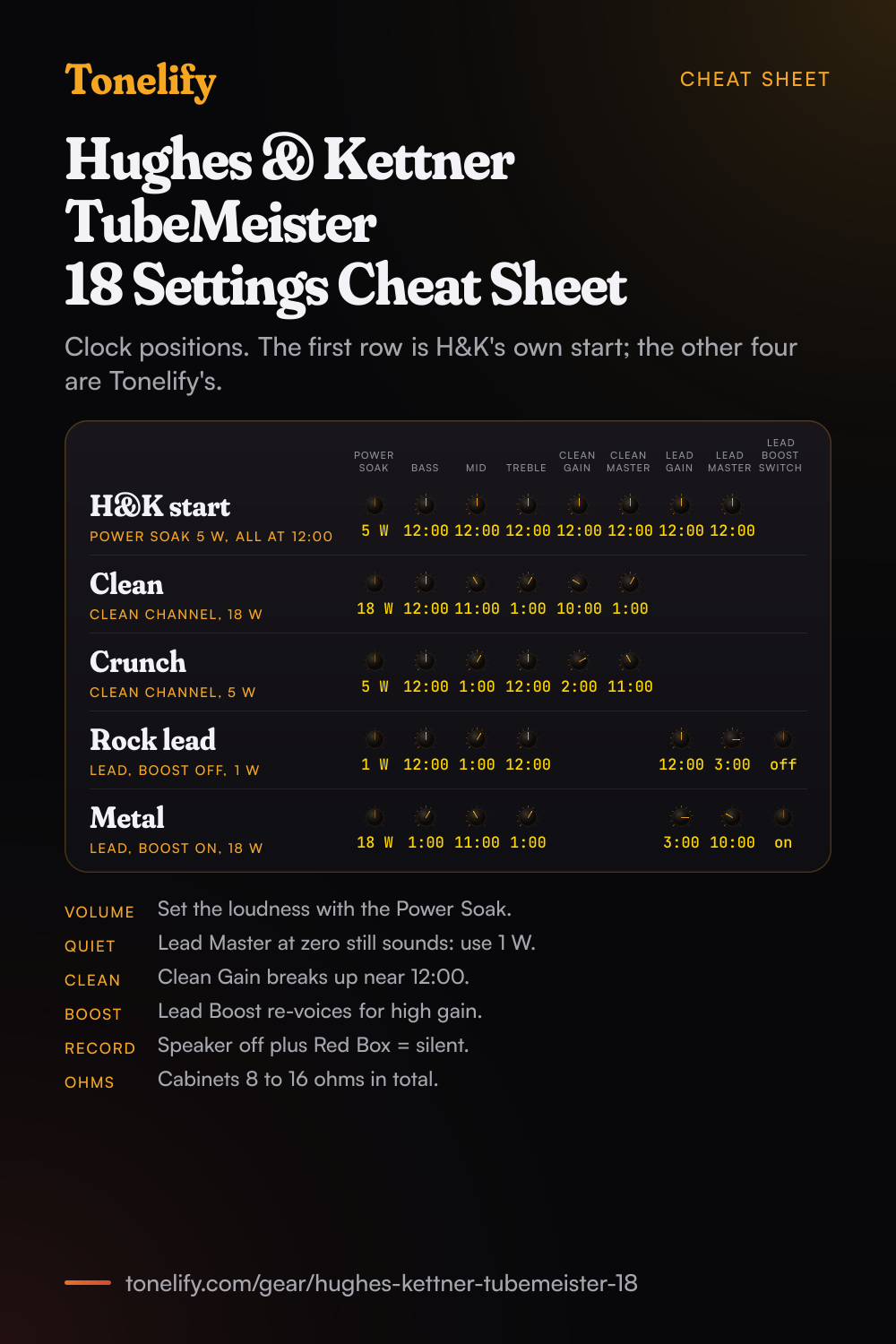
Free download
Printable cheat sheet: PDF and PNG
The h&k start, clean, crunch, rock lead and metal settings from this page, together on one sheet with short tips. The PDF prints on white; the PNG is the dark version for your phone.
Starting settings on the Hughes & Kettner TubeMeister 18
Positions as clock times, since the knobs carry no numbers: 12:00 is the middle of the travel. They are where to begin, not Hughes & Kettner's numbers: pick the channel first, then move one control at a time from here.
Hughes & Kettner's starting point
Power Soak 5 W, Clean Gain 12:00, Clean Master 12:00, Lead Gain 12:00, Lead Master 12:00, Bass 12:00, Mid 12:00, Treble 12:00. This one is Hughes & Kettner's own: the manual says the best way to discover the amp is to set the Power Soak to five-watt mode and all knobs to the 12 o'clock position, then adjust Gain and Master to taste the very different flavors of preamp and power tube distortion. H&K says to think of Gain and Master as the yin and yang of sound-shaping rather than volume controls, and to set the basic volume with the Power Soak on the back.
- Power Soak 5 W
- Clean Gain 12:00
- Clean Master 12:00
- Lead Gain 12:00
- Lead Master 12:00
- Bass 12:00
- Mid 12:00
- Treble 12:00
Hughes & Kettner's own starting point.
Clean
Clean channel, Power Soak 18 W, Clean Gain 10:00, Clean Master 1:00, Bass 12:00, Mid 11:00, Treble 1:00. H&K's manual says the Clean channel will begin to overdrive somewhere around the 12 o'clock setting, depending on the output of your pickups, so Clean Gain stays below noon here. Full power gives the most headroom; with hot humbuckers take Clean Gain to 9:00. These values are Tonelify's, not H&K's.
- Power Soak 18 W
- Clean Gain 10:00
- Clean Master 1:00
- Bass 12:00
- Mid 11:00
- Treble 1:00
Hot humbuckers: Clean Gain 9:00.
Crunch on the Clean channel
Clean channel, Power Soak 5 W, Clean Gain 2:00, Clean Master 11:00, Bass 12:00, Mid 1:00, Treble 12:00. H&K says the Clean channel sweeps from pristine clean to throaty crunch sounds and reacts to the slightest nudge of the guitar's volume knob, so this crunch cleans up when you roll the guitar back. Mid a little past noon keeps chords thick. Tonelify's values, not H&K's.
- Power Soak 5 W
- Clean Gain 2:00
- Clean Master 11:00
- Bass 12:00
- Mid 1:00
- Treble 12:00
Roll the guitar volume back to clean up.
Classic rock lead
Lead channel, Lead Boost switch off, Power Soak 1 W, Lead Gain 12:00, Lead Master 3:00, Bass 12:00, Mid 1:00, Treble 12:00. Two of H&K's own tips set this one up: for creamy lead tones turn the Lead Master well up for smooth power amp saturation, and for classic rock sounds drop the Power Soak to a lower setting and crank the Master so the power tubes get a workout. The clock positions are Tonelify's.
- Power Soak 1 W
- Lead Boost switch off
- Lead Gain 12:00
- Lead Master 3:00
- Bass 12:00
- Mid 1:00
- Treble 12:00
Master well up, Power Soak down.
Boosted modern metal
Lead channel, Lead Boost switch on, Power Soak 18 W, Lead Gain 3:00, Lead Master 10:00, Bass 1:00, Mid 11:00, Treble 1:00. H&K says the Boost re-voices the Lead channel for modern high-gain sound, and that for an edgier metal sound you back off the Master and turn up the Gain. For modern sounds that need a fast, tightly focused response the manual sets the Power Soak to full power with the Master down. At home, drop the Power Soak to 1 W and leave the rest. Clock positions are Tonelify's.
- Power Soak 18 W
- Lead Boost switch on
- Lead Gain 3:00
- Lead Master 10:00
- Bass 1:00
- Mid 11:00
- Treble 1:00
Gain up, Master back.
Silent recording with the Red Box
Set the Power Soak to Speaker off and run a microphone cable from the Red Box out to a line level input on your mixer or interface. H&K's manual says the Red Box signal is tapped post power amp and pre Power Soak, so you still record the full tube sound, and that the Master settings change its level while the Power Soak mode does not. In the Speaker off position the head needs no speaker connected; in every other position it must have one.
Chasing one song? Name it and the matcher writes that song's settings for the Hughes & Kettner TubeMeister 18.
What controls does the Hughes & Kettner TubeMeister 18 have?
The Hughes & Kettner TubeMeister 18 has 8 controls on its front panel: Clean Gain, Clean Master, Lead Gain, Lead Master, Lead Boost switch, Bass, Mid and Treble.
Hughes & Kettner TubeMeister 18 specifications
- Power
- 18W, with a four-stage power soak down to silent
- Channels
- Clean, Lead
- Front panel
- Clean Gain, Clean Master, Lead Gain, Lead Master, Lead Boost switch, Bass, Mid, Treble
What the Hughes & Kettner TubeMeister 18 panel means when you dial it in
18W, with a four-stage power soak down to silent. At that rating the power section starts working early, so the loudness knob is part of the tone setting rather than separate from it. There is no presence control on this panel, so everything above the treble band has to come from the treble control and the guitar's own tone knob. A setting copied from an amp with presence has to be rebalanced here. Gain and master volume are separate, so the preamp can be driven hard at a volume that is liveable. Where a tone sits between the two is part of the answer, not a detail. 2 channels, Clean and Lead, and a setting only means something once the channel it belongs to is named.
Hughes & Kettner TubeMeister 18 questions
How does the Power Soak on the TubeMeister 18 work?
It sets the output power and so the basic volume. H&K's manual lists four modes: normal operation at 18 watts, 5 watts, 1 watt and Speaker off at 0 watts for silent recording. H&K adds that it changes the feel as well as the volume: full power with the Master down for modern, tightly focused sounds, and a lower setting with the Master cranked for classic rock power tube saturation.
Why can't I turn the TubeMeister 18 all the way down?
H&K's manual says you cannot mute the amp by turning the Lead Master all the way down. To play very quietly it recommends the five or one watt mode on the Power Soak instead of backing the Master way down.
What does the Lead Boost switch do?
H&K says it re-voices the Lead channel to summon modern high-gain sound with plenty of punch and endless sustain. Its LED lights red when it is on. With a footswitch connected, the front button no longer switches it and only shows its status.
Do the two channels share the EQ?
Yes. Bass, Mid and Treble are common to both channels, but H&K's manual says their separate EQ filtering circuits are voiced differently for each channel, so the same knob position sounds different on Clean and Lead.
How do I record silently with the TubeMeister 18?
Set the Power Soak to Speaker off and patch the Red Box out to a mixer with a microphone cable, with the mixer's XLR input set to line level. H&K says the Red Box adds speaker emulation, taps the signal post power amp and pre Power Soak, and that in the mute position you do not need a speaker connected.
What speaker cabinet can I use with the TubeMeister 18 head?
Any guitar cabinet or combination of cabinets with a total impedance between 8 and 16 ohms, per H&K. The manual gives the sums: two 8 ohm cabinets in series make 16 ohms, and two 16 ohm cabinets in parallel make 8 ohms. On the combo the jack is already used by the internal speaker.
How does the effects loop on the TubeMeister 18 work?
It is a serial loop. H&K's manual says it activates when you insert a plug into the Return jack. Send goes to your effect's input and Return to its output; you can also use Send alone to feed a tuner or another power amp.
What footswitch does the TubeMeister 18 use?
A two-button switch such as the Hughes & Kettner FS-2 on a stereo cable: tip switches the channel and ring the Lead Boost. A one-button FS-1 switches channels only. H&K adds that a MIDI switcher or looper can be connected to the same jack.
What is TSC on the TubeMeister 18?
Tube Safety Control. H&K's manual says it adjusts the bias of the power tubes automatically and continuously, so there is nothing for you to do. With no LEDs lit the power tubes are working normally; one LED flashing means that tube has been shut down and must be replaced by a technician.
Do I need matched tubes for the TubeMeister 18?
No. Insert a pick into the TSC slot with the amp on to make the LEDs flash; H&K says TSC ensures optimum sound if the difference in flash counts is no greater than four, and the amp still runs safely above that, though a matched set improves the tone. Tubes should be replaced by a qualified technician.
What tubes does the TubeMeister 18 use?
Two 12AX7 (ECC83) preamp tubes and two EL84 power tubes, for 18 watts, per H&K's specifications.
How long should the TubeMeister 18 warm up?
H&K's manual says to give the tubes about 30 seconds before flipping Standby to Play, and to use Standby during short breaks so the tubes stay at operating temperature.
What is the difference between the TubeMeister 18 head and combos?
Per H&K, the head weighs 5 kg and measures 356 x 156 x 150 mm. The combo has a 10" Celestion Ten 30 and weighs 9.4 kg, and the Twelve combo a 12" RockDriver Classic 60 at 15.4 kg. The reverb is on the combo only, and H&K set it to be more pronounced on the Clean channel than on the Lead.
Is there a printable TubeMeister 18 settings cheat sheet?
Yes. The cheat sheet on this page puts all five settings on one page, from H&K's own 12 o'clock start to boosted metal, each with its channel and Power Soak mode. Download the PDF to print it, or save the PNG to your phone.
Does Tonelify support the Hughes & Kettner TubeMeister 18?
Yes, and its front panel is stored, so settings only ever reference controls this guitar amp has: Clean Gain, Clean Master, Lead Gain, Lead Master, Lead Boost switch, Bass, Mid, Treble. You will not be told to set a knob that is not there.
Sources
Panel, specifications and dates checked against these on .
Similar amps from other makers
Settings for the song you are chasing
Name a song and Tonelify reads the documented rig behind the recording, then writes the settings for the controls the Hughes & Kettner TubeMeister 18 has. A first plan starts with 7 days free, $0 today.