
Mooer GE300 Lite presets and settings
Smaller GE300 from 2020: 108 amp models, 43 cabs with two mics, IR loading, Tone Capture, 255 presets, a 30-second looper and, since 2026 firmware, NAM A1 and A2 files.
⚡ Match a tone on this unitHow do you dial in a specific tone on a Mooer GE300 Lite?
A multi-effects unit gives you the whole chain in one box, which means the order of the blocks is as much of the answer as the values inside them. Settings for the Mooer GE300 Lite name the amp model, the block order and the parameters together, rather than handing you numbers with no chain to put them in.
Name the song you are chasing in the tone matcher and Tonelify returns the settings for this exact multi-effects unit, not the settings the original artist used. Those are two different things: the recording was made on gear most players do not own.
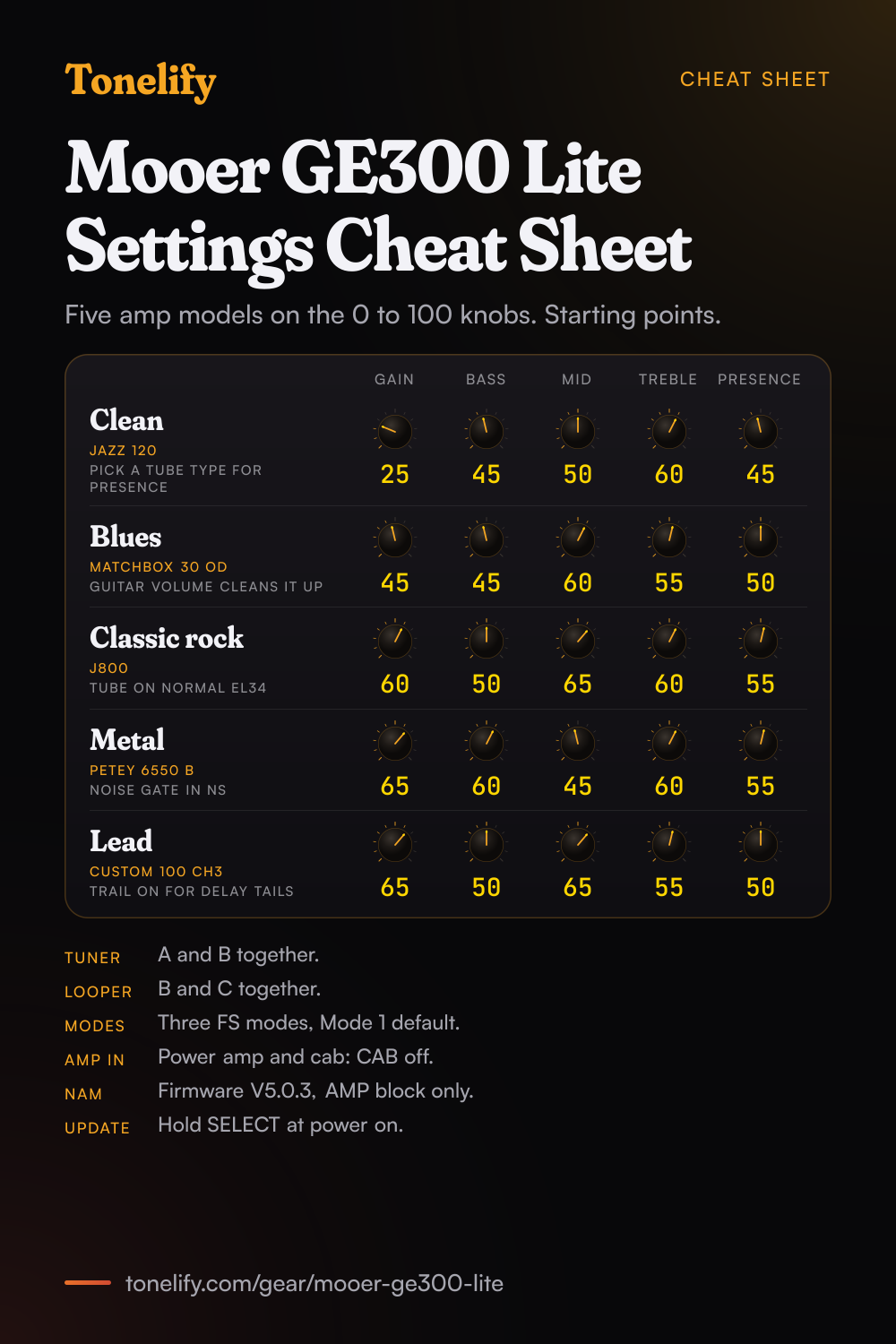
Free download
Printable cheat sheet: PDF and PNG
The clean, blues, classic rock, metal and lead settings from this page, together on one sheet with short tips. The PDF prints on white; the PNG is the dark version for your phone.
Starting settings on the Mooer GE300 Lite
Values as the unit's screen shows them, on its own scale; each drawn knob shows that value's share of the range. They are where to begin, not Mooer's numbers: pick the amp model first, then move one control at a time from here.
Clean
Jazz 120, slot 102 in the AMP block, which Mooer bases on the Roland JC-120. Gain 25, Bass 45, Mid 50, Treble 60, Presence 45. Presence and Bias are power amp controls, so they work only with a Tube type picked; Tube set to OFF bypasses the power amp modelling. Pair it with the Jazz 212 cab, Mooer's JC120 212, and add chorus from FXB for the classic JC sound.
- Gain 25
- Bass 45
- Mid 50
- Treble 60
- Presence 45
Pick a Tube type for Presence.
Edge of breakup and blues
Matchbox 30 OD, the overdrive channel of a Matchless C30, slot 95. Gain 45, Bass 45, Mid 60, Treble 55, Presence 50. Turn the guitar's volume down and it cleans up; turn it up for the solo. Regal Tone Od1, the Tweed channel of a Tone King Falcon, and US Blues OD, the overdrive channel of a Fender Blues Deluxe, are the other low gain choices.
- Gain 45
- Bass 45
- Mid 60
- Treble 55
- Presence 50
Classic rock
J800, Mooer's model of the Marshall JCM 800, slot 10, with the 1960 412 cab. Gain 60, Bass 50, Mid 65, Treble 60, Presence 55, with Tube on Normal EL34. Keep the mids up: rock guitar sits in the midrange. For more push, put Jimmy OD, Mooer's Paul Cochrane Timmy, in DS/OD in front of it.
- Gain 60
- Bass 50
- Mid 65
- Treble 60
- Presence 55
Metal
Petey 6550 B, the Rhythm channel of a Peavey 6505+, slot 59, with the Petey 412 cab, Mooer's Peavey 6505 412. Gain 65, Bass 60, Mid 45, Treble 60, Presence 55. In the NS block, Noise Gate is Mooer's studio gate with full controls, Noise Killer the hardest gate and Intel Reducer a background noise reducer. If it fizzes, lower Gain before Treble.
- Gain 65
- Bass 60
- Mid 45
- Treble 60
- Presence 55
Noise Gate in the NS block.
Lead
Custom 100 Ch3, the lead channel of a Custom Audio Amplifiers PT100, slot 85. Gain 65, Bass 50, Mid 65, Treble 55, Presence 50, with an Analog delay from the DELAY block at a low mix. Turn Trail on and the delay and reverb tails ring on when you change presets or switch them off; Trail moves those effects to the end of the chain.
- Gain 65
- Bass 50
- Mid 65
- Treble 55
- Presence 50
Trail on for the delay tails.
Chasing one song? Name it and the matcher writes that song's settings for the Mooer GE300 Lite.
Mooer GE300 Lite amp models
The AMP block's 108 models, by slot, with the amp Mooer bases each one on: 105 amp channels and three acoustic guitar simulators. Every model has Gain, Bass, Mid and Treble, a Mode switch (Original, or Distinct, which trims lows and highs before the preamp and scoops the upper mids after it), a Tube choice for the power amp, Presence and Bias for that power amp, Preamp Out and Master.
| Slot | Model | Based on |
|---|---|---|
| 1 | US Blues JR | Fender Blues Junior |
| 2 | 65 US DX | Fender 65 Deluxe Reverb |
| 3 | 65 US TW | Fender 65 Twin Reverb |
| 4 | US Sonic | Fender Super Sonic |
| 5 | US Blues CL | Fender Blues Deluxe (clean channel) |
| 6 | US Blues OD | Fender Blues Deluxe (overdrive channel) |
| 7 | 59 US BASS | Fender 59 Bassman |
| 8 | UK30 CL | VOX AC30 (clean channel) |
| 9 | UK30 OD | VOX AC30 (overdrive channel) |
| 10 | J800 | Marshall JCM 800 |
| 11 | J900 | Marshall JCM 900 |
| 12 | PLX 100 | Marshall Plexi 100 |
| 13 | J2525 Ch1 | Marshall JCM2525 (clean channel) |
| 14 | J2525 Ch2 | Marshall JCM2525 (lead channel) |
| 15 | J410 CL | Marshall JVM410 (green channel) |
| 16 | J410 DS | Marshall JVM410 (red channel) |
| 17 | US Gold 100 CL | Friedman BE100 (clean channel) |
| 18 | US Gold 100 DS | Friedman BE100 (distortion channel) |
| 19 | US Gold 50A | Friedman Smallbox 50 (clean channel) |
| 20 | US Gold 50B | Friedman Smallbox 50 (distortion channel) |
| 21 | Cali LS CH1 | Mesa/Boogie Lonestar (clean channel) |
| 22 | Cali LS Ch2 | Mesa/Boogie Lonestar (overdrive channel) |
| 23 | Cali Dual 1 | Mesa/Boogie Dual Rectifier (clean channel) |
| 24 | Cali Dual 2 | Mesa/Boogie Dual Rectifier (distortion channel) |
| 25 | TRI REC CL | Mesa/Boogie Triple Rectifier (clean channel) |
| 26 | TRI REC DS | Mesa/Boogie Triple Rectifier (distortion channel) |
| 27 | MARKIII CL | Mesa/Boogie Mark III (clean channel) |
| 28 | MARKIII DS | Mesa/Boogie Mark III (distortion channel) |
| 29 | Cali MK4 A | Mesa/Boogie Mark IV (Rhythm 1 channel) |
| 30 | Cali MK4 B | Mesa/Boogie Mark IV (Rhythm 2 channel) |
| 31 | Cali MK4 C | Mesa/Boogie Mark IV (lead channel) |
| 32 | MARKV CL | Mesa/Boogie Mark V (clean channel) |
| 33 | MARKV DS | Mesa/Boogie Mark V (drive channel) |
| 34 | Cali JP A | Mesa/Boogie JP2C (clean channel) |
| 35 | Cali JP B | Mesa/Boogie JP2C (crunch channel) |
| 36 | Cali JP C | Mesa/Boogie JP2C (distortion channel) |
| 37 | Eagle FB Ch1 | ENGL Fireball 100 (clean channel) |
| 38 | Eagle FB Ch2 | ENGL Fireball 100 (distortion channel) |
| 39 | Powerbell CL | ENGL E645 (clean channel) |
| 40 | Powerbell DS | ENGL E645 (distortion channel) |
| 41 | Blacknight CL | ENGL E650 Blackmore Signature (clean channel) |
| 42 | Blacknight DS | ENGL E650 Blackmore Signature (distortion channel) |
| 43 | Eagle 670 CL | ENGL E670 (clean channel) |
| 44 | Eagle 670 CR | ENGL E670 (crunch channel) |
| 45 | Eagle 670 L1 | ENGL E670 Lead (channel 1) |
| 46 | Eagle 670 L2 | ENGL E670 Lead (channel 2) |
| 47 | Satsuma TH200A | Orange Thunderverb 200 (clean channel) |
| 48 | Satsuma TH200B | Orange Thunderverb 200 (distortion channel) |
| 49 | Satsuma TH30A | Orange TH30 (clean channel) |
| 50 | Satsuma TH30B | Orange TH30 (distortion channel) |
| 51 | Rock Vrb CL | Orange Rockerverb (clean channel) |
| 52 | Rock Vrb DS | Orange Rockerverb (distortion channel) |
| 53 | Citrus 30 | Orange Ad30 |
| 54 | EV 5050 CL | EVH 5150 (clean channel) |
| 55 | EV 5050 DS | EVH 5150 (distortion channel) |
| 56 | PV 5050 CL | Peavey 5150 (clean channel) |
| 57 | PV 5050 DS | Peavey 5150 (Rhythm channel) |
| 58 | Petey 6550 A | Peavey 6505+ (clean channel) |
| 59 | Petey 6550 B | Peavey 6505+ (Rhythm channel) |
| 60 | Petey Satch CL | Peavey JSX (clean channel) |
| 61 | Petey Satch CR | Peavey JSX (crunch channel) |
| 62 | Petey Satch UL | Peavey JSX (Ultra channel) |
| 63 | Herby Ch1 | Diezel Herbert (channel 1) |
| 64 | Herby Ch2 | Diezel Herbert (channel 2) |
| 65 | Herby Ch3 | Diezel Herbert (channel 3) |
| 66 | VHS Ch1 | Diezel VH4 (channel 1) |
| 67 | VHS Ch2 | Diezel VH4 (channel 2) |
| 68 | VHS Ch3 | Diezel VH4 (channel 3) |
| 69 | VHS Ch4 | Diezel VH4 (channel 4) |
| 70 | Hugen CL | Diezel Hagen (clean channel) |
| 71 | Hugen OD | Diezel Hagen (overdrive channel) |
| 72 | Hugen DS | Diezel Hagen (distortion channel) |
| 73 | Randy Devil CL | Randall Satan (clean channel) |
| 74 | Randy Devil DS | Randall Satan (distortion channel) |
| 75 | SLOW 100 CR | Soldano SLO-100 (crunch channel) |
| 76 | SLOW 100 DS | Soldano SLO-100 (distortion channel) |
| 77 | JET 100H CL | Jet City JCA100H (clean channel) |
| 78 | JET 100H OD | Jet City JCA 100H (overdrive channel) |
| 79 | Koche OD | Koch Powertone (overdrive channel) |
| 80 | Koche DS | Koch Powertone (distortion channel) |
| 81 | Blueno UG 30A | Bruno Underground 30 (low gain) |
| 82 | Blueno UG 30B | Bruno Underground 30 (overdrive) |
| 83 | Custom 100 Ch1 | Custom Audio Amplifiers PT100 (clean channel) |
| 84 | Custom 100 Ch2 | Custom Audio Amplifiers PT100 (overdrive channel) |
| 85 | Custom 100 Ch3 | Custom Audio Amplifiers PT100 (lead channel) |
| 86 | Mr. Smith CL | PRS ARCHON (clean channel) |
| 87 | Mr. Smith DS | PRS ARCHON (distortion channel) |
| 88 | Taxidea Taxus A | Suhr Badger 30 (low gain) |
| 89 | Taxidea Taxus B | Suhr Badger 30 (high gain) |
| 90 | Shittcow GR | VHT Pittbull (green channel) |
| 91 | Shittcow RD | VHT Pittbull (red channel) |
| 92 | Doctor3 A | DR.Z MAZ 38 (low gain) |
| 93 | Doctor3 B | DR.Z MAZ 38 (high gain) |
| 94 | Matchbox 30 CL | Matchless C30 (clean channel) |
| 95 | Matchbox 30 OD | Matchless C30 (overdrive channel) |
| 96 | Regal Tone CL | Tone King Falcon (Rhythm channel) |
| 97 | Regal Tone Od1 | Tone King Falcon (Tweed channel) |
| 98 | Regal Tone Od2 | Tone King Falcon (lead channel) |
| 99 | Carol CL | Two Rock Coral (clean channel) |
| 100 | Carol OD | Two Rock Coral (overdrive channel) |
| 101 | Cardeff | Two Rock Cardeff |
| 102 | Jazz 120 | Roland JC-120 |
| 103 | HWT 103 | Hiwatt DR-103 |
| 104 | HT Club CL | Blackstar HT Stage 100 (clean channel) |
| 105 | HT Club DS | Blackstar HT Stage 100 (distortion channel) |
| 106 | Acoustic 1 | Acoustic guitar simulator 1 |
| 107 | Acoustic 2 | Acoustic guitar simulator 2 |
| 108 | Acoustic 3 | Acoustic guitar simulator 3 |
Mooer GE300 Lite cabinets
The CAB block's 43 factory cabinets. Each has two microphones with their own type, Center and Distance, a Mic 1 and Mic 2 balance, Low cut, High cut and Early Reflection. The 21 mic types are SM57, SM7A, U47, U87, M143, M147, KM184, NT1, NT2, NTV, MD421, MD441, E609, E835, MXL2001, MXL2003, C3000, C4000B, C414, D112 and C535. Slots after 43 hold third-party IRs.
| Slot | Cabinet | Based on |
|---|---|---|
| 1 | US DLX 112 | Fender 65 Deluxe Reverb 112 |
| 2 | US TWN 212 | Fender 65 Twin Reverb 212 |
| 3 | US Bass 410 | Fender 59 Bassman 410 |
| 4 | Sonic 112 | Fender Super Sonic 112 |
| 5 | Blues 112 | Fender Blues Deluxe 112 |
| 6 | 1960 412 | Marshall 1960A 412 |
| 7 | Eagle P412 | ENGL Pro XXL 412 |
| 8 | Eagle S412 | ENGL Vintage XXL 412 |
| 9 | Mark 112 | Mesa/Boogie Mark 112 |
| 10 | Rec 412 | Mesa/Boogie Rectifier Standard 412 |
| 11 | Citrus 412 | Orange PPC 412 |
| 12 | Citrus 212 | Orange PPC 212 |
| 13 | Slow 412 | Soldano Slo 412 |
| 14 | DR.ZEE 112 | DR.Z MAZ 112 |
| 15 | DR.ZEE 212 | DR.Z Z-Wreck 212 |
| 16 | Jazz 212 | Roland JC120 212 |
| 17 | UK 212 | VOX AC30 212 |
| 18 | HWT 412 | Hiwatt Ap412 |
| 19 | PV 5050 412 | Peavey 5150 412 |
| 20 | Regal Tone 110 | Tone King Falcon 110 |
| 21 | Two Stones 212 | Two Rock 212 |
| 22 | Cardeff 112 | Two Rock 112 |
| 23 | EV 5050 412 | EVH 5150 412 |
| 24 | HT 412 | Blackstar HTV 412 |
| 25 | Gas Station 412 | Diezel Hagen 412 |
| 26 | Blueno 212 | Bruno 212 Football |
| 27 | Custom 212 | Custom Audio 212 |
| 28 | Herby 412 | Diezel RV412 |
| 29 | VHS 412 | Diezel Fv412 |
| 30 | Doctor3 112 | DR.Z MAZ38 112 |
| 31 | US Gold 412 | Friedman 412 |
| 32 | US Gold 112 | Friedman Small Box 112 |
| 33 | Matchbox 30 112 | Matchless 112 |
| 34 | Cali 412-1 | Mesa/Boogie Recto Trad |
| 35 | Cali 412-2 | Mesa/Boogie RoadKing 412 |
| 36 | Satsuma 212 | Orange PPC 212 |
| 37 | Petey 412 | Peavey 6505 412 |
| 38 | Petey 212 | Peavey JSX 212 |
| 39 | Mr Smith 112 | PRS Archon 212 |
| 40 | Randy Devil 412 | Randall RD412 |
| 41 | Taxidea Taxus 112 | Suhr 112 |
| 42 | Shittcow 412 | VHT 412 |
| 43 | Acoustic 112 | No cabinet named |
GE300 Lite firmware updates
What Mooer's GE300 Lite downloads page lists for each update, newest first. Every one from V2.0.2 on resets the unit, so back up your presets with the editor first; to enter update mode, hold SELECT while you power on.
| Firmware | What it added |
|---|---|
| V5.0.3, 4 August 2026 | Neural Amp Modeler (NAM) A1 and A2 models, converted on loading, into the AMP block only |
| V5.0.2, 5 January 2026 | Four drives (ROD881, RED AT, ODR1, BE OD), Noise Reducer, Auto Pan, Stereo Enhancer, Stereo Rotary, Doubling, Studio Delay, Morph PingPong, three reverbs, all delays in stereo, 80 amp file slots and 50 IR slots, dual IRs, PATCH LEVEL, tuner reference 430 to 450 Hz, new screens |
| V3.0.1 | Intelligent Harmony in FXA, 60's Vibe in FXB, names on CTRL footswitches |
| V2.0.2 | GNR and GIR files from GE Labs and MOOER Studio, 50 amp file slots, a third footswitch mode, new mic models, PARA PREF menu |
Mooer GE300 Lite specifications
The manual's specification table, with its connections from the rear panel page.
| GE300 Lite | |
|---|---|
| Presets | 255, in banks of three (A, B, C) |
| Screen | 5 inch LCD, 854 x 480 |
| Input | 1/4 inch, Guitar 1 MΩ or Line 10 kΩ, with a Guitar/Line switch |
| Outputs | Two 1/4 inch, 470 Ω; two balanced XLR, 300 Ω, with ground lift |
| Headphones | 1/4 inch stereo, 16 Ω |
| Effects loop | One mono send (100 Ω) and return (1 MΩ) |
| AUX IN | 3.5 mm stereo, 10 kΩ |
| Expression | Two 1/4 inch TRS jacks, EXP1 and EXP2, 10 to 100 kΩ |
| MIDI | MIDI IN and OUT, 5-pin |
| USB | USB-B, USB 2.0 audio, 2 in 2 out, 44.1 kHz, 24 bit |
| IR files | WAV, 44.1 kHz, 24 bit, 2048 points |
| Converters | 44.1 kHz, 24 bit, 114 dB dynamic range |
| Power | 9 V DC, 2 A, centre negative |
| Size | 287 x 208 x 64 mm |
| Weight | 2.1 kg |
Mooer GE300 Lite specifications
- Released
- 2020
Mooer GE300 Lite questions
What is the Mooer GE300 Lite?
A smaller version of Mooer's GE300 floor modeller, announced in June 2020 at $549. It has 108 amp models built with Mooer's non-linear modelling, 43 cabinets, an IR loader, 164 effects, Tone Capture, a 5 inch screen, eight footswitches and 255 presets. It measures 287 by 208 by 64 mm and weighs 2.1 kg.
What is the difference between the GE300 Lite and the GE300?
Guitar World's launch news said most of the GE300's amps and effects crossed over, but not its Synth Engine. The Lite's manual gives it one mono effects loop, a single MIDI port and 255 presets in banks of three. Our Mooer GE300 page covers the full size unit, with its stereo loop and synth.
What amps are in the Mooer GE300 Lite?
108 models: 105 amp channels and three acoustic guitar simulators. Mooer bases them on Fender, VOX, Marshall, Friedman, Mesa/Boogie, ENGL, Orange, EVH, Peavey, Diezel, Randall, Soldano, Jet City, Koch, Bruno, Custom Audio Amplifiers, PRS, Suhr, VHT, DR.Z, Matchless, Tone King, Two Rock, Roland, Hiwatt and Blackstar amps. The full list by slot is below.
What do the amp controls do on the GE300 Lite?
Gain sets the input level and the preamp drive; Bass, Mid and Treble shape the tone. Mode is Original or Distinct, which trims lows and highs before the preamp and scoops the upper mids after it. Tube picks the power amp, from Normal EL34 to JJ EL84, or OFF to bypass it; Presence and Bias belong to that power amp. Preamp Out and Master set the levels.
How many cabinets and mics does the GE300 Lite have?
43 factory cabinets, each with two microphones you can set apart: type, Center and Distance, plus a Mic 1 and Mic 2 balance, Low cut, High cut and Early Reflection. There are 21 mic types, modelled on mics such as the Shure SM57 and SM7A, Neumann U47 and U87, Sennheiser MD421 and AKG C414.
Can the GE300 Lite load IRs?
Yes, WAV files at 44.1 kHz and 24 bits, 2048 points, loaded through the editor over USB. The manual gives the CAB block 20 free slots for third-party IRs; firmware V5.0.2 of January 2026 raised that to 50 and added dual IRs, loaded left and right separately or blended. With an IR in place, the mic controls go, but High and Low cut and Early Reflection stay.
Can the Mooer GE300 Lite load NAM captures?
Yes, since firmware V5.0.3 of 4 August 2026. Neural Amp Modeler A1 and A2 model files go through a built-in converter when they load, and only into the AMP block. It also loads Mooer's own MNRS files: GNR for amps and GIR for cabs, made in the free GE Labs app or downloaded from MOOER Studio, with 80 amp file slots since V5.0.2.
What is Tone Capture on the GE300 Lite?
Mooer's learning and comparison engine, with three modes. GUIT samples guitars so yours sounds like another; AMP & STOMP samples your drives, distortions and amps; IR creates cabinet impulse responses. After a capture, Low, Mid, High and Output adjust it.
How many presets does the GE300 Lite hold?
255, in banks of three, A, B and C, chosen with the A, B and C footswitches or the SELECT knob, with BANK UP and BANK DOWN for the banks. Over MIDI they run from 1A to 85C, in MIDI banks 0 and 1.
What are the GE300 Lite footswitch modes?
Three, set in FS MODE; Mode 1 is the default. Mode 1 gives three CTRL switches on top and presets A, B and C below. Mode 2 makes all six CTRL switches. Mode 3 makes all six presets, and pressing the current preset's switch again turns them into CTRL switches. A CTRL switch can turn up to 7 blocks on or off, tap tempo, open the tuner or looper, mute, or switch an amp channel from EXP 2.
How do you open the tuner and looper on the GE300 Lite?
Press A and B together for the tuner, and B and C together for the looper. The tuner mutes or passes the sound and is calibrated at A 440 Hz; V5.0.2 widened its range to 430 to 450 Hz. In the looper, A records, plays and overdubs, B plays once, C stops and, held, clears, and CTRL 1 to 3 run undo, reverse and half speed.
How long is the looper on the GE300 Lite?
30 seconds of stereo loop, by the feature list in Mooer's manual and Guitar World's launch news; the looper page of the same manual says 30 minutes. The loop keeps playing while you edit or change presets and stays saved after you power off.
What inputs and outputs does the GE300 Lite have?
A guitar input with a Guitar/Line switch, two 1/4 inch outputs, two balanced XLR outputs with ground lift, a 1/4 inch stereo headphone output, a mono effects loop, a 3.5 mm AUX IN, two expression pedal jacks, MIDI in and out, and USB-B for USB audio, 2 in and 2 out at 44.1 kHz and 24 bits.
How do you use the GE300 Lite with a guitar amp?
Mooer's recommended setups: with a power amp and a guitar cabinet, turn the CAB block off. Sending the XLR outputs to a full range PA and the 1/4 inch output to a power amp and cabinet at once, put CAB last in the chain with OUTPUT before it.
What power supply does the GE300 Lite need?
9 V DC at 2 A, centre negative, and Mooer recommends the supply in the box. There is no battery.
What are the best Mooer GE300 Lite settings for metal?
Start with Petey 6550 B, the Peavey 6505+ Rhythm channel: Gain 65, Bass 60, Mid 45, Treble 60, Presence 55, with Noise Gate in the NS block and the Petey 412 cab. These are starting points rather than Mooer's numbers; if it fizzes, lower Gain first.
How do you build a patch on the Mooer GE300 Lite?
Pick the amp model first, then set its controls, then add the blocks in signal-chain order: drive before the amp, time and modulation after it. A patch built the other way around ends up compensating for the wrong stage. Tonelify returns the model, the order and the parameters together.
Does Tonelify support the Mooer GE300 Lite?
Yes. Name it in the tone matcher along with the song you are chasing and the settings come back adapted to it. Gear does not need to be in the catalog for a match to run.
Sources
Panel, specifications and dates checked against these on .
More Mooer gear
Similar multi-effects units from other makers
Settings for the song you are chasing
Name a song and Tonelify reads the documented rig behind the recording, then writes the settings for a rig with the Mooer GE300 Lite in it. A first plan starts with 7 days free, $0 today.