
NUX MG-300 presets and settings
Compact floor unit with two footswitches and a built-in expression pedal. 24 amp models, 24 cabinets and 4 microphones in the manual's tables, third-party IR loading, a 60 second looper, 56 drum beats and USB recording.
⚡ Match a tone on this gearHow do you dial in a specific tone on a NUX MG-300?
A multi-effects unit gives you the whole chain in one box, which means the order of the blocks is as much of the answer as the values inside them. Settings for the NUX MG-300 name the amp model, the block order and the parameters together, rather than handing you numbers with no chain to put them in.
Name the song you are chasing in the tone matcher and Tonelify returns the settings for this exact multi-effects unit, not the settings the original artist used. Those are two different things: the recording was made on gear most players do not own.
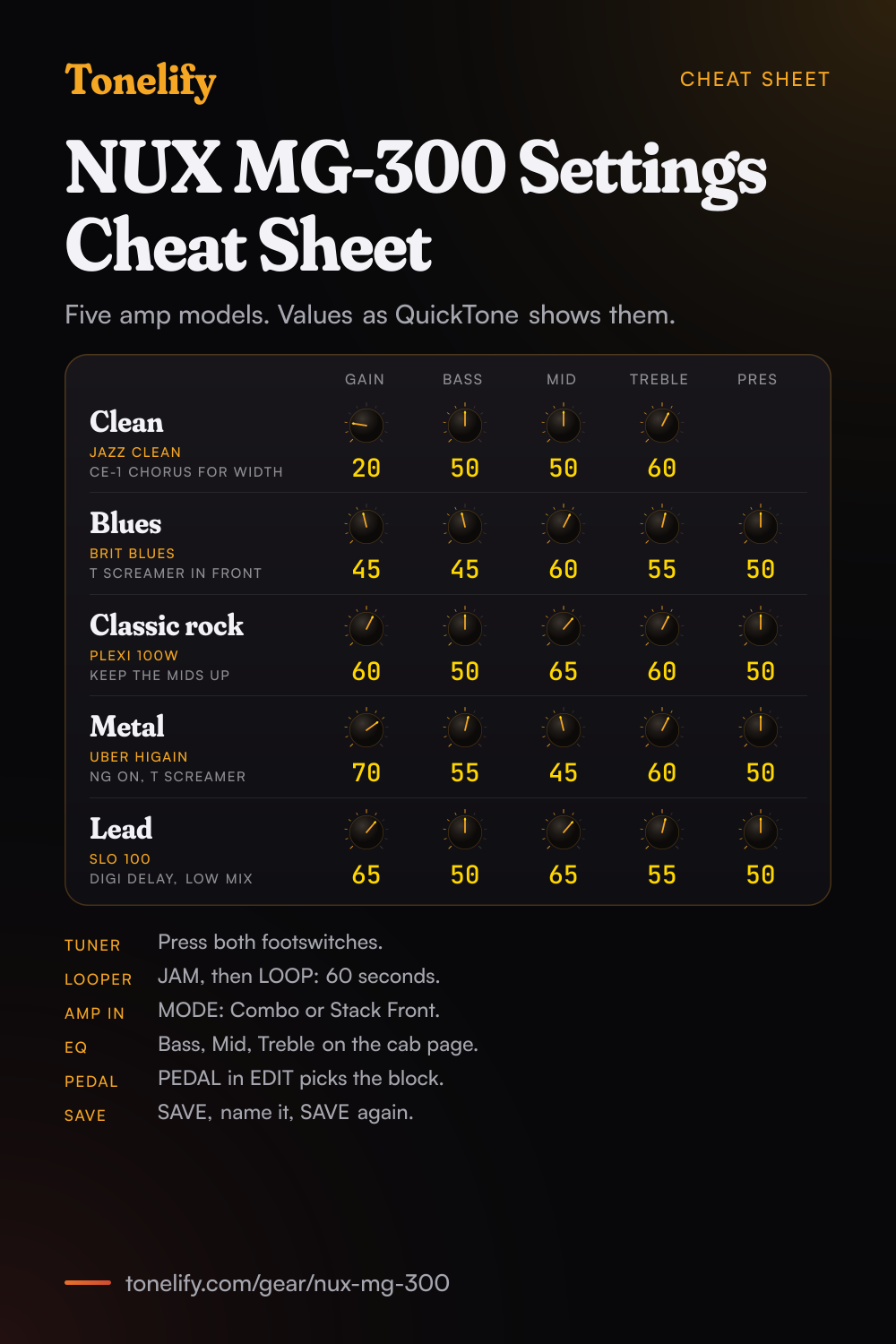
Free download
Printable cheat sheet: PDF and PNG
The clean, blues, classic rock, metal and lead settings from this page, together on one sheet with short tips. The PDF prints on white; the PNG is the dark version for your phone.
Starting settings on the NUX MG-300
Values as the NUX QuickTone app shows them, on the unit's own scale; each drawn knob shows that value's share of the range. They are where to begin, not NUX's numbers: pick the amp model first, then move one control at a time from here.
Clean
JAZZ CLEAN, first in the manual's AMP LIST. Gain 20, Bass 50, Mid 50, Treble 60. On the unit, the AMP page sets Gain with the GAIN knob, Presence with LEVEL and the amp's Level with MASTER, while Bass, Middle and Treble sit on the SPEAKER CABINET page on the same three knobs. Use the amp's Level to balance this preset against your others. For width, CE-1 CHORUS in the MOD block sets Depth and Rate on its first page and Mix and Pre-Post on its second; MASTER turns the page.
- Gain 20
- Bass 50
- Mid 50
- Treble 60
Edge of breakup and blues
BRIT BLUES, 21st in the manual's AMP LIST. Gain 45, Bass 45, Mid 60, Treble 55, Pres 50. For a pedal in front, T SCREAMER, BLUES DRIVE and MORNING DRIVE in the EFX block each put Level on the GAIN knob, Tone on LEVEL and Drive on MASTER: keep Drive low and Level up to push the amp rather than replace its grit.
- Gain 45
- Bass 45
- Mid 60
- Treble 55
- Pres 50
Classic rock
PLEXI 100W, ninth in the AMP LIST. Gain 60, Bass 50, Mid 65, Treble 60, Pres 50. Keep the mids up: rock guitar sits in the midrange, and scooping it is the usual reason a preset sounds thin next to a band. PLEXI 45, BRIT 800 and 1987X 50W follow it in the AMP LIST.
- Gain 60
- Bass 50
- Mid 65
- Treble 60
- Pres 50
Metal
UBER HIGAIN, last in the AMP LIST. Gain 70, Bass 55, Mid 45, Treble 60, Pres 50. Turn on the NG block, where GAIN sets the Threshold and LEVEL the Decay. For tighter palm mutes, put T SCREAMER in EFX with its Drive, on the MASTER knob, low, and take the amp's Gain down a step. DUAL RECT and DIE VH4 are the next models to try.
- Gain 70
- Bass 55
- Mid 45
- Treble 60
- Pres 50
Add T SCREAMER in EFX before you raise the Gain.
Lead
SLO 100, 13th in the AMP LIST. Gain 65, Bass 50, Mid 65, Treble 55, Pres 50, with DIGI DELAY in the DLY block at a low Mix. Its first page sets Time and Feedback, the second Mix and Pre-Post and the third Sub-Division, with MASTER turning the page, and the TAP button sets the delay time by tapping. In EDIT mode the PEDAL button can hand the expression pedal to the DLY block, where it controls the delay's Mix.
- Gain 65
- Bass 50
- Mid 65
- Treble 55
- Pres 50
DIGI DELAY in DLY, Mix low.
NUX MG-300 amp list
The manual's AMP LIST has 24 models. NUX does not say which amps they are modelled on, in the manual or on its product page, so they are given here by name only, in the manual's order. NUX's product page counts 25 cabinet IRs and Bonedo's review counts 25 amps and 25 cabinets in one paragraph and 24 amps in another; the list here is the manual's.
- AMP LIST (24)
- JAZZ CLEAN, DELUXE RVB, BASS MATE, TWEEDY, TWIN RVB, HIWIRE, CLASS A 15, CLASS A 30, PLEXI 100W, PLEXI 45, BRIT 800, 1987X 50W, SLO 100, FRIEDMAN, DUAL RECT, DIE VH4, VIBRO KING, BUDDA, MR Z 38, SUPER RVB, BRIT BLUES, MATCH D30, BRIT 2000, UBER HIGAIN
NUX MG-300 cab list
24 speaker cabinets in the manual's SPEAKER CABINET LIST, picked separately from the amp: the manual says you can make your own combination. The cabinet page also holds the amp's Bass, Middle and Treble, on the GAIN, LEVEL and MASTER knobs. Third-party IRs load through NUX's QuickTone software.
- SPEAKER CABINET LIST (24)
- JAZZ 212, BLACK 112, TWEED 410, TWEED 112, TWIN 212, CUSTOM 412, BLUE 112, BLUE 212, GREEN 412, G12L 412, T75 412, V30 412, SLO 412, HBE 412, RECT 412, BOTM 412, VIBRO 212, EVL 112, BUTQ 212, SUPER 212, BRIT 212, DC 212, G12M 412, UBER 412
NUX MG-300 mic list
Four microphones for the cabinet, each in one of three positions, which the GAIN, LEVEL and MASTER knobs set on the MIC page.
- MICROPHONE LIST (4)
- DYNAMIC E906, DYNAMIC SM57, CONDENSER U87, CONDENSER C414
- Microphone positions (3)
- Edge, Middle, Center
NUX MG-300 effects list
The manual's effects tables, block by block, in the order they print. The delay table gives the name ANALOG DELAY to three entries with different controls, so those are marked by their place in the table. The expression pedal can also run a WAH, which has no table of its own.
- COMPRESSION (1)
- Compressor (Gain sets the output level, Level the sensitivity)
- EFX: drive effects and pitch shifter (14)
- DIST+, RC BST, AC BST, DIST ONE, T SCREAMER, BLUES DRIVE, MORNING DRIVE, MODERN DISTORTION, REDIRT, CRUNCH, TUBE DR, RED FUZZ, MUFF DIST, PITCH BENDER
- EQ (1)
- 6-band EQ at 100 Hz, 200 Hz, 400 Hz, 800 Hz, 1.6 kHz and 3.2 kHz
- NG (1)
- Noise gate (Threshold and Decay)
- MOD (11)
- CE-1 CHORUS, ST CHORUS, FLANGE, FLANGER, PH90 PHASER, PH100 PHASER, CHORUS +, U-VIBE, TREMOLO, ROTARY SPEAKER, EH CHORUS
- DLY (8)
- ANALOG DELAY (first in the table), MEMORY GUY, DIGI DELAY, MOD DELAY, TAPE ECHO, REVERSE DELAY, ANALOG DELAY (seventh), ANALOG DELAY (eighth, with Width)
- RVB (4)
- ROOM REVERB, HALL REVERB, PLATE REVERB, SPRING REVERB
NUX MG-300 specifications
- Released
- 2020
NUX MG-300 questions
What amps are in the NUX MG-300?
The manual's AMP LIST has 24: JAZZ CLEAN, DELUXE RVB, BASS MATE, TWEEDY, TWIN RVB, HIWIRE, CLASS A 15, CLASS A 30, PLEXI 100W, PLEXI 45, BRIT 800, 1987X 50W, SLO 100, FRIEDMAN, DUAL RECT, DIE VH4, VIBRO KING, BUDDA, MR Z 38, SUPER RVB, BRIT BLUES, MATCH D30, BRIT 2000 and UBER HIGAIN. NUX does not say which amps they are modelled on, so this page gives the names only. NUX's product page counts 25 built-in cabinet IRs against the manual's 24 cabinets, and Bonedo's 2020 review gives both 24 and 25 amps. The full lists are below.
How many effects does the NUX MG-300 have?
Besides 24 amps, 24 cabinets and 4 microphones, the manual's tables list a compressor, 14 EFX (13 drives and the PITCH BENDER), a 6-band EQ, a noise gate, 11 modulation effects, 8 delays and 4 reverbs, and the expression pedal adds a wah. Bonedo's review counted a wah, a compressor, 11 drives plus the pitch shifter, 13 modulation effects, 6 delays and 4 reverbs, so the totals differ by source.
How do you build a tone on the MG-300?
The manual's signal path runs CMP, EFX, AMP, EQ, NG, MOD, DLY and RVB, and the AMP block holds the amp, the speaker cabinet and the microphone. Press EDIT/EXIT, move along the chain with the GROUP MODULE buttons, choose a model or turn the block off with SELECT, and set it with GAIN, LEVEL and MASTER; where a block shows PGE, MASTER turns to its next page. Bonedo's review adds that the order of the blocks can be changed.
How do you use the MG-300 with a guitar amp?
Press MODE and pick one of five output modes with SELECT: Studio Direct for a mixer, active speakers or an audio interface, Combo Front for the front input of a combo, Combo Rear for a combo's FX loop return, and Stack Front and Stack Rear for the same on a head. Bonedo's review found that Combo Front or Stack Front bypasses the speaker simulation, which is how you play through a real amp and cabinet; there is no global switch for it.
What do the MG-300's footswitches do?
There are two. In preset mode they step down and up through the presets, and pressing both together opens the chromatic tuner. In JAM mode the up switch starts and stops the drums and the down switch runs the looper. The SELECT knob also steps through presets, and the GROUP MODULE buttons jump from bank to bank.
How long is the looper on the MG-300?
60 seconds. Press JAM, then use the LOOP footswitch: one press records, the next plays and the next overdubs; holding it for a second undoes the last overdub and holding again redoes it; two presses stop the loop, and pressing and holding once it has stopped clears it. NUX says the looper fits the phrase to the drum tempo.
Does the MG-300 have a drum machine?
Yes, with 56 beats: seven in each of eight styles, which are Rock, Country, Blues, Metal, Funk, Jazz, Ballad and Pop, plus a metronome with seven sounds. In JAM mode SELECT sets the tempo from 40 to 240 bpm, GAIN picks the beat, LEVEL sets the drum volume and MASTER the loop volume, and the GROUP MODULE buttons choose the style.
What can the MG-300's expression pedal control?
Volume, or one block, chosen by pressing PEDAL in EDIT mode: WAH runs the wah filter, EFX the drive's GAIN or the PITCH BENDER's pitch, AMP the amp's Level, and MOD, DLY and RVB their Mix. Bonedo's review describes the second function as switched by pressing the pedal down at the toe. To calibrate it, hold EDIT/EXIT and SAVE for 3 seconds to open the SYSTEM MENU, go to PEDAL and press EDIT.
Can you load IRs into the MG-300?
Yes, through NUX's QuickTone software. NUX gives the IR resolution as 512 samples and the format as 48 kHz WAV; Bonedo's review found 44.1 kHz files loaded too. There is one user IR slot, and it belongs to the preset, so each preset can hold its own IR.
Can the MG-300 record to a computer?
Yes. Over the micro B USB port it works as an audio interface with a re-amp function, routed in QuickTone. Bonedo's review lists standard, re-amp and dry and wet setups, and found it worked on a PC without an extra ASIO driver, at 48 kHz with two outputs. NUX publishes ASIO driver V3.29.0 for Windows 7 and V5.30.0 for Windows 10 and later, and its 2020 page suggested a buffer of 128 samples.
What firmware is the NUX MG-300 on?
NUX's MG-300 page lists firmware V4.02.23 for Windows and macOS, beside QuickTone V2.4.12.27. NUX warns that this firmware is only for the global version: on the domestic version, sold only in mainland China, updating may cause a malfunction or damage. In 2020 the page listed V1.0.6.19, dated 19 June 2020.
How do you update the MG-300's firmware?
NUX's update guide: download the update kit, connect the MG-300 to the computer with a micro USB cable and run the NUX DFU Updater. Hold down both footswitches while you plug in the 9V supply and let go once the pedal shows as connected; both LEDs blink. Select the .bin file, click Start Update and do not unplug the USB cable or the power until it finishes, then close the updater and unplug both.
What inputs and outputs does the MG-300 have?
A 1/4 inch mono instrument input, a 1/4 inch main output marked OUTPUT and PHONES, a 1/8 inch stereo AUX IN for a music player, micro B USB and a 9V DC jack. The supply in the box is 9V, negative tip by the manual. The manual says the pedal powers on with a cable in the input, and asks you to unplug the input and the power when you stop playing. It measures 230 by 160 by 58 mm and weighs 754 g.
How do presets and saving work on the MG-300?
Presets are numbered by bank and letter, such as 1A, 1B and 9A. Bonedo's review counts two sets of nine banks of four presets, 72 in all, laid out as user and factory presets. To save, press SAVE, name the preset with SELECT for each letter and the GROUP MODULE buttons to move along, and press SAVE again; the manual asks you to save before you change preset.
When did the NUX MG-300 come out, and is the MKII the same?
NUX's MG-300 page was up by August 2020 with firmware dated 19 June 2020, and Bonedo reviewed it in October 2020 at a shop price of 129 euros. The MG-300 MKII is a separate unit with its own manual, firmware and editor: its manual lists 25 amp models and ten blocks, including a Patch Level block, and NUX's page adds three scenes per preset, 36 built-in IRs, 24 user IR slots and USB-C. This page covers the original MG-300.
What are the best NUX MG-300 settings for metal?
Start with UBER HIGAIN, Gain 70, Bass 55, Mid 45, Treble 60 and Pres 50, with the NG block on and T SCREAMER in EFX. These are starting points rather than NUX's numbers. If it fizzes, lower Gain first and Treble second.
How do you build a patch on the NUX MG-300?
Pick the amp model first, then set its controls, then add the blocks in signal-chain order: drive before the amp, time and modulation after it. A patch built the other way around ends up compensating for the wrong stage. Tonelify returns the model, the order and the parameters together.
Does Tonelify support the NUX MG-300?
Yes. Name it in the tone matcher along with the song you are chasing and the settings come back adapted to it. Gear does not need to be in the catalog for a match to run.
Sources
Panel, specifications and dates checked against these on .