
Boss GX-10 presets and settings
Compact floor unit with a colour touch screen, three footswitches and a built-in expression pedal. Up to 15 effects per memory, two of them amps, in 198 user and 99 preset memories, with sixteen slots for your own speaker IRs and a USB-C audio interface.
⚡ Match a tone on this gearHow do you dial in a specific tone on a Boss GX-10?
A multi-effects unit gives you the whole chain in one box, which means the order of the blocks is as much of the answer as the values inside them. Settings for the Boss GX-10 name the amp model, the block order and the parameters together, rather than handing you numbers with no chain to put them in.
Name the song you are chasing in the tone matcher and Tonelify returns the settings for this exact multi-effects unit, not the settings the original artist used. Those are two different things: the recording was made on gear most players do not own.
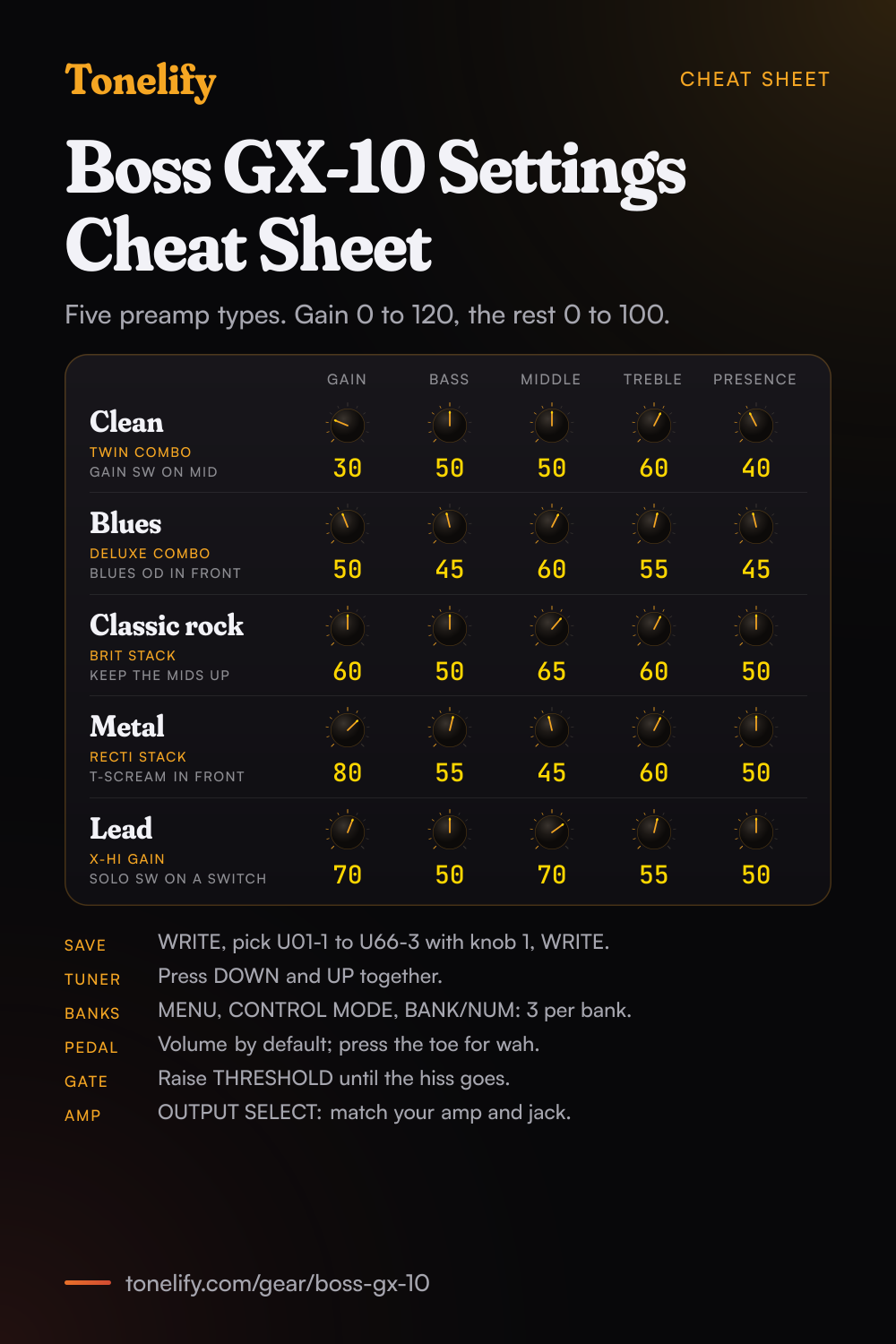
Free download
Printable cheat sheet: PDF and PNG
The clean, blues, classic rock, metal and lead settings from this page, together on one sheet with short tips. The PDF prints on white; the PNG is the dark version for your phone.
Starting settings on the Boss GX-10
Values as the unit's screen shows them, on its own scale; each drawn knob shows that value's share of the range. They are where to begin, not Boss's numbers: pick the amp model first, then move one control at a time from here.
Clean
TWIN COMBO preamp type, which BOSS says models a Fender Twin Reverb. Gain 30, Bass 50, Middle 50, Treble 60, Presence 40, with GAIN SW on MID. On the GX-10, Gain runs from 0 to 120 and the tone controls from 0 to 100, and BOSS builds each type's sound with the three-way GAIN SW on MID. To change a value, press EFFECTS, touch the AIRD PREAMP icon in the effect chain to edit it and drag its parameter icons up and down, or turn the four knobs under the screen. JC-120 models the Roland JC-120, and NATURAL is the type BOSS describes as an unembellished clean that minimizes an amp's trebly character and boomy low end. Preset P02-1 JC CLEAN is BOSS's own to compare against. These are starting points, not BOSS's numbers.
- Gain 30
- Bass 50
- Middle 50
- Treble 60
- Presence 40
Edge of breakup and blues
DELUXE COMBO, BOSS's model of a Fender Deluxe Reverb, or TWEED COMBO, its model of a Fender Bassman 4x10 combo. Gain 50, Bass 45, Middle 60, Treble 55, Presence 45. Dig in for grit and play lighter to clean up. For more push, drag an OVERDRIVE in front of the preamp and pick BLUES OD, which BOSS calls the crunch sound of its BD-2, with the drive low, so the pedal pushes the amp rather than taking it over. DIAMOND AMP models a VOX AC30. Presets P01-3 STUDIO BLUES and P12-1 TWEED DRIVE are BOSS's own to compare against.
- Gain 50
- Bass 45
- Middle 60
- Treble 55
- Presence 45
Classic rock
BRIT STACK, which BOSS says models a Marshall 1959. Gain 60, Bass 50, Middle 65, Treble 60, Presence 50. Keep the mids up: rock guitar sits in the midrange, and scooping it is the usual reason a patch sounds thin next to a band. MAXIMUM is BOSS's own amp in the same family, the response and tone of a vintage Marshall made even higher gain, in BOSS's words, and ORNG STACK models the dirty channel of an Orange Rockerverb. For more drive without touching the knobs, move GAIN SW from MID to HIGH.
- Gain 60
- Bass 50
- Middle 65
- Treble 60
- Presence 50
Metal
RECTI STACK, which BOSS bases on the Channel 2 Modern mode of a MESA/Boogie Dual Rectifier, or BGNR UB METAL, the high-gain channel of a Bogner Uberschall. Gain 80, Bass 55, Middle 45, Treble 60, Presence 50. JUGGERNAUT is BOSS's own large stack, tweaked in pursuit of the ultimate metal sound, and X-TITAN its tight high-gain sound with an edge. Add the NOISE SUPPRESSOR and raise its THRESHOLD only until the hiss between chords goes: BOSS says to set it so the decay of the guitar sound sounds natural, and warns that a high setting can leave no sound when you play with the guitar's volume turned down. For tighter palm mutes, put an OVERDRIVE on T-SCREAM, BOSS's model of the Ibanez TS-808, before the preamp with the drive low, and take the preamp's Gain down a step. Presets P01-2 HEAVY METAL and P21-3 DJENT METAL are BOSS's to compare against.
- Gain 80
- Bass 55
- Middle 45
- Treble 60
- Presence 50
T-SCREAM before the preamp, NOISE SUPPRESSOR on.
Lead
X-HI GAIN, BOSS's high-gain type built on MDP for a wide range and, in BOSS's words, a great-feeling sense of separation. Gain 70, Bass 50, Middle 70, Treble 55, Presence 50: more Middle than the rhythm sounds so the solo cuts through. Every AIRD preamp has a SOLO SW, which BOSS says switches to a tone suitable for solos, with its own SOLO LEVEL. To put it on a footswitch, press MENU, touch CTL/EXP, then ASSIGN SETTINGS, and pick the switch as the SOURCE, TOGGLE as the MODE and the preamp's SOLO SW as the parameter. The BOOSTER's MID BOOST type is the other route: BOSS says placing it before the AIRD PREAMP produces a sound suitable for solos. For a delay in time with the song, set the DELAY's TIME to a BPM value instead of 1 to 2000 ms, so it follows the memory's MASTER BPM, and give a switch BPM TAP, which BOSS lists for tap input of the MASTER BPM. Preset P09-1 HI-GAIN LEAD is BOSS's own to compare against.
- Gain 70
- Bass 50
- Middle 70
- Treble 55
- Presence 50
SOLO SW on a footswitch through ASSIGN SETTINGS.
The three footswitches and the expression pedal
The GX-10 has three footswitches, DOWN, UP and CTL1, and how they work depends on the control mode, set under MENU, CONTROL MODE. In UP/DOWN mode, the factory setting, DOWN and UP step through the memories in order and CTL1 operates the function assigned to it; pressing DOWN and UP together brings up the tuner, and UP and CTL1 together switch to MANUAL mode. BANK/NUM mode treats three memories as a bank: the three switches recall memories 1, 2 and 3 of the bank, DOWN and UP together go to the previous bank, and UP and CTL1 together to the next. MANUAL mode turns all three into switches for the functions you assign, so one memory can hold, say, a drive, a delay and a boost. The built-in expression pedal is set by default, in BOSS's words, to toggle between volume and wah, with the tuner when the pedal is pulled back: press the pedal down with your toes to switch the pedal effect on or off. The rear CTL2,3/EXP2 jack takes a second expression pedal or footswitches, and BOSS lists the FS-5U, FS-5L, FS-6, FS-7, EV-30, FV-500L, FV-500H and Roland EV-5.
Boss GX-10 amp list
The AIRD PREAMP has 23 types for guitar and the AIRD BASS PREAMP has 9 for bass, the same types as the GX-100's. BOSS names what 11 of the guitar types and 7 of the bass types model; the rest are BOSS's own designs, and the row gives BOSS's description of the sound. A memory can hold two AIRD preamps.
| Preamp type | For | What BOSS says it is |
|---|---|---|
| TRANSPARENT | Guitar | A broad frequency range and an extremely flat response; good for acoustic guitar |
| NATURAL | Guitar | An unembellished clean that minimises an amp's trebly character and boomy low end |
| BOUTIQUE | Guitar | A crunch that lets picking nuances through more faithfully than conventional combo amps |
| SUPREME | Guitar | A crunch that responds to picking, with the character of a 4x12 cabinet |
| MAXIMUM | Guitar | The response and tone of a vintage Marshall, with higher gain |
| JUGGERNAUT | Guitar | A large stack sound tweaked for metal |
| X-CRUNCH | Guitar | A crunch that uses MDP for a crisp tone from all strings |
| X-HI GAIN | Guitar | A high-gain sound that uses MDP for a wide range and a sense of separation |
| X-MODDED | Guitar | A core sound that uses MDP to keep its definition even at extreme gain |
| X-ULTRA | Guitar | A high-gain sound that uses MDP for a dense midrange with dynamics |
| X-OPTIMA | Guitar | A high-gain sound that uses MDP to stress balance for phrases and ensemble playing |
| X-TITAN | Guitar | A tight high-gain sound with an edge, which uses MDP |
| JC-120 | Guitar | Roland JC-120 |
| TWIN COMBO | Guitar | Fender Twin Reverb |
| DELUXE COMBO | Guitar | Fender Deluxe Reverb |
| TWEED COMBO | Guitar | Fender Bassman 4x10 combo |
| DIAMOND AMP | Guitar | VOX AC30 |
| BRIT STACK | Guitar | Marshall 1959 |
| RECTI STACK | Guitar | MESA/Boogie Dual Rectifier, Channel 2 in Modern mode |
| MATCH COMBO | Guitar | Matchless D/C-30, left input |
| BG COMBO | Guitar | A MESA/Boogie combo amp |
| ORNG STACK | Guitar | Orange Rockerverb, dirty channel |
| BGNR UB METAL | Guitar | Bogner Uberschall, high-gain channel |
| NATURAL BASS | Bass | An uncoloured clean sound for bass |
| X-DRIVE BASS | Bass | A high-gain bass sound that uses MDP for a wide range and a sense of separation |
| CONCERT | Bass | Ampeg SVT |
| STUDIO BASS | Bass | Markbass Little Mark III |
| SILVER TUBE | Bass | Fender Bassman 100 |
| CLASSIC BLUE | Bass | Acoustic 360 |
| SOLID STACK | Bass | Gallien-Krueger 800RB |
| FAT TUBE | Bass | Orange AD200B MKIII |
| DARK DRV | Bass | Darkglass Electronics Microtubes B7K |
Boss GX-10 effects list
BOSS counts 170 effect types, the same as the GX-100. A memory holds up to 15 effects, plus the divider and mixer, the send/return and the looper, in any order or in parallel; BOSS adds that DSP capacity can stop an effect from being placed before that. Where BOSS names the pedal a type models, it is in brackets. MDP is BOSS's name for processing that treats each part of the signal by its pitch range and dynamics.
- COMPRESSOR (3 types)
- BOSS COMP (BOSS CS-3), D-COMP (MXR Dyna Comp), ORANGE (Dan Armstrong Orange Squeezer)
- BOOSTER (3 types)
- MID BOOST, CLEAN BOOST, TREBLE BOOST
- OVERDRIVE (9 types)
- NATURAL OD, WARM OD, BLUES OD (BOSS BD-2), OD-1 (BOSS OD-1), SD-1 (BOSS SD-1), CRUNCH, T-SCREAM (Ibanez TS-808), TURBO OD (BOSS OD-2), CENTA OD (Klon Centaur)
- DISTORTION (8 types)
- DIST, DS-1 (BOSS DS-1), A-DIST, FAT DS, LEAD DS, RAT (ProCo RAT), GUV DS (Marshall Guv'nor), DIST+ (MXR Distortion+)
- METAL DISTORTION (4 types)
- METAL DS, METAL ZONE (BOSS MT-2), HM-2 (BOSS HM-2), METAL CORE (BOSS ML-2)
- FUZZ (3 types)
- OCT FUZZ, '60S FUZZ (Fuzz Face), MUFF FUZZ (Electro-Harmonix Big Muff Pi)
- MDP dynamics and drive
- X-COMPRESSOR, X OVERDRIVE, X DISTORTION
- Modulation
- CHORUS, PRIME CHORUS, FLANGER, PRIME FLANGER, PHASER, SCRIPT PHASER, PRIME PHASER, CLASSIC-VIBE, ROTARY, VIBRATO, PRIME VIBRATO, TREMOLO, PAN, RING MODULATOR, SLICER, HUMANIZER
- Pitch
- PITCH SHIFTER, HARMONIST, OVERTONE, OCTAVE, POLY OCTAVE, S-BEND, PEDAL BEND
- Delay
- DELAY, DELAY PLUS, ANALOG DELAY, SPACE ECHO, SHIMMER DELAY, TERA ECHO, TWIST, WARP
- Reverb
- REVERB, REVERB PLUS, SHIMMER REVERB
- Wah, filter and simulators
- WAH, TOUCH WAH, AUTO WAH, AC GUITAR SIMULATOR, AC RESONANCE, SITAR SIMULATOR, SLOW GEAR, DEFRETTER, FEEDBACKER
- Amp, EQ, level and routing
- AIRD PREAMP, PARAMETRIC EQUALIZER, GRAPHIC EQUALIZER, NOISE SUPPRESSOR, FOOT VOLUME, DIVIDER/MIXER, SEND/RETURN, PHRASE LOOP
- Bass effects
- AIRD BASS PREAMP, X-BASS COMPRESSOR, BASS OVERDRIVE, X BASS OVERDRIVE, BASS DISTORTION, BASS METAL DISTORTION, BASS FUZZ, BASS CHORUS, BASS FLANGER, PRIME BASS FLANGER, BASS PHASER, PRIME BASS PHASER, BASS PITCH SHIFTER, BASS HARMONIST, BASS OCTAVE, BASS SLOW GEAR, BASS DEFRETTER, BASS TOUCH WAH, BASS S-BEND, BASS WAH, BASS PEDAL BEND
Boss GX-10 preset list
The 99 preset memories sit in banks P01 to P33, three to a bank, and cannot be overwritten: copy one to a user memory, U01-1 to U66-3, to change it. P30-2 to P32-3 are bass presets and P33 holds three looper presets. The names are the GX-100's first 99, in the same order.
- P01 to P11
- P01-1 GX DUAL DRIVE, P01-2 HEAVY METAL, P01-3 STUDIO BLUES, P02-1 JC CLEAN, P02-2 LEAD DRIVE, P02-3 CRUNCH LEAD, P03-1 NEO SOUL, P03-2 MODERN OD, P03-3 MODERN DS, P04-1 CLEAN+SHIMMER, P04-2 MILD DRIVE, P04-3 ACOUSTIC GUITAR, P05-1 X-ULTRA FEED, P05-2 X-OPTIMA SD-1, P05-3 X-TITAN MDP, P06-1 DUAL X LEAD, P06-2 SLICER DRIVE, P06-3 HUMANIZER AC, P07-1 BRIGHT SITAR, P07-2 AUTO WAH BOX, P07-3 FUZZY ROCK, P08-1 PHASER CLEAN, P08-2 BG DRIVE, P08-3 OCTAVE CLEAN, P09-1 HI-GAIN LEAD, P09-2 DIMENSION FL, P09-3 DRIVE + OCT CLN, P10-1 SYNTH LEAD, P10-2 RICH CHORUS DS, P10-3 BASIC GIG, P11-1 ROTARY+ECHO, P11-2 AMBIENT CLEAN, P11-3 FUSION SOLO
- P12 to P22
- P12-1 TWEED DRIVE, P12-2 FLYING OVERTONE, P12-3 CONSOLE CLEAN, P13-1 DUAL CRUNCH, P13-2 FUZZ SOLO, P13-3 BOOST BAR BROS, P14-1 THE BELLS, P14-2 WINDWARD, P14-3 ANCIENT MOON, P15-1 CAPO'S & NUTS, P15-2 WINTER IN 2047, P15-3 JAZZ CLUB, P16-1 GITARRE SPIELEN, P16-2 SLOW DANCE, P16-3 OVERTONE ORGAN, P17-1 NEW AGED BLUES, P17-2 SPACE ECHO, P17-3 CLEAR DRIVE, P18-1 GOOD FEELING, P18-2 SURF COWBOY, P18-3 AMERICANA, P19-1 TREBLE BOOST, P19-2 DIGITAL OCEAN, P19-3 FUNK DRIVE, P20-1 SUPER CLEAN/DS, P20-2 ANCIENT DREAM, P20-3 OCTAVE FUNK, P21-1 GRAVITY GAINS, P21-2 AMBIENT LEAD, P21-3 DJENT METAL, P22-1 SKYBLUE PINK, P22-2 FUZZY DIST, P22-3 DIMI GILMORIX
- P23 to P33
- P23-1 A LIGHTER TOUCH, P23-2 HARMONIC DIST, P23-3 PROUD DAD, P24-1 DRY CRUNCH, P24-2 OCTAVE CRUNCH, P24-3 FUSION SWELLS, P25-1 LO-FI CLEAN, P25-2 SLAP GUITAR, P25-3 1993, P26-1 OCTAVE ORGAN, P26-2 BIG DRIVE, P26-3 BLUE LAKE, P27-1 FAIRY OF FOREST, P27-2 HARMONIC DRIVE, P27-3 PROG LEAD TONE, P28-1 CRYSTAL CLEAN, P28-2 CLEAN BOOSTER, P28-3 BUBBLE DELAY, P29-1 HOT COUNTRY, P29-2 EXPENSIVE TASTE, P29-3 SWAMP CHORUS, P30-1 EVERY 00'S MOVIE, P30-2 STUDIO BASS, P30-3 ROCK BASS CRUNCH, P31-1 CLEAN ROCK BASS, P31-2 T WAH BASS, P31-3 DIST ROCK BASS, P32-1 MONO BASS CLOUD, P32-2 SYNTHY OCT BASS, P32-3 FUZZ BASS, P33-1 LOOPER CLEAN, P33-2 LOOPER CRUNCH, P33-3 LOOPER DRIVE
Boss GX-10 specifications
- Released
- 2024
Boss GX-10 questions
What amps are in the Boss GX-10?
32 AIRD preamp types, 23 for guitar and 9 for bass, the same types as the GX-100's. BOSS names the amp behind 11 of the guitar types: JC-120 (Roland JC-120), TWIN COMBO (Fender Twin Reverb), DELUXE COMBO (Fender Deluxe Reverb), TWEED COMBO (Fender Bassman 4x10 combo), DIAMOND AMP (VOX AC30), BRIT STACK (Marshall 1959), RECTI STACK (MESA/Boogie Dual Rectifier, Channel 2 Modern), MATCH COMBO (Matchless D/C-30), BG COMBO (a MESA/Boogie combo), ORNG STACK (Orange Rockerverb dirty channel) and BGNR UB METAL (Bogner Uberschall high-gain channel). The other twelve, from TRANSPARENT and NATURAL to JUGGERNAUT and the six X types, are BOSS's own. The bass types include models of the Ampeg SVT, Markbass Little Mark III, Fender Bassman 100, Acoustic 360, Gallien-Krueger 800RB, Orange AD200B MKIII and Darkglass Microtubes B7K. The full table is below.
What do the AIRD preamp controls on the GX-10 do?
Gain runs from 0 to 120, and Bass, Middle, Treble and Presence from 0 to 100, with a Level for the whole preamp. GAIN SW picks one of three levels of distortion, LOW, MID or HIGH, and BOSS builds each type's sound with it on MID. Sag sets how much the compression changes in response to the power amp, and Resonance how much the dynamics are affected by the power amp and the speaker transformer working together, both from -10 to +10. A Bright switch appears on some types only. SP TYPE picks the cabinet, and MIC TYPE, MIC DISTANCE and MIC POSITION the microphone in front of it.
How many effects can the GX-10 run at once?
Up to 15 in one memory, from the 170 effect types BOSS counts, plus the divider and mixer, the send/return and the looper, which BOSS writes as 15+3. You drag the icons into any order on the touch screen, or into parallel paths with the divider. Within that, a memory takes up to two AIRD preamps, the same effect up to nine times, and one looper, one divider/mixer and one send/return, and BOSS notes that DSP capacity can grey out a new effect before the limits are reached.
What presets come with the Boss GX-10?
99 preset memories, P01-1 to P33-3, three to a bank, which cannot be overwritten, beside 198 user memories, U01-1 to U66-3. The names are the GX-100's first 99 presets in the same order, from GX DUAL DRIVE and HEAVY METAL to the bass presets and three looper presets in P33. System Program 1.02 of October 2024 added the presets in P05-1 to P07-2. More memories come from BOSS TONE EXCHANGE, and BOSS says GX-100 Livesets are fully compatible with the GX-10.
How do you save a memory on the GX-10?
Press WRITE, touch WRITE on the screen or press knob 1, and choose the user memory, U01-1 to U66-3, with knob 1; hold the knob down while you turn it to move between banks. Name it with knobs 2 to 4 and the SELECT knob, then touch EXEC or press WRITE again. An edit you do not save is lost when you switch memory or turn the power off. The same WRITE menu has EXCHANGE, INITIALIZE and INSERT, to swap two user memories, reset one to standard settings or insert one at another place.
Does the Boss GX-10 have a tuner?
Yes. Press the DOWN and UP switches together, or with the factory settings pull the expression pedal back to its minimum. REF. PITCH runs from 435 to 445 Hz, 440 by default, and TUNER OUTPUT sets what you hear while tuning: MUTE, BYPASS for the dry guitar, or THRU for the current effect sound. The SELECT knob switches between the normal and streaming displays, and a True Temperament mode. System Program 1.05, of March 2026, removed the polyphonic tuner.
Which OUTPUT SELECT setting should you use on the GX-10?
Set it to what the OUTPUT jacks feed: press MENU, touch IN/OUT SETTINGS, then OUTPUT SELECT. LINE/PHONES is for headphones, a keyboard amp, a mixer or a digital recorder. For a guitar amp the settings come in pairs, one for the amp's input and one for its return: JC-120, KATANA-100 and KATANA-100/212 for those amps, and TUBE COMBO 112, TUBE COMBO 212 and TUBE STACK 412 for other valve amps. Two more cover bass amps with and without a tweeter. BOSS recommends an input that no preamp affects, such as a RETURN jack rather than the guitar input.
Can you load your own IRs into the GX-10?
Yes. SP TYPE has 16 user slots, USER1 to USER16, filled with IR data by a dedicated tool BOSS offers on its website, and BOSS's launch release says BOSS Tone Studio loads your own speaker cab IRs from a Mac or Windows computer. Without one, SP TYPE offers the ORIGINAL cabinet of the amp you picked, cabinets from a 1x8 to an 8x12 double stack and bass cabinets, or OFF, with nine MIC TYPE choices, from a Shure SM57 model to a Royer R-121, three blends of the two and FLAT.
Does the Boss GX-10 have Bluetooth?
Not by itself. BOSS states that the GX-10 does not offer Bluetooth functionality: you attach the BT-DUAL adaptor, sold separately, to the Bluetooth ADAPTOR jack on the rear panel. With it, music from a phone plays through the OUTPUT jacks or the PHONES jack, after you pair GX-10 Audio, and the BOSS TONE STUDIO for GX-10 app edits effects and saves settings once you connect to GX-10 MIDI from the app's own settings. BOSS's EV-1-WL wireless expression pedal and FS-1-WL wireless footswitch are options too.
Can the GX-10 be used as an audio interface?
Yes, over its USB-C port: you can record the GX-10 on a computer and play the computer's sound through its OUTPUT jacks. On Windows and macOS, set USB DRIVER to VENDOR and install the GX-10 driver from BOSS's website; on an iOS device, GENERIC uses standard iOS functions, with some limits. LOOPBACK sends the computer's sound mixed with the GX-10's to the computer, and BOSS Tone Studio on the computer edits and backs up memories.
How long is the looper on the GX-10?
38 seconds in mono or 19 seconds in stereo. Place the looper in the effect chain like any other block, then in UP/DOWN mode set CTL1 to LOOP CTL under CONTROL FUNCTION: it starts recording, then alternates between playback and overdubbing, two presses stop it and a long press erases it. LOOP STOP and LOOP CLEAR can go on CTL2 and CTL3, on the rear jack. At the default PLAY LEVEL of 100, the loop plays as loud as you.
Can the Boss GX-10 run on batteries?
No. Its power supply is the included AC adaptor, the PSB-1U, and BOSS gives the current draw as 600 mA. The unit weighs 2.2 kg and measures 300 by 183 mm, 74 mm high. Auto Off turns it off after 20 minutes without use by default, and unsaved edits are lost when it does; it can be set to 1, 5 or 10 hours, or off.
How is the GX-10 different from the GX-100?
Size and switches. BOSS says the GX-10 has the GX-100's core sound engine and colour touch display in a more portable unit, and both list 170 effect types, 15+3 blocks per memory and a 38 second looper. The GX-100 has eight footswitches, MIDI in and out and amp control jacks, at 460 by 193 mm and 3.5 kg; the GX-10 has three footswitches and USB-C, at 300 by 183 mm and 2.2 kg. The GX-100 holds 200 user and 100 preset memories, the GX-10 198 and 99. Both need the BT-DUAL for Bluetooth.
How is the GX-10 different from the GX-1?
The GX-1 is the smaller, cheaper one: 146 effect types, a 320 by 240 colour screen where the GX-10's 480 by 272 one is a touch screen, three knobs and buttons for its eight blocks, built-in Bluetooth, and four AA batteries or USB bus power, launched at 229.99 US dollars in January 2026. The GX-10 has 170 types, up to 15 effects per memory with two preamps, four knobs and a send/return loop for your own pedals, and runs on its AC adaptor. Both have 23 AIRD guitar amp types, an expression pedal and three footswitches.
How do you update the GX-10 firmware?
With a computer and a USB cable. Hold WRITE while you turn the GX-10 on until GX-10 Updater appears, connect it to the computer, copy the files from BOSS's update into the GX-10 drive, then eject it; never turn the unit off during the update. The startup screen shows the installed version at the lower right. The latest in BOSS's notes is System Program 1.06, of May 2026, which fixed the low effect level of SHIMMER REVERB and SHIMMER DELAY, so memories that use them get louder.
What are the best Boss GX-10 settings for metal?
Start with RECTI STACK or BGNR UB METAL, Gain 80 of 120, Bass 55, Middle 45, Treble 60 and Presence 50, with the noise suppressor on and T-SCREAM before the preamp. These are starting points rather than BOSS's numbers. If it fizzes, lower Gain first and Treble second.
When did the Boss GX-10 come out and what did it cost?
BOSS announced it on 24 October 2024 as a compact guitar and bass processor with the sound engine and colour touch display of the GX-100, for sale at authorised US BOSS retailers that October at 399.99 US dollars.
How do you build a patch on the Boss GX-10?
Pick the amp model first, then set its controls, then add the blocks in signal-chain order: drive before the amp, time and modulation after it. A patch built the other way around ends up compensating for the wrong stage. Tonelify returns the model, the order and the parameters together.
Does Tonelify support the Boss GX-10?
Yes. Name it in the tone matcher along with the song you are chasing and the settings come back adapted to it. Gear does not need to be in the catalog for a match to run.
Sources
Panel, specifications and dates checked against these on .
- BOSS: GX-10 Parameter Guide and Sound list (PDF)
- BOSS: GX-10 Reference Manual (PDF)
- BOSS: GX-10 Startup Guide (PDF)
- BOSS: GX-10 System Program update notes
- BOSS: GX-10 launch press release, 24 October 2024
- BOSS: GX-10 product page
- BOSS: GX-100 Reference Manual (PDF), for the comparison
- BOSS: GX-1 Reference Manual (PDF), for the comparison
The manuals are the GX-10 files BOSS's owner's manuals page links, read on 7 November 2026, with the System Program notes up to Ver.1.06. The preset numbers come from the Sound list, read row by row; the names match the GX-100's first 99 presets in the same order.