Drive pedal settings
Boss DS-1 settings from Nirvana to metal
Updated 9 min read5 knob panels9 sources
Start with Level where switching the pedal on and off makes no change in loudness, Tone at 4 to 5 and Dist at 5, then move Tone before anything else. For grunge and punk, turn Dist up to 7 to 9 into a clean amp. For a rock lead, keep Dist at 2 to 4 into an amp that is already breaking up. For metal, set Dist at 8 to 10 with Tone at 4 to 5, keep the amp's bass at 5 or below and add a noise gate.
The DS-1's Tone knob is not a treble control. BOSS's manual says turning it clockwise cuts lower frequencies for a sharper sound and turning it counterclockwise cuts higher frequencies for a softer, warmer one. Turned up, it thins the sound as well as brightening it, which is why a DS-1 set bright can sound fizzy and small.
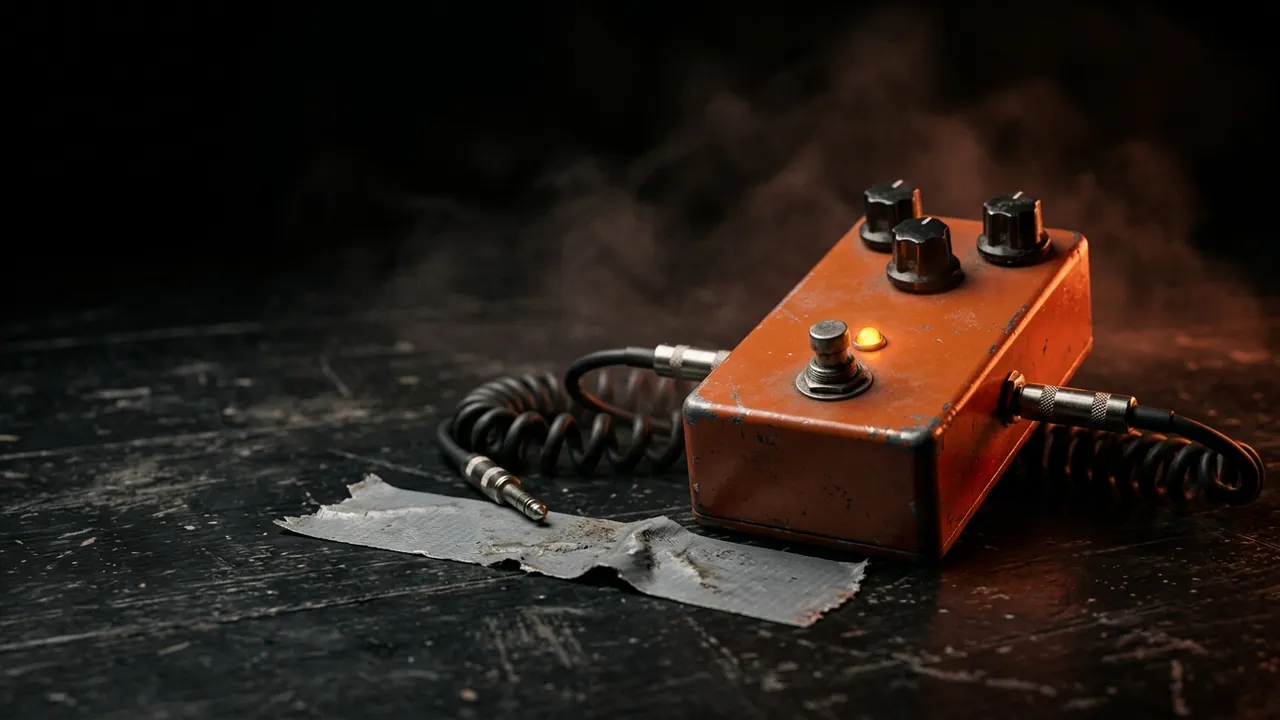
What the three knobs do
Dist sets the depth of the distortion and the length of the sustain together: BOSS's manual says turning it clockwise gives deeper distortion and a longer sustain. Level sets the output, and BOSS's instruction is to set it so there is no volume difference between the effect and the straight guitar.
Tone works as a tilt. Clockwise cuts the low end, counterclockwise cuts the high end, so at either extreme the pedal loses part of the guitar. Around 4 to 5 it keeps both, which is why that is the place to start, and why Tone, more than Dist, decides whether a DS-1 sounds full or thin.
- Level unity
- Tone 4 to 5
- Dist 5
Level at unity, as loud on as off. Move Tone before anything else.
Kurt Cobain and the DS-1 on Nevermind
Guitar.com's account of the Nevermind sessions says Cobain used a DS-1 Distortion and an Electro-Harmonix Small Clone, and that a ProCo RAT was also allegedly used on some songs. Wikipedia's article on the pedal says he used 1980s editions of the DS-1 as well as the later DS-2. By In Utero the pedal had changed: Guitar.com's In Utero rundown lists his Boss DS-2 and a Tech 21 SansAmp, not the DS-1.
No source records where Cobain set the knobs, so the "Kurt Cobain DS-1 settings" that circulate online are other people's guesses. A starting point for the Nevermind sound is Dist 7 to 9, Tone 4 to 5 and Level at unity or a little above, into a clean or lightly crunchy amp, on the bridge pickup. Butch Vig named a Mesa/Boogie, a Fender Bassman and a Vox AC30 as the album's amps, so the pedal was never the whole sound.
- Level unity
- Tone 4 to 5
- Dist 7 to 9
Level at unity or a little above. A starting point, not Cobain's settings: no source records where he set the knobs.
Punk and rock rhythm
For punk and pop-punk rhythm into a clean amp, set Dist at 6 to 8, Tone at 5 and Level at unity or above, and let the amp's middle control carry the chords. Down-picked power chords need definition more than saturation, so stop raising Dist once the notes in a chord stop sounding separate.
Into an amp's crunch channel, the same pedal needs far less: Dist at 3 to 5. Two stages of distortion stack, and a DS-1 at full Dist into a driven amp gives fizz and mush rather than more power.
- Level unity
- Tone 5
- Dist 6 to 8
Level at unity or above. Into a crunch channel, Dist 3 to 5 instead.
A light DS-1 for leads: Prince on Purple Rain
Guitar.com says Prince's lead parts on the Purple Rain album typically went through a Mesa/Boogie Mark IIB, with his overdrive coming from "a light application of a Boss DS-1". MusicRadar describes the solo with the bass rolled off and the presence increased. The pedal there adds edge to an amp that already has some drive; it is not doing the work on its own.
To use it the same way, set Dist at 2 to 4, Tone at 5 and Level a little above unity, into an amp on the edge of breakup, then shape the sound with the amp's EQ: bass down, presence up.
- Level above unity
- Tone 5
- Dist 2 to 4
Into an amp on the edge of breakup, with its bass down and presence up.
Metal: what a DS-1 can and cannot do
Into a clean amp, a DS-1 at Dist 8 to 10 reaches hard rock and older metal gain. Keep Tone at 4 to 5, set the amp's bass at 5 or below so the low end stays tight, and put a noise gate after the pedal. Turning Tone up for bite cuts the low end at the same time, which is the opposite of what a metal rhythm needs.
On Metallica: Tonelify's Master of Puppets page traces the band's distortion to the amps, a Mesa/Boogie Mark IIC+ into Marshall heads, and no source ties those records to a DS-1. A DS-1 into a clean amp gets you the gain, not that sound. For a modern high-gain rig, a Tube Screamer style boost in front of a high-gain amp is the more usual tool.
- Level unity
- Tone 4 to 5
- Dist 8 to 10
Amp bass at 5 or below, with a noise gate after the pedal.
DS-1W: Standard and Custom modes
The Waza Craft DS-1W adds a mode switch. BOSS's manual says S, standard, recreates the original DS-1 with a newly designed circuit, and C, custom, is tuned to be more dynamic and thick. Its Tone knob is described the same way as the original's: clockwise cuts the low end and boosts the high end, and all the way counterclockwise cuts the high end and boosts the low end.
The settings on this page are written for the original pedal and suit S mode. In C mode, start from the same positions and compare the two by ear at the same loudness.
DS-1 or DS-2?
The DS-2 Turbo Distortion, which BOSS released in 1987, adds a Turbo selector. Its manual describes Turbo I as a powerful distortion with flat characteristics, and Turbo II as a sticky distortion with a distinctive midrange, likened to a large valve amp played at full volume. Its Tone knob is a plainer treble control than the DS-1's: clockwise emphasises the highs and counterclockwise cuts them.
Cobain used both, the DS-1 on Nevermind and the DS-2 by In Utero. For the Nevermind sound the DS-1 is the closer pedal; for the In Utero sound, look at the DS-2 and the SansAmp instead.
When it sounds wrong
Fizzy: bring Tone down to 4 or 5 first, then Dist. Thin: Tone down a step and the amp's middle up. Quieter when it is on: raise Level until the pedal matches the bypassed guitar, which is where BOSS says to set it. Mush into a distorted channel: use the amp's clean channel, or drop Dist to 3 to 5.
Distorting oddly on battery power: BOSS's manual says a very low battery can make the sound distort, and that the CHECK light dims when the battery is nearly flat. Replace it or use a PSA adaptor.
These positions are starting points for the pedal. The amp after it decides as much of the sound, so the same DS-1 setting lands differently on a clean Fender, a crunchy Marshall and a modelling combo. When you want one song's whole chain set for the amp you own, Tonelify works out the positions for that rig, pedal included.
Songs with a DS-1 in the chain


Common questions
What are Kurt Cobain's DS-1 settings?
No source records them. Guitar.com and Wikipedia confirm he used a DS-1 on Nevermind, but not where the knobs sat. A starting point for that sound is Dist 7 to 9, Tone 4 to 5 and Level at unity or a little above, into a clean or lightly crunchy amp.
Is the Tone knob on a DS-1 a treble control?
No. BOSS's manual says clockwise cuts lower frequencies and counterclockwise cuts higher frequencies, so it tilts the sound between warm and sharp. Turning it up for bite also thins the low end.
What are the best Boss DS-1 settings for metal?
Into a clean amp, Dist 8 to 10, Tone 4 to 5 and Level at unity, with the amp's bass at 5 or below and a noise gate after the pedal. Keep Tone near the middle, because turning it up cuts the low end a metal rhythm needs.
Did Metallica use a Boss DS-1?
No source ties Metallica's records to a DS-1. Tonelify's Master of Puppets page traces the album's distortion to the amps: a Mesa/Boogie Mark IIC+ into Marshall heads.
Where should Level be set on a DS-1?
Where switching the pedal on and off makes no change in loudness. That is BOSS's own instruction in the manual, and it stops the pedal sounding better or worse only because it is louder or quieter.
What is the difference between the DS-1 and the DS-1W?
The DS-1W adds a mode switch. BOSS says S recreates the original DS-1 with a newly designed circuit and C is tuned to be more dynamic and thick. The Dist, Tone and Level knobs work the same way on both.
Sources
Gear in this guide
Settings for your own amp
This guide covers what is true of every rig. For a specific song on a specific amp, Tonelify reads the documented chain behind the recording and returns gain, bass, middle, treble and presence values for the controls your amp actually has. Free for 7 days, no charge until the trial ends.