Amp cheat sheets
Fender amp settings: Twin, Deluxe Reverb, Princeton, Blues Junior and Hot Rod
Updated 11 min read4 knob panels6 sources
On a '65 Deluxe Reverb, plug into Input 1 of the Vibrato channel and start clean at Volume 3, Treble 5, Bass 4 and Reverb 2; it starts to break up around Volume 4 to 5. On a '65 Twin Reverb, start clean on the Vibrato channel at Volume 3, Treble 5, Middle 4, Bass 4 and Reverb 2. On a Blues Junior IV, whose dials run 1 to 12, set Volume 3 and Master 7 for clean, or press FAT with Volume 8 and Master 4 for crunch.
Fender's manuals say what each control does but give no settings, so every value on this page is Tonelify's starting point; the Deluxe Reverb, Princeton Reverb, Blues Junior IV and Hot Rod Deluxe IV values are the same as on our gear pages. The '65 reissues have no master volume, so on those the Volume knob sets both the drive and the loudness.
Free download
Printable cheat sheet: PDF and PNG
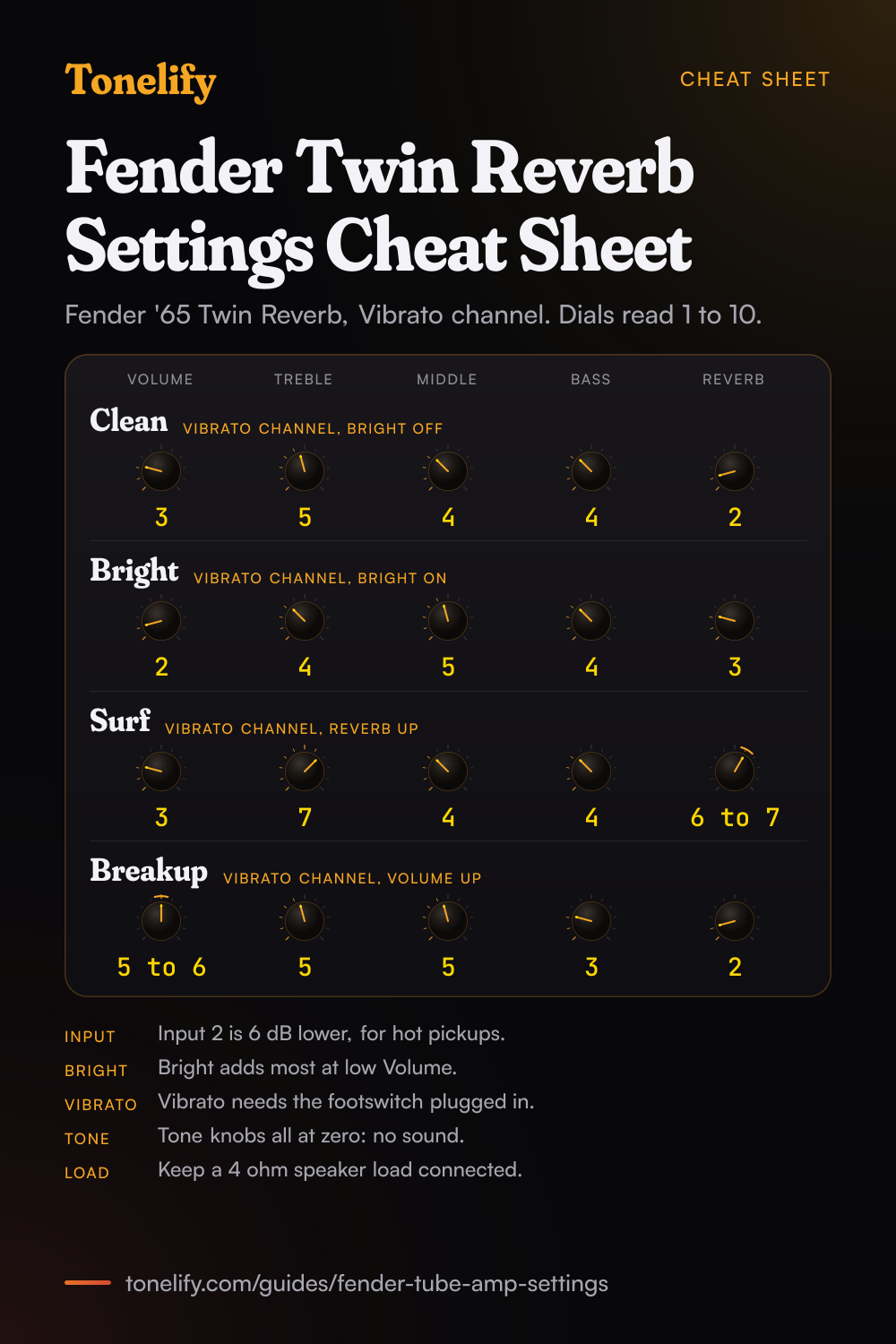
The clean, bright, surf and breakup settings from this guide, together on one sheet with short tips. The PDF prints on white; the PNG is the dark version for your phone.
Volume, Master and where a Fender breaks up
The '65 Twin Reverb, Deluxe Reverb and Princeton Reverb have no master volume. Fender's manuals say the Volume adjusts the loudness of the amplifier,[1] and on these amps it also sets how hard the valves are driven, so the clean sound gets louder until it starts to break up. On a Deluxe Reverb that happens around 4 to 5 on the dial, depending on your pickups. On a Twin, with 85 watts, it happens far louder than most rooms allow.
The Blues Junior IV and Hot Rod Deluxe IV split the job. On the Blues Junior IV, Fender says the Volume adjusts preamp gain and the Master adjusts the overall volume output of the amplifier, to be set after the Volume.[4] On the Hot Rod Deluxe IV, the Drive and Master do the same on the Drive channels, while the Normal channel has only a Volume.[5] So on those two, set the Volume or Drive for the amount of grit first, then the Master for the room.
Which Fender tube amp do you have?
All five are valve combos. The '65 reissues have dials printed 1 to 10; the Blues Junior IV and Hot Rod Deluxe IV have dials that run to 12, so 6 is not the middle on those. The settings below use the numbers printed on each amp's own dial.
| Amp | Power | Valves | Speaker | Channels | Master |
|---|---|---|---|---|---|
| '65 Twin Reverb | 85W | 4 x 6L6GC | Two 12 inch | Normal and Vibrato, each with Bright and Middle | No |
| '65 Deluxe Reverb | 22W | 2 x 6V6GT | 12 inch Jensen C12K | Normal and Vibrato | No |
| '65 Princeton Reverb | 12W | 2 x 6V6 | 10 inch Jensen C-10R | One | No |
| Blues Junior IV | 15W | 2 x EL84 | 12 inch Celestion A-Type | One, with FAT boost | Yes |
| Hot Rod Deluxe IV | 40W | 2 x 6L6GC | 12 inch Celestion A-Type | Normal, Drive, More Drive | Drive channels only |
Best Fender Twin Reverb settings
Use the Vibrato channel, because Fender's manual says the reverb and vibrato affect only the Vibrato channel.[1] Clean: Volume 3, Treble 5, Middle 4, Bass 4, Reverb 2. Bright clean, with the Bright switch on: Volume 2, Treble 4, Middle 5, Bass 4, Reverb 3. Surf: Volume 3, Treble 7, Middle 4, Bass 4, Reverb 6 to 7. Edge of breakup: Volume 5 to 6, Treble 5, Middle 5, Bass 3, Reverb 2.
Fender says the Bright boost is more noticeable at lower Volume settings,[1] which is why the bright clean sits at Volume 2. The Twin is loud: Volume 5 to 6 on 85 watts is a stage level, so most players get the breakup from a pedal instead. Keep every tone knob off zero, because the manual says that if either group of tone controls is turned fully counter-clockwise there will be no sound from that channel.[1] These are Tonelify's starting points; Fender's manual gives no settings.
- Volume 3
- Treble 5
- Middle 4
- Bass 4
- Reverb 2
Input 2 if hot pickups break up.
- Volume 2
- Treble 4
- Middle 5
- Bass 4
- Reverb 3
Bright adds most at low Volume.
- Volume 3
- Treble 7
- Middle 4
- Bass 4
- Reverb 6 to 7
Reverb fully down switches it off.
- Volume 5 to 6
- Treble 5
- Middle 5
- Bass 3
- Reverb 2
Very loud: a pedal gets it quieter.
Best Fender Deluxe Reverb settings
The '65 Deluxe Reverb has Volume, Treble and Bass on each channel and no Middle knob. Use the Vibrato channel for these settings: Fender says it provides more treble boost than the Normal channel,[2] and it is the only channel with reverb and vibrato. The amp is 22 watts, so the breakup arrives at a volume a band can use.
These are Tonelify's starting points, the same as on our '65 Deluxe Reverb page. For tremolo, add Speed 5 and Intensity 4 to the clean setting, with the footswitch plugged in.
| Sound | Channel | Volume | Treble | Bass | Reverb |
|---|---|---|---|---|---|
| Clean | Vibrato, Input 1 | 3 | 5 | 4 | 2 |
| Edge of breakup | Vibrato, Input 1 | 4 to 5 | 5 | 4 | 2 |
| Cranked blues | Vibrato, Input 1 | 6 to 7 | 5 | 3 | 2 |
| Surf reverb | Vibrato, Input 1 | 3 | 7 | 4 | 6 to 7 |
Best Fender Princeton Reverb settings
The '65 Princeton Reverb is one channel with Volume, Treble, Bass and Reverb, plus Speed and Intensity for the vibrato, on a 10 inch speaker. Fender says its robust 12-watt platform even provides enough output for small gigs and rehearsals.[3] American Songwriter's review hears incredible cleans from 1 to 3, a sweet spot from about 4 to 6[6] and tube distortion above that, which is where the rows below sit.
These are Tonelify's starting points, the same as on our '65 Princeton Reverb page. An earlier edition of the manual rated it at 15 watts.
| Sound | Input | Volume | Treble | Bass | Reverb |
|---|---|---|---|---|---|
| Clean | Input 1 | 2 to 3 | 6 | 4 | 2 |
| Edge of breakup | Input 1 | 4 to 6 | 5 | 4 | 2 |
| Cranked | Input 1 | 7 to 8 | 5 | 3 | 2 |
| Surf reverb | Input 1 | 3 | 7 | 4 | 6 to 7 |
Best Fender Blues Junior settings
The Blues Junior IV has one channel with Volume, Treble, Bass, Middle, Master and Reverb, and a FAT button. Fender says FAT boosts preamp gain for extra distortion and sustain,[4] and the footswitch that comes with the amp turns it on and off. With the footswitch plugged in, the FAT button on the panel is disabled.[4]
The dials run to 12, so these numbers sit higher than on the '65 reissues. They are Tonelify's starting points, the same as on our Blues Junior IV page. For a solo, set the crunch row and step on the FAT footswitch.
| Sound | FAT | Volume | Treble | Bass | Middle | Master | Reverb |
|---|---|---|---|---|---|---|---|
| Clean | Off | 3 | 7 | 6 | 5 | 7 | 4 |
| Edge of breakup | Off | 6 | 6 | 5 | 7 | 5 | 3 |
| Crunch with FAT | On | 8 | 6 | 5 | 6 | 4 | 2 |
| Surf reverb | Off | 3 | 8 | 5 | 5 | 7 | 8 |
Best Fender Hot Rod Deluxe settings
The Hot Rod Deluxe IV has three channels on one set of tone controls: Normal, Drive and More Drive. Fender says More Drive boosts the gain and distortion of the Drive channel,[5] and the Master adjusts the loudness of the Drive and More Drive channels together with the Drive knob.[5] The Normal channel has a Bright switch and its own Volume, and Presence shapes the very top after the preamp.
Because the tone controls are shared, a Middle that suits the Drive channel also changes the clean. These are Tonelify's starting points on the 1 to 12 dial, the same as on our Hot Rod Deluxe IV page.
| Sound | Channel | Volume or Drive | Master | Treble | Bass | Middle | Reverb | Presence |
|---|---|---|---|---|---|---|---|---|
| Clean | Normal, Bright out | 4 | Not used | 6 | 5 | 5 | 4 | 5 |
| Edge of breakup | Normal, pushed, Bright out | 7 | Not used | 6 | 4 | 7 | 3 | 5 |
| Drive channel crunch | Drive | 4 | 3 | 6 | 5 | 7 | 2 | 6 |
| More Drive lead | More Drive in | 5 | 3 | 6 | 4 | 7 | 2 | 5 |
Bright switch, Input 1 and Input 2
The Twin has a Bright switch on each channel and the Hot Rod Deluxe IV has one on the Normal channel; the Deluxe Reverb, Princeton Reverb and Blues Junior IV have none. Turn it on when a dark guitar needs more sparkle at low volume, and off once the Volume is up, where it adds less and can get harsh.
The '65 reissues and the Hot Rod Deluxe IV have two inputs. On the Twin, Fender says both Inputs 1 provide 6 dB more gain than Inputs 2,[1] and the Hot Rod's manual says Input 2 gives a cleaner response with high-output and pre-amplified guitars.[5] Start in Input 1; move to Input 2 if humbuckers break up before you want them to.
Reverb, vibrato and the footswitch
On the Twin and Deluxe Reverb, the reverb and vibrato work on the Vibrato channel only, and Fender says the vibrato will not function without the footswitch plugged in.[1] Turning the Reverb knob fully counter-clockwise switches the reverb off. A tremolo to start from on any of the three '65 reissues: Speed 5 and Intensity 4 with the Volume around 3 to 4.
The Blues Junior IV and Hot Rod Deluxe IV have spring reverb and no vibrato; their footswitches pick the FAT boost or the channels instead. On the Hot Rod, the manual says the Channel Select button on the panel is disabled while the footswitch is plugged in.[5]
Pedals, Standby and speaker loads
Only the Hot Rod Deluxe IV has an effects loop: Fender says to connect Preamp Out to the input of your effects and the effects output to the Power Amp In jack.[5] On the other four, every pedal goes in front of the input. Those clean, no-master amps take a drive pedal well, and the Princeton's review calls it a great pedal platform at lower volumes.[6]
The Twin, Deluxe Reverb and Hot Rod Deluxe IV have a Standby switch, which Fender says keeps the valve heaters warm so there is no warm-up wait after a short break. Never switch on without a speaker: the Twin's manual says a speaker must always be connected at the main speaker jack when the amplifier is on, with a total load of 4 ohms.[1]
Common questions
What are the best Fender amp settings?
On a '65 Deluxe Reverb, clean on the Vibrato channel at Volume 3, Treble 5, Bass 4 and Reverb 2, with breakup around Volume 4 to 5. On a '65 Twin Reverb, Volume 3, Treble 5, Middle 4, Bass 4 and Reverb 2. On a Blues Junior IV, Volume 3, Treble 7, Bass 6, Middle 5, Master 7 and Reverb 4 on its 1 to 12 dial. These are Tonelify's starting points; Fender publishes no settings.
What are the best settings for a Fender Blues Junior?
Clean: FAT off, Volume 3, Treble 7, Bass 6, Middle 5, Master 7, Reverb 4. Edge of breakup: Volume 6, Middle 7, Master 5. Crunch: FAT on, Volume 8, Treble 6, Bass 5, Middle 6, Master 4, Reverb 2. The dials run to 12, so set the Volume for the grit first, then the Master for the room.
What are the best Fender Twin Reverb settings?
Clean on the Vibrato channel with Bright off: Volume 3, Treble 5, Middle 4, Bass 4, Reverb 2. For a bright clean, switch Bright on and use Volume 2, Treble 4, Middle 5. For surf, Treble 7 and Reverb 6 to 7. It is 85 watts with no master, so breakup at Volume 5 to 6 is very loud.
What are the best Fender Deluxe Reverb settings?
Vibrato channel, Input 1: clean at Volume 3, Treble 5, Bass 4, Reverb 2; edge of breakup at Volume 4 to 5; cranked blues at Volume 6 to 7 with Bass 3; surf at Volume 3, Treble 7, Reverb 6 to 7. These are the same starting points as on our '65 Deluxe Reverb page.
What are the best Fender Princeton Reverb settings?
Clean at Volume 2 to 3, Treble 6, Bass 4, Reverb 2. Edge of breakup at Volume 4 to 6, Treble 5. Cranked at Volume 7 to 8 with Bass 3. Surf at Volume 3, Treble 7, Reverb 6 to 7. It has no master volume, so the drive comes with the loudness.
What are the best Fender Hot Rod Deluxe settings?
Clean on the Normal channel with Bright out: Volume 4, Treble 6, Bass 5, Middle 5, Reverb 4, Presence 5. Crunch on the Drive channel: Drive 4, Master 3, Middle 7, Reverb 2, Presence 6. For a lead, press More Drive and set Drive 5. The dials run 1 to 12.
Why do Fender amps have no Middle knob?
Some do and some do not. The '65 Deluxe Reverb and Princeton Reverb have only Treble and Bass, so the circuit sets the mids. The '65 Twin Reverb, Blues Junior IV and Hot Rod Deluxe IV have a Middle knob. On the two without one, a mid boost pedal in front fills in the mids.
What does the Bright switch do on a Fender amp?
Fender's manual says it provides an extra boost to the high-frequency range, and that the boost is more noticeable at lower Volume settings. Use it on a dark guitar at low volume, and switch it off as the Volume comes up.
What is the difference between Input 1 and Input 2?
Input 2 has less gain. Fender's Twin Reverb manual says both Inputs 1 provide 6 dB more gain than Inputs 2, and the Deluxe Reverb and Hot Rod manuals say Input 2 suits high-output guitars. Start in Input 1 and move to Input 2 if your pickups break the amp up too early.
Why does the vibrato not work on my Fender amp?
Check the footswitch. Fender's Twin Reverb and Deluxe Reverb manuals say the vibrato will not function without the footswitch plugged in. Also make sure you are on the Vibrato channel, because reverb and vibrato work only there, and that the Intensity knob is not fully down.
Why is there no sound from my Fender Twin Reverb?
Check the tone knobs. The '65 Twin Reverb manual says that if either group of tone controls is turned fully counter-clockwise there will be no sound from that channel. Also check the Standby switch is up for operating mode and a speaker is connected.
Which Fender tube amp is best for playing at home?
A small one with a master volume. The Blues Junior IV has a Master that sets the overall volume after the Volume sets the drive. The '65 Princeton Reverb has no master but only 12 watts, and its review says it can work even at home in some cases. The Twin, at 85 watts, is a stage amp.
Does a Fender Blues Junior have an effects loop?
No. Of the amps on this page, only the Hot Rod Deluxe IV has one, using its Preamp Out and Power Amp In jacks. On the Blues Junior IV, put every pedal between the guitar and the input.
How do I use Standby on a Fender tube amp?
On the Twin, Deluxe Reverb and Hot Rod Deluxe IV, switch Power on with Standby down, then put Standby up to play. Fender says Standby keeps power on the valve filaments only, so there is no warm-up wait after short breaks. The Princeton Reverb and Blues Junior IV have only a power switch.
Is there a printable Fender Twin Reverb settings cheat sheet?
Yes. The cheat sheet on this page puts the four Twin Reverb settings, clean, bright clean, surf and edge of breakup, on one page with five knobs each. Download the PDF to print it on white, or save the PNG to your phone. The other amps have their own sheets on their gear pages.
Sources
The numbers in brackets in the text point to this list.
- Fender: '65 Twin Reverb owner's manual (PDF, hosted by Thomann)
- Fender: '65 Deluxe Reverb owner's manual (PDF)
- Fender: '65 Princeton Reverb owner's manual, 2020 edition (PDF)
- Fender: Blues Junior IV owner's manual (PDF)
- Fender: Hot Rod Deluxe IV and Hot Rod DeVille IV owner's manual (PDF)
- American Songwriter: Fender '65 Princeton Reverb review
Gear in this guide
Settings for your own amp
This guide covers what is true of every rig. For a specific song on a specific amp, Tonelify reads the documented chain behind the recording and returns gain, bass, middle, treble and presence values for the controls your amp actually has. A first plan starts with 7 days free, $0 today.