Amp cheat sheets
Vox AC settings: AC10, AC15 and AC30 Top Boost guide
Updated 10 min read4 knob panels5 sources
On a Vox AC15C1 or AC30C2, start a chime clean on the Top Boost channel at Volume 3 to 4 (3 on the AC30), Treble 5, Bass 5 and Tone Cut 4, with the Master set to taste. For British crunch, push the Top Boost Volume to 7 to 8 with Treble 6, Bass 4 and the Master at 3 to 4 (3 on the AC30). On the single channel AC10C1, play clean at Gain 3 and Volume 6, and crunch at Gain 8 and Volume 3.
Vox's manuals say to begin with the Top Boost tone controls at 12 o'clock and give no other numbers, so every value on this page is Tonelify's starting point; the AC15C1 and AC30C2 values are the same as on our gear pages. Tone Cut works the opposite way to a treble knob: turning it clockwise removes highs.

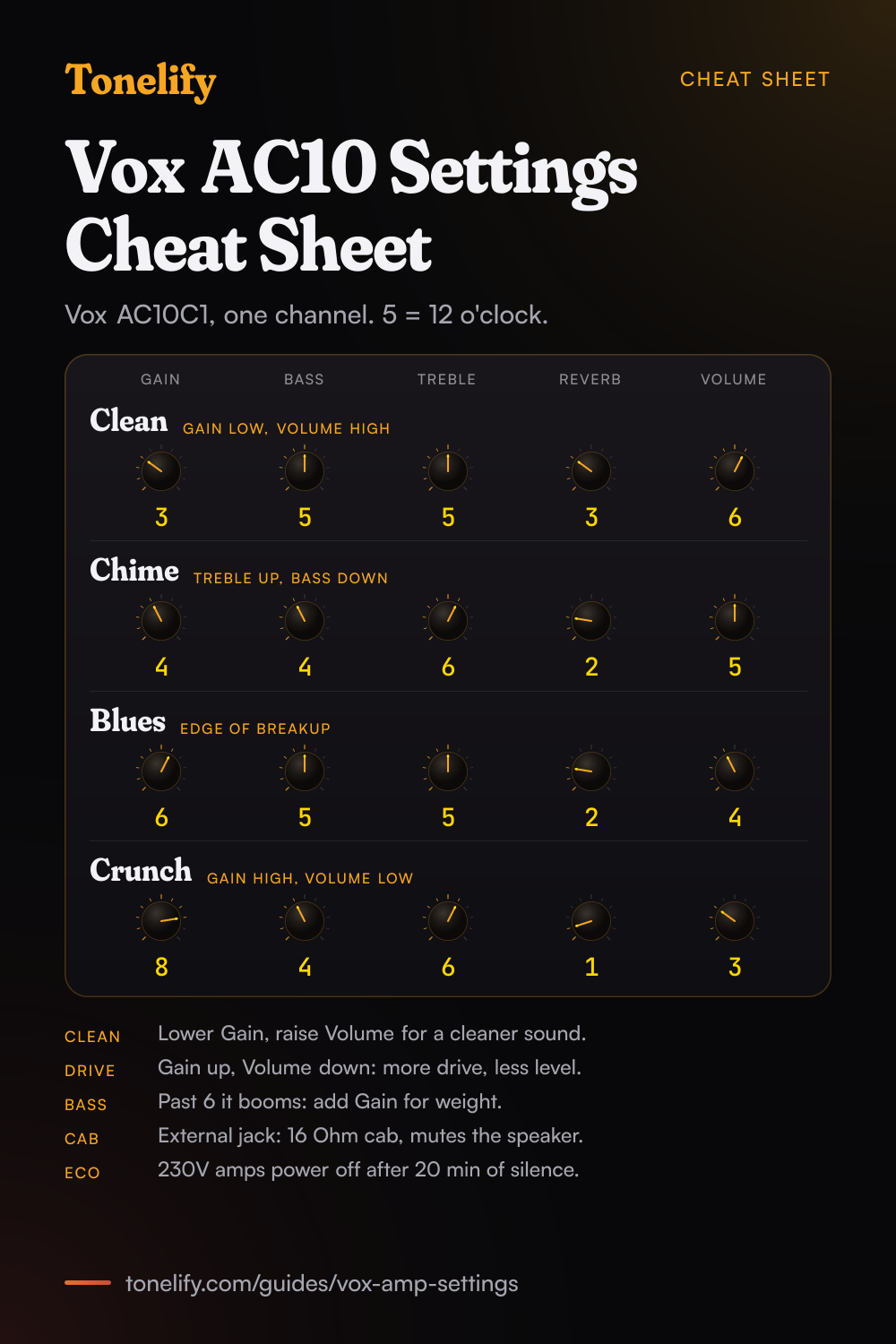
Free download
Printable cheat sheet: PDF and PNG
The clean, chime, blues and crunch settings from this guide, together on one sheet with short tips. The PDF prints on white; the PNG is the dark version for your phone.
Volume, Gain and Master on a Vox AC
On every AC Custom amp, one knob sets how hard the preamp is driven and another sets how loud the amp plays. On the AC10C1 those are Gain and Volume. Vox says the Gain determines the sensitivity of the preamp, and that cleaner sounds can be achieved by lowering the Gain and raising the Volume.[1] Setting the Volume lower and the Gain higher will give you a fatter, more distorted tone at a lower volume.
The AC15C1 and AC30C2 work the same way with different names. Each channel's Volume sets the preamp, and the Master sets the overall level. Vox's manual says that if you keep the Top Boost volume low and the Master volume high, you will get a clean sound at a high volume;[2] turn the channel up and the Master down for more distortion at a lower overall volume. So in a small room, the crunch rows below use a low Master, not a low channel Volume.
Which Vox AC do you have?
All three are valve amps with EL84 power valves, from Vox's Custom series. If the panel shows one input and five knobs it is an AC10C1; two channels with one input each make it an AC15C1; two channels with high and low inputs and an effects loop on the back make it an AC30C2.[2] The X models, the AC15C1X and AC30C2X, use Celestion Alnico Blue speakers and take the same settings.
| Amp | Power | Speaker | Channels | Controls |
|---|---|---|---|---|
| AC10C1 | 10W, 2 x EL84 | 1 x 10 inch VX10 | One | Gain, Bass, Treble, Reverb, Volume |
| AC15C1 | 15W, EL84 | 1 x 12 inch Celestion G12M Greenback | Two: Normal, Top Boost | Volumes, Treble, Bass, Tone Cut, Master, Reverb, Tremolo |
| AC30C2 | 30W, 4 x EL84 | 2 x 12 inch Celestion G12M Greenback | Two, each with high and low inputs | As the AC15C1, plus Reverb Tone and an effects loop |
Best Vox AC10 settings
The AC10C1 is a single channel amp, so every sound comes from the balance of Gain and Volume. Clean: Gain 3, Bass 5, Treble 5, Reverb 3, Volume 6. Chime: Gain 4, Bass 4, Treble 6, Reverb 2, Volume 5. Blues at the edge of breakup: Gain 6, Bass 5, Treble 5, Reverb 2, Volume 4. Crunch: Gain 8, Bass 4, Treble 6, Reverb 1, Volume 3.
Vox describes the Treble as soft and round when turned down and bright and cutting when cranked,[1] and the Bass as thin and light down to warm and heavy turned up.[1] On a 10 inch speaker, Bass past 6 tends to boom, so add Gain for weight before more Bass. These are Tonelify's starting points; Vox's manual gives no settings.
- Gain 3
- Bass 5
- Treble 5
- Reverb 3
- Volume 6
Lower Gain, raise Volume for cleaner.
- Gain 4
- Bass 4
- Treble 6
- Reverb 2
- Volume 5
Pick hard and it starts to break up.
- Gain 6
- Bass 5
- Treble 5
- Reverb 2
- Volume 4
Roll the guitar volume back to clean up.
- Gain 8
- Bass 4
- Treble 6
- Reverb 1
- Volume 3
Add Gain for weight, not Bass.
Best Vox AC15C1 settings
The Normal channel has a Volume and nothing else, so its tone comes from the Tone Cut and Reverb, which work on both channels. The Top Boost channel adds Treble and Bass. For the chime, keep the Top Boost Volume low: Vox says you can set it lower for a cleaner, chimey sound.[2] For crunch, turn it up and bring the Master down.
These are Tonelify's starting points, the same as on our AC15C1 page. The tremolo works on either channel: start at Depth 4 to 5 and Speed 3 to 5 with the Reverb at 2.
| Sound | Channel | Volume | Treble | Bass | Tone Cut | Master | Reverb |
|---|---|---|---|---|---|---|---|
| Clean | Normal | 3 to 4 | Not on Normal | Not on Normal | 3 | to taste | 2 |
| Chime clean | Top Boost | 3 to 4 | 5 | 5 | 4 | to taste | 2 to 3 |
| Blues, edge of breakup | Top Boost | 5 to 6 | 5 | 5 to 6 | 5 | 4 to 5 | 2 |
| British crunch | Top Boost, pushed | 7 to 8 | 6 | 4 | 5 to 6 | 3 to 4 | 1 |
Best Vox AC30C2 settings
The AC30C2 has the same two channels with twice the power, so the same sounds need a little less Volume and Master: the chime sits at Top Boost Volume 3 and the crunch at Master 3. Each channel has a high and a low input, and the reverb has a Tone knob as well as a Level knob.[2] Start in the high input; use the low input if a hot pickup breaks up too early.
For a wet reverb on either channel, set Reverb Level 6 to 7 and Reverb Tone 6 to 7, with Top Boost Treble 5 and Tone Cut 4. The tremolo starts at Depth 4 to 5 and Speed 3 to 5 with Reverb Level 2 to 3. These are Tonelify's starting points, the same as on our AC30C2 page.
| Sound | Channel | Volume | Treble | Bass | Tone Cut | Master | Reverb Level | Reverb Tone |
|---|---|---|---|---|---|---|---|---|
| Clean | Normal, high input | 3 to 4 | Not on Normal | Not on Normal | 3 | to taste | 2 | 5 |
| Chime clean | Top Boost | 3 | 5 | 5 | 4 | to taste | 2 to 3 | 5 |
| Blues, edge of breakup | Top Boost | 5 to 6 | 5 | 5 | 5 | 4 | 2 | 5 |
| British crunch | Top Boost, pushed | 7 to 8 | 6 | 4 | 6 | 3 | 1 | 5 |
Top Boost Treble, Bass and Tone Cut
Vox's manual warns that the tone controls on the Top Boost channel are very interactive: increasing the level of the Treble control will cut the Bass level.[2] It says it is best to begin with the tone controls at 12 o'clock and experiment, which is why every Top Boost row above starts at 5. Set the Treble first, then the Bass, because a Treble change moves the Bass.
Tone Cut is the knob that confuses most new owners. Vox says it does the opposite of what you may think: turning it clockwise will decrease the higher frequencies and turning it counterclockwise will add them.[2] It sits in the power amp, not the preamp like the Treble and Bass,[2] so it works on both channels. If the amp sounds harsh, turn Tone Cut up before you turn the Treble down.
Reverb and tremolo on a Vox AC
On the AC15C1 the reverb has one Level knob for both channels. The AC30C2 adds a Reverb Tone knob that makes the reverb brighter clockwise and darker counterclockwise, and Vox says turning the Level fully clockwise gives a wet, saturated sound.[2] The AC10C1 has one Reverb knob, which Vox says ranges from subtle ambience to a spacious swell.[1]
The AC15C1 and AC30C2 have tremolo with Speed and Depth on both channels. Vox describes it as having someone sat next to your amplifier turning the master volume up and down, and says the Depth at maximum gives a very choppy sound. The optional VFS2A footswitch turns the reverb and tremolo on and off.[2] The AC10C1 has no tremolo.
The Vox chime and the British Invasion
Vox's own history page says the sound of VOX dates back to the 1950s, with The Beatles, The Rolling Stones, Queen, Jimi Hendrix and Radiohead all part of the VOX story.[5] Its AC30 page says the AC30 earned its place in history as the amplifier that powered the British Invasion,[4] and its AC15 page says the AC15 Custom carries on the tradition that began in 1958.[3]
Vox does not publish the settings any of those players used, and neither do we. The bright, ringing Top Boost sound people call the Vox chime is closest to the chime clean rows: Top Boost Volume 3 to 4, Treble 5, Bass 5 and Tone Cut 4. Push the Volume to 7 to 8 for the crunchier British rock sound.
Pedals, the effects loop and Standby
Only the AC30C2 has an effects loop. Vox says it sends at -10dB, which suits stomp boxes,[2] and that running delay pedals in the loop prevents strange distortions to the delayed repeats. On the AC10C1 and AC15C1, every pedal goes between the guitar and the input; a light overdrive in front of the Top Boost channel suits these amps well.
The AC15C1 and AC30C2 have a Standby switch. Vox's manual says to turn on the Power switch first and wait 2 to 3 minutes before turning on Standby, which helps prolong tube life.[2] For an external cabinet on the AC10C1, Vox says the external speaker jack mutes the internal speaker and takes a 16 Ohm cabinet;[1] switch the amp off before you connect it.
Common questions
What are the best Vox AC15 settings?
For a chime clean on an AC15C1, use the Top Boost channel at Volume 3 to 4, Treble 5, Bass 5, Tone Cut 4 and Reverb 2 to 3, with the Master to taste. For British crunch, Top Boost Volume 7 to 8, Treble 6, Bass 4, Tone Cut 5 to 6, Master 3 to 4 and Reverb 1. These are Tonelify's starting points; Vox's manual only says to begin the tone controls at 12 o'clock.
What are the best Vox AC30 settings?
On an AC30C2, the chime clean is Top Boost Volume 3, Treble 5, Bass 5, Tone Cut 4, Reverb Level 2 to 3 and Reverb Tone 5. For crunch, Top Boost Volume 7 to 8, Treble 6, Bass 4, Tone Cut 6, Master 3 and Reverb Level 1. Start in the high input and move to the low input if the guitar breaks up too early.
What are the best Vox AC10 settings?
Clean at Gain 3, Bass 5, Treble 5, Reverb 3 and Volume 6. For blues at the edge of breakup, Gain 6, Bass 5, Treble 5, Reverb 2 and Volume 4. For crunch, Gain 8, Bass 4, Treble 6, Reverb 1 and Volume 3. Vox's manual says lowering the Gain and raising the Volume gives cleaner sounds.
What does Tone Cut do on a Vox AC?
It removes high frequencies. Vox says it does the opposite of what you may think: turning it clockwise decreases the highs and counterclockwise adds them. It sits in the power amp, so it works on both channels. Start it at 3 to 4 for a clean or chime and 5 to 6 for crunch.
Why do the Treble and Bass interact on a Vox Top Boost channel?
Vox's manual says the Top Boost tone controls are very interactive: raising the Treble cuts the Bass. Begin with both at 12 o'clock, set the Treble first, then adjust the Bass, and check the Treble again after any big Bass change.
How do I get the Vox chime?
Use the Top Boost channel with its Volume low, at 3 to 4, Treble 5, Bass 5 and Tone Cut 4, and set the loudness with the Master. Vox's manual says you can set the Top Boost Volume lower for a cleaner, chimey sound. On an AC10C1, try Gain 4, Treble 6, Bass 4 and Volume 5.
What Vox AC30 settings sound like The Beatles?
Vox names The Beatles as part of the VOX story and calls the AC30 the amplifier that powered the British Invasion, but it does not publish their settings, and we do not guess them. For a bright, ringing 1960s clean, start from the chime row: Top Boost Volume 3, Treble 5, Bass 5 and Tone Cut 4.
How do I get more distortion from a Vox AC15 at low volume?
Turn the Top Boost Volume up and the Master down. Vox's manual says setting the Master lower and the channel volumes higher gives a fatter, more distorted tone at a lower volume. Our crunch row uses Top Boost Volume 7 to 8 with the Master at 3 to 4.
What is the difference between the Normal and Top Boost channels?
The Normal channel has only a Volume knob, so its tone is set with the Tone Cut and reverb. The Top Boost channel adds its own Treble and Bass and more gain, which is where the chime and crunch sounds on this page come from. Both share the Master, Tone Cut, reverb and tremolo.
Does the Vox AC15 have an effects loop?
No. Of the amps on this page, only the AC30C2 has one, and Vox says it sends at -10dB, which suits stomp boxes. On the AC15C1 and AC10C1, run every pedal between the guitar and the input.
How do I use Standby on a Vox AC15 or AC30?
Turn on the Power switch, wait 2 to 3 minutes, then turn on Standby. Vox says doing this each time you play helps prolong tube life, and Standby keeps the valves at a working temperature between sets. The AC10C1 has no Standby switch.
Is the Vox AC10 a tube amp?
Yes. Vox's manual lists two 12AX7 and two EL84 valves, 10 W RMS into 16 Ohms and a 10 inch VX10 speaker. It is a single channel amp with Gain, Bass, Treble, Reverb and Volume.
Why does my Vox AC10 switch itself off?
The 230V version has an auto power-off function. Vox's manual says it powers the amp down after 20 minutes of no audio input, and that it can be turned off with the ECO switch on the back panel next to the mains inlet.
Why does my Vox amp make noise when I switch it on?
Vox's manuals say that because of the design, it may take a few minutes until the circuit becomes stable after the power is turned on, and some noise might occur during this time but it soon disappears. Give it a few minutes before you judge the sound.
Is there a printable Vox AC10 settings cheat sheet?
Yes. The cheat sheet on this page puts the four AC10C1 settings, clean, chime, blues and crunch, on one page with five knobs each. Download the PDF to print it on white, or save the PNG to your phone. The AC15C1 and AC30C2 have their own sheets on their gear pages.
Sources
The numbers in brackets in the text point to this list.
Gear in this guide
Settings for your own amp
This guide covers what is true of every rig. For a specific song on a specific amp, Tonelify reads the documented chain behind the recording and returns gain, bass, middle, treble and presence values for the controls your amp actually has. A first plan starts with 7 days free, $0 today.