Get the style
Mk.gee guitar tone: the Jaguar, the Tascam 424 and amp settings
Updated 6 min read3 knob panels9 sources
Mk.gee's guitar tone comes from a Fender Jaguar strung as a baritone, run into a Tascam Portastudio 424 cassette recorder in place of an amp, with the 424's preamp pushed hard. MusicRadar describes the result as a lo-fi sound that shifts between clean, mid-forward drive and crunchy, blown-out fuzz, with no tape involved. Guitar World also reports a Roland VG-8 modeller in the rig.
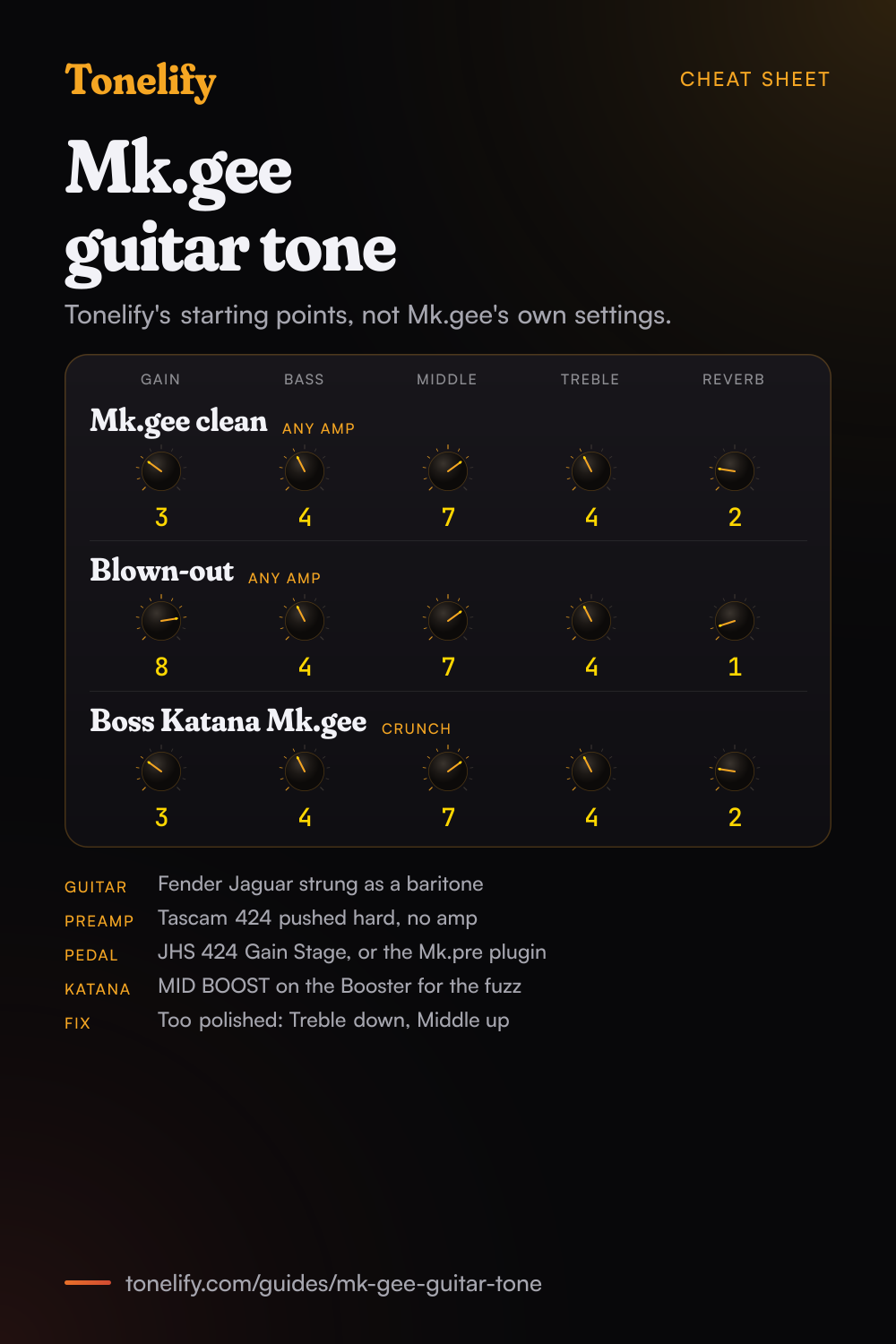
No interview gives Mk.gee's knob settings, so these are Tonelify's starting points. On an amp, set Gain 3, Bass 4, Middle 7, Treble 4 and Reverb 2 for the gooey clean, and raise the Gain to 8 for the blown-out parts. On a Boss Katana, select Crunch with the same knobs and a Spring reverb, and switch in MID BOOST on the Booster for the fuzzier parts. The JHS 424 Gain Stage pedal and Audio Hertz's Mk.pre plugin both model the 424's preamp.
Free download
Printable cheat sheet: PDF and PNG
The mk.gee clean, blown-out and boss katana mk.gee settings from this guide, together on one sheet with short tips. The PDF prints on white; the PNG is the dark version for your phone.
What Mk.gee plays
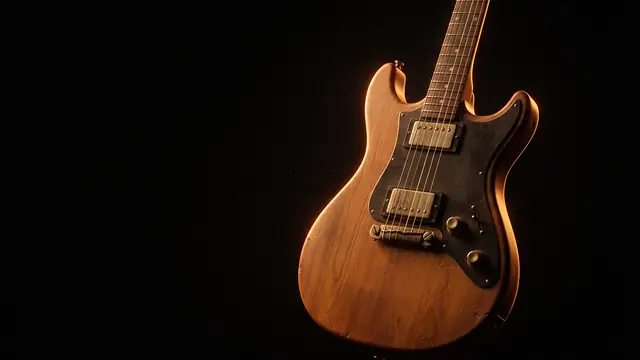
Mk.gee, the stage name of Michael Gordon, plays a Fender Jaguar strung as a baritone guitar. Guitar World described it as the now-signature Jaguar when Mk.gee played Saturday Night Live in November 2024, and the same report credits Andrew Aged on a heavily modded Charvel T-style guitar beside it.[1]
The amp is the unusual part: there is none. MusicRadar reports that Mk.gee has been known to run the guitar directly into a Tascam Portastudio 424, pushing the preamp section hard.[2] It is a four-track cassette recorder, but no tape is involved: the 424's preamp works as an overdrive pedal.[4] Guitar World adds a Roland VG-8, a modeller Roland released in 1995, as another piece of the rig, citing The Atlantic's gear report.[5]
On why the sound is so smeared, Mk.gee told Dazed that growing up on low-quality MP3s probably explains liking underwater-sounding things, because that was 12-bit music.[6]
What the Tascam 424 does to the guitar
Audio Hertz, which models the 424's preamp, calls it legendary for its raw, mid-forward guitar crunch.[4] MusicRadar describes Mk.gee's sound as shifting between clean, mid-forward drive and crunchy, blown-out fuzz, and JHS promises rubbery clean tones, high headroom and smashed-out fuzz from its copy of the circuit.[3]
So the sound sits in the middle of the frequency range, with less low end and less top than a guitar amp. The same channel goes from clean to fuzz with how hard it is driven, which is why the picking hand, not a footswitch, moves the sound between clean and broken-up.
Amp settings for Mk.gee's tone
On a guitar amp, start at Gain 3, Bass 4, Middle 7, Treble 4 and Reverb 2 for the gooey clean. Middle above Bass and Treble gives the mid-forward shape the 424 is known for, and Gain 3 stays clean on light picking but starts to break up when you dig in.
For the blown-out parts, set Gain 8 and Reverb 1, with Bass 4, Middle 7 and Treble 4 as before. If the amp has a single channel, a fuzz or an overdrive with its gain high gets you there instead.
No interview publishes Mk.gee's settings, and the rig has no amp to copy, so these are Tonelify's starting points from the descriptions above, not a measured copy.
- Gain 3
- Bass 4
- Middle 7
- Treble 4
- Reverb 2
Middle above Bass and Treble. Clean on light picking, breaking up when you dig in.
- Gain 8
- Bass 4
- Middle 7
- Treble 4
- Reverb 1
Or keep the clean settings and add a fuzz with its gain high.
Mk.gee settings on a Boss Katana
Select Crunch and set Gain 3, Bass 4, Middle 7 and Treble 4, with Reverb 2 on Spring Reverb, red in bank A on a MkII as shipped. On a Katana 100, set Presence to 3 to take the top off. BOSS describes Crunch as a fat crunch sound that faithfully responds to the nuances of your picking,[8] which suits a sound that moves with the picking hand.
For the fuzzier parts, switch in MID BOOST on the Booster, red in bank B on a MkII as shipped. BOSS calls it a booster with unique characteristics in the midrange.[9] Raise its drive until the chords start to break apart, and store the clean sound on CH1 and the boosted one on CH2.
- Gain 3
- Bass 4
- Middle 7
- Treble 4
- Reverb 2
Spring Reverb, MID BOOST on the Booster for the fuzzier parts, Presence 3 on a Katana 100.
The 424 Gain Stage pedal and the Mk.pre plugin
JHS Pedals' 424 Gain Stage is a preamp pedal modelled on the 424 MK1. MusicRadar reports that it uses the original UPC4570 and NJM4565 op-amps, with knobs for Volume, Bass, Treble, Gain 1 and Gain 2, one footswitch and a balanced XLR output with a ground lift.[2] JHS founder Josh Scott introduced it by saying that Mk.gee was not using a guitar amp but a Tascam 424.[3] It sold for $249 at launch in August 2025.
Audio Hertz's Mk.pre plugin models the same preamp in a DAW, with Gain and Output controls linked by an Auto-Gain button, and Input and Mix controls.[4] Audio Hertz says it is not a tape sim or a generic saturator. Either one goes in front of a clean amp, or straight to the desk, in place of the amp settings above.
The other guitar in the band
Some of the pads and synth-like sounds at the shows come from Andrew Aged, who plays guitar with Mk.gee. In a Guitar World interview, Aged lists the pedals from the last run: a Chase Bliss Mood, a Benson Portastudio prototype as the main fuzz and gain, an MXNLHLT 424 as a super bright EQ and limiter, a Free The Tone reverb, a Slow Gear-type pedal and an Eventide TriceraChorus.[7]
Those are Aged's pedals, not Mk.gee's. They are worth knowing because the band's sound is two guitars, and a swell or a chorus you hear at a show may come from the other side of the stage.
When it sounds wrong
Too polished: turn Treble down a step and Middle up, and cut the reverb. The sound is narrow on purpose.
Too much low end: turn Bass down to 3. A baritone-strung guitar already has more low end than a standard one.
Fuzz that will not clean up: lower the Gain and play softer. On the 424 the same channel does both, so the picking hand does the switching.
Common questions
How does Mk.gee get that guitar tone?
A Fender Jaguar strung as a baritone, run into a Tascam Portastudio 424 in place of an amp, with the 424's preamp pushed hard. MusicRadar describes the sound as shifting between clean, mid-forward drive and crunchy, blown-out fuzz. Guitar World also reports a Roland VG-8 modeller in the rig.
What guitar does Mk.gee play?
A Fender Jaguar, which Guitar World calls now-signature and reports is strung as a baritone guitar. It was the guitar Mk.gee played on Saturday Night Live in November 2024. The sources here do not give the string gauges or the tuning.
Does Mk.gee use an amp?
Not in the usual way. MusicRadar reports that Mk.gee has been known to run the guitar directly into a Tascam Portastudio 424, pushing its preamp hard, and that no tape is involved: the 424's preamp works as an overdrive. JHS founder Josh Scott put it as not using a guitar amp but a Tascam 424.
What is the Tascam 424?
A four-track cassette recorder, the Portastudio 424. MusicRadar notes that recorders like it were used on records such as Bruce Springsteen's Nebraska. Mk.gee uses only its preamp section, which Audio Hertz calls legendary for its raw, mid-forward guitar crunch.
What amp settings get close to Mk.gee's tone?
Tonelify's starting point is Gain 3, Bass 4, Middle 7, Treble 4 and Reverb 2 for the clean, and Gain 8 with Reverb 1 for the blown-out parts. Middle above Bass and Treble copies the mid-forward shape of the 424. No interview gives Mk.gee's own settings.
What are the Boss Katana settings for Mk.gee?
Crunch at Gain 3, Bass 4, Middle 7 and Treble 4, with Reverb 2 on Spring Reverb and Presence 3 on a Katana 100. For the fuzzier parts, switch in MID BOOST on the Booster, which BOSS calls a booster with unique characteristics in the midrange, and store it on CH2.
What is the JHS 424 Gain Stage?
A preamp pedal JHS Pedals modelled on the Tascam 424 MK1, with knobs for Volume, Bass, Treble, Gain 1 and Gain 2, one footswitch and a balanced XLR output with a ground lift. MusicRadar reports it uses the original UPC4570 and NJM4565 op-amps. It was $249 at launch in August 2025.
Is there a Mk.gee plugin?
Audio Hertz's Mk.pre models the 424's preamp in a DAW, with Gain and Output linked by an Auto-Gain button, plus Input and Mix controls. It is not Mk.gee's own product: it models the same preamp Mk.gee uses. Audio Hertz says it is not a tape sim or a generic saturator.
Does Mk.gee use a Roland VG-8?
Guitar World reports, citing The Atlantic, that the Roland VG-8 is another piece of Mk.gee's rig. The VG-8 is a guitar modeller Roland released in 1995, and Guitar World says its used prices rose after Mk.gee's debut album came out.
What pedals does Mk.gee's band use?
Andrew Aged, who plays guitar with Mk.gee, told Guitar World the last run had a Chase Bliss Mood, a Benson Portastudio prototype as the main fuzz, an MXNLHLT 424 as an EQ and limiter, a Free The Tone reverb, a Slow Gear-type pedal and an Eventide TriceraChorus. Those are Aged's pedals, not Mk.gee's.
Why does Mk.gee's guitar sound underwater?
The 424's preamp gives a narrow, mid-forward sound with less low end and top than an amp. Mk.gee told Dazed that growing up on low-quality MP3s, 12-bit music, is probably why underwater-sounding things appeal.
Is there a printable Mk.gee guitar settings cheat sheet?
Yes. The cheat sheet on this page puts the Mk.gee clean, the blown-out setting and the Boss Katana settings on one page, with the gear and the fixes under them. Download the PDF to print it on white, or save the PNG to your phone.
Sources
The numbers in brackets in the text point to this list.
- Guitar World: Mk.gee and the Fender Jaguar on SNL, by Janelle Borg (11 November 2024)
- MusicRadar: JHS Pedals puts a Portastudio in a pedal, by Matt Mullen (12 August 2025)
- Guitar World: JHS Pedals' 424 Gain Stage, by Matt Owen (11 August 2025)
- MusicRadar: Audio Hertz's Mk.pre plugin, by Matt Mullen (15 September 2025)
- Guitar World: how Mk.gee is bringing back the Roland VG-8, by Janelle Borg (15 April 2026)
- MusicRadar: Mk.gee on 12-bit music and underwater sounds (12 September 2024)
- Guitar World: Andrew Aged interview (3 April 2025)
- BOSS: KATANA Mk II Owner's Manual (PDF)
- BOSS: Using BOSS TONE STUDIO for KATANA Gen3, computer (PDF)
Gear in this guide
Settings for your own amp
This guide covers what is true of every rig. For a specific song on a specific amp, Tonelify reads the documented chain behind the recording and returns gain, bass, middle, treble and presence values for the controls your amp actually has. A first plan starts with 7 days free, $0 today.