Get the style
How to get a grunge guitar tone on any amp
Updated 9 min read3 knob panels10 sources
Start with Gain at 6, Bass at 6, Middle at 4, Treble at 6 and Presence at 5, with the reverb at 2 or less, on the bridge pickup. If your amp is still clean at that gain, keep it clean to crunchy and put a distortion pedal in front, which is how much of Nevermind was made. For a quiet verse, drop the Gain to 2 and keep everything else.
Most of the weight on grunge records comes from layering, not from the gain knob. Butch Vig has said Drain You stacks one clean and five distorted guitar tracks, and Dave Jerden built the rhythm sound on Alice in Chains' Dirt from three amps at once. One guitar through one amp sounds smaller, so keep the gain moderate and make the loud sections jump up in level rather than in saturation.
Grunge amp settings to start from
These are the positions the song pages on this site start from for grunge, on a generic amp with Gain, Bass, Middle, Treble and Presence running 0 to 10. Gain 6 is a crunch that still lets a chord ring, Bass 6 gives the low strings their weight, and Middle 4 sits a little under noon without the deep scoop of 1980s metal.
Treat the Gain number as a target sound, not a fixed position. On an amp that is still clean at 6, use a pedal for the drive and keep the amp clean to crunchy; on a high-gain channel, start lower. Reverb stays at 2 or below: these records are dry and close.
- Gain 6
- Bass 6
- Middle 4
- Treble 6
- Presence 5
- Reverb 0 to 2
Bridge pickup. A starting point, not the settings on any record.
Nirvana: pedals into fairly clean amps
Butch Vig has described Nevermind as recorded fairly basically: Kurt Cobain had a Mesa/Boogie, Vig rented a Vox AC30 for clear tones and a Fender Bassman that became the main amp on Lithium and on some of the heaviest parts, and the pedals were Cobain's Big Muff, Vig's Russian Big Muff, a Rat and a Small Clone chorus.[2] Guitar.com's account of the sessions adds a Boss DS-1.[1] Vig also says a couple of songs, Breed and Territorial Pissings, went straight into a preamp with the gain turned up and no amp at all.[2]
Within songs the amps changed with the section. Wikipedia's In Bloom article puts a Mesa/Boogie on the verses and a Bassman on the double-tracked choruses.[3] By In Utero the drive came mostly from a Tech 21 SansAmp, according to Guitar.com's rundown of that album.[4]
On one amp, set the clean sound first, then put a distortion pedal in front for the loud parts. A DS-1 at Dist 7 to 9 and Tone 4 to 5, at unity level or a little above, into a clean or lightly crunchy amp is a starting point for the Nevermind sound, the same one the DS-1 guide gives.
- Level unity
- Tone 4 to 5
- Dist 7 to 9
Into a clean or lightly crunchy amp. A starting point, not Cobain's settings: no source records where he set the knobs.
Alice in Chains: thick low end, moderate gain
Jerry Cantrell's sound rests on a G&L Rampage, an all-maple guitar with one pickup and one volume knob. On Facelift he used a Marshall modified by Reinhold Bogner, which he describes as clear low end with a lot of growl that does not come at the cost of definition.[5] His main Rampage is tuned down a half step.
For Dirt, producer Dave Jerden split the guitar three ways at once: a Bogner Fish preamp into a VHT power amp for the lows, a Bogner Ecstasy for the mids and a Rockman recorded direct for the highs, with each track doubled and panned, six in all.[6] On one amp that means a full bass and a smooth treble rather than more gain: raise the gain only until the riff starts losing definition.
Pearl Jam: a Marshall and a Strat, played loose
Mike McCready's own account of the Ten rig is a black 1962 Japanese reissue Stratocaster into a Marshall JCM800 and a 4x12, with a Fender Bassman for clean tones,[7] while Stone Gossard played mostly Les Pauls. On Alive, producer Tim Palmer remembers McCready nailing the outro solo once he put a Uni-Vibe on it.[8]
That is a crunch rather than a wall of fuzz. Take the gain down a step from the Nirvana setting, keep the middle up a little more for the leads, and leave room for feel. Jeff Ament remembers a hundred takes of Even Flow,[9] and McCready says it was the only song the band recorded that many times, and that it was about how it felt rather than technique.[7]
Soundgarden: drop D and two amps at once
For the heavy guitars on Black Hole Sun, producer Michael Beinhorn split the signal between a 50-watt Marshall JMP half stack and a Mesa/Boogie Dual Rectifier.[10] The verse arpeggios went through a Leslie rotating-speaker cabinet, and the song is in drop D, tuned slightly sharp.[10]
So the verse wants a clean amp with a rotary or vibe effect rather than a chorus, and the chorus a thick, low drive. Two amps blended give more body than either alone, so on one amp keep the bass full and resist turning the gain past the point where the low D still sounds like a note.
Quiet verse, loud chorus: two sounds, not one
Much of grunge moves between a quiet verse and a loud chorus. Vig says the watery verse sound on Smells Like Teen Spirit is the Small Clone.[2] On Lithium the verses are loose single notes and double stops, and the chorus is a thick fuzz into a Bassman. Riding one gain setting through both never gets either right.
Set the clean sound with the Gain at 2 and the reverb at about 3, then switch to the drive with a pedal or a second channel. Make the chorus a real step up in level as well as in gain: on the records the loud parts are also doubled, so they arrive bigger as well as dirtier.
- Gain 2
- Bass 6
- Middle 4
- Treble 6
- Presence 5
- Reverb 3
Add a chorus for the Nevermind verses, a rotary or vibe for Black Hole Sun.
Settings for one song on your amp
These are starting points on a generic amp. Each grunge song in the library has its own page with the rig the record was made on, its sources, and a starting point for that song. When you want the settings worked out for the amp and guitar you own, Tonelify does that for any song in the library.
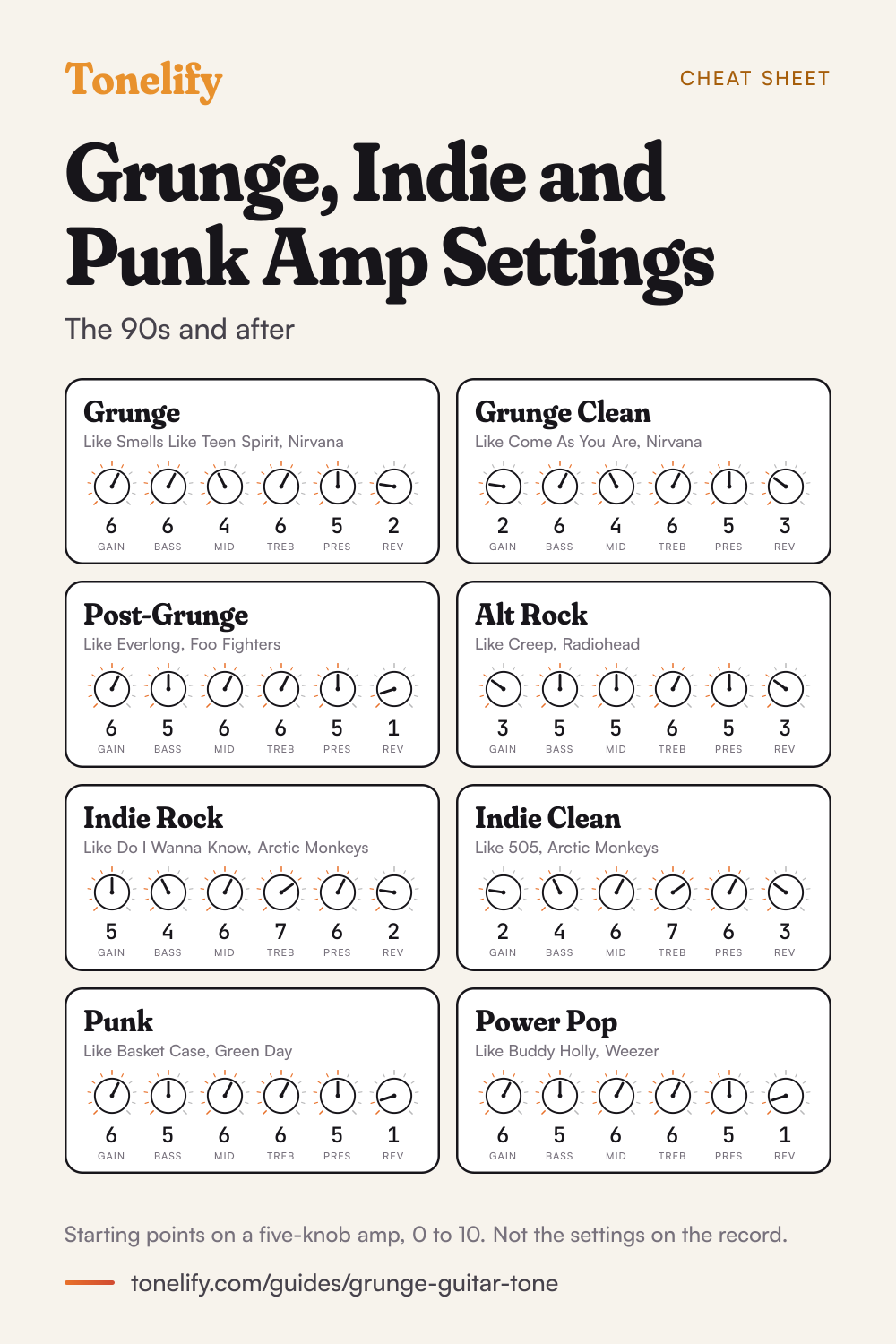
Every setting from this guide on one sheet
Each style with the song it comes from and its starting point on a five-knob amp, the same numbers as the song pages. Open it full size to print, or save it for later.
Grunge songs in the library


Common questions
What are good grunge amp settings?
Start with Gain 6, Bass 6, Middle 4, Treble 6 and Presence 5, with the reverb at 2 or less, on the bridge pickup. If the amp stays clean at that gain, use a distortion pedal in front of it instead, and drop the Gain to 2 for quiet verses.
What distortion did Kurt Cobain use on Nevermind?
Butch Vig names Cobain's Big Muff, his own Russian Big Muff, a Rat and a Small Clone chorus as the pedals on the sessions, and Guitar.com adds a Boss DS-1. By In Utero most of the drive came from a Tech 21 SansAmp.
What tuning is grunge in?
There is no single grunge tuning. Jerry Cantrell's main guitar is tuned down a half step, Black Hole Sun is in drop D tuned slightly sharp, and Lithium is a whole step down. Check the song's own page before you retune.
Can I get a grunge tone on a small practice amp?
Yes. Use the crunch or drive channel with the gain around 6, or the clean channel with a distortion pedal in front, keep the bass full and the middle a little under noon. Expect one guitar to sound smaller than the records, which stack several tracks.
Sources
The numbers in brackets in the text point to this list.
- Guitar.com: the gear Kurt Cobain used on Nevermind
- Guitar.com: Butch Vig on recording guitars with Nirvana
- Wikipedia: In Bloom
- Guitar.com: the gear used on In Utero
- Guitar World: Jerry Cantrell on the G&L Rampage and his Facelift amp
- Guitar.com: the gear Jerry Cantrell used on Alice in Chains' Dirt
- Guitar World: Mike McCready looks back on 30 years of Ten
- Wikipedia: Alive (Pearl Jam song)
- Wikipedia: Even Flow
- Produce Like A Pro: Black Hole Sun, inside the song with Michael Beinhorn
Gear in this guide
Settings for your own amp
This guide covers what is true of every rig. For a specific song on a specific amp, Tonelify reads the documented chain behind the recording and returns gain, bass, middle, treble and presence values for the controls your amp actually has. A first plan starts with 7 days free, $0 today.