
Valeton GP-5 presets and settings
Mini pedal with one footswitch and a colour screen, edited in the Valeton Suite phone app. Nine modules at once from 32 amp models and over 100 effects, plus a loader for NAM captures and up to 20 cabinet IRs.
⚡ Match a tone on this gearHow do you dial in a specific tone on a Valeton GP-5?
A multi-effects unit gives you the whole chain in one box, which means the order of the blocks is as much of the answer as the values inside them. Settings for the Valeton GP-5 name the amp model, the block order and the parameters together, rather than handing you numbers with no chain to put them in.
Name the song you are chasing in the tone matcher and Tonelify returns the settings for this exact multi-effects unit, not the settings the original artist used. Those are two different things: the recording was made on gear most players do not own.
Free download
Printable cheat sheet: PDF and PNG
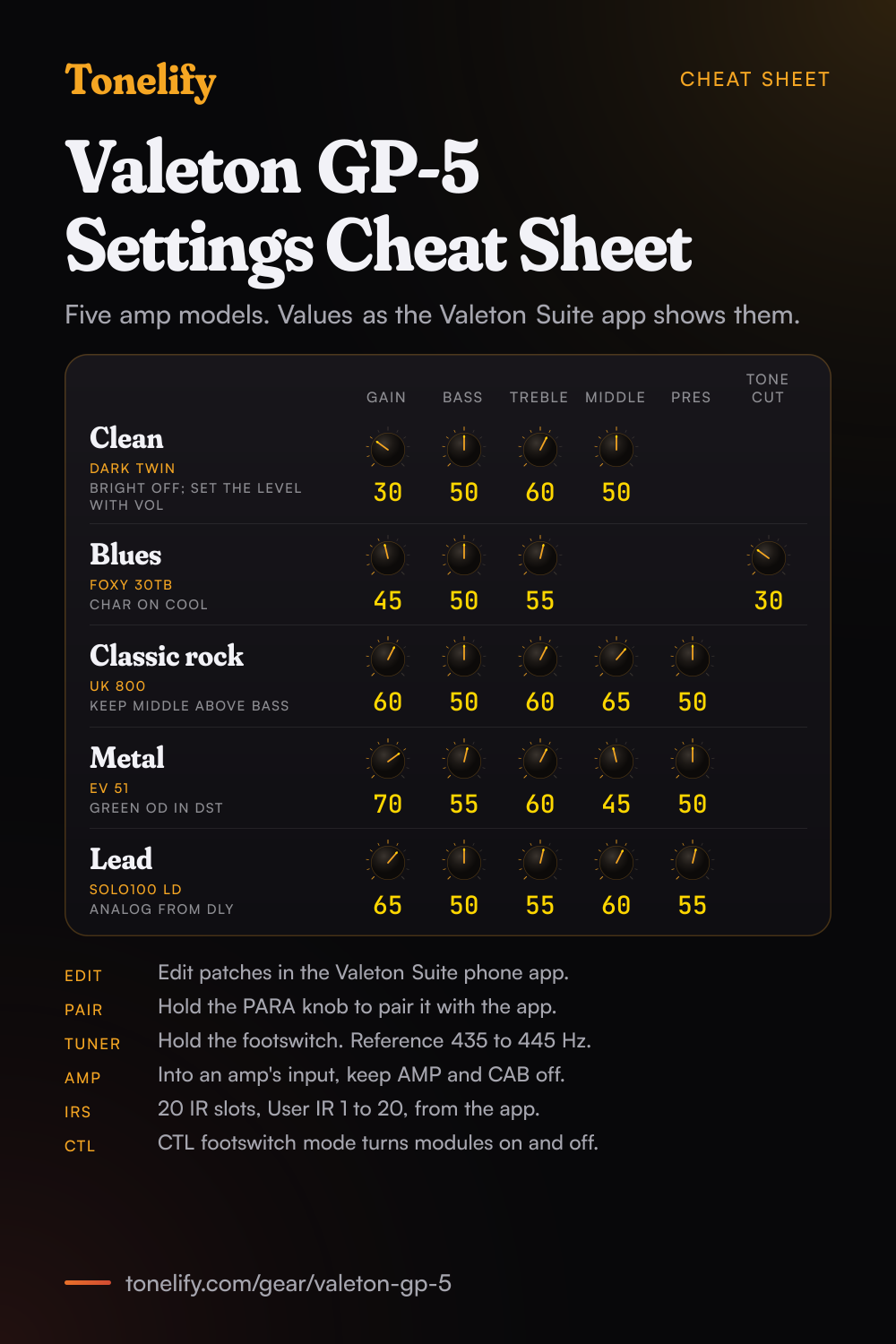
The clean, blues, classic rock, metal and lead settings from this page, together on one sheet with short tips. The PDF prints on white; the PNG is the dark version for your phone.
Starting settings on the Valeton GP-5
Values as the Valeton Suite app shows them, on the unit's own scale; each drawn knob shows that value's share of the range. They are where to begin, not Valeton's numbers: pick the amp model first, then move one control at a time from here.
Clean
Dark Twin, which Valeton bases on the Fender '65 Twin Reverb. Gain 30, Bass 50, Middle 50, Treble 60, Bright off. Valeton's list calls Gain the pre gain and VOL the post gain, so set the level with VOL and keep Gain low for a clean that stays clean. For a capture of the same amp, load the factory SnapTone file Twin RVB, which Valeton models after the '65 Twin Reverb's Normal channel with a 2x12 cabinet. J-120 CL, based on the Jazz Chorus, is the other big clean, and it has no Gain control at all.
- Gain 30
- Bass 50
- Middle 50
- Treble 60
Bright off; set the level with VOL.
Edge of breakup and blues
Foxy 30TB, Valeton's model of the VOX AC30HW's Top Boost channel. Gain 45, Bass 50, Treble 55, Tone cut 30, Char on Cool. It has Bass and Treble but no Middle, plus Tone cut, and Char picks between two characters: Cool, with lower gain, and Hot, with higher gain, so Hot is the step to take before more Gain. Tweedy, based on the Fender Tweed Deluxe, has only Gain, Tone and VOL. Among the factory SnapTone files, BJ3 OD and UK BB OD are captures of a Fender Blues Junior III and a Marshall Bluesbreaker in their overdrive tones.
- Gain 45
- Bass 50
- Treble 55
- Tone cut 30
Char on Cool; Hot for more gain.
Classic rock
UK 800, Valeton's model of the Marshall JCM800. Gain 60, Bass 50, Middle 65, Treble 60, PRES 50. Keep the mids up: rock guitar sits in the midrange, and scooping it is the usual reason a patch sounds thin next to a band. UK 45, the JTM45's normal channel, and UK 50JP, a JMP50 with its inputs jumped and two Gain controls, are the older Marshalls. Two factory SnapTone files cover the same ground as captures: UK 800, of a JCM800 with a 4x12, and UK SLP, of a 1959SLP.
- Gain 60
- Bass 50
- Middle 65
- Treble 60
- PRES 50
Keep Middle above Bass.
Metal
EV 51, Valeton's model of the Peavey 5150's Lead channel, or Mess DualM, channel 3 of a Mesa/Boogie Dual Rectifier in Modern mode. EV 51: Gain 70, Bass 55, Middle 45, Treble 60, PRES 50. Turn on NR: its Gate, based on the ISP Decimator, has one control, THRE, the level it opens at. Valeton's Q&A says a click or pop between notes with distortion on comes from the gate opening and closing, and that adjusting the threshold removes it. For tighter palm mutes, put Green OD, Valeton's model of the Ibanez TS-808, in DST before the amp with its Gain low, and take the amp's Gain down a step.
- Gain 70
- Bass 55
- Middle 45
- Treble 60
- PRES 50
Add Green OD in DST before you raise the Gain.
Lead
Solo100 LD, Valeton's model of the Soldano SLO100's overdrive channel. Gain 65, Bass 50, Middle 60, Treble 55, PRES 55. Add Analog from DLY, which Valeton describes as a warm delay with an analog feel, and keep its Mix low so the repeats sit behind the notes. To bring a boost and the delay in with one press, set the footswitch to CTL mode in the global settings and choose in the Valeton Suite app which modules it switches.
- Gain 65
- Bass 50
- Middle 60
- Treble 55
- PRES 55
CTL mode: one press for boost and delay.
Bass and acoustic
Valeton says the GP-5 works with electric, bass and acoustic guitars. For bass, the AMP module has Classic Bass, based on the Ampeg SVT, Foxy Bass, on the VOX AC-100, and Mess Bass, on the Mesa/Boogie Bass 400, with Bass OD in DST, Bass EQ 1 and 2, and the Bellman 2x12 and AMPG 4x10 cabinets; Toucher, the envelope filter in PRE, has a Guitar and a Bass mode. Eight of the factory SnapTone files are bass amps, from AGL DB BS, after the Aguilar DB 750, to Juice ODBS, after the Orange Bass MKIII. For an acoustic, AC Pre1 and AC Pre2 are both based on the AER Colourizer 2 preamp: Pre1's EQ centre runs from 90 Hz to 1.6 kHz and Pre2's from 680 Hz to 11 kHz, and an EQ Gain of 50 leaves it neutral.
Valeton GP-5 amp list
The AMP module has 32 models: 27 guitar amps, 3 bass amps and 2 acoustic preamps. Each row gives the amp Valeton names as the basis, in the manual's order. Where the manual's own entry is unclear, the row says so rather than guessing.
| Model | Type | Based on |
|---|---|---|
| Tweedy | Clean | Fender Tweed Deluxe |
| Bellman 59N | Clean | Fender '59 Bassman |
| Dark Twin | Clean | Fender '65 Twin Reverb |
| Foxy 30N | Clean | VOX AC30HW, normal channel |
| J-120 CL | Clean | The "Jazz Chorus" solid-state combo, as Valeton puts it |
| Match CL | Clean | Matchless Chieftain 212 combo, clean |
| L-Star CL | Clean | Mesa/Boogie Lone Star, channel 1 |
| UK 45 | Drive | Marshall JTM45, normal channel |
| UK 50JP | Drive | Marshall JMP50, inputs jumped |
| UK 800 | Drive | Marshall JCM800 |
| Bellman 59B | Drive | Fender '59 Bassman, Bright channel |
| Foxy 30TB | Drive | VOX AC30HW, Top Boost channel |
| SUPDual OD | Drive | Supro Dual-Tone 1624T, channels 1 and 2, dirty |
| Solo100 OD | Drive | Soldano SLO100, crunch channel |
| Z38 OD | Drive | Dr. Z Maz 38 Sr. combo, Hi input |
| Bad-KT OD | Drive | Bad Cat Hot Cat 30, overdrive channel |
| Juice R100 | Hi Gain | Orange Rockerverb 100, Dirty channel |
| Dizz VH | Hi Gain | Diezel VH4, channel 3 |
| Dizz VH+ | Hi Gain | Diezel VH4, channel 4 |
| Eagle 120 | Hi Gain | ENGL Savage 120 |
| EV 51 | Hi Gain | Peavey 5150, Lead channel |
| Solo100 LD | Hi Gain | Soldano SLO100, overdrive channel |
| Mess DualV | Hi Gain | Mesa/Boogie Dual Rectifier, channel 3, Vintage mode |
| Mess DualM | Hi Gain | Mesa/Boogie Dual Rectifier, channel 3, Modern mode |
| Power LD | Hi Gain | ENGL Powerball II E645/2, channel 4 |
| Flagman+ | Hi Gain | A "Brown Eye" UK-style boutique head, HBE channel, as Valeton puts it |
| Bog RedV | Hi Gain | Bogner XTC, red channel |
| Classic Bass | Bass | Ampeg SVT |
| Foxy Bass | Bass | VOX AC-100 |
| Mess Bass | Bass | Mesa/Boogie Bass 400 |
| AC Pre1 | Acoustic | AER Colourizer 2 acoustic preamp, EQ centre 90 Hz to 1.6 kHz |
| AC Pre2 | Acoustic | AER Colourizer 2 acoustic preamp, EQ centre 680 Hz to 11 kHz |
Valeton GP-5 cab list
The CAB module has 20 factory cabinets, 18 for guitar and 2 for bass, and 20 slots, User IR 1 to 20, for your own impulse responses, loaded from the Valeton Suite app or the desktop software.
| Cabinet | Type | Based on |
|---|---|---|
| TWD CP 1x8 | Small cab | Vintage Fender Champ 1x8 |
| Dark VIT 1x12 | Small cab | Vintage Fender Vibrolux 1x12 |
| Foxy 1x12 | Small cab | Vintage VOX AC15 1x12 |
| L-Star 1x12 | Small cab | Mesa/Boogie Lone Star 1x12 |
| Dark CS 2x12 | Small cab | A custom modified Fender 2x12 |
| Dark Twin 2x12 | Small cab | Vintage Fender '65 Twin Reverb 2x12 |
| SUP Star 2x12 | Small cab | Mesa/Boogie Lone Star 2x12 |
| J-120 2x12 | Small cab | The "Jazz Chorus" 2x12 |
| Foxy 2x12 | Small cab | Vintage VOX AC30 2x12 |
| UK GRN 2x12 | Small cab | Marshall 2550 2x12 |
| UK GRN 4x12 | Large cab | Vintage Marshall 4x12 with Celestion Greenbacks |
| Bog 4x12 | Large cab | Bogner 4x12 |
| Dizz 4x12 | Large cab | Diezel 4x12 |
| EV 4x12 | Large cab | Peavey 6505 4x12 |
| Solo 4x12 | Large cab | Soldano 4x12 |
| Mess 4x12 | Large cab | Mesa/Boogie Rectifier 4x12 |
| Eagle 4x12 | Large cab | ENGL 4x12 |
| Juice 4x12 | Large cab | Orange PPC412 |
| Bellman 2x12 | Bass cab | Vintage Fender "Piggyback" Bassman 2x12 |
| AMPG 4x10 | Bass cab | Ampeg SVT-410HE |
Valeton GP-5 effects list
Ten modules, in the order Valeton's list gives them: NR, PRE, DST, SnapTone (shown as N→S), AMP, CAB, EQ, MOD, DLY and RVB. Up to nine run at once, and Valeton says the order of some of them can be changed, which is done in the Valeton Suite app. Where Valeton names what an effect is based on, it is in brackets.
- NR (1)
- Gate (ISP Decimator)
- PRE (10)
- COMP (Ross Compressor), COMP4 (Keeley C4 4-knob compressor), Boost (Xotic EP Booster), Micro Boost (MXR M133 Micro Amp), B-Boost (Xotic BB Preamp), Toucher (envelope filter), Crier (auto wah), OCTA (polyphonic octave), Pitch (polyphonic pitch shifter and harmoniser), Detune
- DST (10)
- Green OD (Ibanez TS-808 Tube Screamer), Yellow OD, Super OD, SM Dist, Plustortion (MXR M104 Distortion+), La Charger (MI Audio Crunch Box), Darktale (ProCo The Rat, early LM308 version), Sora Fuzz (Dallas-Arbiter Fuzz Face), Red Haze (Dallas-Arbiter Fuzz Face), Bass OD
- EQ (5)
- Guitar EQ 1, Guitar EQ 2, Bass EQ 1, Bass EQ 2, Mess EQ (the 5-band EQ on Mesa/Boogie amps)
- MOD (11)
- A-Chorus (Arion SCH-1), B-Chorus, Jet, N-Jet, O-Phase (MXR M101 Phase 90), M-Vibe (Voodoo Lab Micro Vibe), V-Roto, Vibrato, O-Trem (Demeter TRM-1 Tremulator), Sine Trem, Bias Trem
- DLY (10)
- Pure, Analog, Slapback, Sweet Echo, Tape, Tube, Rev Echo, Ring Echo, Sweep Echo, Ping Pong
- RVB (10)
- Air, Room, Hall, Church, Plate L, Plate, Spring, N-Star, Deepsea, Sweet Space
Valeton GP-5 factory SnapTone files
SnapTone is Valeton's name for a NAM (Neural Amp Modeler) capture converted for the unit. The GP-5 ships with 50 and stores up to 80, loaded into the SnapTone module, shown as N→S, which has its own Gain, VOL, Bass, Middle and Treble. What each file is modelled after, by Valeton's list, is in brackets, with the cabinet where Valeton names one.
- Pedals (5)
- 14 DST (Fortin NATAS), Force OCD (Fulltone OCD V3, HP mode), Revolt DST (Suhr Riot, Natural mode), SweetDrive (Mad Professor Sweet Honey), FlagmanDST (a British modern high-gain pedal, unnamed)
- Clean amps (10)
- Foxy 30 (VOX AC30, 2x12), Twin RVB (Fender 65 Twin Reverb, Normal channel, 2x12), Match 30 (Matchless DC-30, channel 1, 2x12), MessStar S (Mesa Boogie Lone Star Special 30-watt, 1x12), MessJP CH1 (Mesa Boogie JP2C, channel 1, 4x12), Rock2 CL (Two-Rock Classic Reverb Signature, 1x12), Lany LH20 (Laney Lionheart L20H, Clean channel, 2x12), SUPDual (Supro Dual-Tone, channels 1 and 2 clean, 2x12), BJ3 CL (Fender Blues Junior III clean, 1x12), UK BB CL (Marshall Bluesbreaker clean, 2x12)
- Overdrive amps (6)
- BJ3 OD (Fender Blues Junior III overdrive, 1x12), UK BB OD (Marshall Bluesbreaker overdrive, 2x12), UK 410 OD (Marshall JVM410, Crunch channel, 4x12), Rock2 OD (Two-Rock Custom Reverb Signature, 2x12), HW100 (Hiwatt Custom 100 DR103, 4x12), Juice CR N (Orange CR120, Dirty channel, 4x12)
- Distortion and high-gain amps (19)
- Foxy 30JMI (VOX JMI AC30, 2x12), Bog DST (Bogner Ecstasy 101B, channel 3, 4x12), CV XV (Carvin XV-212, Lead channel, 2x12), MessJP CH2 (Mesa Boogie JP2C, channel 2, 4x12), MessJP CH3 (Mesa Boogie JP2C, channel 3, 4x12), UK 800 (Marshall JCM800, 4x12), UK SLP (Marshall 1959SLP, 4x12), UK410 DST1 (Marshall JVM410, OD1 channel, red mode, 4x12), UK410 DST2 (Marshall JVM410, OD2 channel, red mode, 4x12), UK 900 (Marshall JCM900, channel B, 4x12), UK 2000 (Marshall JCM2000, 4x12), UK DSL (Marshall DSL100H, OD2 channel, 4x12), Dizz VH (Diezel VH4, channel 4, 4x12), Mess TriV (Mesa Boogie Triple Rectifier, channel 3, Vintage mode, 4x12), Mess TriM (Mesa Boogie Triple Rectifier, channel 3, Modern mode, 4x12), Mess 2C+ (Mesa Boogie Mark IIC+, Lead channel, 4x12), Eagle Iron (ENGL Ironball E606, Lead channel, 4x12), H&K BLK200 (Hughes & Kettner Black Spirit 200, Lead channel, 4x12), JuiceCRMAX (Orange CR120, Dirty channel with everything at maximum, 4x12)
- Bass amps and acoustic simulators (10)
- AGL DB BS (Aguilar DB 750), AMPG 6 BS (Ampeg SVT-6 Pro), EB Faf BS (EBS Fafner), HACK BS (Hartke HD50 combo), PV BS (Peavey VB-2), MATT BS (Markbass CMD 151P combo), H&K BS (Hughes & Kettner Bassmaster preamp), Juice ODBS (Orange Bass MKIII), AC SIM (an acoustic simulator's Enhance mode), Piezo SIM (an acoustic simulator's Piezo mode)
Valeton GP-5 questions
What amps are in the Valeton GP-5?
32 in the AMP module: 27 guitar amps, 3 bass amps and 2 acoustic preamps, the same line-up as the GP-50. Valeton's effect list bases them on amps including the Fender Tweed Deluxe (Tweedy), '59 Bassman (Bellman 59N and 59B) and '65 Twin Reverb (Dark Twin), the VOX AC30HW (Foxy 30N and 30TB), the Marshall JTM45 (UK 45), JMP50 (UK 50JP) and JCM800 (UK 800), the Matchless Chieftain (Match CL), the Mesa/Boogie Lone Star (L-Star CL) and Dual Rectifier (Mess DualV and DualM), the Supro Dual-Tone (SUPDual OD), Soldano SLO100 (Solo100 OD and LD), Dr. Z Maz 38 Sr. (Z38 OD), Bad Cat Hot Cat 30 (Bad-KT OD), Orange Rockerverb 100 (Juice R100), Diezel VH4 (Dizz VH and VH+), ENGL Savage 120 (Eagle 120) and Powerball II (Power LD), Peavey 5150 (EV 51) and Bogner XTC (Bog RedV). On top of these come 50 factory SnapTone files, captures of further amps and pedals. Valeton says the GP-5 uses the same modelling engine as the GP-200, with the same core algorithms on different hardware, which may lead to slight differences in tone.
What is the difference between the Valeton GP-5 and the GP-50?
The GP-5 is the smaller of the two: one footswitch instead of two, and no editing on the unit itself, since its patches are edited only in the Valeton Suite phone app. The GP-50 has a built-in battery, a 20 second looper and MIDI in and thru jacks, none of which the GP-5's manual lists. Both have the same 32 amp models and the same 50 factory SnapTone files, but the GP-5's PRE module has no C-Wah or AC Sim, and its CAB module no acoustic simulation. Both have 100 patch slots; the GP-5's factory patches fill the first 50, the GP-50's the first 55. The GP-5's manual gives 92 mm by 44.6 mm by 50.5 mm and 250 g, against the GP-50's 122 mm by 82 mm by 54 mm and 430 g.
How do you edit patches on the Valeton GP-5?
Only in the Valeton Suite app for iOS and Android, over the GP-5's built-in wireless connection. Hold the PARA knob on the main screen to start pairing, choose GP-5 in the app and connect: from there you adjust the tone, rearrange the effect modules, choose the modules the footswitch controls, import NAM files and load third-party IRs. If the app cannot find the unit, check that your phone has given the app Bluetooth access. Valeton Suite for Windows and macOS works over USB for managing patches, SnapTone files and IRs in batches, and for firmware updates, which the phone app does not do.
What is SnapTone on the Valeton GP-5?
Valeton's format for NAM (Neural Amp Modeler) captures. The SnapTone module, shown as N→S on the screen, loads a file converted from a NAM file and has its own Gain, VOL, Bass, Middle and Treble. The GP-5 comes with 50 files and stores up to 80: 5 pedals, 35 guitar amps, 8 bass amps and 2 acoustic simulators, each modelled after a named unit, such as the Fortin NATAS pedal (14 DST) or a Mesa Boogie Mark IIC+ Lead channel (Mess 2C+).
How many effects can the GP-5 run at once?
Up to nine of its ten modules: NR, PRE, DST, SnapTone, AMP, CAB, EQ, MOD, DLY and RVB. Valeton counts over 100 effects, and the manual's effect list has 109 models when the 32 amps and 20 cabinets are counted. Valeton says the order of some modules can be changed, which you do in the Valeton Suite app.
What do the footswitch modes do on the GP-5?
Set the mode under FS Mode in the global settings, which the PARA knob opens. In 0-99, the default, each press steps to the next of the 100 patches; in 0-9 it steps through the ten patches of the current bank, where the tens digit is the bank. A-Z is a song list: you pick the patches and their order, and each press goes to the next one. In CTL the press turns the modules you assigned in the app on and off, and in Tuner it opens the tuner and bypasses the GP-5, so the whole patch works like one stompbox. Valeton says turning the PARA knob changes patch whatever the footswitch mode, and holding the footswitch opens the tuner in any mode.
Should you use the GP-5's amp models with a guitar amp?
Into the front of a guitar amp, Valeton says to keep the AMP and CAB modules off. In the amp's effects loop, between its send and return, it recommends using only EQ, MOD, DLY and RVB, again with AMP and CAB off. Into the amp's return alone, the GP-5's AMP module does the preamp's job with the amp's power amp: keep CAB off, or turn on No Cab in the global settings. Into headphones, an interface, monitors or a PA, keep AMP and CAB on and No Cab off.
Can you load your own IRs into the GP-5?
Yes: 20 slots for third-party cabinet IRs, User IR 1 to 20 in the CAB module, loaded from the Valeton Suite app or the desktop software. Valeton's Q&A says the GP-5 takes 44.1 kHz IR files and reads most third-party IRs of 200 ms and 500 ms; if one gives an error, the file may be incompatible or corrupted.
What power supply does the Valeton GP-5 need?
A 9V DC supply with a 5.5 x 2.1 mm centre-negative plug giving at least 100 mA, or 5V over the USB-C port at 190 mA or more, which can come from a USB power adapter or a power bank. Valeton warns that a centre-positive supply may damage it. If the GP-5 restarts when another pedal on the same supply is switched on or off, that is a voltage drop on a supply whose outputs are not isolated, and Valeton recommends an isolated one.
Can the Valeton GP-5 be used as an audio interface?
Yes, over USB-C with a computer or a phone, and Valeton's product page lists it as 2 in and 2 out. Windows needs Valeton's ASIO driver; macOS, iOS and Android need none, though a phone may need an OTG adapter. It runs at 44.1 kHz only, so set your DAW to that. It can record the guitar and the Bluetooth audio from your phone together, and the global settings set the recording level (REC Level), the Bluetooth audio's recording level (BT REC) and the USB playback level (MON Level), each from -20 dB to +20 dB.
Is the Valeton GP-5 stereo?
Its output is a 1/4 inch TRS stereo jack, unbalanced, which also drives headphones. A TS cable takes the left channel only, which suits a mono amp or pedal, and Valeton says the jack is not a DI. Modulation, delays such as Ping Pong and reverbs are stereo, but a mono effect such as a distortion placed after them turns the signal back to mono. Analog bypass is mono too.
How do you use the tuner on the GP-5?
Hold the footswitch on the main screen; the signal is muted while you tune. The note shows in the middle, flat to the left and sharp to the right, and the scale turns from red to yellow to green as you get in tune. Turn the PARA knob to set the reference A from 435 Hz to 445 Hz; 440 Hz is the default. With the footswitch in Tuner mode, a press opens the tuner and bypasses the unit instead, and the PARA knob picks Ana (analog) or DSP bypass. Press the footswitch to leave.
Does the GP-5 have MIDI or an expression pedal input?
Not as jacks. It takes MIDI over USB from a computer or tablet: CC0 selects patches 00 to 99, CC7 sets the patch volume, CC48 to CC57 switch the ten modules on and off, CC58 the tuner and CC69 the CTL footswitch. A USB MIDI controller cannot plug straight in, because the GP-5 and most controllers are both USB devices that need a host. Valeton's Q&A says Bluetooth MIDI is under development, and that external MIDI expression pedals over Bluetooth will come with a future firmware update.
What are the best Valeton GP-5 settings for metal?
Start with EV 51, Gain 70, Bass 55, Middle 45, Treble 60 and PRES 50, with the NR gate on and Green OD in DST. These are starting points rather than Valeton's numbers. If it fizzes, lower Gain first and Treble second.
How big is the Valeton GP-5?
A mini pedal in a metal case with one footswitch. Valeton gives two sets of figures: its manual says 92 mm wide, 44.6 mm deep and 50.5 mm high at 250 g, and its product page 93.5 mm by 42 mm by 52 mm at 237 g. It has a colour LCD, a VOL knob for the main output and the PARA knob, which changes patch, opens the global settings and starts Bluetooth pairing.
What firmware is the Valeton GP-5 on?
Valeton's English manual covers firmware V1.0.3, and its product page lists firmware V1.0.6 to download, for the phone app's version 1.0.4. Updates go in through the desktop Valeton Suite over USB; About in the global settings shows the version you have. Valeton's Q&A says you can go straight to the latest version without the ones in between, as long as you update the software to match.
How do you build a patch on the Valeton GP-5?
Pick the amp model first, then set its controls, then add the blocks in signal-chain order: drive before the amp, time and modulation after it. A patch built the other way around ends up compensating for the wrong stage. Tonelify returns the model, the order and the parameters together.
Does Tonelify support the Valeton GP-5?
Yes. Name it in the tone matcher along with the song you are chasing and the settings come back adapted to it. Gear does not need to be in the catalog for a match to run.
Sources
Panel, specifications and dates checked against these on .