
Zoom G5n presets and settings
Large floor unit with an Overview Display over four units, each with its own display, four knobs and a footswitch, plus a built-in expression pedal, an output booster and a TAP switch. Nine effects in a patch, 200 patches, an 80 second looper, 68 rhythm patterns and USB audio.
⚡ Match a tone on this unitHow do you dial in a specific tone on a Zoom G5n?
A multi-effects unit gives you the whole chain in one box, which means the order of the blocks is as much of the answer as the values inside them. Settings for the Zoom G5n name the amp model, the block order and the parameters together, rather than handing you numbers with no chain to put them in.
Name the song you are chasing in the tone matcher and Tonelify returns the settings for this exact multi-effects unit, not the settings the original artist used. Those are two different things: the recording was made on gear most players do not own.
Free download
Printable cheat sheet: PDF and PNG
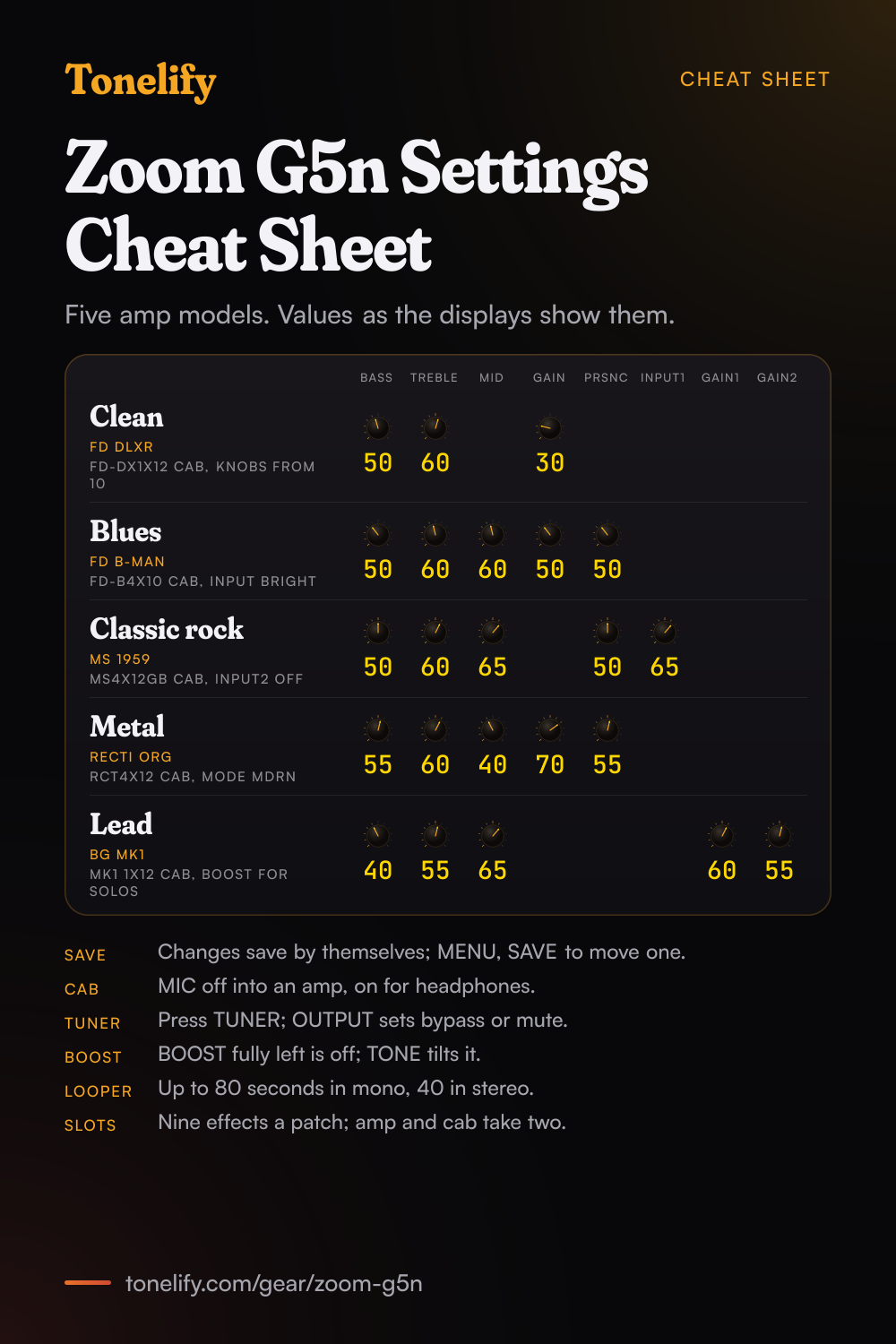
The clean, blues, classic rock, metal and lead settings from this page, together on one sheet with short tips. The PDF prints on white; the PNG is the dark version for your phone.
Starting settings on the Zoom G5n
Values as the unit's screen shows them, on its own scale; each drawn knob shows that value's share of the range. They are where to begin, not Zoom's numbers: pick the amp model first, then move one control at a time from here.
Clean
FD DLXR, Zoom's model of the Fender '65 Deluxe Reverb, with the FD-DX1x12 cabinet, Zoom's model of the Deluxe's own cabinet with one 12 inch Jensen C-12K. Gain 30, Bass 50, Treble 60. The model has no MID control, and its knobs run from 10 to 100, not from 0. Zoom's own clean starting point is a different amp: 091 Twin Basic is a basic setting for FD TWNR, and 033 RC Clean puts RC Boost in front of it. 112 DeluxeGang is Zoom's crunch sound on FD DLXR.
- Gain 30
- Bass 50
- Treble 60
Edge of breakup and blues
FD B-MAN, Zoom's model of the Fender '59 Bassman, with the FD-B4x10 cabinet and its four 10 inch Jensens. Input BRIGHT, Gain 50, Bass 50, MID 60, Treble 60, PRSNC 50. This model's knobs run from 10 to 120, so 50 is under halfway. Zoom pairs the amp with SweetDrv in 101 MuddyRock, an all-purpose crunch. For Texas blues, 013 TexasToasT drives FD TWNR with TS Drive, its simulation of the Ibanez TS808, and 113 GRID SRV uses BG GRID, Zoom's model of the Mesa Boogie Grid Slammer.
- Gain 50
- Bass 50
- MID 60
- Treble 60
- PRSNC 50
Classic rock
MS 1959, Zoom's model of the Marshall 1959 Super Lead 100, with the MS4x12GB cabinet, Zoom's model of a Marshall 1960 B-type with G12M Greenbacks. Input1 65, Input2 OFF, Bass 50, MID 65, Treble 60, PRSNC 50. The amp has no single Gain knob: Input1 and Input2 set the gain of its two inputs, and either can be OFF. Zoom's 121 ZEP 1959 is a straight rock sound inspired by Jimmy Page with Led Zeppelin. For the JCM800 sound, Zoom uses MS 800 in 005 The Brown and 087 BallzNFace.
- Input1 65
- Bass 50
- MID 65
- Treble 60
- PRSNC 50
Metal
Recti ORG, Zoom's model of the Mesa Boogie Dual Rectifier's Orange channel, with the RCT4x12 cabinet and its Vintage 30s. Mode MDRN, Gain 70, Bass 55, MID 40, Treble 60, PRSNC 55. Mode sets the character, VNTG or MDRN. Put NoiseGate first: Zoom describes it as a noise gate that cuts the sound during playing pauses. That is the pairing in Zoom's 110 Industrial, a high-gain sound with the MDRN mode, while 108 MonkeyRCT uses VNTG for a powerful backing sound. For the Bogner sound, 016 AxeAttack and 023 BGN Djent use XtasyBlue. 123 DZ DRIVE is a high-gain sound Zoom designed for amp use, and DZ DRV, Zoom's model of the Diezel Herbert's channel 2, is among the pre-loaded amps.
- Gain 70
- Bass 55
- MID 40
- Treble 60
- PRSNC 55
NoiseGate, the amp and its cabinet use three of the nine slots.
Lead
BG MK1, Zoom's model of the Mesa Boogie Mark I combo, with the MK1 1x12 cabinet and its Altec 417-8H. Gain1 60, Gain2 55, Bass 40, MID 65, Treble 55. Gain1 and Gain2 set the gain of the first and second stages. Zoom's 119 MK1 LEAD uses this amp to evoke the sound of early Santana, and 026 Carlos gets there with BG MK3 and Hall. For the solo itself, turn up the BOOST knob: the G5n's output booster sits just before the output and emulates a tube booster, and the TONE knob beside it leans the boost towards low or high frequencies.
- Gain1 60
- Gain2 55
- Bass 40
- MID 65
- Treble 55
Acoustic guitar
Aco.Sim, in the DRIVE category, changes the tone of an electric guitar to make it sound like an acoustic guitar. Zoom's own 037 TAcoustic pairs it with RackComp, 094 GlassLoops combines it with UK 30A for strumming, and 060 Dobro uses it with Gt GEQ 7 for the body resonance of a resonator guitar. 018 LushAcoust is Zoom's acoustic sound with StereoCho and Plate. With headphones, Zoom's patch list says to turn on the MIC parameter of the cabinet effect.
Chasing one song? Name it and the matcher writes that song's settings for the Zoom G5n.
Zoom G5n amp list
Zoom's effect list has 16 amp models, and the G5n's version 2.0 comes with 13 of them pre-loaded, the count on Zoom's product page. The other three, MS 45os, FD MASTER and MATCH30, are Guitar Lab downloads. Fifteen model a named amp, and UK 30A is described only as an early class A British combo. An amp and its cabinet are separate effects, so the pair takes two of a patch's nine.
| Amp | On the G5n | What Zoom says it models |
|---|---|---|
| MS 800 | Pre-loaded | Marshall JCM800 2203 |
| MS 1959 | Pre-loaded | Marshall 1959 Super Lead 100 |
| MS 45os | Guitar Lab | Marshall JTM 45 Offset |
| FD TWNR | Pre-loaded | Fender '65 Twin Reverb |
| FD B-MAN | Pre-loaded | Fender '59 Bassman |
| FD DLXR | Pre-loaded | Fender '65 Deluxe Reverb |
| FD MASTER | Guitar Lab | Fender ToneMaster, B channel |
| UK 30A | Pre-loaded | An early class A British combo amp |
| BG MK1 | Pre-loaded | Mesa Boogie Mark I combo |
| BG MK3 | Pre-loaded | Mesa Boogie Mark III combo |
| XtasyBlue | Pre-loaded | Bogner Ecstasy, Blue channel |
| HW 100 | Pre-loaded | Hiwatt Custom 100 |
| Recti ORG | Pre-loaded | Mesa Boogie Dual Rectifier, Orange channel |
| ORG120 | Pre-loaded | Orange Graphic120 |
| DZ DRV | Pre-loaded | Diezel Herbert, channel 2 |
| MATCH30 | Guitar Lab | Matchless DC-30 |
Zoom G5n cabinet list
Each amp has a cabinet to go with it, and Zoom models the cabinets with impulse responses. 13 come pre-loaded with version 2.0, the three for the Guitar Lab amps are downloads. MIC is the parameter to set: OFF when the unit feeds a guitar amp, ON for headphones or monitor speakers. With MIC on, a second parameter balances a Shure SM57 against a Sennheiser MD421.
| Cabinet | On the G5n | What Zoom says it models |
|---|---|---|
| MS4x12 | Pre-loaded | Marshall 1960 A-type cabinet, four 12in Celestion speakers |
| MS4x12GB | Pre-loaded | Marshall 1960 B-type cabinet, four 12in Celestion G12M Greenback |
| MS4x12AL | Guitar Lab | Marshall JTM45 offset half stack cabinet, four 12in Celestion G12 Alnico |
| FD2x12 | Pre-loaded | Fender '65 Twin Reverb cabinet, two 12in Jensen speakers |
| FD-B4x10 | Pre-loaded | Fender '59 Bassman cabinet, four 10in Jensen speakers |
| FD-DX1x12 | Pre-loaded | Fender '65 Deluxe Reverb cabinet, one 12in Jensen C-12K |
| FD MA2x12 | Guitar Lab | Fender ToneMaster 2x12 cabinet, two 12in Celestion G12-80 |
| UK2x12 | Pre-loaded | An early British combo amp, two 12in Celestion Alnico speakers |
| MK1 1x12 | Pre-loaded | Mesa Boogie Mark I cabinet, one 12in Altec 417-8H |
| MK3 1x12 | Pre-loaded | Mesa Boogie Mark III cabinet, one 12in Celestion Black Shadow |
| BGN4x12 | Pre-loaded | Bogner Ecstasy cabinet, four 12in Celestion speakers |
| HW4x12 | Pre-loaded | Hiwatt SE-4123 cabinet, four 12in Fane speakers |
| RCT4x12 | Pre-loaded | Mesa Boogie Recto Standard Slant cabinet, four 12in Celestion Vintage 30 |
| ORG4x12 | Pre-loaded | Orange PPC412 cabinet, four 12in Celestion Vintage 30 |
| DZ4x12F | Pre-loaded | Diezel 412F cabinet, four 12in Celestion Vintage 30 |
| MA2x12 | Guitar Lab | Matchless DC-30 cabinet, a 12in Celestion G12H30 and a G12M Greenback |
Zoom G5n effects list
Zoom's effect list names 116 effects besides the amps and cabinets, in eight categories. 100 come pre-loaded with the G5n's version 2.0, the number on Zoom's product page; (Guitar Lab) marks the 16 you download. A patch combines up to nine effects in any order; if the processing runs out, PROCESS OVERFLOW appears and effects are bypassed. Where Zoom names what an effect models, it is in brackets.
- DYNAMICS (10)
- Comp (in the style of the MXR Dyna Comp), RackComp, SlowATTCK, ZNR, MuteSW, GrayComp (ROSS Compressor), NoiseGate, OptComp, BlackOpt (Guitar Lab), LMT-76 (UREI 1176LN) (Guitar Lab)
- FILTER (14)
- AutoWah, Resonance, Cry, SeqFLTR (the flavour of a Z.Vex Seek-Wah), Gt GEQ, Gt GEQ7, St Gt GEQ, ParaEQ, EG FLTR, RndmFLTR, LowPassFL, Exciter, Step, LFO FLTR
- DRIVE (21)
- TS Drive (Ibanez TS808), EP Stomp (Maestro Echoplex preamp), RC Boost, GoldDrive, SweetDrv, DYN Drive, RedCrunch, MetalWRLD (BOSS Metal Zone), TB MK1.5, OctFuzz, SpotBoost, Aco.Sim, NYC Muff (Electro-Harmonix Big Muff Pi), HG THRTTL, BG GRID (Mesa Boogie Grid Slammer), TS+Boost, RedCR+BST (Guitar Lab), DIST 1 (BOSS DS-1) (Guitar Lab), Squeak (ProCo RAT) (Guitar Lab), UpOctBSTR (Guitar Lab), OutputBST (Guitar Lab)
- MODULATION (22)
- Tremolo, Chorus, StereoCho, Phaser, VinFLNGR (similar to an MXR M-117R), TheVibe, Vibrato, Octave, RingMod, Detune, PitchSHFT, MonoPitch, HPS, Kick FLNG, Slicer, CloneCho (Electro-Harmonix Small Clone), SuperCho (BOSS CH-1 Super Chorus), StonePha (Electro-Harmonix Small Stone), CoronaTri (TC Electronic Corona Tri-Chorus), BendCho, AnalogCho (Guitar Lab), WarpPhase (Guitar Lab)
- SFX (3)
- Bomber, AutoPan, LoopRoll (Guitar Lab)
- DELAY (15)
- Delay, AnalogDly, TapeEcho, ReverseDL, ModDelay, Hold DLY, P-P Delay, FilterDly, Dual DLY, Pitch DLY, SlapBackD, A-Pan DLY, PhaseDly (Guitar Lab), TapeEcho3 (Maestro Echoplex EP-3) (Guitar Lab), ICE Delay (Guitar Lab)
- REVERB (14)
- Air, Room, Hall, HD Hall, Spring, FD Spring (the spring reverb of the '65 Fender Twin Reverb), Plate, EarlyRef, SpaceHole, Church, Ambience, ParticleR, Chamber (Guitar Lab), GateRev (Guitar Lab)
- PEDAL (17)
- PDL Vol, BlackWah (the Cry Baby), ChromeWah (a British wah with a chrome finish), WAH100 (an Ibanez wah), PDL Pitch, PDL MnPit, PDL Vibe, PDL Drive, PDL PHSR, PDL Delay, PDL Rev, OSC Echo, VoiceWah, PDL Roto, P-BitCRSH, PDL FLNGR, PDL Reso (Guitar Lab)
Zoom G5n patch list
The G5n holds 200 patches in banks of four. Zoom's version 2.0 patch list fills 001 to 124 and leaves 125 to 200 empty. The comments are Zoom's own and name the effects each patch uses. With headphones, Zoom says to turn on the MIC parameter of the cabinet effect. All Initialize brings the factory patches back.
| No. | Name | Zoom's comment |
|---|---|---|
| 001 | Lead BGN | This modern lead sound uses XtasyBlue and ModDelay. |
| 002 | Phazed | This is an MS 800 drive sound with a phaser effect. |
| 003 | UFO | Using ParaEQ, the midrange is emphasized in this sound in the style of Michael Schenker. |
| 004 | DreamWorld | This crunch sound has TapeEcho and Hall reverb added to SweetDrv. |
| 005 | The Brown | MS 800 is used to emulate Eddie Van Halen's brown sound. |
| 006 | Funk Sauce | This funk rhythm tone adds Air to AutoWah and Phaser effects. |
| 007 | Hard Rock | This drive sound that uses XtasyBlue and Hall is good for hard rock. |
| 008 | GrungeFuzz | The distortion of TB MK1.5 is added to XtasyBlue for this grunge fuzz sound. |
| 009 | MS.Mudd | FD Spring reverb is added to a powerful drive sound made using MS 800. |
| 010 | OctaveSolo | This lead tone combines Octave with MS 800 and TS Drive effects. |
| 011 | HeavenSent | ReverseDL and Plate are used create this mystical sound. |
| 012 | SL-Drive | XtasyBlue and two Delays are combined to create a long sound with a Steve Lukather feel. |
| 013 | TexasToasT | This crunch sound uses TS Drive to drive FD TWNR and suits Texas blues well. |
| 014 | DjentDrive | This heavy jet sound uses XtasyBlue and Plate effects. |
| 015 | FacialCln | This clean sound uses Comp and StereoCho. It is perfect for arpeggio playing. |
| 016 | AxeAttack | Gt GEQ 7 is used in addition to XtasyBlue for this modern heavy sound that emphasizes the low mid range. |
| 017 | Live Again | Plate reverb is added to a clean step filter sound. |
| 018 | LushAcoust | This acoustic guitar sound combines StereoCho and Plate for a wide reverb tone. |
| 019 | MuteBackin | FD TWNR and Phaser are used in this clean sound that is good for muted backing parts. |
| 020 | MtlMonster | This monster drive sound emphasizes the AutoWah effect using Octave. |
| 021 | TS | This blues setting combines TS Drive and FD TWNR. |
| 022 | Barra | This flanger sound uses MS 800 and VinFLNGR. |
| 023 | BGN Djent | This sharp jet sound that is suitable for drop tunings uses XtasyBlue and GoldDrive. |
| 024 | OrganBlues | PDL Roto and FD TWNR are combined in this setting. Use it when playing backing chords for an organ-like sound. |
| 025 | Jimmy | MS 800 and TapeEcho are used to create this sound in the style of Jimmy Page. |
| 026 | Carlos | BG MK3 and Hall create a sound with a distinctive mid range in the style of Santana. |
| 027 | Edgy | This sound in the style of The Edge, the U2 guitarist, uses UK 30A. Control the AnalogDly with the TAP switch. |
| 028 | Rhapsody | TS Drive boosts UK 30A. The midrange provides a distinctive sound in the style of Brian May. |
| 029 | LatinSolo | BG MK3 and AnalogDly are used to create a lead tone that has the characteristics of a combo amp. |
| 030 | ZepDrive | This was created with the sound of Led Zeppelin's Heartbreaker in mind. |
| 031 | Eruption | Phaser and TapeEcho are used to create the early sound of Van Halen. |
| 032 | Sweet Lead | Using XtasyBlue and Delay, this lead tone is good for sweet fusion styles. |
| 033 | RC Clean | RC Boost enhances the clean sound of FD TWNR. |
| 034 | Blues | This lead tone, which is good for blues, uses GoldDrive to boost FD TWNR. |
| 035 | EarlyBrits | UK 30A and FD Spring combine to make an early British rock sound. |
| 036 | Surf | This setting is inspired by the surf rock sound of The Beach Boys. |
| 037 | TAcoustic | This realistic acoustic guitar sound uses the Aco.Sim and RackComp effects. |
| 038 | UKxUS | This crunch sound fuses a UK preamp with a US cabinet. |
| 039 | Brit Grit | This crunch sound uses UK 30A and HD Hall. |
| 040 | Hot Twin | This fat drive sound has the gain of FD TWNR turned up. |
| 041 | Fuunnkk | This funky pedal wah uses ChromeWah and FD TWNR effects. |
| 042 | Vibra Wah | Vibrato and BlackWah are used to create this shimmering pedal wah sound. |
| 043 | EchoContrl | Use the pedal to control the delay of this drive sound. |
| 044 | Rock Organ | This rock organ sound is inspired by Deep Purple. |
| 045 | ChuckWah | This wah sound was created by Chuck Loeb of Fourplay using UK2x12 and BlackWah. |
| 046 | FD Wah | This clean wah setting uses ChromeWah and FD TWNR. |
| 047 | Pedal Mod | Use the pedal to control the modulation of this clean sound. |
| 048 | Crush PDL | This extreme pitch shifter pedal sound uses MonoPitch and PDL Pitch. |
| 049 | Johnny | Tremolo and ModDelay are used to create this alternative rock sound. It is perfect for arpeggio playing. |
| 050 | SuperSonic | TB MK1.5 and PitchSHFT are combined in this octave-up sound. |
| 051 | Loopertron | This synth-style octave sound is created using OctFuzz and TapeEcho. |
| 052 | Gayageum | Aco.Sim and PitchSHFT are used to simulate the sound of a Gayageum. |
| 053 | Sighs | This JCM800 drive sound uses Phaser and TapeEcho. |
| 054 | Jimi | This uses BlackWah and MS 800 for a Jimi Hendrix style tone. |
| 055 | CleanSlide | This simple clean tone is good for slide playing. |
| 056 | DirtySlide | This crunchy sound is perfect for slide playing. |
| 057 | Confusion | This reverse playback sound uses MS 800 and ReverseDL. |
| 058 | Smooth | FD TWNR and Chorus are used to create a clean sound that is good for smooth jazz. |
| 059 | Metal | MetalWRLD and MS 800 combine to create a metal sound. |
| 060 | Dobro | This uses Aco.Sim and Gt GEQ 7 to create the body resonance of a resonator guitar. This is perfect for slide playing. |
| 061 | AutoFunk | This funky auto-wah sound uses AutoWah and FD TWNR effects. |
| 062 | ClnSlide2 | This clean sound is perfect for slide playing. FD TWNR is used to create this fat tone. |
| 063 | Talker | A deep reverb is applied to UK 30A and PDL Pitch for this sound. This is perfect for long tones. |
| 064 | Sing | This crunchy lead sound uses UK 30A and GoldDrive. |
| 065 | Low Blow | This drive sound uses FD TWNR and DYN Drive. |
| 066 | Elise | This deep reverb sound uses FD Spring and Spring. |
| 067 | Don | UK 30A and Spring are used in this sound that adds tremolo to crunch. |
| 068 | Birds | AnalogDly and TapeEcho are used for this wide and super-long reverb sound. |
| 069 | Chuck1 | This effect set was created by Chuck Loeb of Fourplay. |
| 070 | DirtyHairy | This overdrive sound combines EP Stomp and GoldDrive. |
| 071 | Duck Tales | Using SlowATTCK and Resonance, this sound was inspired by ducks quacking. |
| 072 | SpacFlange | This clean flanger sound uses FD TWNR and Kick FLNG. |
| 073 | Robot Talk | RedCrunch and SeqFLTR are used for this steep filter sound. |
| 074 | Mr,Mud | This basic lead sound uses MS 800 and AnalogDly. |
| 075 | UltraDrive | Three drive pedals are combined to make this ultra-powerful drive sound. |
| 076 | MoonBeams | The gentle fluctuations of PDL Roto are added to Aco.Sim in this modulation sound. |
| 077 | Schizo | RC Boost and OSC Echo are used in this echo sound that is activated by stepping on the pedal. |
| 078 | C Harmony | This harmony sound uses HPS set to Cm. VinFLNGR is its secret ingredient. |
| 079 | The Pulse | RedCrunch and SeqFLTR are used in this intense sequencer sound. |
| 080 | ThePitcher | PDL Pitch is added to a drive sound for a standard pedal pitch setting. |
| 081 | Euphoria | This flanger sound with a sense of floating uses Aco.Sim and ModDelay. |
| 082 | The Force | This modern lead sound uses XtasyBlue and AnalogDly. |
| 083 | TheVintage | This is a nostalgic sound that uses FD TWNR and Spring. |
| 084 | A Wah | This auto-wah sound uses UK 30A and AutoWah effects. |
| 085 | Wactave | Octave and AutoWah are used for this octave wah sound. |
| 086 | Steppin' | The frequency of the SeqFLTR can be controlled with the TAP switch for this crunch sound. |
| 087 | BallzNFace | This massive drive sound combines TS Drive and MS 800. |
| 088 | OffThChain | Phaser and XtasyBlue are used to make this phase drive sound. |
| 089 | GhostWaltz | The distortion of UK 30A is added to SeqFLTR for this sequence filter sound. |
| 090 | Sideways | This drive sound uses Delay and PDL Pitch, which allows the pitch to be changed with the pedal. |
| 091 | Twin Basic | This is a basic setting for FD TWNR. |
| 092 | S2T Basic | This fat crunch sound uses MS 800. Turn MetalWRLD on when it suits what you are playing. |
| 093 | Bomb Basic | The sound explodes in response to the input. |
| 094 | GlassLoops | Combining UK 30A and Aco.Sim, this acoustic guitar sound is good for strumming. |
| 095 | ShredFest | XtasyBlue and Gt GEQ 7 are used to create this shredding tone. |
| 096 | StringGt | SlowATTCK is used effectively in this sound inspired by strings. |
| 097 | Rezo Cln | This filter delay sound uses Resonance and Delay effects. |
| 098 | PsY;BoM; | This psychedelic fuzz sound uses TB MK1.5 and ReverseDL. |
| 099 | NicoVoice | This simulates the sound of an erhu using SlowATTCK. |
| 100 | TripEcho | TB MK1.5 and OSC Echo are used in this fuzzy oscillating sound. |
| 101 | MuddyRock | This all-purpose crunch sound combines SweetDrive and FD B-MAN. |
| 102 | GrungeMuff | This 90's alternative rock sound features NYC Muff. |
| 103 | Comp Phase | GrayComp and Phaser are used for this sound for playing disco funk rhythm guitar. |
| 104 | SummerHW | This crunch sound uses HW100 to evoke Summertime Blues as played by The Who. |
| 105 | DreamBox | This patch uses HG THRTTL for a smooth high-gain sound in the style of Dream Theater's John Petrucci. |
| 106 | NV Clone | This uses CloneCho to create a sound based on the solo in Nirvana's Smells Like Teen Spirit. |
| 107 | Random LP | A combination of RndmFLTR and NYC MUFF creates this complex sound. Use it with a looper to layer solo playing. |
| 108 | MonkeyRCT | This powerful backing sound uses the VNTG mode of the Recti ORG effect. Use KickFLNG to add accents to phrases. |
| 109 | POP CHORUS | This combination of SuperCho and compressor effects is perfect for rhythmic chucking in pop music. |
| 110 | Industrial | The MDRN mode of Recti ORG is combined with NoiseGate for this high-gain sound that is perfect for industrial rock. |
| 111 | P-FunkLead | This patch uses FilterDly to create a wild lead sound in the style of P-FUNK. |
| 112 | DeluxeGang (Amp) | This crunch sound uses FD DLXR and features dazzling high frequencies and impactful middle frequencies. |
| 113 | GRID SRV | This blues sound in the style of SRV uses BG GRID. |
| 114 | BonyStone | This blues rock sound uses a combination of StonePha and SweetDrv. |
| 115 | CornFLT | LowPassFL and a heavy distortion are combined in this filter sound with a nu metal style. |
| 116 | ORG Glory | This backing crunch sound uses ORG120 and is perfect for British-style rock. |
| 117 | Corona Eye | This 80's sound uses CoronaTri. |
| 118 | ExciteShop | A hard crunch sound for studio work is created using the Exciter. |
| 119 | MK1 LEAD | This lead tone uses MK1 to evoke the sound of early Santana. |
| 120 | BitCrusher | This patch uses P-BitCRSH. Move the pedal to add glitching noise. |
| 121 | ZEP 1959 | This straight rock sound is inspired by the sound of Jimmy Page with Led Zeppelin. |
| 122 | TS+BOOST | This practical setting uses TS+Boost. |
| 123 | DZ DRIVE | This high gain sound with DZ DRIVE is designed for amp use. |
| 124 | ParticleR | This lead tone with gentle reverberations uses ParticleR. |
Zoom G5n specifications
- Released
- 2016
Zoom G5n questions
What amps are in the Zoom G5n?
Version 2.0 of the G5n comes with 13 amp models pre-loaded: MS 800 (Marshall JCM800 2203), MS 1959 (Marshall 1959 Super Lead 100), FD TWNR (Fender '65 Twin Reverb), FD B-MAN ('59 Bassman), FD DLXR ('65 Deluxe Reverb), UK 30A (an early class A British combo), BG MK1 and BG MK3 (Mesa Boogie Mark I and Mark III), XtasyBlue (Bogner Ecstasy, Blue channel), HW 100 (Hiwatt Custom 100), Recti ORG (Dual Rectifier, Orange channel), ORG120 (Orange Graphic120) and DZ DRV (Diezel Herbert, channel 2). Three more, MS 45os, FD MASTER and MATCH30, are Guitar Lab downloads. Each has a cabinet to match.
What is the difference between the Zoom G5n and the G3n?
The G5n runs nine effects at once to the G3n's seven, stores 200 patches to its 150, and adds an Overview Display above four unit displays where the G3n has three. It has a built-in expression pedal, an output booster with BOOST and TONE knobs, a MASTER LEVEL knob where the G3n sets the level in a menu, and a TAP switch of its own. Its USB port is an audio interface; the G3n's is USB MIDI. Both share Zoom's one effect list. The G5n is the big one: 454 mm wide and 3.4 kg by Zoom's specifications.
How many effects can the G5n use at once?
Nine, in whatever order you like, with the amp and the cabinet each counting as one. If the processing capability or the number of units is exceeded, PROCESS OVERFLOW appears and effects are bypassed until you delete some or change their types. Each unit is a Unit Display, four parameter knobs and a footswitch, and the Overview Display shows the whole chain at a glance. MENU, then ADD, DELETE or CHAIN, adds, removes or reorders effects.
What patches come with the Zoom G5n?
Zoom's version 2.0 patch list has 124 factory patches, 001 to 124, in a memory of 200; 125 to 200 are empty by default. It starts with 001 Lead BGN, 002 Phazed and 003 UFO, and ends with 122 TS+BOOST, 123 DZ DRIVE and 124 ParticleR. Zoom's comments name the effects in each patch and, often, the player it had in mind, from 005 The Brown for Eddie Van Halen to 104 SummerHW for The Who. The full list is below.
How do you save a patch on the G5n?
Mostly you do not have to: parameter adjustments are saved automatically. With AUTO SAVE set to OFF, in SETUP and SYSTEM, nothing is saved by itself, and the unit asks whether to save your changes when you switch patches. To store a patch in another place, press MENU, choose SAVE, pick where it goes and choose YES. SWAP, in the same menu, exchanges two patches, and PATCH sets a patch's level from 0 to 120 and its name.
What does the output booster on the G5n do?
It works on the signal just before the output and emulates a tube booster. Turn BOOST all the way left for off and to the right for more boost. TONE emphasises low frequencies to the left and high frequencies to the right, with no change at the centre. It is separate from MASTER LEVEL, which runs from minus infinity to +6 dB and sits at 0 dB when centred. Zoom's effect list also has OutputBST, which it describes as the G5n's output booster improved as an effect.
Can the Zoom G5n be used as an audio interface?
Yes. Zoom's specifications list the USB port as USB Audio, and the manual gives 16-bit, 44.1 kHz for Windows and Mac. On the USB AUDIO screen, MONITOR BALANCE runs from 0, only the direct signal, to 100, only the computer, and RECORDING GAIN from -6 to +6 dB. To hear the guitar after it has passed through your DAW, set the balance to 100; at other settings Zoom says it sounds like a flanger is on.
How long is the looper on the G5n?
Up to 80 seconds in mono or 40 in stereo, and half of that with UNDO switched on. It comes in four types, mono or stereo and taking one unit or two, and a patch can hold one looper. The recording time can be MANUAL or 1 to 64 quarter notes, and playback can STOP, FINISH or FADE OUT. Changing patch stops the loop and deletes it. With a rhythm playing, recording starts after a count-in and the loop is adjusted to stay in time.
Does the G5n have a drum machine?
It has 68 rhythm patterns, from 8Beats1 and Rock1 to Shuffle, Bossa, 12/8, 5/4 and metronome patterns. The rhythm sits in a unit like an effect: its footswitch starts and stops it and its knobs set the pattern, the tempo from 40 to 250 bpm and the volume. That tempo is shared by every effect, the rhythms and the looper. Changing patch stops the rhythm.
How do you tune with the Zoom G5n?
Press the TUNER switch. OUTPUT, in the TUNER MENU, sets what you hear while tuning: BYPASS for the dry guitar, MUTE for silence or EFFECT for the patch. The tuner can be chromatic or set to standard guitar tuning, 7-string included, open A, D, E or G, or DADGAD, with flat tuning of one to three semitones. The reference pitch for A runs from 435 to 445 Hz.
How does the expression pedal on the G5n work?
Choose a pedal effect, such as PDL Vol, BlackWah or PDL Pitch, and press the front end of the pedal down to turn it on or off. With EXT PDL on in SETUP, a second pedal effect goes to an FP01 or FP02 in the CONTROL IN jack. If the pedal does too little or too much, hold MENU while switching on to calibrate it, and a hex key in the screw on its side sets the torque.
What is Guitar Lab for the G5n?
Zoom's free software for Mac and Windows. It downloads new effects, amp and cabinet models and patches, including artist patches for the G5n, edits effect parameters and chains, and backs up and organises patches. Zoom still adds to it: its product page lists OverDrive (December 2025), BitCrush (February 2026) and DynaDelay (April 2026). Zoom's support page offers G5n firmware version 3.0 and Guitar Lab 7.3, and updating the firmware does not erase saved patches.
How do you update the firmware on the G5n?
Download the update from Zoom's support page and connect the G5n to the computer with a USB cable. Hold FS1 and FS2 while you set the POWER switch to ON, then run the update application. Complete! shows when it has finished. Do not disconnect the cable during the update. To check your version, open MENU, SETUP, SYSTEM and VERSION.
How do you reset the G5n to factory settings?
Hold the control knob down while you set the POWER switch to ON, turn the knob to YES and press it. Complete! shows when it has finished. Zoom calls this All Initialize: it restores every setting, patches included, to the factory defaults, so your own patches are lost.
What are the best Zoom G5n settings for metal?
Recti ORG in MDRN mode with the RCT4x12 cabinet, Gain 70, Bass 55, MID 40, Treble 60 and PRSNC 55, with NoiseGate first. These are starting points rather than Zoom's numbers. If it fizzes, lower Gain first and Treble second. For Zoom's own heavy sounds, try 110 Industrial, 016 AxeAttack, 023 BGN Djent and 123 DZ DRIVE.
When did the Zoom G5n come out, and is it discontinued?
Sweetwater reported it from Winter NAMM on 21 January 2016, with five amps, five cabinets and 68 effects at launch. Firmware version 2.0 brought it to 13 amps, 13 cabinets and 100 effects, and Zoom's product page now says the G5n has been discontinued. Zoom's support page still offers its firmware, Guitar Lab and documents.
How do you build a patch on the Zoom G5n?
Pick the amp model first, then set its controls, then add the blocks in signal-chain order: drive before the amp, time and modulation after it. A patch built the other way around ends up compensating for the wrong stage. Tonelify returns the model, the order and the parameters together.
Does Tonelify support the Zoom G5n?
Yes. Name it in the tone matcher along with the song you are chasing and the settings come back adapted to it. Gear does not need to be in the catalog for a match to run.
Sources
Panel, specifications and dates checked against these on .
More Zoom gear
Similar multi-effects units from other makers
Settings for the song you are chasing
Name a song and Tonelify reads the documented rig behind the recording, then writes the settings for a rig with the Zoom G5n in it. A first plan starts with 7 days free, $0 today.