Amp cheat sheets
Positive Grid Spark settings for clean, blues, rock and metal
Updated 10 min read4 knob panels5 sources
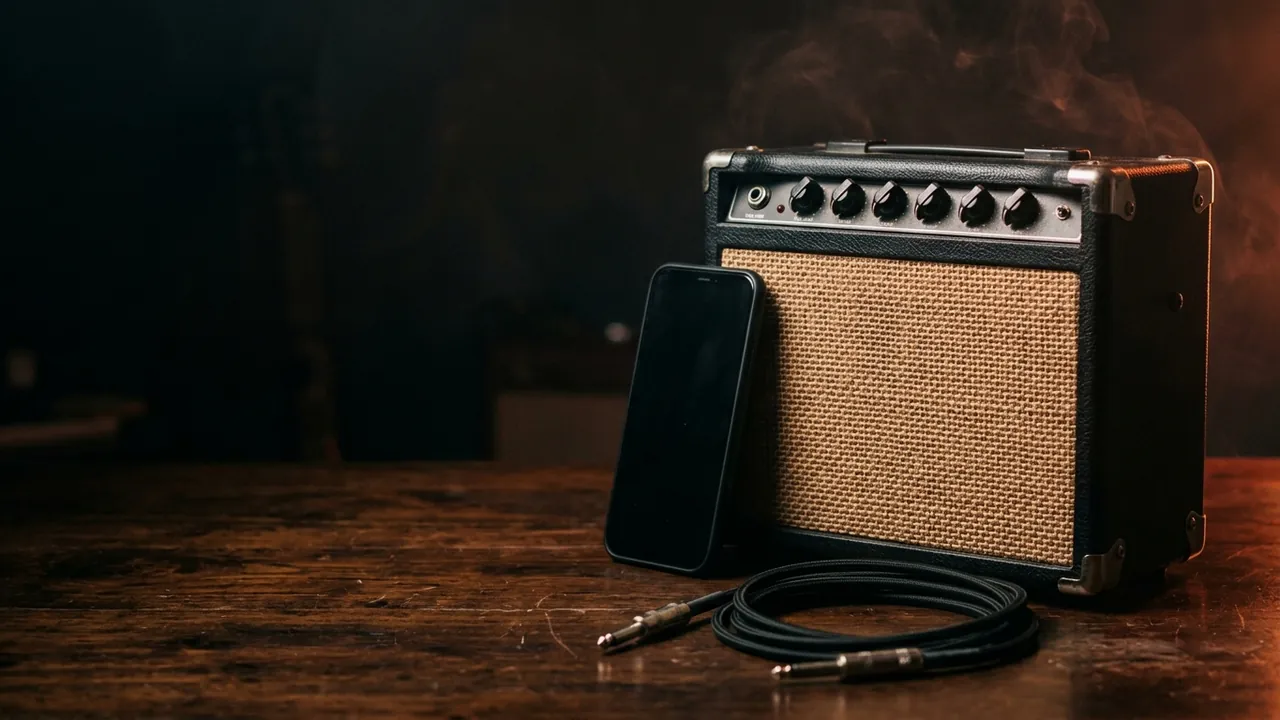
Pick the amp model first, then set the knobs. For clean, use Black Duo with Gain 2 to 3, Bass 5, Mid 5, Treble 6 and Reverb around 3. For classic rock, use Plexiglas with Gain 5 to 6, Bass 5, Mid 6 to 7 and Treble 6. For metal, use Insane or Treadplate with Gain 6 to 7, Bass 4 to 5, Mid 5, Treble 6 to 7 and the Noise Gate switched on in the Spark app.
Positions are on a 0 to 10 scale, with 5 at twelve o'clock. Positive Grid publishes the amp behind each Spark model: Black Duo is inspired by a Fender Twin Reverb, Plexiglas by a Marshall Super Lead 100, Insane by an EVH 5150 III and Treadplate by a Mesa Boogie Triple Rectifier. The Spark GO and Spark MINI have no tone knobs on the amp, so on those every setting here is made in the app.
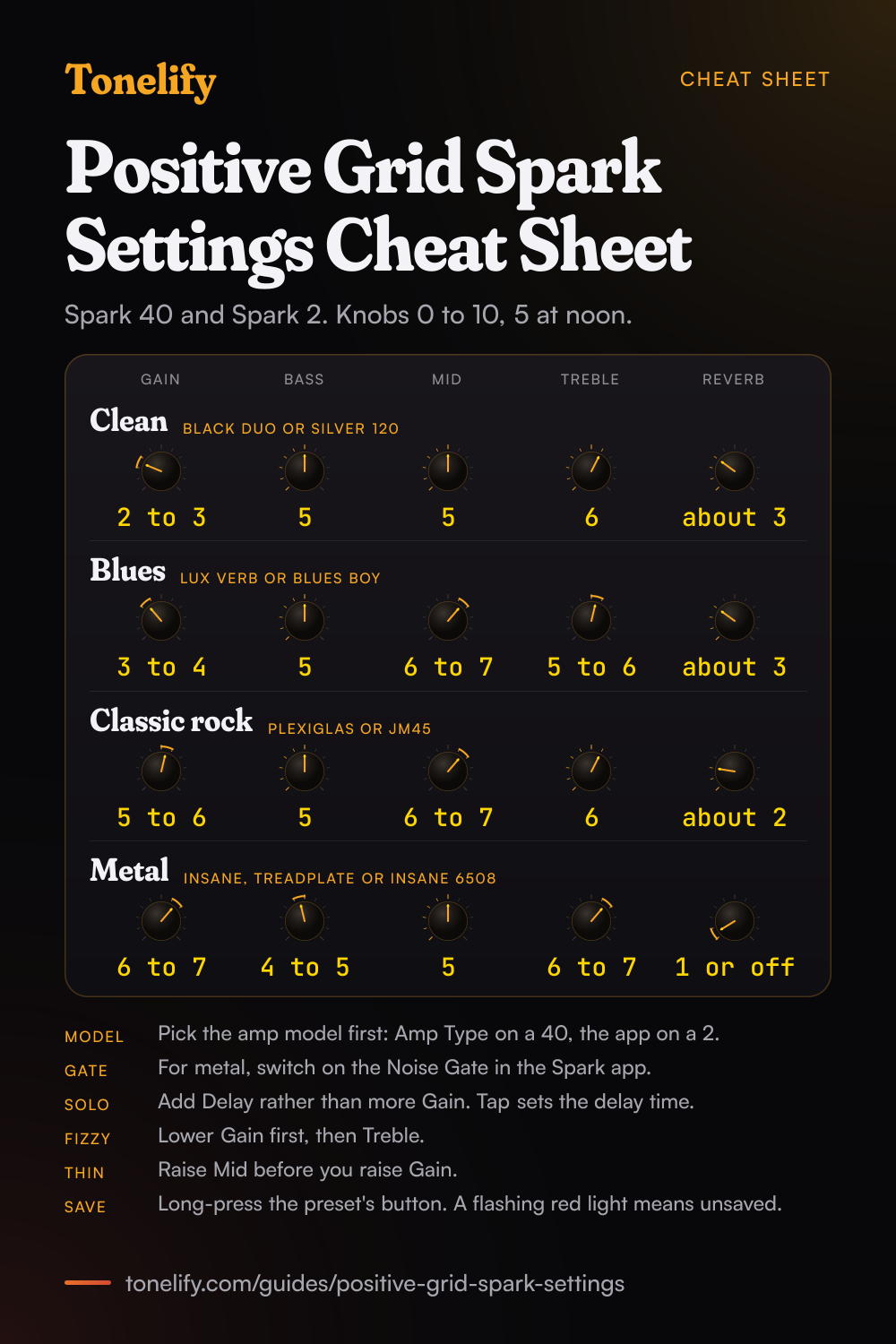
Free download
Printable cheat sheet: PDF and PNG
The clean, blues, classic rock and metal settings from this guide, together on one sheet with short tips. The PDF prints on white; the PNG is the dark version for your phone.
Which Spark has which controls
The Spark 40 has an Amp Type switch, Gain, Bass, Mid, Treble and Master for the amp, Mod, Delay and Reverb for the effects, and an Output knob for the guitar's overall volume. Positive Grid's manual says the Amp Type switch changes the model in the current preset, and that models the switch cannot reach are chosen in the Spark app. The effect knobs set how much of each effect you hear; the effect itself is chosen in the app.
The Spark 2 has the same amp and effect knobs but no Amp Type switch: each of its eight presets holds one amp model, picked in the app. The Spark GO and Spark MINI have only a preset selector, a guitar volume and a music volume, and store four presets each. On those two, the gain, EQ and amp model live inside the presets, and the app is where you change them.
| Spark | Amp and EQ knobs | Presets on the amp | Amp model chosen with |
|---|---|---|---|
| Spark 40 | Gain, Bass, Mid, Treble, Master | 4 | The Amp Type switch, or the app for the rest |
| Spark 2 | Gain, Bass, Mid, Treble, Master | 8, in red and green banks of four | The Spark app |
| Spark GO | None | 4 | The Spark app |
| Spark MINI | None | 4 | The Spark app |
Which real amp each Spark model is based on
Positive Grid's help centre lists the amp models in the Spark app with the classic amp each one is inspired by. The list has 36 models: 25 guitar amps in five groups, Clean, Glassy, Crunch, High Gain and Metal, plus acoustic, bass and preamp models. Find the amp a record was made with in this list and you have the right model before you touch a knob.
Not every Spark carries every model. The Spark 40's manual gives 30 amp models and the Spark 2's and GO's give 33, and the list does not say which models each amp has, so check the app for yours. Two gaps matter for famous songs: the list has no Marshall JCM800 model and no Mesa Boogie Mark series model.
| Spark model | Group | Inspired by |
|---|---|---|
| Silver 120 | Clean | Roland JC120 |
| Black Duo | Clean | Fender Twin Reverb |
| AD Clean | Clean | Orange AD 30 |
| MATCH DC | Clean | Matchless DC30 |
| ODS 50 | Clean | Dumble ODS 50 HRM |
| Tweed Bass | Glassy | Fender Bassman |
| AC Boost | Glassy | Vox AC30 |
| Checkmate | Glassy | Teisco Checkmate 20 |
| Two Stone SP50 | Glassy | Two Rock Studio Pro 50 |
| American Deluxe | Crunch | Fender '57 Custom Deluxe |
| Plexiglas | Crunch | Marshall Super Lead 100 |
| JM45 | Crunch | Marshall JTM45 |
| Lux Verb | Crunch | Fender Deluxe Reverb |
| Blues Boy | Crunch | Fender Blues Junior |
| RB 101 | High Gain | Bogner Ecstasy 101 |
| British 30 | High Gain | Orange AD30 |
| American High Gain | High Gain | Mesa Boogie JP-2C |
| SLO 100 | High Gain | Soldano SLO-100 |
| YJM100 | High Gain | Marshall YJM100 Signature |
| Treadplate | Metal | Mesa Boogie Triple Rectifier |
| Insane | Metal | EVH 5150 III |
| SwitchAxe | Metal | H&K Switch Blade |
| Rocker V | Metal | Orange Rockerverb 50 |
| BE 101 | Metal | Friedman BE100 |
| Insane 6508 | Metal | Peavey 6505 |
Clean settings
Black Duo, inspired by a Fender Twin Reverb, or Silver 120, inspired by a Roland JC120. Gain 2 to 3, Bass 5, Mid 5, Treble 6, Reverb around 3. Keep Gain low and take the level from Master; a clean model stays clearer that way when you strum hard.
Single coils usually want Treble a step lower than humbuckers, because they already have more top end. For a warmer clean that breaks up when you dig in, try Lux Verb, inspired by a Fender Deluxe Reverb, at the same settings.
- Gain 2 to 3
- Bass 5
- Mid 5
- Treble 6
- Reverb about 3
Blues and edge-of-breakup settings
Lux Verb, inspired by a Fender Deluxe Reverb, or Blues Boy, inspired by a Fender Blues Junior. Gain 3 to 4, Bass 5, Mid 6 to 7, Treble 5 to 6, Reverb around 3. The sound should be clean when you play softly and gritty when you dig in, so set Gain where hard picking just starts to break up.
Then use the guitar's volume knob: back to 7 or 8 for rhythm, up to 10 for a solo. For more push, put the app's Over Drive or Tube Drive in front of the amp with its drive low, so it thickens the sound rather than taking it over.
- Gain 3 to 4
- Bass 5
- Mid 6 to 7
- Treble 5 to 6
- Reverb about 3
Classic rock settings
Plexiglas, inspired by a Marshall Super Lead 100, or JM45, inspired by a Marshall JTM45. Gain 5 to 6, Bass 5, Mid 6 to 7, Treble 6, Reverb around 2. Keep the mids up: classic rock sits in the midrange, and scooping it is the usual reason a rock tone sounds thin next to a band.
For hard rock, raise Gain to 6 or 7 and leave Mid where it is. For a solo, add Delay rather than more Gain, and set its time with the Tap button: Positive Grid's manual says tapping it more than twice sets the delay tempo.
- Gain 5 to 6
- Bass 5
- Mid 6 to 7
- Treble 6
- Reverb about 2
Metal settings
Insane, inspired by an EVH 5150 III, Treadplate, inspired by a Mesa Boogie Triple Rectifier, or Insane 6508, inspired by a Peavey 6505. Gain 6 to 7, Bass 4 to 5, Mid 5, Treble 6 to 7, Reverb 1 or off. Most rhythm parts need less gain than people expect: each step past 7 adds fizz and blurs palm mutes more than it adds weight.
Switch on the Noise Gate in the app, so the silence between riffs stays silent. For a tighter low end, add a drive from the app's Drive section in front of the amp with its drive near zero and its level high, the same job a Tube Screamer does in front of a valve head, and take the amp's Gain a step lower.
- Gain 6 to 7
- Bass 4 to 5
- Mid 5
- Treble 6 to 7
- Reverb 1 or off
Noise Gate on in the Spark app.
Matching a song: the record's amp in Spark terms
Each of Tonelify's song pages reports the amp used on the recording. Where that amp, or a close relative, is in Positive Grid's list, the matching model is the place to start. Where it is not, start in the group the sound belongs to and set the knobs as above.
When you want one song set up on the Spark you own, Tonelify picks the model and writes the knob positions for that song against the Spark's own controls.
| Song | Amp on the record | Spark model | How close |
|---|---|---|---|
| Back in Black | Marshall Super Lead | Plexiglas | Same model |
| Crazy Train | Marshall 1959 Super Lead | Plexiglas | Same model |
| Money for Nothing | Marshall JTM45 | JM45 | Same model |
| Sultans of Swing | Fender Twin | Black Duo | Same family: the list gives a Twin Reverb |
| Come As You Are | Vox AC30 (likely) | AC Boost | Same model, if the AC30 is right |
| In Bloom | Fender Bassman on the choruses | Tweed Bass | Same model |
| Hotel California | Cranked Fender Tweed Deluxe | American Deluxe | Nearest by name: the list gives a '57 Custom Deluxe |
| Everlong | Mesa/Boogie Rectifier | Treadplate | Same family: the list gives a Triple Rectifier |
| Psychosocial | Orange Rockerverb 100 and a Diezel | Rocker V | Same family, and only half the rig |
| Master of Puppets | Mesa/Boogie Mark IIC+ | None | No Mark series model in the list |
| Killing in the Name | Marshall JCM800 2205 | None | No JCM800 model in the list |
Spark GO and Spark MINI: settings without knobs
The GO and the MINI have a preset selector, a guitar volume and a music volume on top, and nothing else that shapes the tone. Each stores four presets. To set one up, connect the Spark app, pick the amp model, set Gain, Bass, Mid and Treble there with the numbers above, and save the result to one of the four slots.
A useful set of four is clean, crunch, metal and a lead with delay, one per slot, so the selector does the job the missing knobs would. On a GO, also check the EQ Scenario in the app's device settings: Positive Grid's manual says it switches the amp's output EQ between Balanced, Rock, Acoustic and Bass, for music and guitar alike.
When it sounds wrong
Fizzy or harsh: lower Gain first, then Treble. Fizz is almost always too much gain, not too little EQ. Thin: raise Mid before you raise Gain. Muddy: lower Bass first, then Gain.
A change gone after switching presets on a Spark 40: the knobs change the current preset, and Positive Grid's manual says its red light flashes once it has been modified. Long-press the preset's button to overwrite it with the new settings.
Good at home and boomy at a gig: ears hear less bass and treble at low volume, so settings made quietly tend to carry extra bass. Set the tone close to the volume you will play at.
Songs from the table


Common questions
What are the best Positive Grid Spark settings for metal?
Start with a Metal model such as Insane, inspired by an EVH 5150 III, or Treadplate, inspired by a Mesa Boogie Triple Rectifier. Set Gain 6 to 7, Bass 4 to 5, Mid 5 and Treble 6 to 7, switch on the Noise Gate in the Spark app, and add a drive in front with its level high before you raise the Gain any further.
Does the Spark GO or Spark MINI have tone knobs?
No. Positive Grid's manuals list only a preset selector, a guitar volume and a music volume on top of each. Gain, EQ and the amp model are set in the Spark app and saved to one of the four presets the amp stores.
Which Spark amp models are Marshalls?
Positive Grid lists three: Plexiglas, inspired by a Marshall Super Lead 100, JM45, inspired by a Marshall JTM45, and YJM100, inspired by the Marshall YJM100 Signature. There is no JCM800 model in the list.
How many amp models does the Spark have?
Positive Grid's Amp & Effect List gives 36 amp models in the Spark app, 25 of them guitar amps. The amps' own manuals give 30 for the Spark 40 and 33 for the Spark 2 and Spark GO, so check the app for the models your unit has.
What does the Amp Type switch on the Spark 40 do?
It changes the amp model in the current preset. Positive Grid's manual says models the switch cannot reach are selected in the Spark app, which is also where the effect types are chosen; the Mod, Delay and Reverb knobs only set how much of each you hear.
Is there a Mesa Mark model on the Spark for Metallica songs?
Not in Positive Grid's list. Its Mesa Boogie models are American High Gain, listed as a JP-2C, and Treadplate, listed as a Triple Rectifier. Master of Puppets was recorded through a Mark IIC+, so treat either Spark model as a starting point rather than the same amp.
Is there a printable Positive Grid Spark settings cheat sheet?
Yes. The cheat sheet on this page puts the clean, blues, classic rock and metal starting points for a Spark 40 or Spark 2 on one page, with the amp models to pick and short tips on the noise gate, solos and saving under them. Download the PDF to print it on white, or save the PNG to your phone.
Sources
Gear in this guide
Settings for your own amp
This guide covers what is true of every rig. For a specific song on a specific amp, Tonelify reads the documented chain behind the recording and returns gain, bass, middle, treble and presence values for the controls your amp actually has. Free for 7 days, no charge until the trial ends.