
Positive Grid Spark NEO settings
Positive Grid's guitar amp headphones of 2025, with a 2.4GHz wireless transmitter for the guitar, 33 amp models, 43 effects and four presets, and the amp knobs set in the Spark app.
⚡ Match a tone on this amp- Gain (Spark app)
- Bass (Spark app)
- Middle (Spark app)
- Treble (Spark app)
- Volume (Spark app)
- Preset Selector
- Guitar Volume (+/-)
- Wireless Receiver
How do you dial in a specific tone on a Positive Grid Spark NEO?
The Positive Grid Spark NEO is a modelling amp, so a tone match here has two halves: which model or voicing to select, and where to set the controls once it is selected. Getting the second right on the wrong model gets you nowhere. Tonelify picks the voicing first and writes the knob positions against it, using the front panel this unit actually has.
Name the song you are chasing in the tone matcher and Tonelify returns the settings for this exact guitar amp, not the settings the original artist used. Those are two different things: the recording was made on gear most players do not own.
Settings for this amp only ever use controls it actually has, because its front panel is stored in our gear database. You will not be told to set a knob that is not on the amp.
Free download
Printable cheat sheet: PDF and PNG
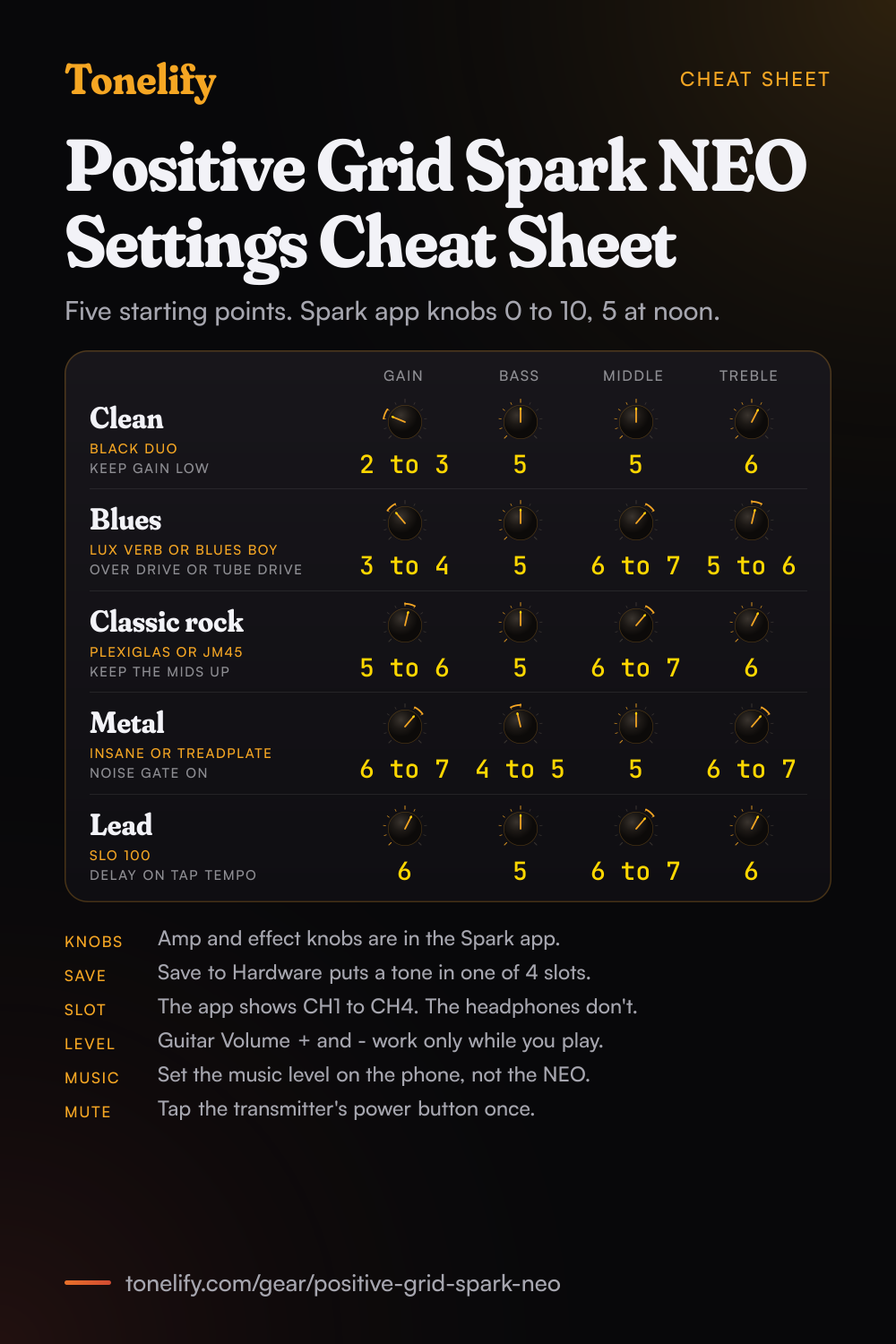
The clean, blues, classic rock, metal and lead settings from this page, together on one sheet with short tips. The PDF prints on white; the PNG is the dark version for your phone.
Starting settings on the Positive Grid Spark NEO
Positions on a 0 to 10 scale, with 5 at twelve o'clock. They are where to begin, not Positive Grid's numbers: pick the amp type first, then move one control at a time from here.
Where the settings are
The Spark NEO headphones have four controls in Positive Grid's specification: the Main Power Button, which is also the Bluetooth Pair Button, the Preset Selector, the Guitar Volume buttons (+/-) and the power button for the built-in Wireless Receiver (RX). The amp and effect knobs are in the Spark app for iOS and Android. Power on the headphones, tap the PAIR/POWER button on the right side so the Bluetooth LED starts to breathe, then open the Spark app and tap Connect. Positive Grid calls this the Tone Control connection, and it is made from inside the Spark app, not from the phone's Bluetooth settings. Double-tap the amp or an effect in the signal chain to pick a model, then turn its knobs. The app draws each amp with its own panel: on AD Clean, in Positive Grid's screenshots, the knobs are Gain, Bass, Middle, Treble and Volume, and the panels below use those names. While a knob turns, the app shows its value with one decimal, 5.0 with the knob at noon in Positive Grid's own screen recording, so the panels are positions on a 0 to 10 scale. Positive Grid publishes no values for the NEO's four factory presets. These are starting points, not Positive Grid's numbers.
Clean
Black Duo, the Spark model Positive Grid says is inspired by a Fender Twin Reverb, from its Clean group. Gain 2 to 3, Bass 5, Middle 5, Treble 6. Keep Gain low and set the level with the Guitar Volume + and - buttons on the headphones. They change the guitar volume only, and to prevent accidental presses they work only while the guitar is sending sound, so play a chord while you press them. On headphones reverb sits right at your ears: pick Room Studio A or Plate Short in the REVERB slot and keep it lower than you would on a speaker. Silver 120, inspired by a Roland JC120, is the other clean to try at the same settings.
- Gain 2 to 3
- Bass 5
- Middle 5
- Treble 6
Edge of breakup and blues
Lux Verb, inspired by a Fender Deluxe Reverb, or Blues Boy, inspired by a Fender Blues Junior, both in Positive Grid's Crunch group. Gain 3 to 4, Bass 5, Middle 6 to 7, Treble 5 to 6. Set Gain where hard picking just starts to break up, then ride the guitar's own volume knob: back to 7 or 8 for rhythm, up to 10 for a solo. For more push, put Over Drive or Tube Drive in the DRIVE slot, in front of the amp, with its drive set low.
- Gain 3 to 4
- Bass 5
- Middle 6 to 7
- Treble 5 to 6
Classic rock
Plexiglas, inspired by a Marshall Super Lead 100, or JM45, inspired by a Marshall JTM45, both in Positive Grid's Crunch group. Gain 5 to 6, Bass 5, Middle 6 to 7, Treble 6. Keep the mids up: rock guitar sits in the midrange, and a scooped Middle is the usual reason a preset sounds thin. For hard rock, raise Gain to 6 or 7 and leave Middle where it is. When you switch over from the clean preset, Preset Volume Normalization, further down, can keep the level steady; Positive Grid says it works on calibrated presets.
- Gain 5 to 6
- Bass 5
- Middle 6 to 7
- Treble 6
Metal
Insane, inspired by an EVH 5150 III, Treadplate, inspired by a Mesa Boogie Triple Rectifier, or Insane 6508, inspired by a Peavey 6505. All three are in Positive Grid's Metal group. Gain 6 to 7, Bass 4 to 5, Middle 5, Treble 6 to 7. Switch on the Noise Gate in the GATE slot, the one effect in Positive Grid's Gate group: with closed headphones there is no room noise to cover hiss between riffs. Each step of Gain past 7 adds fizz and blurs palm mutes more than it adds weight.
- Gain 6 to 7
- Bass 4 to 5
- Middle 5
- Treble 6 to 7
Noise Gate on in the GATE slot.
Lead
SLO 100, inspired by a Soldano SLO-100, or American High Gain, inspired by a Mesa Boogie JP-2C, both in Positive Grid's High Gain group. Gain 6, Bass 5, Middle 6 to 7, Treble 6. For a solo, add delay rather than more Gain: pick Digital Delay or Vintage Delay in the DELAY slot and switch on its BPM Sync. Positive Grid's manual says Tap Tempo then syncs delays and modulations to the BPM you assign to the preset, set by tapping TAP, typing the BPM or using the + and - buttons.
- Gain 6
- Bass 5
- Middle 6 to 7
- Treble 6
Delay synced with Tap Tempo in the app.
Saving tones to the four presets
The Spark NEO stores four presets on the headphones themselves, so you can switch between them and play without the Spark app. Each press of the Preset Selector on the right ear moves to the next slot, 1, 2, 3, 4 and back to 1. The headphones do not show which slot is active: Positive Grid says to open the Spark app, where the preset name and its slot label, CH1, CH2, CH3 or CH4, appear at the top of the Tone page. To keep a tone from this page, build it on the Tone page, tap the menu at the top right, tap Save to Hardware and choose which of the 4 slots to overwrite. Presets saved to the hardware stay through power-off. Four slots take four of the five tones here, for example clean, blues or classic rock, metal and lead. A factory reset erases all four, so back them up in the app first.
Preset Volume Normalization, Hi-Z and auto shutdown
These settings sit on the NEO's device card in the Spark app, and only while the app is connected through Tone Control: tap the Menu tab at the bottom right, then the product card at the top of the Menu page. Preset Volume Normalization, when it is on, balances the volume of calibrated presets so the level stays the same when you switch. Its reference levels are Soft, a lower average level with more dynamic headroom, Standard, the default balance, and Loud, a higher average level. Firmware 1.16.1.60 optimised it. Hi-Z Mode compensates for pickup output: on for high-output pickups such as active humbuckers, off for low-output pickups such as single coils. Power Settings sets the Auto Shutdown timer, after which the NEO powers off when no audio is detected, and Voice Guide switches the voice prompts for low battery and maximum volume on or off.
Playing through the wireless transmitter
Plug the Spark NEO Wireless Transmitter (TX) into the guitar and turn it on, then power on the headphones: the built-in receiver turns on with them and connects to the transmitter automatically. Positive Grid's specification gives the link as its own 2.4GHz wireless audio at 24 bit and 48 kHz, with 3.8 ms of latency and a range of 5 metres in line of sight; its FAQ says up to 3 to 5 metres. If the receiver finds no transmitter, it turns itself off after 15 seconds to save battery. Tap the transmitter's power button once to mute the guitar between songs and again to unmute, or press the RX button on the left side of the headphones; double-tap the transmitter's power button to pair it with the headphones again. The plug is hinged to fit most guitars, but Positive Grid has confirmed that the PRS Silver Sky, the Ibanez S Series and the Ibanez PIA, JEM and UV need an adapter. A standard 1/4 inch guitar cable into the headphones works as well.
Positive Grid Spark NEO amp list
Positive Grid's list has 33 amp models once the three preamps marked for the Spark LIVE and EDGE are left out, and 33 is the count in the Spark NEO's and the Spark NEO Core's specifications: 25 for electric guitar in five groups, 4 acoustic and 4 bass. The headphones have no amp knobs. Each of the four presets on them holds one amp model, picked in the Spark app and saved with Save to Hardware.
| Spark model | Group | Inspired by |
|---|---|---|
| Silver 120 | Clean | Roland JC120 |
| Black Duo | Clean | Fender Twin Reverb |
| AD Clean | Clean | Orange AD 30 |
| MATCH DC | Clean | Matchless DC30 |
| ODS 50 | Clean | Dumble ODS 50 HRM |
| Tweed Bass | Glassy | Fender Bassman |
| AC Boost | Glassy | Vox AC30 |
| Checkmate | Glassy | Teisco Checkmate 20 |
| Two Stone SP50 | Glassy | Two Rock Studio Pro 50 |
| American Deluxe | Crunch | Fender '57 Custom Deluxe |
| Plexiglas | Crunch | Marshall Super Lead 100 |
| JM45 | Crunch | Marshall JTM45 |
| Lux Verb | Crunch | Fender Deluxe Reverb |
| Blues Boy | Crunch | Fender Blues Junior |
| RB 101 | High Gain | Bogner Ecstasy 101 |
| British 30 | High Gain | Orange AD30 |
| American High Gain | High Gain | Mesa Boogie JP-2C |
| SLO 100 | High Gain | Soldano SLO-100 |
| YJM100 | High Gain | Marshall YJM100 Signature |
| Treadplate | Metal | Mesa Boogie Triple Rectifier |
| Insane | Metal | EVH 5150 III |
| SwitchAxe | Metal | H&K Switch Blade |
| Rocker V | Metal | Orange Rockerverb 50 |
| BE 101 | Metal | Friedman BE100 |
| Insane 6508 | Metal | Peavey 6505 |
| Pure Acoustic | Acoustic | PG Original |
| Fishboy | Acoustic | Fishman Acoustic Amp |
| Jumbo | Acoustic | PG Original |
| Flat Acoustic | Acoustic | PG Original |
| RB-800 | Bass | Gallien-Krueger 800RB |
| Sunny 3000 | Bass | Sunn 300T |
| W600 | Bass | Eden WTP600 |
| Hammer 500 | Bass | Aguilar Tone Hammer 500 |
Positive Grid Spark NEO effects list
44 effects in Positive Grid's list once the vocal and mic effects marked for the Spark LIVE and EDGE are left out, in six groups. The Spark NEO's specification gives 43, and the list does not say which one the Spark NEO lacks. In the Spark app the signal chain runs in a fixed order, GATE, COMP/WAH, DRIVE, AMP, MOD/EQ, DELAY and REVERB, and every effect is set on its own knobs there.
- Gate (1)
- Noise Gate
- Comp (6)
- LA Comp, Sustain Comp, Red Comp, Bass Comp, Optical Comp, Auto Wah
- Drive (10)
- Booster, Tube Drive, Over Drive, Fuzz Face, Black Op, Bass Muff, Guitar Muff, Bassmaster, SAB Driver, Clone Drive (Klon Centaur)
- MOD/EQ (12)
- Tremolo, Chorus, Flanger, Phaser, Vibrato, UniVibe, Cloner Chorus, Classic Vibe, Tremolator, Tremolo Square, Guitar EQ, Bass EQ
- Delay (6)
- Digital Delay, Echo Filt, Vintage Delay, Reverse Delay, Multi Head, Echo Tape
- Reverb (9)
- Room Studio A, Chamber, Hall Natural, Plate Short, Hall Ambient, Plate Rich, Hall Medium, Plate Long, Room Studio B
What controls does the Positive Grid Spark NEO have?
The Positive Grid Spark NEO has 8 controls on its front panel: Gain (Spark app), Bass (Spark app), Middle (Spark app), Treble (Spark app), Volume (Spark app), Preset Selector, Guitar Volume (+/-) and Wireless Receiver button.
Positive Grid Spark NEO specifications
- Voicings
- Silver 120, Black Duo, AD Clean, MATCH DC, ODS 50, Tweed Bass, AC Boost, Checkmate, Two Stone SP50, American Deluxe, Plexiglas, JM45, Lux Verb, Blues Boy, RB 101, British 30, American High Gain, SLO 100, YJM100, Treadplate, Insane, SwitchAxe, Rocker V, BE 101, Insane 6508
- Front panel
- Gain (Spark app), Bass (Spark app), Middle (Spark app), Treble (Spark app), Volume (Spark app), Preset Selector, Guitar Volume (+/-), Wireless Receiver button
- Released
- 2025
What the Positive Grid Spark NEO panel means when you dial it in
There is no presence control on this panel, so everything above the treble band has to come from the treble control and the guitar's own tone knob. A setting copied from an amp with presence has to be rebalanced here. Drive and volume have separate knobs, so the amp can sound driven at a volume that is liveable. Where a tone sits between the two is part of the answer, not a detail. The selectable voicings are Silver 120, Black Duo, AD Clean, MATCH DC, ODS 50, Tweed Bass, AC Boost, Checkmate, Two Stone SP50, American Deluxe, Plexiglas, JM45, Lux Verb, Blues Boy, RB 101, British 30, American High Gain, SLO 100, YJM100, Treadplate, Insane, SwitchAxe, Rocker V, BE 101 and Insane 6508. Picking the voicing comes before the knob positions, because the same numbers land somewhere else on each one.
Positive Grid Spark NEO questions
What amps are in the Positive Grid Spark NEO?
33 amp models and 43 effects, Positive Grid's specification says, the same counts as the Spark GO's and the Spark 2's. Positive Grid's Amp & Effect List has 33 amps once the preamps marked for the Spark LIVE and EDGE are left out: 25 guitar amps in five groups, Clean, Glassy, Crunch, High Gain and Metal, plus 4 acoustic and 4 bass, from Silver 120 (Roland JC120) and Black Duo (Fender Twin Reverb) to Plexiglas (Marshall Super Lead 100) and Insane (EVH 5150 III). The full table is below.
Can you use the Spark NEO without the app?
Yes, with the four presets stored on the headphones: Positive Grid says you can switch between them and play without connecting to the Spark app. Pick one with the Preset Selector on the right ear and set the level with Guitar Volume + and -. To change the amp, the effects or their knobs, connect the app, edit the preset and save it to one of the 4 hardware slots so it stays on the headphones.
How do you switch and save presets on the Spark NEO?
Press the Preset Selector on the right ear: each press cycles through the 4 slots, 1, 2, 3, 4 and back to 1. The headphones do not show which slot is active, so Positive Grid points to the Spark app, which shows the slot label, CH1 to CH4, at the top of the Tone page. To save, edit the preset on the Tone page, tap the menu at the top right, tap Save to Hardware and choose the slot to overwrite. Presets saved to the hardware stay through power-off.
How does the Spark NEO wireless transmitter work?
It plugs into the guitar's output jack and sends the signal to a receiver built into the headphones over Positive Grid's own 2.4GHz wireless audio, at 24 bit and 48 kHz with 3.8 ms of latency, the specification says. The receiver switches on with the headphones and connects automatically. The range is 5 metres in line of sight in the specification and up to 3 to 5 metres in Positive Grid's FAQ. Tapping the transmitter's power button mutes the guitar, and the transmitter runs up to 13 hours on a charge.
Will the Spark NEO transmitter fit my guitar?
Most likely. Positive Grid says its flexible hinged plug fits the majority of standard guitar inputs and body styles, but some guitars with recessed inputs or custom body shapes may need an adapter. It has confirmed that the PRS Silver Sky, the Ibanez S Series and the Ibanez PIA, JEM and UV need one. Without the transmitter, a standard 1/4 inch guitar cable plugs into the headphones.
Can you use Spark LINK with the Spark NEO?
Partly. The NEO's transmitter pairs only with Spark NEO headphones and is not compatible with the Spark LINK transmitter. You can still plug the Spark LINK receiver into the NEO headphones' input jack and pair it with the Spark LINK transmitter. Spark LINK is fully compatible with the Spark NEO Core, which uses a wired connection instead of a transmitter.
What is the difference between the Spark NEO and the Spark NEO Core?
The wireless link. Positive Grid says the Spark NEO includes a proprietary 2.4GHz transmitter for untethered playing, while the NEO Core has the same amp modelling, effects and Spark app integration over a wired connection. Both have 33 amps and 43 effects, 40mm drivers, 32 ohms and 100 dB SPL at 1 kHz, and up to 6 hours of guitar and Bluetooth play time. The NEO headphones weigh 370 g and the Core 363 g. Sonicstate gave the NEO's launch price as 199 US dollars; Guitar World gave the Core's as 159 US dollars on 29 October 2025.
How long does the Spark NEO battery last?
Up to 6 hours playing guitar with Bluetooth audio and up to 8 hours of Bluetooth audio alone, Positive Grid's specification says; its charging article puts the 8 hours at 50% volume with the receiver off and no guitar input. The transmitter runs up to 13 hours. Over USB-C at 5V/2A, the headphones charge in 3.5 hours and the transmitter in 2. Positive Grid says the NEO is designed to be used only when it is not charging. Its built-in battery is 1,300 mAh and approved for airplane travel, in your carry-on baggage.
Can you listen to music on the Spark NEO while you play?
Yes. Press the PAIR/POWER button and pick Spark NEO Audio in the phone's Bluetooth settings. Spark NEO mixes the Bluetooth audio and your guitar signal together, so you can jam over any app. The headphones' Volume + and - buttons control only the guitar, so set the music level on the phone, tablet or computer. This Bluetooth Audio link is separate from the Tone Control link the Spark app uses, and the two run at the same time. Pairing mode ends if no device connects within one minute.
Can you record with the Spark NEO or use it live?
No. Positive Grid says the NEO is not designed for recording in a DAW or for live performance, and that its USB-C port is only for charging and firmware updates. It has no line out: Positive Grid describes it as built for wireless, headphone-only listening.
Does the Spark NEO have noise cancelling or a microphone?
Neither. It has no active noise cancellation, but Positive Grid says its earcups give passive noise isolation. It has no built-in microphone. On a phone call through it you hear the caller, but the phone's microphone does not work at the same time, so Positive Grid says to switch to handheld mode in the call app to talk; on a laptop, the computer's own microphones work.
Does the Spark NEO have a tuner?
In the Spark app. Positive Grid's specification lists the tuner among the app's features, and the manual puts the Tuner and Metronome on the Menu page: play a string, and the note turns green when it is in tune. None of the headphones' controls in Positive Grid's panel overview is a tuner.
Can you play bass or acoustic guitar through the Spark NEO?
Yes. Positive Grid says the 1/4 inch input works with guitars, basses and acoustic/electric instruments equipped with pickups, and its launch release says the tone engine is tailored to electric, acoustic and bass guitars. The app's list has four bass amp models, RB-800, Sunny 3000, W600 and Hammer 500, and four acoustic models. Hi-Z Mode on the device card sets the input for the pickup's output.
Does Smart Jam or the looper work on the Spark NEO?
No to both. Positive Grid says the looper is not available on the NEO, and Smart Jam and Video Recording need the phone's microphone to hear the amp, which they cannot do when the sound goes only to headphones. Quick Jam works, with drum and bass tracks to play along with, and of the Spark app's three voice commands the NEO supports Play a backing track and Metronome.
Can you use a footswitch with the Spark NEO?
Yes, Positive Grid's Spark Control or Spark Control X, separate Positive Grid products, connected to the NEO through the Spark app. Positive Grid's command list names the Spark NEO and the Spark NEO Core among the compatible amps; its commands include switching hardware presets 1 to 4, toggling the effect slots and Tap Tempo, and Positive Grid's chart marks which ones each amp supports.
How do you factory reset the Spark NEO?
Power the headphones off completely. Hold the Preset and Power buttons together for 5 seconds, until the Power LED starts flashing white; a quick tap on Power or Preset at this point cancels. Then long-press Preset or Power until the Power LED blinks twice, and the reset is complete. It erases all 4 onboard presets, the Bluetooth pairing and the power saving settings, so back up the presets first.
How do you update the Spark NEO firmware?
With Positive Grid's Spark NEO Firmware Updater on a computer running macOS 10.13 or later or Windows 8 or later, over USB-C; it does not run on iOS, iPadOS or Android. Back up your presets with Tone Vault in the Spark app or ToneCloud first, and do not disconnect the cable during the update. The latest version in Positive Grid's release notes is 1.16.1.60, of 17 February 2025, which optimised Preset Volume Normalization and CPU usage and fixed muting when switching presets rapidly. Positive Grid notes a Windows 11 25H2 MIDI change that can stop the updater, with its own fix.
When did the Spark NEO come out and what did it cost?
Sonicstate printed Positive Grid's announcement on 11 February 2025, the day Positive Grid's iOS release notes say the Spark app became ready for the Spark NEO. It gave the price as 199 US dollars, including the headphones, the wireless transmitter and full access to the Spark App, with four onboard, customizable guitar presets and custom-designed 40mm drivers.
Does Tonelify support the Positive Grid Spark NEO?
Yes, and its front panel is stored, so settings only ever reference controls this guitar amp has: Gain (Spark app), Bass (Spark app), Middle (Spark app), Treble (Spark app), Volume (Spark app), Preset Selector, Guitar Volume (+/-), Wireless Receiver button. You will not be told to set a knob that is not there.
Sources
Panel, specifications and dates checked against these on .
- Positive Grid: Spark NEO user manual v1.0.0 (PDF)
- Positive Grid: Spark NEO Technical Specification
- Positive Grid: Panel Overview (Spark NEO)
- Positive Grid: Pair Spark NEO with the Spark App (Tone Control)
- Positive Grid: Switch and Customize Presets on Spark NEO
- Positive Grid: Device Card Settings for Spark NEO
- Positive Grid: Connect the instrument to the Spark NEO
- Positive Grid: Mute Mode
- Positive Grid: Will Spark NEO Wireless Transmitter (TX) fit my guitar's output jack?
- Positive Grid: What is the range of the Spark NEO Wireless Transmitter (TX)?
- Positive Grid: Can I Use Spark LINK with Spark NEO Core or Spark NEO?
- Positive Grid: Can I connect the Spark NEO with the regular Spark LINK Transmitter?
- Positive Grid: Bluetooth Connection (Bluetooth Audio) for Spark NEO
- Positive Grid: Charge the Spark NEO & Charging/Play time
- Positive Grid: Can I bring my Spark NEO on airplanes?
- Positive Grid: Can I use Spark NEO for recording in a DAW or live performances?
- Positive Grid: Why doesn't the Smart Jam or Video Recording feature work with Spark NEO?
- Positive Grid: Which voice commands can I use with Spark NEO?
- Positive Grid: Factory Reset for Spark NEO
- Positive Grid: Spark NEO Firmware Update
- Positive Grid: Spark NEO Firmware Release Notes
- Positive Grid: Spark NEO Core Technical Specification
- Positive Grid: What's the difference between Spark NEO and Spark NEO Core?
- Positive Grid: Adjusting Effects and Presets (Spark app)
- Positive Grid: Amp & Effect List
- Positive Grid: Spark Control / Spark Control X Command Availability in the Spark app
- Positive Grid: Spark app release notes (iOS / iPadOS)
- Sonicstate: Positive Grid Launches Spark NEO (11 February 2025)
- Guitar World: Positive Grid's $159 Spark NEO Core (29 October 2025)
The manual is the v1.0.0 file on Positive Grid's download server, and the help centre articles were read on 7 November 2026. The knob scale comes from Positive Grid's own screen recording in its Adjusting Effects and Presets article, where the Spark app shows the value of a turning knob with one decimal, 5.0 at noon. Sonicstate printed Positive Grid's launch announcement on 11 February 2025.