
Fulltone OCD settings
⚡ Match a tone on this pedal- Volume
- Tone
- Drive
- HP/LP
How do you dial in a specific tone on a Fulltone OCD?
A drive pedal is not an amount of gain, it is a shape. The Fulltone OCD changes what reaches the amp's input, so where it sits in the chain and how the amp is set behind it matter as much as the pedal's own controls. Settings here cover both ends: the pedal, and the amp underneath it.
Name the song you are chasing in the tone matcher and Tonelify returns the settings for this exact pedal, not the settings the original artist used. Those are two different things: the recording was made on gear most players do not own.
Settings for this unit only ever use controls it actually has, because its front panel is stored in our gear database. You will not be told to set a knob that is not on the unit.
Free download
Printable cheat sheet: PDF and PNG
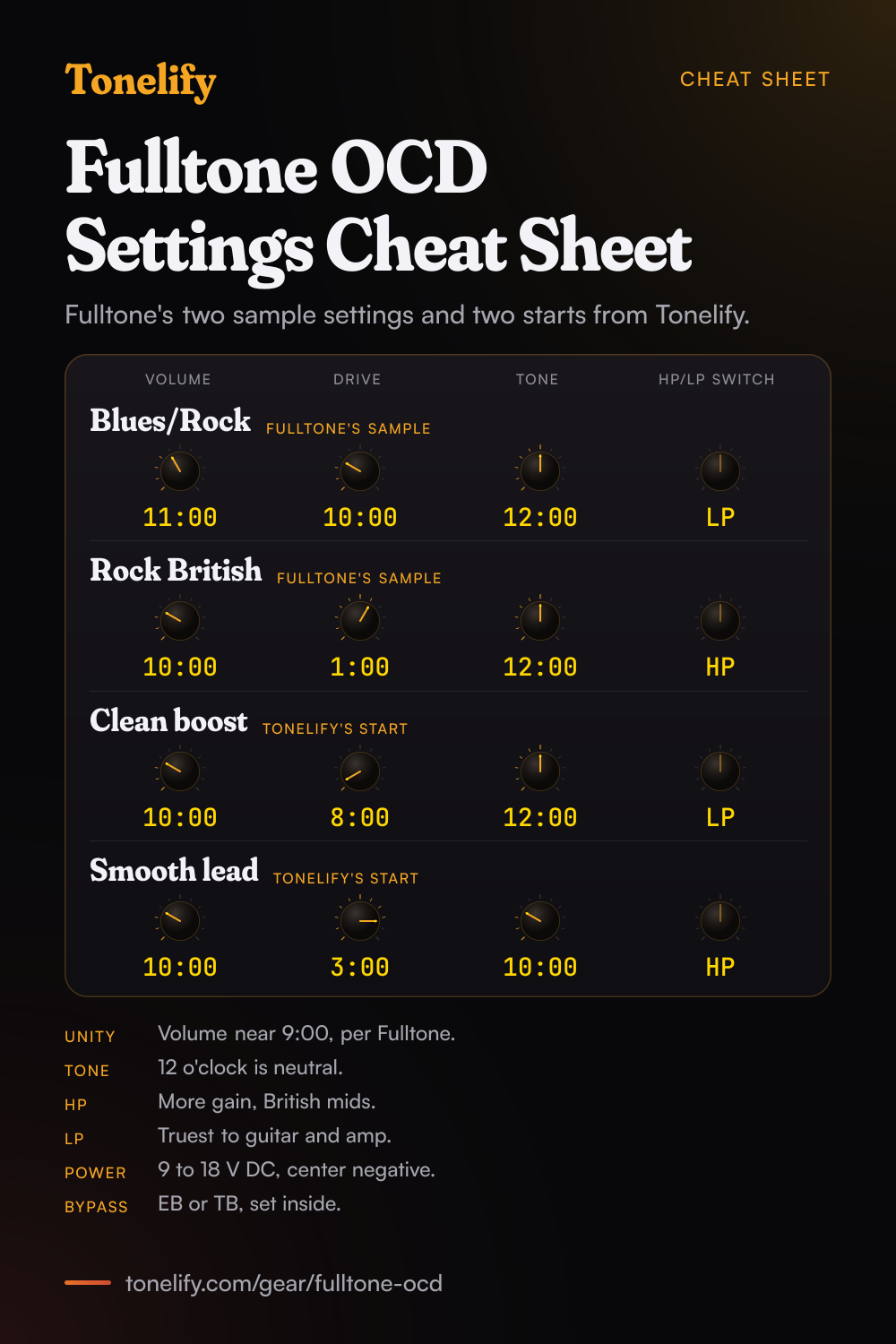
The blues/rock, rock british, clean boost and smooth lead settings from this page, together on one sheet with short tips. The PDF prints on white; the PNG is the dark version for your phone.
Starting settings on the Fulltone OCD
Positions as clock times, since the knobs carry no numbers: 12:00 is the middle of the travel. They are where to begin, not Fulltone's numbers: move one control at a time from here.
Fulltone's Blues/Rock Rhythm
Volume 11:00, Drive 10:00, Tone 12:00, HP/LP switch LP. This is the Blues/Rock Rhythm sample setting in Fulltone's OCD V2 manual, played on the neck pickup into a clean set amp. The manual gives Tone as set to preference; noon is Tonelify's pick, because the manual says the 12 o'clock position is very much neutral. LP keeps the sound close to your own guitar and amp, with very little coloration.
- Volume 11:00
- Drive 10:00
- Tone 12:00
- HP/LP switch LP
Volume, Drive and LP from Fulltone's manual; Tone at noon is Tonelify's pick.
Fulltone's Rock British
Volume 10:00, Drive 1:00, Tone 12:00, HP/LP switch HP. This is the Rock British sample setting in Fulltone's manual, played on the bridge pickup into a clean set amp. Fulltone's manual says HP gives increased distortion, more volume and a slight lift in the midrange between 1 and 2 kHz for a British vibe, like a Vox or a Marshall. Volume sits lower than in the Blues/Rock setting because HP is louder.
- Volume 10:00
- Drive 1:00
- Tone 12:00
- HP/LP switch HP
Volume, Drive and HP from Fulltone's manual; Tone at noon is Tonelify's pick.
Clean boost
Drive 8:00, Volume 10:00, Tone 12:00, HP/LP switch LP. This one is Tonelify's, not Fulltone's, built from Fulltone's own rules. The manual says to keep Drive below 10 o'clock for cleaner sounds and for boosting your amp's input without changing your basic tone, and that unity gain is around 9 o'clock on Volume. Volume a little past that pushes the amp harder. LP is the mode the manual calls excellent for clean boosting.
- Drive 8:00
- Volume 10:00
- Tone 12:00
- HP/LP switch LP
Tonelify's starting point, from the rules in Fulltone's manual.
Smooth lead
Drive 3:00, Tone 10:00, Volume 10:00, HP/LP switch HP. This one is Tonelify's, not Fulltone's, except for Tone: Fulltone's manual says to turn Tone counterclockwise to 10 o'clock or so for smoother high-gain lead sounds, with Drive higher than 12 o'clock. HP adds gain and midrange for the lead to sit forward. If notes blur together, bring Drive back toward noon.
- Drive 3:00
- Tone 10:00
- Volume 10:00
- HP/LP switch HP
Tone from Fulltone's manual; Drive, Volume and HP are Tonelify's.
Chasing one song? Name it and the matcher writes that song's settings for the Fulltone OCD.
OCD controls and HP vs LP
What each control does, in Fulltone's words from the OCD V2 manual.
| Control | What Fulltone's manual says |
|---|---|
| Drive | Clockwise for more distortion; below 10 o'clock for cleaner sounds and boosting |
| Volume | About 20dB of available gain; unity is around 9 o'clock |
| Tone | Only affects the high frequencies; 12 o'clock is very much neutral |
| HP (High Peak) | More distortion and volume, a slight 1 to 2 kHz lift for a British vibe |
| LP (Low Peak) | Accurate to your guitar and amp; excellent for clean boosting |
| Bypass switch (inside) | Up for Enhanced Bypass, down for True-Bypass |
What controls does the Fulltone OCD have?
The Fulltone OCD has 4 controls on its front panel: Volume, Tone, Drive and HP/LP switch.
Fulltone OCD specifications
- Front panel
- Volume, Tone, Drive, HP/LP switch
- Released
- 2004
What the Fulltone OCD panel means when you dial it in
Its controls are Volume, Tone, Drive and HP/LP switch, and settings for this pedal are written against those names rather than a generic level, tone and gain.
Fulltone OCD questions
What are the best settings for the Fulltone OCD?
Start with Fulltone's two sample settings. Blues/Rock Rhythm: Volume 11 o'clock, Drive 10 o'clock, LP, on the neck pickup. Rock British: Volume 10 o'clock, Drive 1 o'clock, HP, on the bridge pickup. Both are for a clean set amp, and the manual leaves Tone to preference, with 12 o'clock as the neutral point.
What does the HP/LP switch on the OCD do?
It changes the voice. Fulltone's manual says HP (High Peak) gives increased distortion through the Drive range, more volume and a slight midrange increase between 1 and 2 kHz for a British vibe. LP (Low Peak) gives incredible accuracy to the original sound of your guitar and amp, and is excellent for clean boosting and for cranked Blackface or Tweed style amps.
Why is the OCD so loud, and where is unity volume?
Fulltone's manual says the OCD has about 20dB of available gain, more in HP mode, so don't be surprised if you end up running the Volume control at around 9 o'clock to get unity gain. Start there and raise it only if you want the pedal louder than bypass.
Can I run the OCD at 18 volts?
Yes. Fulltone's manual says it runs on the included 9 volt battery or any voltage between 9 and 18 Volts DC, with a standard 2.1mm x 5.5mm plug, negative center. It says 18 VDC is cleaner, louder, and more dynamic, and recommends a regulated adapter such as the Fulltone IPS-18 rather than switching type supplies.
Can the OCD be used as a clean boost?
Yes. Fulltone's manual says to keep the Drive below 10 o'clock for cleaner sounds and for boosting your amp's input without changing your basic tone, and calls LP mode excellent for clean boosting. The Clean boost panel above has Tonelify's start.
What is Enhanced Bypass on the OCD?
Fulltone's own buffered bypass. The manual says it brings back the dynamics and tone that long cables and other pedals take away, with pop free switching. A switch inside the pedal picks Enhanced Bypass (up) or True-Bypass (down); the manual warns to set it full up or full down, never in the middle.
Is the OCD a Tube Screamer clone?
No. Fulltone's manual says the OCD overdrives its JFET opamp and then hard-clips with a pair of MOSFETs later in the circuit. Fulltone's product page says the OCD was the first pedal to use Mosfets as clipping devices, and that 90% of other overdrives are just slight tweaks of the Tube Screamer.
Which OCD version is this?
The OCD V2. Fulltone's manual says V2 raised the input impedance from 330K to 1 Mega ohm with a Class-A JFET input, added a buffered output and made the bypass selectable inside. Fulltone's product page says earlier pedals were all slight variations, V1.0 through V1.8, and that serial 205811 and higher are the less compressed versions some call v2.01.
When did the Fulltone OCD come out?
In 2004. Fulltone's product page says the OCD has received many slight tweaks since its birth in 2004.
What does the Fulltone OCD cost?
Fulltone's product page listed the OCD V2 at $179.00 in the Internet Archive copy of 14 October 2026, which Tonelify read on 7 November 2026.
What are the OCD's specs?
Input impedance 1 mega ohm, output impedance 10k ohms, and a current draw of approximately 8 milliamps, per Fulltone's manual. It runs on a 9 volt battery or a 9 to 18 V DC adapter, and Fulltone gives a limited 5 year warranty.
Does the OCD clean up with the guitar's volume knob?
Yes. Fulltone's manual says you can reach a slew of in-between sounds by turning your guitar's volume control up or down, and that no other pedal cleans up like the OCD.
Where does the Fulltone OCD go in the signal chain?
In front of the amp input, before any time-based effects. Drive pedals interact with what the amp is already doing, so the amp's own gain setting is part of the answer and cannot be ignored when the pedal is dialled in.
Does Tonelify support the Fulltone OCD?
Yes, and its front panel is stored, so settings only ever reference controls this pedal has: Volume, Tone, Drive, HP/LP switch. You will not be told to set a knob that is not there.
Sources
Panel, specifications and dates checked against these on .
The sample settings, controls, power, bypass and specs are from Fulltone's manual. The launch year, price and version history are from Fulltone's product page, read from the Internet Archive copy of 14 October 2026 because the live site refused automated requests. Tone at noon in the samples, the clean boost and the lead panels are Tonelify's, not Fulltone's.
Similar pedals from other makers
Settings for the song you are chasing
Name a song and Tonelify reads the documented rig behind the recording, then writes the settings for a rig with the Fulltone OCD in it. A first plan starts with 7 days free, $0 today.