
Hotone Ampero presets and settings
Floor unit with a 4 inch touch screen, four footswitches and a built-in expression pedal. 76 amps, 60 cabinets, 20 User IR slots and 124 effects in the V4.1 manual, 198 patches, a 100 second looper, 100 drum styles and USB recording.
⚡ Match a tone on this unitHow do you dial in a specific tone on a Hotone Ampero?
A multi-effects unit gives you the whole chain in one box, which means the order of the blocks is as much of the answer as the values inside them. Settings for the Hotone Ampero name the amp model, the block order and the parameters together, rather than handing you numbers with no chain to put them in.
Name the song you are chasing in the tone matcher and Tonelify returns the settings for this exact multi-effects unit, not the settings the original artist used. Those are two different things: the recording was made on gear most players do not own.
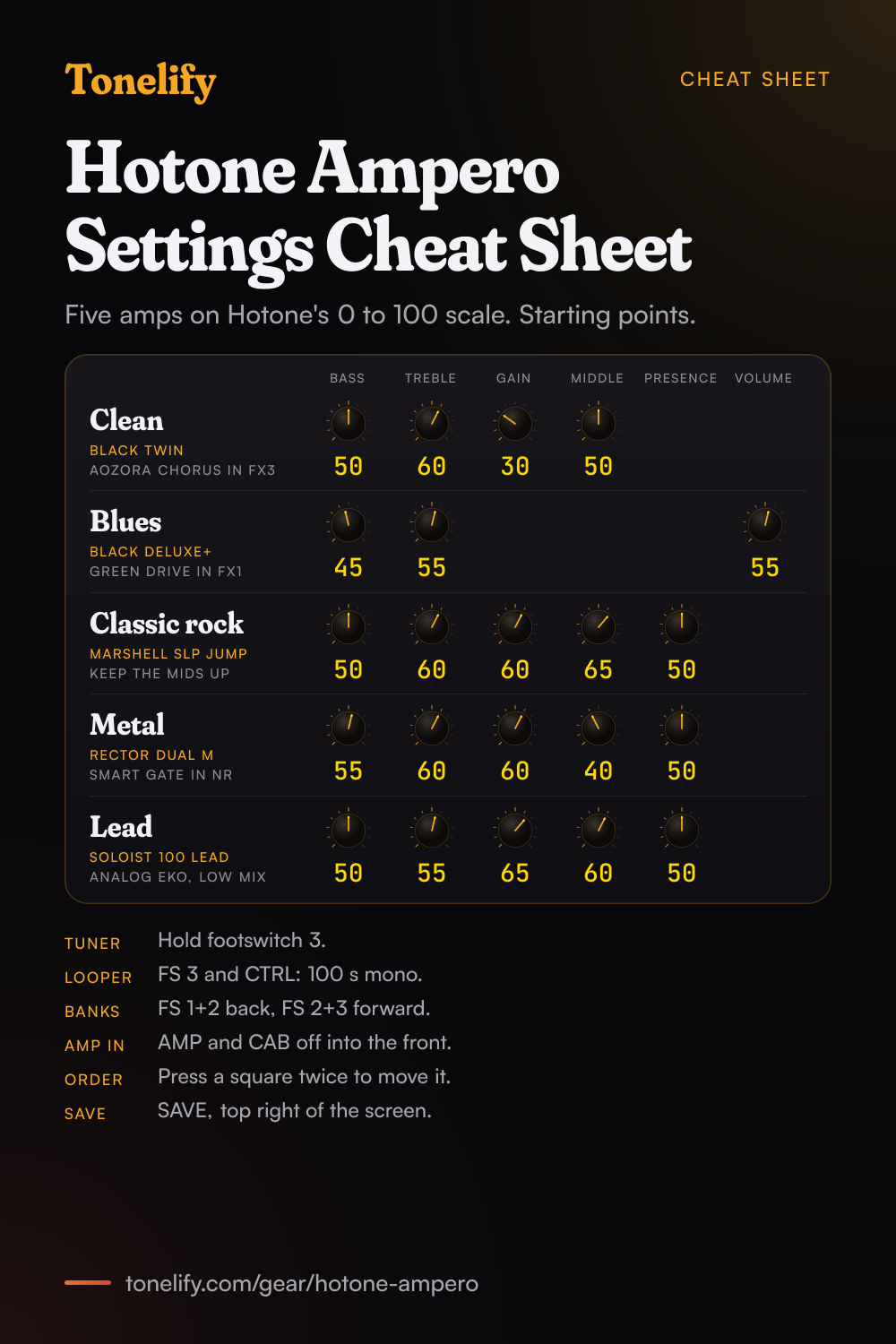
Free download
Printable cheat sheet: PDF and PNG
The clean, blues, classic rock, metal and lead settings from this page, together on one sheet with short tips. The PDF prints on white; the PNG is the dark version for your phone.
Starting settings on the Hotone Ampero
Values as the unit's screen shows them, on its own scale; each drawn knob shows that value's share of the range. They are where to begin, not Hotone's numbers: pick the amp model first, then move one control at a time from here.
Clean
Black Twin, which Hotone says is based on a Fender '65 Twin Reverb. Gain 30, Bass 50, Middle 50, Treble 60, with Bright on and Master set to match your other patches. Hotone's manual gives every amp knob a range of 0 to 100 and lists no preset values, so every setting on this page is a starting point on that scale. For width, put Aozora Chorus, based on the Arion SCH-1, in FX3 after the amp, and pick Black Twin 2x12 in the CAB module. Spring in the RVB module finishes it.
- Gain 30
- Bass 50
- Middle 50
- Treble 60
Bright on. Aozora Chorus in FX3, Black Twin 2x12 cab.
Edge of breakup and blues
Black Deluxe+, Hotone's model of the Vibrato channel of a Fender Blackface Deluxe Reverb. Volume 55, Bass 45, Treble 55, with Output to taste; this model has no Middle knob. Dig in for grit and play lighter to clean up. For more push, put Green Drive, based on the Ibanez TS-808 Tube Screamer, in FX1 before the amp with its Gain low and its Volume up, so it pushes the amp rather than replacing its grit. Black Lux 1x12 or Black Twin 2x12 in the CAB module suit it.
- Volume 55
- Bass 45
- Treble 55
Green Drive in FX1, Gain low, Volume up.
Classic rock
Marshell SLP Jump, based on a Marshall Super Lead 1959 with its channels jumped. Gain 60, Presence 50, Bass 50, Middle 65, Treble 60. Keep the mids up: rock guitar sits in the midrange, and scooping it is the usual reason a patch sounds thin next to a band. Marshell 800, Hotone's JCM800, and Marshell 45 Jump, its JTM45, are the next amps to try. UK Green 4x12 in the CAB module is the cabinet to start with.
- Gain 60
- Presence 50
- Bass 50
- Middle 65
- Treble 60
Metal
Rector Dual M, based on the third channel of a Mesa/Boogie Dual Rectifier in modern mode. Gain 60, Presence 50, Bass 55, Middle 40, Treble 60, with Rector 4x12 in the CAB module. Turn on Smart Gate in the NR module, which Hotone bases on the ISP Decimator, and raise its Threshold just enough to quiet the hiss between chords. For tighter palm mutes, put Green Drive in FX1 with its Gain low, and take the amp's Gain down a step. Eddie 51, Hotone's Peavey 5150, and Engle Saga 1 are the next amps to try.
- Gain 60
- Presence 50
- Bass 55
- Middle 40
- Treble 60
Smart Gate in NR; Green Drive in FX1 before more Gain.
Lead
Soloist 100 Lead, based on the overdrive channel of a Soldano SLO100. Gain 65, Presence 50, Bass 50, Middle 60, Treble 55, with Soloist 4x12 in the CAB module. Put Analog Eko in the DLY module with a low Mix, turn its Sync on and set the CTRL footswitch to Tap Tempo, so the delay time follows your tapping. Hall in the RVB module adds room. For a rhythm and a lead sound in one patch, assign the CTRL footswitch to Module/Tap and choose which modules it turns on.
- Gain 65
- Presence 50
- Bass 50
- Middle 60
- Treble 55
Analog Eko in DLY, Mix low, Sync on; Hall in RVB.
Chasing one song? Name it and the matcher writes that song's settings for the Hotone Ampero.
Hotone Ampero amp list
The V4.1 manual lists 76 models in the AMP module: 19 clean, 28 drive and 22 high gain guitar amps, 5 bass amps and 2 acoustic preamps. Hotone names the amp behind each one, given here in its own words. Two rows repeat a name in the manual: Messe IIC+ 2 appears twice (the third of the Mark II C+ switch settings), and Marshell SLP appears for both the Normal and the Bright channel of the Super Lead.
| Model | Based on, per Hotone | Section |
|---|---|---|
| Tweed Lux | Fender Tweed Deluxe (bright channel, 5E3 version) | Clean |
| Baseman Norm | Fender '59 Bassman (normal channel) | Clean |
| Black Twin | Fender '65 Twin Reverb | Clean |
| Voxy 30HW Norm | VOX AC30HW (normal channel) | Clean |
| Superb Dual Clean | Supro Dual-Tone 1624T (clean tone) | Clean |
| Jazz Clean | The "Jazz Chorus" solid state combo | Clean |
| Emperor Clean | Matchless Chieftain 212 combo (clean tone) | Clean |
| Superstar Clean | Mesa/Boogie Lone Star (CH1) | Clean |
| Glacian Clean | Bogner Shiva (20th Anniversary version, Ch1) | Clean |
| Dr. 38 Clean | Dr. Z Maz 38 Sr. combo (clean sound) | Clean |
| Pendragon Clean | Grindrod Pendragon PG20C (Normal channel, bright off) | Clean |
| Pendragon Clean+ | Grindrod Pendragon PG20C (Normal channel, bright on) | Clean |
| Hot Kitty Clean | Bad Cat Hot Cat 30 (clean channel) | Clean |
| Soloist 100 Clean | Soldano SLO100 (normal channel, clean sound) | Clean |
| Black Deluxe | Fender Blackface Deluxe Reverb (Normal CH) | Clean |
| Black Deluxe+ | Fender Blackface Deluxe Reverb (Vibrato CH) | Clean |
| Brown King Clean | Fender Brownface Vibro-King (FAT switch off) | Clean |
| Silver Master | Fender Silverface Bandmaster (early AB763 version) | Clean |
| Tang A30 Clean | Orange AD30 head (CH 1) | Clean |
| Baseman Bright | Fender '59 Bassman (bright channel) | Drive |
| Voxy 30HW TB | VOX AC30HW (Top Boost channel) | Drive |
| Superb Dual Drive | Supro Dual-Tone 1624T (CH1+2, dirty tone) | Drive |
| Emperor Drive | Matchless Chieftain 212 combo (dirty tone) | Drive |
| Dr. 38 Drive | Dr. Z Maz 38 Sr combo (dirty tone) | Drive |
| Superstar Drive | Mesa/Boogie Lone Star (CH2) | Drive |
| Marshell 45 | Marshall JTM45 (normal channel) | Drive |
| Marshell 45+ | Marshall JTM45 (High Treble channel) | Drive |
| Marshell 45 Jump | Marshall JTM45 ("Jump" connection) | Drive |
| Marshell 50 | Marshall JMP50 (normal channel) | Drive |
| Marshell 50+ | Marshall JMP50 (High Treble channel) | Drive |
| Marshell 50 Jump | Marshall JMP50 ("Jump" connection) | Drive |
| Hot Kitty Drive | Bad Cat Hot Cat 30 (drive channel) | Drive |
| Messe IIC+ 1 | Mesa/Boogie Mark II C+ (Lead channel), switch setting 1 of 3 | Drive |
| Messe IIC+ 2 | Mesa/Boogie Mark II C+ (Lead channel), switch setting 2 of 3 | Drive |
| Messe IIC+ 2 (second) | Mesa/Boogie Mark II C+ (Lead channel), switch setting 3 of 3 | Drive |
| Soloist 100 Crunch | Soldano SLO100 (normal channel, dirty sound) | Drive |
| Marshell 800 | Marshall JCM800 | Drive |
| Pendragon Drive | Grindrod Pendragon PG20C (Drive channel) | Drive |
| Fryman B1 | The "Brown Eye" UK-style boutique head (BE channel), setting 1 of 2 | Drive |
| Fryman B2 | The "Brown Eye" UK-style boutique head (BE channel), setting 2 of 2 | Drive |
| Glacian Drive | Bogner Shiva (20th Anniversary version, Ch2) | Drive |
| Marshell SLP | Marshall Super Lead 1959 (Normal channel) | Drive |
| Marshell SLP (Bright) | Marshall Super Lead 1959 (Bright channel) | Drive |
| Marshell SLP Jump | Marshall Super Lead 1959 ("Jump" connection) | Drive |
| Brown King Drive | Fender Brownface Vibro-King (FAT switch on) | Drive |
| Tang A30 Drive | Orange AD30 head (CH 2) | Drive |
| Dumbell Drive | Dumble Overdrive Special head (Overdrive section on) | Drive |
| Marshell 900 | Marshall JCM900 (Model 4100, channel B) | High gain |
| Dizzle VH B | Diezel VH4 (CH3, blue version) | High gain |
| Dizzle VH S | Diezel VH4 (CH3, silver version) | High gain |
| Engle Saga 1 | ENGL Savage 120 E610 (CH4, contour off) | High gain |
| Engle Saga 2 | ENGL Savage 120 E610 (CH4, contour on) | High gain |
| Powerengle Lead | ENGL Powerball II E645/2 (CH4) | High gain |
| Fryman HB | The "Brown Eye" UK-style boutique head (HBE channel), setting 1 of 2 | High gain |
| Fryman HB+ | The "Brown Eye" UK-style boutique head (HBE channel), setting 2 of 2 | High gain |
| Eddie 51 | Peavey 5150 (LEAD channel) | High gain |
| Soloist 100 Lead | Soldano SLO100 (overdrive channel) | High gain |
| Messe IV Lead 1 | Mesa/Boogie Mark IV (Lead channel), switch setting 1 of 3 | High gain |
| Messe IV Lead 2 | Mesa/Boogie Mark IV (Lead channel), switch setting 2 of 3 | High gain |
| Messe IV Lead 3 | Mesa/Boogie Mark IV (Lead channel), switch setting 3 of 3 | High gain |
| Tangerine R100 | Orange Rockerverb 100 (Dirty channel) | High gain |
| Rector Dual V | Mesa/Boogie Dual Rectifier (CH3, vintage mode) | High gain |
| Rector Dual M | Mesa/Boogie Dual Rectifier (CH3, modern mode) | High gain |
| Dizzle VH+B | Diezel VH4 (CH4, blue version) | High gain |
| Dizzle VH+S | Diezel VH4 (CH4, silver version) | High gain |
| Boger XT Blue V | Bogner Ecstasy ("Blue" channel, Vintage mode) | High gain |
| Boger XT Blue M | Bogner Ecstasy ("Blue" channel, Modern mode) | High gain |
| Boger XT Red V | Bogner Ecstasy ("Red" channel, Vintage mode) | High gain |
| Boger XT Red M | Bogner Ecstasy ("Red" channel, Modern mode) | High gain |
| Alchemy Pre | Alembic F-2B preamp | Bass |
| Ampage Classic | Ampeg SVT bass amp | Bass |
| Ampage Flip | Ampeg B-15 "Flip Top" bass amp | Bass |
| Voxy Bass | Vintage VOX AC-100 bass amp | Bass |
| Messe Bass 400 | Mesa/Boogie Bass 400 amp | Bass |
| Acoustic Preamp 1 | AER Colourizer 2 acoustic preamp, setting 1 of 2 | Acoustic |
| Acoustic Preamp 2 | AER Colourizer 2 acoustic preamp, setting 2 of 2 | Acoustic |
Hotone Ampero cab list
The CAB/IR module holds 50 guitar cabinets and 10 bass cabinets, 10 acoustic body IRs and 20 User IR slots for your own files. Every cabinet, user IRs included, shares the same controls: Mic Type, Volume, Low Cut, High Cut and the mic's X, Y and Z position, where X and Y at 0 put the mic on axis and Z sets its distance from the speaker. The manual warns that an empty User IR slot mutes the output.
- Guitar cabinets (50)
- Super Zep 1x6, Tweed Chap 1x8, Tweed Prince 1x10, Black Lux 1x12, Black Vint 1x12, Routine 1x12, Glacian 1x12, Bad Kitty 1x12, Voxy 1x12, Dark Star 1x12, Atom Open 1x12, Tweed Lux 1x12, US Studio 1x12, Ace 20 1x12, UK G12M 1x12, Voxy 2x12, Emperor 2x12, Jazz Twin 2x12, Black Twin 2x12, UK Green 2x12, Tweed Super 2x10, Boutique 2x12, Baseman 2x12, Superb 2x12, Match Twin 2x12, Superstar 2x12, Freedom 2x12, Black Custom 2x12, Twin Rock 2x12, Bluesky 2x12, Baseman 4x10, UK Lead 4x12, UK Trad 2x12, UK Modern 4x12, UK Green 4x12, Eddie 4x12, Rector 4x12, Boger 4x12, Engle 4x12, Urban 4x12, Soloist 4x12, Tang 4x12, Hiway 4x12, UK Black 4x12, The Way 4x12, Dumbell 4x12, Dizzle 4x12, Triple 4x12, UK T75 4x12, US King 4x12
- Bass cabinets (10)
- Adam 1x15, Worker 1x15, Flip Top 1x15, US Bass 2x10, Mark 2x10, Adam 4x10, Ampage 4x10, Worker 4x10, Hacker 4x12, Ampage 8x10
- Acoustic IRs (10)
- Dreadnought 1, Dreadnought 2, Orchestal, Jumbo, Hum Bird, Auditorium, Classical, Mandolin, Fretless Bass, Double Bass
- User IRs (20 slots)
- User IR 1 to 20: 24-bit, 44.1 kHz mono WAV files, 1024 points
- Mic types (10, plus OFF)
- Dyn 57 (Shure SM57), Dyn 58 (Shure SM58), Dyn 421 (Sennheiser MD421), Dyn 16 (Electro-Voice RE16), Dyn 112 (AKG D112), Dyn 609 (Sennheiser e609), Con U67 (Neumann U67), Con 87A (Shure Beta 87A), Con U87 (Neumann U87), Rib 121 (R121)
Hotone Ampero effects list
124 models outside the amps and cabinets: 83 for the FX1, FX2 and FX3 modules, 3 noise gates in NR, 7 EQs, 21 delays and 10 reverbs. Where Hotone names the pedal or unit a model is based on, it is given in brackets. The NR gates can also go in FX1 and FX2. Hotone's specification counts 270 effects, which is these 124 with the 76 amps, the 60 cabinets and the 10 acoustic IRs.
- FX: Dynamic (12)
- Comprosso (Ross Compressor), Comparoma 4 (Keeley C4), Blue Sustainer, Squeezer, Affinity Boost (Xotic AC Booster), Beefy Boost (Xotic BB Preamp), Pristine Boost (Xotic RC Booster), FET Boost, Enhancer (Xotic EP Booster), Forest Boost (Fortin Grind), Gated Boost, Micro Boost (MXR M133 Micro Amp)
- FX: Frequency (19)
- Acoustic Refiner, AC Sim, Dynamic Basso, Toucher, Crier, Voxy Wah (VOX V846), Cry Wah (Dunlop CryBaby), Petrus Wah (Dunlop CryBaby JP95), Soul Press (Hotone Soul Press), Bass Press (Hotone Bass Press), Clean Octa, Dirty Octa, Harmony, Telephone Line, Satisfaction, Path Filter, Bit Krusher, Ring Mod, Pitch Shift
- FX: Overdrive and distortion (29)
- Green Drive (Ibanez TS-808 Tube Screamer), Yellow Drive, Swarm Drive (Providence SOV-2 Stampede OD), Super Drive, Screamood, Dr. Blues, Force Drive (Fulltone OCD V3), Tube Clipper (B. K. Butler Tube Driver), Zen Garden (Hermida Zendrive), Direct Touch (Barber Direct Drive), Big Pie (Electro-Harmonix Big Muff Pi), Face Fuzz (Dallas-Arbiter Fuzz Face), Bend Fuzz (Sola Sound Tone Bender MkII), Black Tail (ProCo The Rat), Plustortion (MXR M104 Distortion+), Smooth Dist, Governor (Marshall Guv'Nor), Crunchist (MI Audio Crunch Box), Purple Plexi (Wampler Plexitortion), Panama Lead, Bass Crusher, Solid Steel, Precise Attack (Horizon Devices Precision Drive), Blues Butter (Marshall Bluesbreaker), Magic T (Paul Cochrane Timmy V2), Prince of Drive (Analog.Man Prince of Tone), Behemoth M (Darkglass Microtubes B7K), Basshammer 1 (Aguilar Tone Hammer), Basshammer 2 (Aguilar Tone Hammer)
- FX: Modulation (23)
- Aozora Chorus (Arion SCH-1), Grand Choruium, Liquid C, Aquaria M, Choruium B, Detune, Jetter, Jetter B, Jetter N, Trem Jet, Pulser, Grand Vibrato, Shiver, Shiver T, 90 Phaser (MXR M101 Phase 90), Green Phaser, Twirl N, Twirl P, Minivibe (Voodoo Lab Micro Vibe), Revolver (Shin-ei Uni-Vibe), Helicopter (Demeter TRM-1 Tremulator), Custom Trem, Sweller
- NR (3)
- Smart Gate (ISP Decimator), Fast Gate, Custom Gate
- EQ (7)
- Guitar EQ 1, Guitar EQ 2, Bass EQ 1, Bass EQ 2, Para EQ, Graphic EQ, V-EQ (the 5-band EQ on Mesa/Boogie amps)
- DLY (21)
- Sweetie, Recaller (Electro-Harmonix Deluxe Memory Man), Pure Eko, Analog Eko, Ekopress 80 (Maxon AD80), Mag Eko, Tube Eko, Ekopress 900 (Maxon AD900), Ekopress 999 (Maxon AD999), Backmask, Dual Eko, Ping Pong, Multi Head, Slapback, Vintage Rack, Sweep Eko, Trem Eko, Lofi Eko, Ring Eko, Ekoverb, Ambience
- RVB (10)
- Room, Hall, Church, Plate, Spring, Izumi, Northstar, Oceandeep, Sweet Space, Shimmer
Hotone Ampero specifications
- Released
- 2019
Hotone Ampero questions
What is the Hotone Ampero?
A floor amp modeller and multi-effects unit from Hotone, also called the MP-100. Guitar.com reported it unveiled at Music China in October 2018 at an expected price of about USD 300, and MusicRadar's NAMM report in January 2019 gave early listings of around 400 euros or 350 pounds. It has a 4 inch 800 by 480 touch screen, four footswitches and a built-in expression pedal. Hotone's manual gives its size as 320 by 147 by 46 mm and its weight as 1408 g.
What amps are in the Hotone Ampero?
The V4.1 manual lists 76 models in the AMP module: 19 clean, 28 drive and 22 high gain guitar amps, 5 bass amps and 2 acoustic preamps. Hotone names the amp behind each one: Black Twin is based on a Fender '65 Twin Reverb, Marshell 800 on a Marshall JCM800, Eddie 51 on a Peavey 5150 and Rector Dual M on a Mesa/Boogie Dual Rectifier. The launch reports in 2018 and 2019 counted 64 amps, so later firmware added the rest. The full list is below.
How many effects does the Ampero have?
Hotone's specification says 270. That count takes in everything: the 76 amps, 60 cabinets and 10 acoustic body IRs, plus 124 other models. Those are 83 for the FX1, FX2 and FX3 modules (dynamics, filters and pitch, drives and modulation), 3 noise gates, 7 EQs, 21 delays and 10 reverbs. Up to 9 modules run at once, and the effects list below gives every name with the pedal Hotone bases it on.
How many presets does the Hotone Ampero hold?
198 patches in 66 banks of 3: 33 user banks you can save to and 33 factory banks, F01 to F33, which you can adjust but not save. Tap footswitches 1, 2 or 3 to choose a patch, footswitches 1 and 2 together to go back a bank and footswitches 2 and 3 together to go forward. Press SAVE at the top right of the screen to keep your changes; the manual warns that switching patches or turning the unit off first loses them.
Can you load IRs into the Ampero?
Yes. The CAB module has 20 User IR slots for your own files, loaded through Hotone's free software. The manual asks for 24-bit, 44.1 kHz mono WAV files and gives the IR processing as 1024 points. It also warns that choosing an empty User IR slot mutes the output. Beside the slots are 50 guitar cabinets, 10 bass cabinets and 10 acoustic body IRs, each with a choice of 10 microphone models and a mic position.
How do you change the signal chain order on the Ampero?
The default chain is FX1, FX2, AMP, NR, CAB, EQ, FX3, DLY and RVB, shown as a row of squares on the screen. To move one, press its square twice to pick it up, then press the square where it should go. The VOLUME/TEMPO square stays fixed at the end. Up to 9 modules run at the same time, and every effect in the NR module is also available in FX1 and FX2.
How do you use the tuner on the Hotone Ampero?
Press and hold footswitch 3. Quick access knob 1 sets the reference pitch from 432 to 447 Hz, with 440 Hz as standard, and quick access knob 3 picks the tuner mode: Bypass passes the dry signal, Thru passes the effected signal and Mute silences the output. Press any footswitch or the Back button on the screen to leave the tuner.
How long is the Ampero looper?
100 seconds or 50 seconds, depending on the mode. Press footswitch 3 and the CTRL footswitch together to open the looper. In Pre mode it records mono audio without the effects, up to 100 seconds; in Post mode it records stereo audio with the effects, up to 50 seconds. Footswitch 1 plays the loop at half speed and footswitch 2 plays it in reverse. In Post mode, changing patches does not change the loop already recorded.
Does the Hotone Ampero have a drum machine?
Yes, with 100 drum styles. Select DRUM on the main screen and scroll the style list. TEMPO runs from 40 to 250 BPM and VOLUME from 0 to 100. Turn on BPM SYNC to set the drum tempo with tap tempo, so the drums and the patch share one tempo. Leaving the drum menu does not stop the drums.
What can the Ampero's expression pedal control?
Up to four effect parameters at once, set in the CTRL/EXP menu. Push the pedal all the way forward until it clicks to turn it on; the LED under it turns green. When it is off, it works as a volume pedal, with its own range and sweep curve. A second pedal or a footswitch can go in the EXP 2/FS jack, and Hotone suggests its own Soul Press or Bass Press.
How do you use the Ampero with a guitar amp?
Into the front of an amp, run a cable from the left unbalanced output, set Out Mode to Inst, and turn off the AMP and CAB modules, as Hotone advises. Into an amp's FX loop return or a power amp, turn off the CAB module only. The global No Cab Mode bypasses the CAB module on either output without changing your saved patches, so the same patches work at home on headphones and on stage through an amp.
Can the Hotone Ampero record to a computer?
Yes. Its USB 2.0 Type-B port works as a USB Audio 2.0 interface at 24 bit and 44.1 kHz. Windows needs Hotone's driver, and the manual says it is plug and play on macOS. Rec Mode sets the left and right recording channels to the dry or the effected signal, so you can record both at once, and the REAMP switch sends the computer's playback through the Ampero's effects chain.
What software does the Ampero use?
Hotone's free Ampero software for Windows and macOS, downloaded from hotoneaudio.com/support. The manual says it manages the device, adjusts tones, transfers files, updates the firmware, restores settings and loads third-party IR files. This page follows the manual for firmware V4.1; the Pink and 2020 Limited Editions run V4.1A.
Can you use the Ampero with acoustic guitar or bass?
Yes. The Input Mode switch has E.GT for electric guitar or bass, A.GT for acoustic instruments and LINE for keyboards; A.GT raises the input impedance to 4.7 MΩ. For acoustic there are 2 preamps based on the AER Colourizer 2 and 10 body IRs, from Dreadnought to Double Bass. For bass there are 5 bass amps, including models of the Ampeg SVT and B-15, 10 bass cabinets and bass drives and EQs.
Does the Hotone Ampero have MIDI?
Yes, a standard 5-pin MIDI IN for a MIDI controller; Hotone suggests its own Cybery. The global MIDI channel can be Omni, which listens on all channels, or any channel from 1 to 16, with Omni as the default. The manual's MIDI chart lists the CC messages it answers, among them tap tempo, the tempo itself, the CTRL footswitch and the looper's controls.
What power supply does the Ampero need?
18V DC, centre negative, and the manual gives the current draw as 500 mA at most. Hotone's safety notes say to always use a DC 18V centre negative adapter. That is twice the voltage most pedals use, so a standard 9V pedalboard supply output will not run it.
How do you build a patch on the Hotone Ampero?
Pick the amp model first, then set its controls, then add the blocks in signal-chain order: drive before the amp, time and modulation after it. A patch built the other way around ends up compensating for the wrong stage. Tonelify returns the model, the order and the parameters together.
Does Tonelify support the Hotone Ampero?
Yes. Name it in the tone matcher along with the song you are chasing and the settings come back adapted to it. Gear does not need to be in the catalog for a match to run.
Sources
Panel, specifications and dates checked against these on .
More Hotone gear
Similar multi-effects units from other makers
Settings for the song you are chasing
Name a song and Tonelify reads the documented rig behind the recording, then writes the settings for a rig with the Hotone Ampero in it. A first plan starts with 7 days free, $0 today.