
Line 6 Helix presets and settings
Blocks are built into a signal chain per preset, so settings are given as block parameters rather than pedal knobs.
⚡ Match a tone on this unitHow do you dial in a specific tone on a Line 6 Helix?
A multi-effects unit gives you the whole chain in one box, which means the order of the blocks is as much of the answer as the values inside them. Settings for the Line 6 Helix name the amp model, the block order and the parameters together, rather than handing you numbers with no chain to put them in.
Name the song you are chasing in the tone matcher and Tonelify returns the settings for this exact multi-effects unit, not the settings the original artist used. Those are two different things: the recording was made on gear most players do not own.
Free download
Printable cheat sheet: PDF and PNG
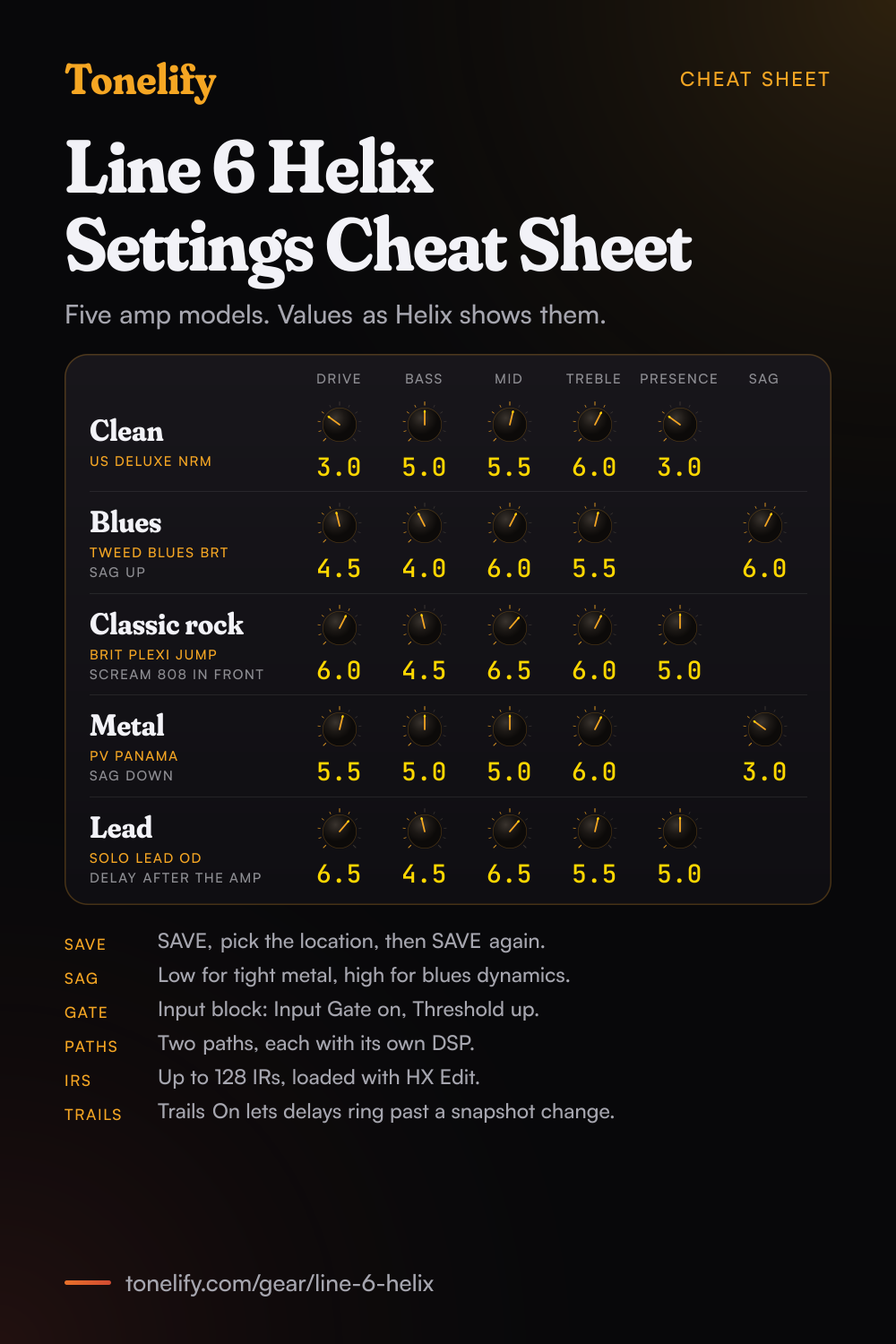
The clean, blues, classic rock, metal and lead settings from this page, together on one sheet with short tips. The PDF prints on white; the PNG is the dark version for your phone.
Starting settings on the Line 6 Helix
Values as the unit's screen shows them, on its own scale; each drawn knob shows that value's share of the range. They are where to begin, not Line 6's numbers: pick the amp model first, then move one control at a time from here.
Clean
US Deluxe Nrm, which Line 6 bases on the normal channel of a Fender Deluxe Reverb, and the amp of the Quick Start template in Line 6's manual. Drive 3.0, Bass 5.0, Mid 5.5, Treble 6.0, Presence 3.0. In an Amp+Cab block the matching cab loads with the amp. Keep Drive low for the clean and set the loudness with the Output block's Level: Line 6 says it sets the path's overall level, which keeps every preset at the same volume through a set. Master, in Line 6's words, adjusts the amount of power amp distortion, and the lower it sits, the less the other power amp controls do. US Double Nrm, based on the Twin Reverb's normal channel, and Placater Clean, based on the clean channel of a Friedman BE-100, are two other cleans to try.
- Drive 3.0
- Bass 5.0
- Mid 5.5
- Treble 6.0
- Presence 3.0
Edge of breakup and blues
Tweed Blues Brt, which Line 6 bases on the bright channel of a Fender Bassman. Drive 4.5, Bass 4.0, Mid 6.0, Treble 5.5, Sag 6.0, right where the amp starts to break up. Line 6's manual says higher Sag values give more touch dynamics and sustain for blues and classic rock riffs. For more push, put Minotaur, based on the Klon Centaur, or Tone Sovereign, based on the Analogman King of Tone, before the amp with its gain low. The Input block's Guitar In-Z sets how the input loads your pickups: Line 6 says a lower value gives a softer feel, with less high end and less gain, and a higher one a tighter feel with the full frequency range. 4x10 Tweed P10R, captured from a 4x10 Fender Bassman with P10R speakers, is the cab to pair with it.
- Drive 4.5
- Bass 4.0
- Mid 6.0
- Treble 5.5
- Sag 6.0
Sag up for touch dynamics, a drive before the amp for more push.
Classic rock
Brit Plexi Jump, which Line 6 bases on a Marshall Super Lead 100 with its channels jumped. Drive 6.0, Bass 4.5, Mid 6.5, Treble 6.0, Presence 5.0. The Mid stays high because rhythm guitar lives in the mids: cut them and the part disappears under the drums. Line 6 says Bias X sets how the power tubes react when pushed hard, low for a tighter feel and high for more tube compression, and that it reacts strongly with Drive and Master. For more gain, put Scream 808, Line 6's model of the Ibanez TS808 Tube Screamer, in front with its gain low, or move to Brit 2204, based on the 50 W Marshall JCM-800 2204. 4x12 Greenback25, captured from a 4x12 Marshall Basketweave with G12M-25 speakers, suits both.
- Drive 6.0
- Bass 4.5
- Mid 6.5
- Treble 6.0
- Presence 5.0
Scream 808 in front, its gain low, for more drive.
Metal
PV Panama, which Line 6 bases on the Peavey 5150. Drive 5.5, Bass 5.0, Mid 5.0, Treble 6.0, Sag 3.0. Line 6's manual says lower Sag values give a tighter response for metal and djent playing, and Bias X set low a tighter feel. In the Input block, turn Input Gate on and raise its Threshold only until the hiss between chords stops; the block's gain reduction meter shows how hard the gate is working. Scream 808 in front with its gain low tightens palm mutes. EV Panama Red, based on the red channel of an EVH 5150III 100 with 6L6 tubes, arrived with firmware 3.80, Line 6's model list says, and is the other 5150 to try. 4x12 Cali V30, captured from a MESA/Boogie 4FB with V30 speakers, is a cab to start from.
- Drive 5.5
- Bass 5.0
- Mid 5.0
- Treble 6.0
- Sag 3.0
Sag down, and the Input block's gate on.
Lead
Solo Lead OD, which Line 6 bases on the overdrive channel of a Soldano SLO-100. Drive 6.5, Bass 4.5, Mid 6.5, Treble 5.5, Presence 5.0. Put a delay after the amp and turn its Trails On: Line 6 says the repeats then keep decaying naturally when the block is bypassed or a different snapshot is selected. Cosmos Echo, based on the Roland RE-201 Space Echo, and Elephant Man, based on the Electro-Harmonix Deluxe Memory Man, are two delays to start from. To bring the solo in with one press, give it a snapshot, or a Stomp mode footswitch: one switch can turn several blocks on and off and flip a parameter between two values at the same time, such as the delay on and the Drive up.
- Drive 6.5
- Bass 4.5
- Mid 6.5
- Treble 5.5
- Presence 5.0
Delay after the amp with Trails On, and a snapshot for the solo.
Two amps and the two paths
Helix has two signal paths, 1 and 2, each running on its own DSP, so a preset with every block on path 1 uses half of what the unit has. A preset can hold up to four Amp+Cab, Amp or Preamp blocks, two per path at most. To run two amps on one path, select a block, press ACTION and move the joystick down: the block moves to a new parallel path B, and the signal splits in two and merges again before the output. Line 6's manual pictures two Amp blocks merging into one Cab > Dual block, and to save DSP suggests a single Amp block into a Cab > Dual, since mixing two cab models already gives a lot of variation. Amp, Preamp and Poly blocks are mono, so it is best to put only mono blocks before an amp. When path 1 runs out of room or DSP, set its Output block to Path 2A and carry on: a serial path has eight block locations, and with the B paths used too, one chain can reach 32, DSP permitting.
Snapshots
Each Helix preset has eight snapshots, which Line 6 calls presets within a preset. A snapshot recalls the on or off state of every block except the Looper, the values of up to 64 parameters, the Command Center messages and, if Tempo Select is set to Per Snapshot, the tempo; it cannot swap one model for another. Press BANK up and BANK down together for Snapshot mode, then pick one of the eight switches. To change a knob per snapshot, push and turn it: the value turns white and appears in brackets. For a block you want to switch by hand, such as a boost, press ACTION and set Knob 5 (Snapshot Bypass) to Off. Turn Trails On in delays and reverbs so they ring on across a change. Press SAVE twice: the preset stores all eight snapshots, and loading it recalls the one that was active when it was saved.
Chasing one song? Name it and the matcher writes that song's settings for the Line 6 Helix.
Line 6 Helix amp list
A Helix preset can hold up to four amp blocks, two per path, in any mix of Amp+Cab, Amp and Preamp. Amp+Cab loads the matching cab with the amp, Amp is the same without the cab, and Preamp models only the preamp stage, which Line 6 recommends when Helix feeds an external amp. Line 6's table, below, has 111 guitar and bass models, 15 of them Line 6 Originals, its own designs, plus Studio Tube Pre, a mic preamp under Preamp > Mic.
| Model | Type | What Line 6 says it is based on |
|---|---|---|
| WhoWatt 100 | Guitar | Hiwatt DR-103 Brill |
| Soup Pro | Guitar | Supro S6616 |
| Stone Age 185 | Guitar | Gibson EH-185 |
| Voltage Queen | Guitar | Victoria Vintage Queen |
| Tweed Blues Nrm | Guitar | Fender Bassman (normal channel) |
| Tweed Blues Brt | Guitar | Fender Bassman (bright channel) |
| Fullerton Nrm | Guitar | Fender 5C3 Tweed Deluxe (normal channel) |
| Fullerton Brt | Guitar | Fender 5C3 Tweed Deluxe (bright channel) |
| Fullerton Jump | Guitar | Fender 5C3 Tweed Deluxe (jumped channels) |
| GrammaticoLG Nrm | Guitar | Grammatico LaGrange (normal channel) |
| GrammaticoLG Brt | Guitar | Grammatico LaGrange (bright channel) |
| GrammaticoLG Jmp | Guitar | Grammatico LaGrange (jumped channels) |
| US Small Tweed | Guitar | Fender Champ |
| US Princess | Guitar | Fender Princeton Reverb |
| US Super Nrm | Guitar | Fender Super Reverb (normal channel) |
| US Super Vib | Guitar | Fender Super Reverb (vibrato channel) |
| US Deluxe Nrm | Guitar | Fender Deluxe Reverb (normal channel) |
| US Deluxe Vib | Guitar | Fender Deluxe Reverb (vibrato channel) |
| US Double Nrm | Guitar | Fender Twin Reverb (normal channel) |
| US Double Vib | Guitar | Fender Twin Reverb (vibrato channel) |
| Mail Order Twin | Guitar | Silvertone 1484 |
| Divided Duo | Guitar | ÷13 JRT 9/15 |
| Interstate Zed | Guitar | Dr Z Route 66 |
| Derailed Ingrid | Guitar | Trainwreck Circuits Express |
| Grammatico GSG | Guitar | Grammatico GSG100 |
| Jazz Rivet 120 | Guitar | Roland JC-120 Jazz Chorus |
| Essex A15 | Guitar | Vox AC-15 |
| Essex A30 | Guitar | Vox AC-30 with top boost |
| A30 Fawn Nrm | Guitar | Vox AC-30 Fawn (normal channel) |
| A30 Fawn Brt | Guitar | Vox AC-30 Fawn (bright channel) |
| Matchstick Ch1 | Guitar | Matchless DC30 (channel 1) |
| Matchstick Ch2 | Guitar | Matchless DC30 (channel 2) |
| Matchstick Jump | Guitar | Matchless DC30 (jumped) |
| Mandarin 80 | Guitar | Orange OR80 |
| Mandarin Rocker | Guitar | Orange Rockerverb 100 MkIII (dirty channel) |
| MOO)))N T Nrm | Guitar | Sunn Model T (normal channel) |
| MOO)))N T Brt | Guitar | Sunn Model T (brite channel) |
| MOO)))N T Jump | Guitar | Sunn Model T (jumped channels) |
| Brit J45 Nrm | Guitar | Marshall JTM-45 (normal channel) |
| Brit J45 Brt | Guitar | Marshall JTM-45 (bright channel) |
| Brit Trem Nrm | Guitar | Marshall JTM-50 (normal channel) |
| Brit Trem Brt | Guitar | Marshall JTM-50 (bright channel) |
| Brit Trem Jump | Guitar | Marshall JTM-50 (jumped) |
| Brit Plexi Nrm | Guitar | Marshall Super Lead 100 (normal channel) |
| Brit Plexi Brt | Guitar | Marshall Super Lead 100 (bright channel) |
| Brit Plexi Jump | Guitar | Marshall Super Lead 100 (jumped) |
| Brit P75 Nrm | Guitar | Park 75 (normal channel) |
| Brit P75 Brt | Guitar | Park 75 (bright channel) |
| Brit 2203 | Guitar | Marshall JCM-800, 100W, 2203 |
| Brit 2204 | Guitar | Marshall JCM-800, 50W, 2204 |
| Placater Clean | Guitar | Friedman BE-100 (clean channel) |
| Placater Dirty | Guitar | Friedman BE-100 (BE/HBE channel) |
| Cartographer | Guitar | Ben Adrian Cartographer |
| German Xtra Blue | Guitar | Bogner Ecstasy 101B, EL34 (blue channel) |
| German Xtra Red | Guitar | Bogner Ecstasy 101B, EL34 (red channel) |
| German Mahadeva | Guitar | Bogner Shiva |
| German Ubersonic | Guitar | Bogner Überschall |
| Cali Texas Ch1 | Guitar | MESA/Boogie Lone Star (clean channel) |
| Cali Texas Ch2 | Guitar | MESA/Boogie Lone Star (drive channel) |
| Cali IV Rhythm 1 | Guitar | MESA/Boogie Mark IV (channel I) |
| Cali IV Rhythm 2 | Guitar | MESA/Boogie Mark IV (channel II) |
| Cali IV Lead | Guitar | MESA/Boogie Mark IV (lead channel) |
| Cali Rectifire | Guitar | MESA/Boogie Dual Rectifier |
| Archetype Clean | Guitar | Paul Reed Smith Archon (clean channel) |
| Archetype Lead | Guitar | Paul Reed Smith Archon (lead channel) |
| ANGL Meteor | Guitar | ENGL Fireball 100 |
| Solo Lead Clean | Guitar | Soldano SLO-100 (clean channel) |
| Solo Lead Crunch | Guitar | Soldano SLO-100 (crunch channel) |
| Solo Lead OD | Guitar | Soldano SLO-100 (overdrive channel) |
| EV Panama Blue | Guitar | EVH 5150III 100, 6L6 (blue channel) |
| EV Panama Red | Guitar | EVH 5150III 100, 6L6 (red channel) |
| PV Panama | Guitar | Peavey 5150 |
| PV Vitriol Clean | Guitar | Peavey Invective (clean channel) |
| PV Vitriol Crunch | Guitar | Peavey Invective (crunch channel) |
| PV Vitriol Lead | Guitar | Peavey Invective (lead channel) |
| Revv Gen Purple | Guitar | Revv Generator 120 (purple/gain ch. 3) |
| Revv Gen Red | Guitar | Revv Generator 120 (red/high gain ch. 4) |
| Das Benzin Mega | Guitar | Diezel VH4 (mega channel) |
| Das Benzin Lead | Guitar | Diezel VH4 (lead channel) |
| Line 6 Clarity | Guitar | Line 6 Original |
| Line 6 Aristocrat | Guitar | Line 6 Original |
| Line 6 Carillon | Guitar | Line 6 Original |
| Line 6 Voltage | Guitar | Line 6 Original |
| Line 6 Kinetic | Guitar | Line 6 Original |
| Line 6 Oblivion | Guitar | Line 6 Original |
| Line 6 Ventoux | Guitar | Line 6 Original |
| Line 6 Elmsley | Guitar | Line 6 Original |
| Line 6 Elektrik | Guitar | Line 6 Original |
| Line 6 Doom | Guitar | Line 6 Original |
| Line 6 Epic | Guitar | Line 6 Original |
| Line 6 2204 Mod | Guitar | Line 6 Original |
| Line 6 Fatality | Guitar | Line 6 Original |
| Line 6 Litigator | Guitar | Line 6 Original |
| Line 6 Badonk | Guitar | Line 6 Original |
| Ampeg B-15NF | Bass | Ampeg B-15NF Portaflex |
| Ampeg SVT Nrm | Bass | Ampeg SVT (normal channel) |
| Ampeg SVT Brt | Bass | Ampeg SVT (bright channel) |
| Ampeg SVT-4 PRO | Bass | Ampeg SVT-4 PRO |
| US Dripman Nrm | Bass | Fender Bassman (Silverface) |
| Woody Blue | Bass | Acoustic 360 |
| Agua Sledge | Bass | Aguilar Tone Hammer |
| Agua 51 | Bass | Aguilar DB51 |
| Mandarin Bass 200 | Bass | Orange AD200 MkIII |
| Cali Bass | Bass | MESA/Boogie M9 Carbine |
| Cali 400 Ch1 | Bass | MESA/Boogie Bass 400+ (channel 1) |
| Cali 400 Ch2 | Bass | MESA/Boogie Bass 400+ (channel 2) |
| G Cougar 800 | Bass | Gallien-Krueger GK 800RB |
| Del Sol 300 | Bass | Sunn Coliseum 300 |
| Busy One Ch1 | Bass | Pearce BC-1 preamp (channel 1) |
| Busy One Ch2 | Bass | Pearce BC-1 preamp (channel 2) |
| Busy One Jump | Bass | Pearce BC-1 preamp (jumped) |
| Studio Tube Pre | Mic preamp | Requisite Y7 mic preamp |
Line 6 Helix cab list
Cab blocks come as Single, which is mono, or Dual, which is stereo, holds two cabs and takes twice the DSP. These are the 46 IR-based cabs that came with firmware 3.50, which Amp+Cab blocks use too. Each takes one of 12 guitar or 12 bass mic models, 1 to 12 inches from the speaker, placed from the centre to the edge of the cone, on axis or 45 degrees off it. The 41 cabs from before 3.50 are still there as Legacy Cabs, with 16 mic models of their own, and Line 6 says the new cabs use significantly less DSP than the legacy ones.
| Cab | What Line 6 says it is captured from |
|---|---|
| Soup Pro Ellipse | 1x6×9" Supro, S6616 |
| 1x8 Small Tweed | 1x8" Fender Champ |
| 1x10 US Princess | 1x10" Fender Princeton Reverb |
| 1x12 Fullerton | 1x12" Fender 5C3 Tweed Deluxe |
| 1x12 Grammatico | 1x12" Grammatico LaGrange |
| 1x12 US Deluxe | 1x12" Fender Deluxe, Oxford |
| 1x12 Open Cast | 1x12" Custom open-back, EVM12L |
| 1x12 Open Cream | 1x12" Custom open-back, G12M-65 |
| 1x12 Cali EXT | 1x12" MESA/Boogie Extension, EVM12L |
| 1x12 Cali IV | 1x12" MESA/Boogie MkIV Combo |
| 1x12 Blue Bell | 1x12" Vox AC-15, Blue Alnico |
| 2x12 Blue Bell | 2x12" Vox AC-30 Fawn, Blue Alnico |
| 2x12 Silver Bell | 2x12" Vox AC-30TB, Silver Alnico |
| 2x12 Match H30 | 2x12" Matchless DC30, Custom G12H-30 |
| 2x12 Match G25 | 2x12" Matchless DC30, Custom G12M-35 |
| 2x12 Double C12N | 2x12" Fender Twin, C12N |
| 2x12 Interstate | 2x12" Dr. Z Z Best, V30 |
| 2x12 Jazz Rivet | 2x12" Roland JC-120 |
| 2x12 Mail C12Q | 2x12" Silvertone 1484, Jensen C12Q |
| 2x12 Mandarin30 | 2x12" Orange, V30 |
| 4x10 Tweed P10R | 4x10" Fender Bassman, P10R |
| 4x10 US Super | 4x10" Fender Super Reverb, CTS alnico |
| 4x12 WhoWatt | 4x12" Hiwatt AP Fane |
| 4x12 Greenback20 | 4x12" Marshall Basketweave G12M-20 |
| 4x12 Greenback25 | 4x12" Marshall Basketweave G12M-25 |
| 4x12 Greenback30 | 4x12" Marshall Basketweave G12H-30 |
| 4x12 1960A T75 | 4x12" Marshall 1960A, G12T-75 |
| 4x12 Blackback30 | 4x12" Park 75, G12H-30 |
| 4x12 Brit V30 | 4x12" Marshall 1960AV, V30 |
| 4x12 Cali V30 | 4x12" MESA/Boogie 4FB, V30 |
| 4x12 Mandarin EM | 4x12" Orange, Eminence |
| 4x12 MOO)))N T75 | 4x12" Sunn, G12T-75 |
| 4x12 Cartog Guv | 4x12" Modified Lee Jackson, Eminence Governor |
| 4x12 Cartog C90 | 4x12" Modified Lee Jackson, Mesa C90 |
| 4x12 Uber T75 | 4x12" Bogner Uberkab, G12T-75 |
| 4x12 Uber V30 | 4x12" Bogner Uberkab, V30 |
| 4x12 XXL V30 | 4x12" ENGL XXL, V30 |
| 4x12 SoloLead EM | 4x12" Soldano, Eminence 12-5875 |
| 1x12 Epicenter | 1x12" Epifani Ultralight |
| 1x15 Ampeg B-15 | 1x15" Ampeg B-15 |
| 2x15 Brute | 2x15" MESA/Boogie, EV |
| 2x15 US Dripman | 2x15" Fender Bassman, JBL D130 |
| 4x10 Garden | 4x10" Eden D410XLT |
| 4x10 Ampeg Pro | 4x10" Ampeg PR-410HLF |
| 6x10 Cali Power | 6x10" MESA/Boogie PowerHouse |
| 8x10 SVT AV | 8x10" Ampeg SVT-810AV |
Line 6 Helix effects list
Many models come in mono and stereo versions, and the stereo one uses about twice the DSP. Helix also has selected effects from Line 6's older DL4, DM4, MM4 and FM4 stompboxes and M13, M9 and M5 processors, in the Legacy subcategory: they are listed apart under each category. Where Line 6 names what a model is based on, it is in brackets; the rest are Line 6 Originals. The polyphonic models, Feedbacker, Poly Detune, Poly Sustain, Poly Pitch, Poly Wham, Poly Capo and 12 String, can each take up to half a path's DSP, so one fits per path. The Looper's six models come last.
- Distortion (44)
- Kinky Boost (Xotic EP Booster), Deranged Master (Dallas Rangemaster Treble Booster), Minotaur (Klon Centaur), Teemah! (Paul Cochrane Timmy Overdrive), Heir Apparent (Analogman Prince of Tone), Tone Sovereign (Analogman King of Tone), Alpaca Rogue (Way Huge Red Llama, modded), Compulsive Drive (Fulltone OCD), Dhyana Drive (Hermida Zendrive), Horizon Drive (Horizon Precision Drive), Valve Driver (Chandler Tube Driver), Top Secret OD (DOD OD-250), Prize Drive (Nobels ODR-1(bc)), Scream 808 (Ibanez TS808 Tube Screamer), Pillars (Earthquaker Devices Plumes), Hedgehog D9 (MAXON SD9 Sonic Distortion), Stupor OD (BOSS SD-1 Overdrive), Deez One Vintage (BOSS DS-1 Distortion, Made-in-Japan), Deez One Mod (BOSS DS-1 Distortion, Keeley modded), Ratatoullie Dist (Pro Co RAT, with LM308 opamp), Vermin Dist (Pro Co RAT), Vital Dist (the octave/distortion circuit of the Earthquaker Devices Life), Vital Boost (the boost circuit of the Earthquaker Devices Life), KWB (Benadrian Kowloon Walled Bunny Distortion), Legendary Drive (Carvin VLD1 Legacy Drive, hi gain channel), Swedish Chainsaw (BOSS HM-2 Heavy Metal Distortion, MIJ), Arbitrator Fuzz (Arbiter Fuzz Face), Pocket Fuzz (Jordan Boss Tone Fuzz), Bighorn Fuzz ('73 Electro-Harmonix Ram's Head Big Muff Pi), Triangle Fuzz (Electro-Harmonix Big Muff Pi), Dark Dove Fuzz (Electro-Harmonix Russian Big Muff Pi), Ballistic Fuzz (Euthymia ICBM Fuzz), Industrial Fuzz (Z.Vex Fuzz Factory), Tycoctavia Fuzz (Tycobrahe Octavia), Wringer Fuzz (Garbage's modded BOSS FZ-2), Thrifter Fuzz, Xenomorph Fuzz (Subdecay Harmonic Antagonizer), Megaphone (a megaphone), Bitcrusher, Ampeg Scrambler (Ampeg Scrambler Bass Overdrive), ZeroAmp Bass DI (Tech 21 SansAmp Bass Driver DI V1), Regal Bass DI (Noble Preamp Bass DI), Obsidian 7000 (Darkglass Electronics Microtubes B7K Ultra), Clawthorn Drive (Wounded Paw Battering Ram)
- Distortion, legacy (17)
- Tube Drive (Chandler Tube Driver), Screamer (Ibanez Tube Screamer), Overdrive (DOD Overdrive/Preamp 250), Classic Dist (Pro Co RAT), Heavy Dist (BOSS Metal Zone), Colordrive (Colorsound Overdriver), Buzz Saw (Maestro Fuzz Tone), Facial Fuzz (Arbiter Fuzz Face), Jumbo Fuzz (Vox Tone Bender), Fuzz Pi (Electro-Harmonix Big Muff Pi), Jet Fuzz (Roland Jet Phaser), L6 Drive (Colorsound Overdriver, modded), L6 Distortion, Sub Oct Fuzz (PAiA Roctave Divider), Octave Fuzz (Tycobrahe Octavia), Bronze Master (Maestro Bass Brassmaster), Killer Z (BOSS Metal Zone MT-2)
- Dynamics (12)
- Deluxe Comp, Red Squeeze (MXR Dyna Comp), Kinky Comp (Xotic SP Compressor), Ampeg Opto Comp (Ampeg Opto Comp Compressor), Rochester Comp (Ashly CLX-52, in conjunction w/ B. Sheehan), LA Studio Comp (Teletronix LA-2A), 3-Band Comp, Noise Gate, Hard Gate, Horizon Gate (the gate circuit of the Horizon Precision Drive), Autoswell, Feedbacker
- Dynamics, legacy (7)
- Tube Comp (Teletronix LA-2A), Red Comp (MXR Dyna Comp), Blue Comp (BOSS CS-1), Blue Comp Treb (BOSS CS-1, Treble switch on), Vetta Comp, Vetta Juice, Boost Comp (MXR Micro Amp)
- EQ (8)
- Simple EQ, Low and High Cut, Low/High Shelf, Parametric, Tilt, 10 Band Graphic (MXR 10-Band Graphic EQ), Cali Q Graphic (MESA/Boogie Mark IV Graphic EQ), Acoustic Sim
- Modulation (30)
- Optical Trem (Fender optical tremolo circuit), 60s Bias Trem (Vox AC-15 Tremolo), Tremolo/Autopan (BOSS PN-2), Harmonic Tremolo, Bleat Chop Trem (Lightfoot Labs Goatkeeper), Script Mod Phase (MXR Phase 90), Pebble Phaser (Electro-Harmonix Small Stone), Ubiquitous Vibe (Shin-ei Uni-Vibe), FlexoVibe, Deluxe Phaser, Gray Flanger (MXR 117 Flanger), Harmonic Flanger (A/DA Flanger), Courtesan Flange (Electro-Harmonix Deluxe EM), Dynamix Flanger, Chorus, 70s Chorus (BOSS CE-1), PlastiChorus (Modded Arion SCH-Z chorus), Ampeg Liquifier Chorus (Ampeg Liquifier Chorus), Trinity Chorus (Dytronics Tri-Stereo Chorus), 4-Voice Chorus, Bubble Vibrato (BOSS VB-2 Vibrato), Vibe Rotary (Fender Vibratone), 122 Rotary (Leslie 122), 145 Rotary (Leslie 145), Triple Rotary (Yamaha RA-200), Retro Reel, Double Take, Poly Detune, AM Ring Mod, Pitch Ring Mod
- Modulation, legacy (26)
- Pattern Tremolo, Panner, Bias Tremolo (1960 Vox AC-15 Tremolo), Opto Tremolo (1964 Fender Deluxe Reverb), Script Phase (MXR Phase 90, script logo version), Panned Phaser (Ibanez Flying Pan), Barberpole, Dual Phaser (Mu-Tron Bi-Phase), U-Vibe (Shin-ei Uni-Vibe), Phaser (MXR Phase 90), Pitch Vibrato (BOSS VB-2), Dimension (Roland Dimension D), Analog Chorus (BOSS CE-1), Tri Chorus (Dytronics Tri-Stereo Chorus), Analog Flanger (MXR Flanger), Jet Flanger (A/DA Flanger), AC Flanger (MXR Flanger), 80A Flanger (A/DA Flanger), Frequency Shift, Ring Modulator, Rotary Drum (Fender Vibratone), Rotary Drum/Horn (Leslie 145), Tape Eater, Warble-Matic, Random S&H, Sweeper
- Delay (28)
- Simple Delay, Mod/Chorus Echo, Dual Delay, Multitap 4, Multitap 6, Ping Pong, Sweep Echo, Ducked Delay (TC Electronic 2290), Reverse Delay, Vintage Digital, Vintage Swell, Pitch Echo, Transistor Tape (Maestro Echoplex EP-3), Cosmos Echo (Roland RE-201 Space Echo), Harmony Delay, Bucket Brigade (BOSS DM-2), Adriatic Delay (BOSS DM-2 w/ Adrian Mod), Adriatic Swell, Elephant Man (Electro-Harmonix Deluxe Memory Man), Multi Pass, Heliosphere, Poly Sustain, Glitch Delay, Euclidean Delay, ADT, Crisscross, Tesselator, Ratchet
- Delay, legacy (17)
- Ping Pong (TC Electronic 2290), Dynamic (TC Electronic 2290), Stereo, Digital, Dig w/Mod, Reverse, Lo Res, Tube Echo (Maestro Echoplex EP-1), Tape Echo (Maestro Echoplex EP-3), Sweep Echo, Echo Platter (Binson EchoRec), Analog Echo (BOSS DM-2), Analog w/Mod (Electro-Harmonix Deluxe Memory Man), Auto-Volume Echo, Multi-Head (Roland RE-101 Space Echo), Bubble Echo, Phaze Eko
- Reverb (13)
- Dynamic Hall, Dynamic Plate, Dynamic Room, Dynamic Ambience, Dynamic Bloom, Shimmer, Hot Springs, Nonlinear, Glitz, Ganymede, Searchlights, Plateaux, Double Tank
- Reverb, legacy (12)
- Plate, Room, Chamber, Hall, Echo, Tile, Cave, Ducking, Octo, '63 Spring, Spring, Particle Verb
- Pitch/Synth (12)
- Pitch Wham (Digitech Whammy), Twin Harmony (Eventide H3000), Simple Pitch, Dual Pitch, Boctaver (Boss OC-2 Octaver), 3 OSC Synth, Poly Pitch, Poly Wham, Poly Capo, 12 String, 3 Note Generator, 4 OSC Generator
- Pitch/Synth, legacy (17)
- Bass Octaver (EBS OctaBass), Smart Harmony (Eventide H3000), Octi Synth, Synth O Matic, Attack Synth (Korg X911 Guitar Synth), Synth String (Roland GR700 Guitar Synth), Growler, Buzz Wave, Rez Synth, Seismik Synth, Analog Synth, Synth Lead, String Theory, Synth FX, Saturn 5 Ring Mod, Synth Harmony, Double Bass
- Filter (4)
- Mutant Filter (Musitronics Mu-Tron III), Mystery Filter (Korg A3), Autofilter, Asheville Pattrn (Moog Moogerfooger MF-105M MuRF Filter)
- Filter, legacy (11)
- Voice Box, V Tron (Musitronics Mu-Tron III), Q Filter, Seeker (Z Vex Seek Wah), Obi Wah (Oberheim voltage-controlled S&H filter), Tron Up (Musitronics Mu-Tron III, up position), Tron Down (Musitronics Mu-Tron III, down position), Throbber (Electrix Filter Factory), Slow Filter, Spin Cycle (Craig Anderton's Wah/Anti-Wah), Comet Trails
- Wah (11)
- UK Wah 846 (Vox V846), Teardrop 310 (Dunlop Cry Baby Fasel model 310), Fassel (Dunlop Cry Baby Super), Weeper (Arbiter Cry Baby), Chrome (Vox V847), Chrome Custom (Modded Vox V847), Throaty (RMC Real McCoy 1), Vetta Wah, Colorful (Colorsound Wah-fuzz), Conductor (Maestro Boomerang), Teardrop Bass Q (Modified Dunlop 105Q)
- Volume/Pan (5)
- Volume Pedal, Gain, Pan, Stereo Width, Stereo Imager
- Looper (6)
- 6 Switch Looper (Mono), 1 Switch Looper (Mono), Shuffling Looper (Mono), 6 Switch Looper (Stereo), 1 Switch Looper (Stereo), Shuffling Looper (Stereo)
Line 6 Helix specifications
- Released
- 2015
Line 6 Helix questions
What amps are in the Line 6 Helix?
111 guitar and bass models in Line 6's Amp and Preamp table for firmware 3.80, 94 for guitar and 17 for bass, plus Studio Tube Pre, a mic preamp. 15 are Line 6 Originals, its own designs; the others are based on real amps, from the Fender Bassman and the Marshall Super Lead 100 to the Peavey 5150, the EVH 5150III and the Diezel VH4, and the full list with what each is based on is below. Each amp can be used three ways: as Amp+Cab, which loads its matching cab, as Amp on its own, or as Preamp, which models only the preamp stage and uses less DSP.
How many effects can the Helix run at once?
There is no fixed number: Line 6 lets you keep adding blocks until the DSP runs out, and a model greyed out in the list will not fit on that path. A serial path has eight block locations, and there are two paths, each with its own DSP. The limits are up to four amp blocks, two per path, four Single Cab or two Dual Cab blocks, one Looper per preset, and one polyphonic block per path, such as Poly Pitch or Feedbacker, which can each take up to half a path's DSP. Line 6 says amps, reverbs and Poly models use the most, and EQ, Dynamics, Volume/Pan and Send/Return blocks relatively little.
What is the difference between the Helix Floor and the Helix LT?
Line 6 says the LT has the same dual-SHARC processing and HX Modeling as the Helix Floor and Helix Rack. The difference is the hardware. Line 6's LT page lists two sends and returns instead of the Floor's four, one jack shared by a second expression pedal and amp switching, and a guitar input only, where the Floor adds an Aux input, a Mic input with phantom power, jacks for two more expression pedals, a CV/expression out and S/PDIF. The Floor's 13 scribble strips, the small displays that name each footswitch's job, are not on the LT's feature list.
How do you save a preset on the Helix?
Press SAVE to open the Save Preset screen, rename it with the joystick, choose the setlist and the location with Knob 4 (Setlist) and Knob 5 (Destination), then press SAVE again or Knob 6 (Save); Line 6's product page adds that pressing SAVE twice quick saves. Helix has eight setlists of 128 presets, 1,024 in all, and any of them can be overwritten. To have a model load with your own settings every time, press ACTION, then PAGE, then Knob 2 (User Default). The free HX Edit application backs up presets, IRs, Favorites and global settings to a computer.
How do snapshots work on the Helix?
Line 6 calls them presets within a preset. Each preset has eight, and each recalls the on or off state of every block except the Looper, up to 64 parameter values, the Command Center messages and, with Tempo Select set to Per Snapshot, the tempo. Press BANK up and BANK down together for Snapshot mode, or press PRESET and turn Knob 5 (Select Snapshot). Push and turn a knob to put it under snapshot control, and turn Trails On in delay, reverb and FX Loop blocks so they ring on when you change. Line 6's tip: Command Center's MIDI, CV and Ext Amp messages go out when a snapshot is recalled, so a snapshot can switch your amp's channel too.
How do you use the Helix with a tube amp?
Line 6 recommends the Preamp models when Helix feeds an external amplifier: they model only the preamp stage and leave the rest to the amp. For the front of a guitar amp, set the 1/4" Outputs to Instrument in Global Settings > Ins/Outs, and skip the Cab or IR block, since the amp's speaker does that job. The four sends and returns work as effects loops, set to Instrument for stompboxes or Line for rack gear, and the EXT AMP jack switches the amp's channels or turns its reverb on and off, from a footswitch or when a snapshot is recalled.
Can the Helix be used as an audio interface?
Yes: Line 6 calls it a USB 2.0, multiple-input/output, 24-bit, 96kHz, low-latency audio interface for Windows and Mac computers, and for iPad and iPhone with Apple's Camera Connection Kit. Record from USB 1/2 for the processed sound, which the Helix outputs monitor with no latency; USB 7 and 8 carry dry signals for re-amping, from the inputs set in Global Settings > Ins/Outs, Guitar and Mic by default. On Windows, install the Line 6 Helix ASIO driver. A Mac needs no driver, though the built-in one runs at 48 kHz only; Line 6's Mac Core Audio driver adds 44.1, 88 and 96 kHz. Use a USB 2.0 port or faster, not a hub.
How do you set the noise gate on the Helix?
Every Input block has one: turn Input Gate on, and its Threshold and Decay come alive; they stay greyed out while it is off. Threshold is the level below which the gate closes, and Decay how quickly it does. The block's gain reduction meter shows how much it is cutting, which helps set it just high enough. The Dynamics category adds Noise Gate and Hard Gate, both Line 6 Originals, and Horizon Gate, based on the gate circuit of the Horizon Precision Drive.
Can you load IRs into the Helix?
Yes, up to 128 at a time, imported with the free HX Edit application as .hir or .wav files; a .wav of any bit depth, length or sample rate is converted on import to 48 kHz, 32-bit, mono and 2,048 samples. Add an IR block after an Amp block, which Line 6 recommends over an Amp+Cab, and pick the IR with Knob 1 (IR Select). A Single IR block runs a 1024-sample IR, two per path, or a higher resolution 2048-sample one, one per path; a Dual IR block holds two, in stereo, one per path. Line 6 adds that IR blocks use significantly less DSP than the Legacy Cabs.
How do you update the Helix firmware?
With HX Edit on a Mac or Windows computer: connect Helix by USB, and HX Edit checks online for a newer version and walks you through a full backup and the update. Line 6 says presets from 2.xx firmware load on 3.xx, but presets saved with 3.0 or later do not load on 2.xx. Updates never add the new factory presets on their own: to load them, back up first, then hold footswitches 7 and 8 while switching Helix on, which replaces every preset in every setlist. This page follows the manual for firmware 3.80.
How do the Helix footswitches work?
FS6 switches between Preset mode, where the middle eight switches load presets, and Stomp mode, where they turn blocks on and off; hold it for two seconds for Pedal Edit mode, which edits a block with your feet and the expression pedal. The switches are touch-sensitive: touch one, without pressing, to select its block on the screen, and touch and hold two to swap their assignments. Press TAP two or more times to set the tempo, and hold it for the tuner, which takes a reference from 425 to 455 Hz. With Stomp Mode Switches set to 10 Switches in Global Settings > Footswitches, the two BANK switches become stomp switches as well.
Why does my Helix show different knobs from these settings?
Because the amp models differ. Line 6's manual calls the first page of amp parameters the tonestack, the knobs you would see on the real amp's panel, and says it and the deeper pages may differ depending on the model, so a model without one of the knobs here skips it. The common amp settings Line 6 lists are Master, Sag, Hum, Ripple, Bias and Bias X. The amp button on the top panel jumps straight to the tonestack, and pressing it again cycles through each amp in the preset. The values on this page are for the models named, as Helix shows them.
How long can the Helix looper record?
The 6 Switch and 1 Switch Loopers record 60 seconds in mono at full speed, or 120 at half speed, and 30 seconds in stereo, or 60 at half speed. The Shuffling Looper, which chops a loop into slices and reorders them, records 60 seconds in mono or 30 in stereo, at full speed only. One Looper block fits in a preset, on either path. Recording at half speed doubles the memory, and switching to full speed then plays the loop an octave up. You can change presets while looping, but playback stops unless the new preset has the same type of looper, mono or stereo.
What are the best Line 6 Helix settings for metal?
Start with PV Panama, based on the Peavey 5150, at Drive 5.5, Bass 5.0, Mid 5.0, Treble 6.0 and Sag 3.0, with the Input block's gate on and Scream 808 in front with its gain low. These are starting points rather than Line 6's numbers. Line 6 ties lower Sag values to a tighter response for metal and djent playing. EV Panama Red, based on the red channel of an EVH 5150III 100, is the newer model to try, and 4x12 Cali V30 is a cab to start from.
When did the Line 6 Helix come out?
Line 6 unveiled it on 11 June 2015 as its new flagship guitar processor, built on its new HX modelling engine, and said the floor unit would ship at the end of summer 2015 at $1,499 (MSRP). Helix Rack, also $1,499, and a $499 foot controller for it were to follow later that autumn.
How do you build a patch on the Line 6 Helix?
Pick the amp model first, then set its controls, then add the blocks in signal-chain order: drive before the amp, time and modulation after it. A patch built the other way around ends up compensating for the wrong stage. Tonelify returns the model, the order and the parameters together.
Does Tonelify support the Line 6 Helix?
Yes. Name it in the tone matcher along with the song you are chasing and the settings come back adapted to it. Gear does not need to be in the catalog for a match to run.
Sources
Panel, specifications and dates checked against these on .
More Line 6 gear
Similar multi-effects units from other makers
Settings for the song you are chasing
Name a song and Tonelify reads the documented rig behind the recording, then writes the settings for a rig with the Line 6 Helix in it. A first plan starts with 7 days free, $0 today.