
Roland JC-120 Jazz Chorus settings
Distortion, reverb and the vibrato and chorus controls are on channel 2 only. Channel 1 is a plain clean channel with its own volume and EQ.
⚡ Match a tone on this amp- Bright
- Volume
- Treble
- Middle
- Bass
- Distortion
- Reverb
- Vib/Chorus
- Speed
- Depth
How do you dial in a specific tone on a Roland JC-120 Jazz Chorus?
Solid-state amps hold their voicing steady across the volume range, which makes the Roland JC-120 Jazz Chorus far more predictable to dial in than a valve amp and is exactly why some of the most aggressive rhythm tones ever recorded came off solid-state heads. The trade is headroom before the EQ starts to sound brittle, so on this amp the treble control does more damage than the gain control does.
Name the song you are chasing in the tone matcher and Tonelify returns the settings for this exact guitar amp, not the settings the original artist used. Those are two different things: the recording was made on gear most players do not own.
Settings for this amp only ever use controls it actually has, because its front panel is stored in our gear database. You will not be told to set a knob that is not on the amp.
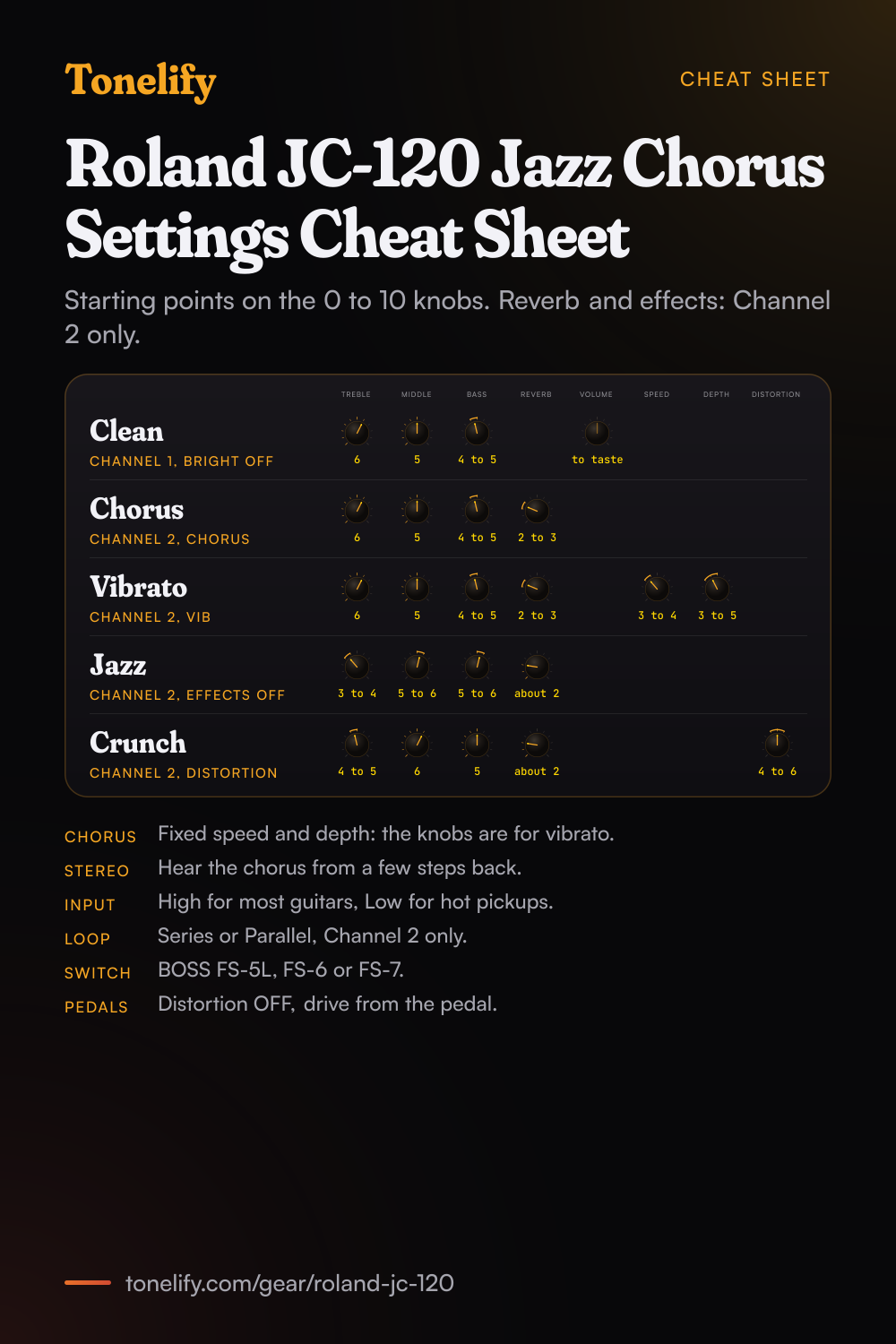
Free download
Printable cheat sheet: PDF and PNG
The clean, chorus, vibrato, jazz and crunch settings from this page, together on one sheet with short tips. The PDF prints on white; the PNG is the dark version for your phone.
Starting settings on the Roland JC-120 Jazz Chorus
Positions on a 0 to 10 scale, with 5 at twelve o'clock. They are where to begin, not Roland's numbers: move one control at a time from here.
Clean
Channel 1, Bright off, Volume to taste, Treble 6, Middle 5, Bass 4 to 5. Channel 1 is the plain one: Roland's manual gives it the Bright switch, Volume, Treble, Middle and Bass and nothing else, so there is no reverb on it. Roland says pros recognise it as the benchmark in clean guitar sound, so start flat and let the pickups decide. The Bright switch gives a bright, clear sound: try it with humbuckers or a dark guitar, and leave it off with bright single coils.
- Volume to taste
- Treble 6
- Middle 5
- Bass 4 to 5
Channel 1 has no reverb: use Channel 2 for it.
Chorus
Channel 2, VIB/OFF/CHORUS on CHORUS, Distortion OFF, Treble 6, Middle 5, Bass 4 to 5, Reverb 2 to 3. Roland's manual says neither the speed nor the depth of the chorus can be changed, so the Speed and Depth knobs do nothing here; the sound is the one Roland built in. Roland explains that the Dimensional Space Chorus feeds a dry sound to one speaker and the same signal with pitch modulation to the other, and the two mix in the room, so judge it from a few steps back rather than with your ear at one speaker.
- Treble 6
- Middle 5
- Bass 4 to 5
- Reverb 2 to 3
The chorus has fixed speed and depth.
Vibrato
Channel 2, VIB/OFF/CHORUS on VIB, Speed 3 to 4, Depth 3 to 5, Treble 6, Middle 5, Bass 4 to 5, Reverb 2 to 3. Vibrato is the effect the two knobs are for: Roland's manual says Speed sets the rate and Depth how deep it goes, clockwise for more of each. Set Speed to the song's pulse first, then raise Depth until the pitch wobble is as strong as you want it.
- Speed 3 to 4
- Depth 3 to 5
- Treble 6
- Middle 5
- Bass 4 to 5
- Reverb 2 to 3
Jazz
Channel 2, Bright off, Distortion OFF, VIB/OFF/CHORUS on OFF, Treble 3 to 4, Middle 5 to 6, Bass 5 to 6, Reverb about 2. Use the neck pickup and roll the guitar's tone knob back a touch: the low Treble softens the pick attack, and a little more Middle keeps single notes round. Channel 2 is the one with reverb; if a hollow-body guitar starts to boom, bring Bass down before anything else.
- Treble 3 to 4
- Middle 5 to 6
- Bass 5 to 6
- Reverb about 2
Crunch
Channel 2, Distortion 4 to 6, Treble 4 to 5, Middle 6, Bass 5, Reverb about 2. Roland's manual says clockwise rotation intensifies the distortion effect and OFF turns it off, and a footswitch can switch it on and off, so it can sit beside a clean sound in the same song. Treble a step lower than for clean keeps it from turning fizzy. For more gain than this, use a drive pedal with Distortion on OFF.
- Distortion 4 to 6
- Treble 4 to 5
- Middle 6
- Bass 5
- Reverb about 2
Pedals, modellers and stereo effects
Roland calls the JC-120 an ideal platform for shaping sound with stompbox pedals, and great with multi-effects, amp modelers and guitar synths, because the clean tone preserves the character of the guitar's sound. Drive pedals go into a High input with the amp's Distortion on OFF. Time effects can go in Channel 2's effects loop on the back: SERIES sends only what comes back from the effect to the speakers, PARALLEL mixes it with the dry sound, and the level switch goes to +4 dBu when the effect's level is high and -20 dBu when it is low. The Return takes stereo on L/MONO and R; in mono, use L/MONO, because Roland says a return into R alone is not heard.
Chasing one song? Name it and the matcher writes that song's settings for the Roland JC-120 Jazz Chorus.
What controls does the Roland JC-120 Jazz Chorus have?
The Roland JC-120 Jazz Chorus has 10 controls on its front panel: Bright switch, Volume, Treble, Middle, Bass, Distortion, Reverb, Vib/Chorus switch, Speed and Depth.
Roland JC-120 Jazz Chorus specifications
- Power
- 120W, as 2x60W stereo
- Speaker
- 2x12"
- Front panel
- Bright switch, Volume, Treble, Middle, Bass, Distortion, Reverb, Vib/Chorus switch, Speed, Depth
- Released
- 1975
What the Roland JC-120 Jazz Chorus panel means when you dial it in
120W, as 2x60W stereo through a 2x12". There is enough headroom to hold a clean setting at band volume, so the gain control does the driving rather than the master. There is no presence control on this panel, so everything above the treble band has to come from the treble control and the guitar's own tone knob. A setting copied from an amp with presence has to be rebalanced here. Drive and volume have separate knobs, so the amp can sound driven at a volume that is liveable. Where a tone sits between the two is part of the answer, not a detail. Reverb is onboard, so a tone that needs it does not need a pedal in the chain.
Roland JC-120 Jazz Chorus questions
What is the difference between Channel 1 and Channel 2 on the JC-120?
Roland's manual lists Channel 1 as the Bright switch, Volume, Treble, Middle and Bass. Channel 2 has the same five and adds Distortion, Reverb, the vibrato Speed and Depth knobs and the VIB/OFF/CHORUS switch, and the effects loop on the back is Channel 2's too. Each channel has its own High and Low inputs, so you pick a channel by the jack you plug into.
Why do the Speed and Depth knobs not change the JC-120's chorus?
Because they set the vibrato only. Roland's manual says neither the speed nor the depth of the chorus effect can be changed: CHORUS on the VIB/OFF/CHORUS switch gives the built-in chorus as Roland set it, VIB gives vibrato at the speed and depth on the two knobs, and OFF gives neither.
How does the JC-120's chorus work?
Roland explains that the Dimensional Space Chorus feeds a dry sound to one speaker and the same signal with pitch modulation applied to the other, and the two tones mix in the listening space. That is why the amp has two power amps, one for each speaker. Roland says the effect debuted with the JC-120 in 1975 and reached pedal form in 1976 with the BOSS CE-1.
Should I use the High or Low input on the JC-120?
High for a guitar with a standard output, Low for very high output instruments, as Roland's manual puts it. Both channels have their own pair. Turn the volume down and the units off before plugging in, as the manual asks.
What footswitch works with the JC-120?
Roland lists the BOSS FS-5L, FS-6 and FS-7 as options. The back panel has footswitch jacks for chorus/vibrato, reverb and distortion, each switching that effect on and off. Roland's manual adds that no effect will be obtained from the footswitch if the Distortion knob or the VIB/OFF/CHORUS switch is set to OFF.
How do I connect a stereo modeller or multi-effects to the JC-120?
Through Channel 2's effects loop: the Return has L/MONO and R jacks for stereo. Roland's manual describes SERIES as the setting where the effect's sound is not mixed with the direct sound, and PARALLEL as the one where they are mixed; set the level switch to +4 dBu for a unit with a high output level and -20 dBu for a low one. In mono, use the L/MONO jack: Roland says a return into R alone is not heard through the speakers.
Can you record the JC-120 direct or use headphones?
It has stereo Line Out jacks, L/MONO and R, which Roland says connect the amp to another amplifier, a mixer or a recorder. There is no headphone jack in the manual's list of connectors. Roland's power-on order is the devices on the inputs first, then the JC-120, then whatever is on the Line Outs, all with the volume down.
How heavy is the Roland JC-120?
Roland's manual gives 28.7 kg, 63 lb 5 oz, including the casters, and 760 by 280 by 622 mm (29 15/16 by 11 1/16 by 24 1/2 inches). The casters come in the box but are not fitted at the factory, and Roland asks for at least two people to carry the amp.
How powerful is the JC-120, and what speakers does it have?
Roland rates it at 120 watts and describes it as a 120-watt stereo amp with two 12-inch silver cone speakers. Roland's history of the series says the sound comes from dual power amps feeding two independent speakers, which is how the chorus can put the dry sound in one speaker and the modulated sound in the other. Power consumption is 130 W.
When did the Roland JC-120 come out?
In 1975. Roland says the JC-120 has been the flagship of the Jazz Chorus series since then and has remained in non-stop production for over five decades. The JC-60, with 60 watts and one 12-inch speaker, was released alongside it.
How is the JC-120 different from the JC-40?
The JC-120 is 120 watts into two 12-inch speakers, with two channels and all of the effects on Channel 2. Roland describes the JC-40 as 40 watts into two 10-inch speakers and the first JC amp with a stereo input. On the JC-120 a stereo source goes into the effects loop's Return instead, because its inputs are mono.
Who played through a Roland Jazz Chorus?
Wikipedia lists early Jazz Chorus users including Andy Summers of The Police, Alex Lifeson, Albert King, Robert Fripp, Adrian Belew and Prince, and notes that the Jazz Chorus became popular for clean tones in heavy metal, naming James Hetfield and Kirk Hammett of Metallica. Robert Smith of The Cure used the rarer JC-160, with four 10-inch speakers.
What are the best Roland JC-120 settings for metal?
Use a high-gain pedal into a High input with the JC-120's Distortion on OFF, Bright off, Treble 4 to 5, Middle 5 to 6, Bass 4 to 5 and the reverb off or low. These are starting points, not Roland's numbers. The amp's strength is a clean sound that passes a pedal through without colouring it, which is how Roland pitches it to pedal and modeller players.
Is there a printable Roland JC-120 settings cheat sheet?
Yes. The cheat sheet on this page puts all five starting settings on one page, from clean to crunch, each with its channel, and short tips under them. Download the PDF to print it on white, or save the PNG to your phone.
Does Tonelify support the Roland JC-120 Jazz Chorus?
Yes, and its front panel is stored, so settings only ever reference controls this guitar amp has: Bright switch, Volume, Treble, Middle, Bass, Distortion, Reverb, Vib/Chorus switch, Speed, Depth. You will not be told to set a knob that is not there.
Sources
Panel, specifications and dates checked against these on .
More Roland gear
Similar amps from other makers
Settings for the song you are chasing
Name a song and Tonelify reads the documented rig behind the recording, then writes the settings for the controls the Roland JC-120 Jazz Chorus has. A first plan starts with 7 days free, $0 today.