
Valeton GP-180 presets and settings
Floor unit with three footswitches, ten module buttons, a colour screen and a 3000 mAh battery, with MIDI in and out. Twelve modules at once, in any order, from 58 amp models and over 200 effects, plus a loader for NAM captures and up to 20 cabinet IRs.
⚡ Match a tone on this gearHow do you dial in a specific tone on a Valeton GP-180?
A multi-effects unit gives you the whole chain in one box, which means the order of the blocks is as much of the answer as the values inside them. Settings for the Valeton GP-180 name the amp model, the block order and the parameters together, rather than handing you numbers with no chain to put them in.
Name the song you are chasing in the tone matcher and Tonelify returns the settings for this exact multi-effects unit, not the settings the original artist used. Those are two different things: the recording was made on gear most players do not own.
Free download
Printable cheat sheet: PDF and PNG
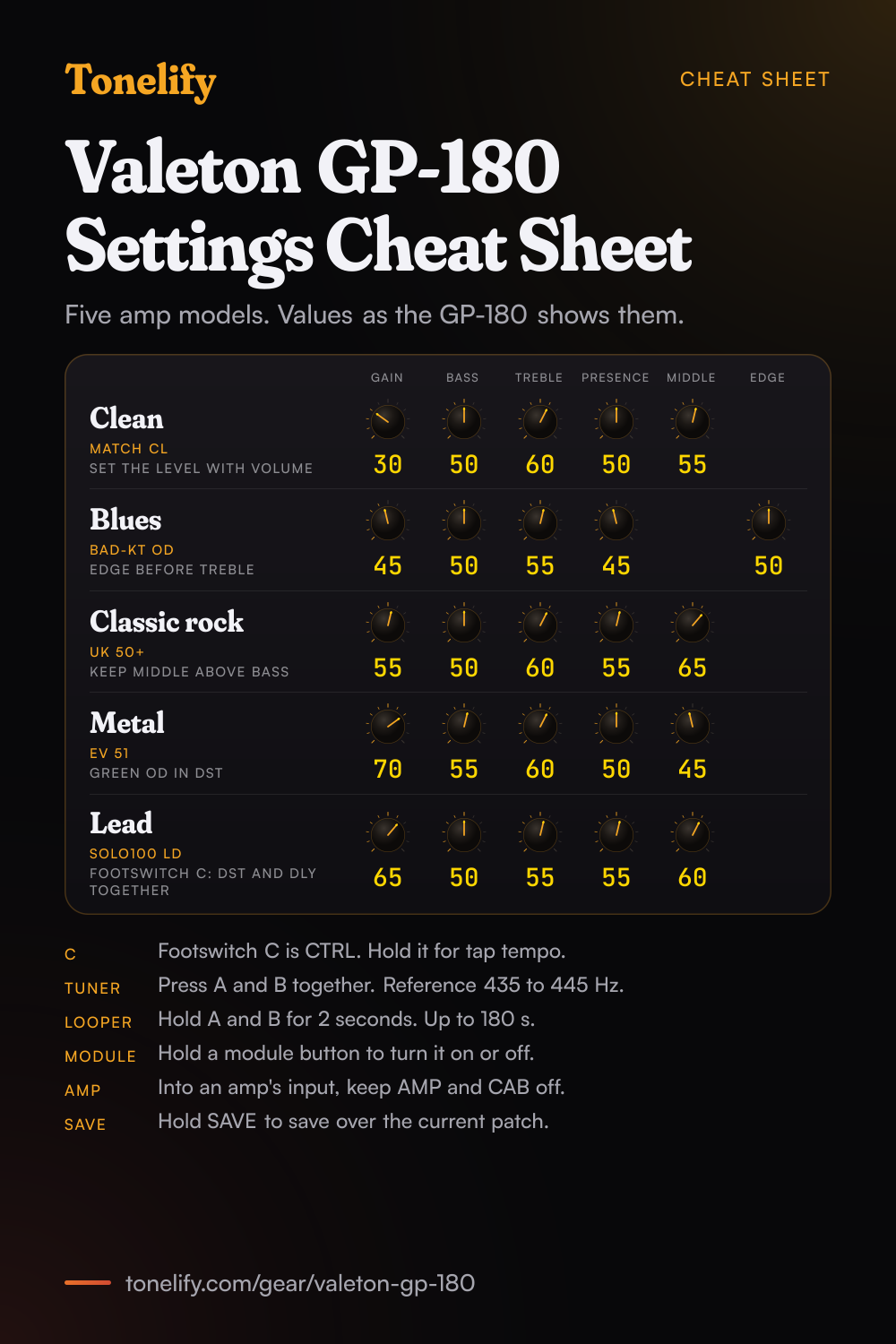
The clean, blues, classic rock, metal and lead settings from this page, together on one sheet with short tips. The PDF prints on white; the PNG is the dark version for your phone.
Starting settings on the Valeton GP-180
Values as the unit's screen shows them, on its own scale; each drawn knob shows that value's share of the range. They are where to begin, not Valeton's numbers: pick the amp model first, then move one control at a time from here.
Clean
Match CL, Valeton's model of the Matchless Chieftain 212 combo's clean tone. Gain 30, Bass 50, Middle 55, Treble 60, Presence 50. Valeton's effect list calls Gain the pre gain and Volume the post gain, so keep Gain low and set the level with Volume. Add Room or Plate from RVB with a low Mix. For a different clean there is J-120 CL, based on the Jazz Chorus, and the factory SnapTone files include Match 35 CL, a capture of a Matchless Clubman 35, and Dark PRI, a Fender '65 Princeton Reverb with a 2x12.
- Gain 30
- Bass 50
- Middle 55
- Treble 60
- Presence 50
Set the level with Volume.
Edge of breakup and blues
Bad-KT OD, Valeton's model of the Bad Cat Hot Cat 30's overdrive channel. Gain 45, Bass 50, Treble 55, Edge 50, Presence 45. It has Bass and Treble but no Middle, and Edge, which Valeton says shapes the high and high-mid character, so start there before you touch Treble. For a pedal in front, OD 9 in DST is Valeton's Ibanez TS9 Tube Screamer and TaiChi OD its Hermida Zendrive. The factory SnapTone file Bad KT OD is a capture of a different Bad Cat, the Lynx 50, on its second channel.
- Gain 45
- Bass 50
- Treble 55
- Edge 50
- Presence 45
Edge before Treble.
Classic rock
UK 50+, Valeton's model of the Marshall JMP50's bright channel. Gain 55, Bass 50, Middle 65, Treble 60, Presence 55. Keep the mids up: rock guitar sits in the midrange. For the sound of the JMP50 with its inputs jumped, UK 50JP has two gains instead of one, Gain1 for the normal channel and Gain2 for the bright one, so start both near 55 and raise Gain2 for more bite. UK Basket 4x12, Valeton's Marshall 1975 basketweave cabinet, suits both, and UK 800, the JCM800, is the next step up in gain.
- Gain 55
- Bass 50
- Middle 65
- Treble 60
- Presence 55
Keep Middle above Bass.
Metal
EV 51, Valeton's model of the Peavey 5150's Lead channel. Gain 70, Bass 55, Middle 45, Treble 60, Presence 50. Turn on NR: Gate 1 is based on the ISP Decimator and has one control, Threshold, the level it opens at. For tighter palm mutes, put Green OD, Valeton's Ibanez TS-808 Tube Screamer, in DST before the amp with its Gain low, and take the amp's Gain down a step. To shape the low end, Mess EQ is the five-band EQ of Mesa/Boogie amps, from 80 Hz to 6.6 kHz.
- Gain 70
- Bass 55
- Middle 45
- Treble 60
- Presence 50
Green OD in DST before you raise the Gain.
Lead
Solo100 LD, Valeton's model of the Soldano SLO100's overdrive channel. Gain 65, Bass 50, Middle 60, Treble 55, Presence 55. Add Tape from DLY, Valeton's solid-state tape echo, with its Mix low. Footswitch C is the GP-180's CTRL footswitch on the main screen, so give it DST and DLY for a solo boost and echo in one press, with up to two modules on each footswitch; hold C to make it tap tempo instead.
- Gain 65
- Bass 50
- Middle 60
- Treble 55
- Presence 55
Footswitch C: DST and DLY together.
Bass and acoustic
The bass models are the GP-150's: Classic Bass after the Ampeg SVT, Mini Bass after the B-15, Foxy Bass after the VOX AC-100, Mess Bass after the Mesa/Boogie Bass 400 and Bass Pre after the Alembic F-2B, with Black Bass, Valeton's Darkglass Microtubes B7K, and Bass Hammer, its Aguilar Tone Hammer, in DST, B-Wah and Bass EQ 1, eight bass cabinets, among them AMPG 8x10 and Mess BS 1x12, and six factory SnapTone bass amps. For an acoustic, AC Pre is based on the AER Colourizer 2, whose EQ centre runs from 90 Hz to 1.6 kHz with an EQ Gain of 50 for neutral, and CAB has five acoustic bodies: AC, OM, JUMBO, Bird and GA.
Valeton GP-180 amp list
The AMP module has 58 models: 52 for guitar, 5 for bass and 1 acoustic preamp. Each row gives the amp Valeton names as the basis, in the manual's order. The type is how Valeton describes the model at its default settings: it says the tone changes as you turn up the Gain, and that drive types short of high gain are all listed as Overdrive. Where the manual's own entry is unclear, the row says so rather than guessing.
| Model | Type | Based on |
|---|---|---|
| Tweedy | Clean | Fender Tweed Deluxe |
| Bellman 59N | Clean | Fender '59 Bassman, Normal channel |
| Bellman 59B | Overdrive | Fender '59 Bassman, Bright channel |
| Dark Twin | Clean | Fender '65 Twin Reverb |
| Silver Twin | Clean | Fender silverface Twin Reverb, built 1967 to 1981 |
| SUPDual CL | Clean | Supro Dual-Tone 1624T, channel 1, clean |
| SUPDual OD | Overdrive | Supro Dual-Tone 1624T, channels 1 and 2, dirty |
| Foxy 30N | Clean | VOX AC30HW, normal channel |
| Foxy 30TB | Overdrive | VOX AC30HW, Top Boost channel |
| J-120 CL | Clean | The "Jazz Chorus" solid-state combo, as Valeton puts it |
| Match CL | Clean | Matchless Chieftain 212 combo, clean |
| Match OD | Overdrive | Matchless Chieftain 212 combo, overdrive |
| L-Star CL | Clean | Mesa/Boogie Lone Star, channel 1 |
| L-Star OD | Overdrive | Mesa/Boogie Lone Star, channel 2 |
| BogSV CL | Clean | Bogner Shiva, 20th Anniversary version, channel 1 |
| BogSV OD | Overdrive | Bogner Shiva, 20th Anniversary version, channel 2 |
| Bog BlueV | Overdrive | Bogner XTC, blue channel, Vintage |
| Bog BlueM | Overdrive | Bogner XTC, blue channel, Modern |
| Bog RedV | Hi Gain | Bogner XTC, red channel, Vintage |
| Bog RedM | Hi Gain | Bogner XTC, red channel, Modern |
| Z38 CL | Clean | Dr. Z Maz 38 Sr. combo, clean |
| Z38 OD | Overdrive | Dr. Z Maz 38 Sr. combo, overdrive |
| Knights CL | Clean | Grindrod Pendragon PG20C, Normal channel, bright off |
| Knights CL+ | Clean | Grindrod Pendragon PG20C, Normal channel, bright on |
| Knights OD | Overdrive | Grindrod Pendragon PG20C, Drive channel |
| Bad-KT CL | Clean | Bad Cat Hot Cat 30, clean channel |
| Bad-KT OD | Overdrive | Bad Cat Hot Cat 30, overdrive channel |
| Solo100 CL | Clean | Soldano SLO100, clean channel |
| Solo100 OD | Overdrive | Soldano SLO100, crunch channel |
| Solo100 LD | Hi Gain | Soldano SLO100, overdrive channel |
| UK 45 | Overdrive | Marshall JTM45, normal channel |
| UK 45+ | Overdrive | Marshall JTM45, bright channel |
| UK 45JP | Overdrive | Marshall JTM45, inputs jumped |
| UK 50 | Overdrive | Marshall JMP50, normal channel |
| UK 50+ | Overdrive | Marshall JMP50, bright channel |
| UK 50JP | Overdrive | Marshall JMP50, inputs jumped |
| UK SLP | Overdrive | Marshall 1959HWTM, a reissue of the late-1960s head |
| UK 800 | Overdrive | Marshall JCM800 |
| UK 900 | Hi Gain | The JCM900, the JCM800's successor |
| Flagman 1 | Overdrive | A "Brown Eye" UK-style boutique head, BE channel, as Valeton puts it |
| Flagman+ 1 | Hi Gain | A "Brown Eye" UK-style boutique head, HBE channel, as Valeton puts it |
| Mess2C+ 1 | Overdrive | Mesa/Boogie Mark IIC+, Lead channel, one of two switch settings |
| Mess2C+ 2 | Overdrive | Mesa/Boogie Mark IIC+, Lead channel, one of two switch settings |
| Mess 2C+ 3 | Overdrive | Not given: the manual's entry has no description |
| Mess4 LD | Hi Gain | Mesa/Boogie Mark IV, Lead channel |
| Mess DualV | Hi Gain | Mesa/Boogie Dual Rectifier, Vintage mode |
| Mess DualM | Hi Gain | Mesa/Boogie Dual Rectifier, Modern mode |
| Juice R100 | Hi Gain | Orange Rockerverb 100, Dirty channel |
| EV 51 | Hi Gain | Peavey 5150, Lead channel |
| Eagle 120 | Hi Gain | ENGL Savage 120 |
| Power LD | Hi Gain | ENGL Powerball II E645/2, channel 4 |
| Dizz VH | Hi Gain | Diezel VH4 |
| Classic Bass | Bass | Ampeg SVT |
| Foxy Bass | Bass | VOX AC-100 bass amp |
| Mess Bass | Bass | Mesa/Boogie Bass 400 |
| Mini Bass | Bass | Ampeg B-15 Flip Top |
| Bass Pre | Bass | Alembic F-2B preamp |
| AC Pre | Acoustic | AER Colourizer 2 acoustic preamp |
Valeton GP-180 cab list
The CAB module has 22 guitar cabinets, 8 bass cabinets and 5 acoustic guitar bodies, plus 20 slots, User IR 1 to 20, for your own impulse responses of 1024 or 2048 points. Each speaker cabinet has Volume, Low Cut, High Cut and Precision, which switches it from 1024 to 2048 points. With Auto CAB Match on, the cabinet follows the amp model you pick.
| Cabinet | Size | Based on |
|---|---|---|
| LUX 1x12 | 1x12 | Vintage Fender Deluxe Reverb 1x12 |
| TWD LUX 1x12 | 1x12 | Vintage Fender Tweed Deluxe 5E3 1x12 |
| Twin 2x12 | 2x12 | Vintage Fender '65 Twin Reverb 2x12 |
| Bellman 4x10 | 4x10 | Fender '59 Bassman 4x10 |
| Foxy 1x12 | 1x12 | Vintage VOX AC15 1x12 |
| Foxy 2x12 | 2x12 | Vintage VOX AC30 2x12 |
| UK 2x12 | 2x12 | Marshall 1936 2x12 |
| UK Vintage 4x12 | 4x12 | Marshall 1982B 4x12 |
| UK Basket 4x12 | 4x12 | Marshall 1975 basketweave 4x12 |
| UK 30 4x12 | 4x12 | Marshall 1960A 4x12 |
| REV 2x12 | 2x12 | Revv 2x12 |
| J-120 2x12 | 2x12 | The "Jazz Chorus" 2x12 |
| Bog 2x12 | 2x12 | Bogner 2x12 with Celestion G12M speakers |
| Bog 4x12 | 4x12 | Bogner 4x12 with Celestion V30 speakers |
| L-Star 2x12 | 2x12 | Mesa/Boogie Lone Star 2x12 |
| Mess 4x12 | 4x12 | Mesa/Boogie OS 4x12 |
| Dizz 4x12 | 4x12 | Diezel 4x12 |
| Eagle 4x12 | 4x12 | ENGL 4x12 |
| Flagman 4x12 | 4x12 | A "Brown Eye" 4x12 with Celestion V30 speakers |
| Solo 4x12 | 4x12 | Soldano 4x12 |
| Juice 4x12 | 4x12 | Orange PPC412 |
| Bellman 2x12 | 2x12 | Fender 1967 Bassman 2x12 |
| AMPG 2x12 | 2x12 | Ampeg SVT 2x12 bass cabinet |
| AMPG 4x10 | 4x10 | Ampeg SVT 4x10 bass cabinet |
| AMPG 8x10 | 8x10 | Ampeg Classic 8x10 bass cabinet |
| MATT 2x12 | 2x12 | Markbass New York 2x12 bass cabinet |
| MATT 2x10 | 2x10 | Markbass Standard 102 Limited Edition 2x10 bass cabinet |
| Tracy 4x10 | 4x10 | Trace Elliot 4x10 bass cabinet |
| Mess BS 1x12 | 1x12 | Mesa Boogie Subway Lite 1x12 bass cabinet |
| Mess BS 2x10 | 2x10 | Mesa Boogie Subway Lite 2x10 bass cabinet |
| AC | Acoustic | A dreadnought acoustic guitar |
| OM | Acoustic | An OM-type acoustic guitar |
| JUMBO | Acoustic | A jumbo acoustic guitar |
| Bird | Acoustic | The "H-Bird" acoustic guitar, as Valeton puts it |
| GA | Acoustic | A GA-type acoustic guitar |
| User IR 1-20 | User IR | 20 slots for your own cabinet IRs |
Valeton GP-180 effects list
Twelve modules in a chain whose order you can change on the unit: NR, PRE, WAH, DST, SnapTone (shown as N→S), AMP, CAB, EQ, MOD, DLY, RVB and VOL, in their default order. The lists below have 103 entries, since PRE and DST share some boosts and overdrives and WAH has the Hammy pitch effect too. Where Valeton names what an effect is based on, or says plainly what it is, that is in brackets.
- NR (3)
- Gate 1 (ISP Decimator), Gate 2, Gate 3 (an inverse expander)
- PRE (23)
- COMP (Ross Compressor), COMP4 (Keeley C4 4-knob compressor), Micro Boost (MXR M133 Micro Amp), B-Boost (Xotic BB Preamp), 14 Boost (Fortin Grind), Boost (Xotic EP Booster), OD 9 (Ibanez TS9 Tube Screamer), Yellow OD, Penesas (Klon Centaur), Super OD, Blues OD, T-Wah (envelope filter, Guitar and Bass modes), A-Wah (auto wah), Step Filter (4-step auto filter), OCTA (polyphonic octave), Pitch (polyphonic pitch shifter and harmoniser), P-Bend (polyphonic pitch shifter and harmoniser), Hammy (Whammy), Ring Mod (ring modulator), Saturate (tape saturation), AC Sim (acoustic simulator, four modes), H to S (simulates the bridge pickup of an ST-style guitar), S to H (simulates the bridge pickup of an LP-style guitar)
- WAH (4)
- V-Wah (VOX V846), C-Wah (the manual repeats the V-Wah's VOX V846 text), B-Wah (wah for bass), Hammy (Whammy)
- DST (26)
- Green OD (Ibanez TS-808 Tube Screamer), OD 9 (Ibanez TS9 Tube Screamer), Yellow OD, Penesas (Klon Centaur), Super OD, Scream OD (a Tube Screamer-style pedal), Blues OD, Force (Fulltone OCD), Tube Clipper (an overdrive pedal with a 12AX7 tube), TaiChi OD (Hermida Zendrive), Lazaro (Electro-Harmonix Big Muff Pi), Red Haze (Dallas-Arbiter Fuzz Face), Plustortion (MXR M104 Distortion+), SM Dist, Darktale (ProCo The Rat, early LM308 version), Chief (Marshall Guv'nor), La Charger (the manual repeats the Chief's Marshall Guv'nor text), Flagman Dist (a modern British high-gain pedal, unnamed), Flex OD (for guitar and bass), Bass OD (for bass), Black Bass (Darkglass Microtubes B7K), Bass Hammer (Aguilar Tone Hammer), Micro Boost (MXR M133 Micro Amp), B-Boost (the manual repeats the Micro Boost text here; the PRE entry names the Xotic BB Preamp), 14 Boost (Fortin Grind), Boost (Xotic EP Booster)
- EQ (4)
- Guitar EQ 1 (5 bands, 125 Hz to 4 kHz), Guitar EQ 2, Bass EQ 1 (5 bands, 33 Hz to 8 kHz), Mess EQ (the 5-band EQ on Mesa/Boogie amps)
- MOD (17)
- G-Chorus (a late-1970s ensemble chorus pedal, chorus mode), C-Chorus (a 4-button purple stereo chorus pedal), B-Chorus (a 4-button purple stereo chorus pedal), Jet, B-Jet (flanger for bass), V-Roto (a BBD-based blue vibrato pedal), Vibrato, O-Phase (MXR M101 Phase 90), Vibe (Shin-Ei Uni-Vibe), O-Trem (Demeter TRM-1 Tremulator), Sine Trem, Triangle Trem, Bias Trem, Detune, Auto Swell (volume swell), Hold (freeze), Freeze (freeze)
- DLY (14)
- BBD Delay S (stereo analog BBD delay), Digital Delay S (stereo digital delay), Pure, Tape (solid-state tape echo), Ping Pong, Slapback, Sweep Echo, Ring Echo, Tube (tube-driven tape echo), Sweet Echo (an analog delay pedal sold from 1981 to 1984), 999 Echo (Maxon AD900), Vintage Rack (a 1980s rack delay), Rev Echo (reverse), Dual Echo (separate left and right delays)
- RVB (11)
- Room, Hall, Church, Plate, Spring, Tube Spring (a tube-driven spring reverb unit), Concert, N-Star, Deepsea, Sweet Space, Shimmer
- VOL (1)
- Volume (volume pedal)
Valeton GP-180 factory SnapTone files
SnapTone is Valeton's name for a NAM (Neural Amp Modeler) capture converted for the unit. The GP-180 ships with 50 and stores up to 100, loaded into the SnapTone module, shown as N→S, which has its own Gain, VOL, Bass, Middle, Treble and Presence. What each file is modelled after, by Valeton's list, is in brackets, with the cabinet where Valeton names one.
- Pedals (7)
- 14 OD (Fortin Fourteen, overdrive), Force OCD (Fulltone OCD, overdrive), Glass Bass Pre (Darkglass B7K bass preamp), J-RAY OD (Vemuram Jan Ray, Mateus Asato signature), KOT OD (Analog.Man King of Tone, overdrive), Mouse DST (ProCo The Rat, distortion), Twin Rock JM (Peace Hill FX TRJM, overdrive)
- Clean amp heads (5)
- Dark CL (Fender 1965 blackface Bassman, clean), Band CL (Fender 1964 Bandmaster, normal channel, clean), Match 35 CL (Matchless Clubman 35, clean), EV53 CH1 (EVH 5150III, channel 1), Mess JP2C CH1 (Mesa/Boogie JP-2C, channel 1)
- Overdrive amp heads (11)
- ARC OD (PRS Archon Classic 50, lead channel), Bad KT OD (Bad Cat Lynx 50, channel 2), Band OD (Fender 1964 Bandmaster, normal channel, overdrive), Boger OD (Bogner Uberschall, overdrive), Dark OD (Fender 1965 blackface Bassman, overdrive), EV53 CH2 (EVH 5150III, channel 2), Hiway OD (Hiwatt Custom 100, overdrive), Match 35 OD (Matchless Clubman 35, overdrive), Mess JP2C CH2 (Mesa/Boogie JP-2C, channel 2), ToneK OD (Tone King Imperial MKII, overdrive), UK Force (a Marshall neoclassical signature amp, overdrive)
- Distortion amp heads (12)
- Boger LD (Bogner Uberschall, distortion), Eagle RB (ENGL E650 Ritchie Blackmore signature, distortion), Eagle Sava (ENGL Savage 120 MKII, distortion), Eagle SM (ENGL E656 Steve Morse signature, distortion), EV53 CH3 (EVH 5150III, channel 3), Flagman BE (a UK-style boutique amp, BE channel), H&K 40 LD (Hughes & Kettner TubeMeister Deluxe 40, lead channel), Mess JP2C CH3 (Mesa/Boogie JP-2C, channel 3), Rev Green (Revv Generator 120 MKIII, green channel), Rev Purple (Revv Generator 120 MKIII, purple channel), Rev Red (Revv Generator 120 MKIII, red channel), Victor Krak (Victory Kraken, distortion)
- Guitar amps with a cabinet (9)
- Dark DLX (Fender '65 Deluxe Reverb, 2x12), Dark PRI (Fender '65 Princeton Reverb, 2x12), Foxy CL (VOX AC30, clean, 2x12), Foxy OD (VOX AC30, overdrive, 2x12), J-120 Bright (the "Jazz Chorus" solid-state combo, bright on, 2x12), Juice Rock50 (Orange Rockerverb 50, distortion, 4x12), L-Star CH1 (Mesa/Boogie Lone Star 100, channel 1, 4x12), L-Star CH2 (Mesa/Boogie Lone Star 100, channel 2, 4x12), UK 900 (Marshall JCM900, distortion, 4x12)
- Bass amps with a cabinet (6)
- AMPG BASS (Ampeg SVT Classic, 6x10), AGUI BASS (Aguilar DB751, 4x10), Hark BASS (Hartke LH1000, clean, 4x10), Hark OD BASS (Hartke LH1000, overdrive, 4x10), MATT BASS (Markbass Standard 104HF, overdrive, 4x10), SBE BASS (EBS HD350, overdrive, 4x10)
Valeton GP-180 questions
What amps are in the Valeton GP-180?
58 in the AMP module, the same line-up as the GP-150: 52 guitar amps, 5 bass amps and the AC Pre acoustic preamp. Valeton bases them on amps from Fender, VOX, Marshall, Matchless, Mesa/Boogie, Bogner, Grindrod, Soldano, Dr. Z, Bad Cat, Supro, Orange, Peavey, ENGL and Diezel, from the Tweed Deluxe (Tweedy) and '65 Twin Reverb (Dark Twin) to the JCM800 (UK 800), the Mark IV (Mess4 LD) and the 5150 (EV 51). The 50 factory SnapTone files add captures of further amps, such as an EVH 5150III, a Revv Generator 120 MKIII and a Victory Kraken, and pedals such as the Analog.Man King of Tone.
What is the difference between the Valeton GP-180 and the GP-150?
The sounds are the same: both manuals list the same 58 amps, 36 cabinets and 50 SnapTone files. The GP-180 has three footswitches instead of two, the third for CTRL or tap tempo, ten module buttons and two EXP/FS jacks, one for MIDI in or an expression pedal and one for MIDI out or footswitches, and it can bypass in analog or DSP. The GP-150 has a built-in expression pedal instead. Valeton gives the GP-180 as 181 mm by 139 mm by 52 mm at 843 g, and the GP-150 as 200 mm by 139 mm by 55 mm at 958 g.
What do the GP-180's three footswitches do?
In Patch Mode, with blue rings, A and B step through patches; in Stomp Mode, green or red, they turn their modules on and off. Change modes by holding B, with the MODE button or in the global settings. Footswitch C is CTRL on the main screen, turning its own modules on and off, and holding it changes it to tap tempo, from 40 to 300 BPM. Each footswitch can switch up to two modules, six per patch. Press A and B together for the tuner, and hold them for more than two seconds for the looper.
What are the module buttons on the GP-180?
Ten buttons, one for each module in the chain but SnapTone and VOL, each lit blue when its module is on. Press one to open the edit screen on that module, press it again to turn the module on or off, and hold one from any screen to turn its module on or off straight away.
Does the Valeton GP-180 have an expression pedal?
Not built in. An external pedal goes in EXP/FS jack 1 once its type is set to EXP; the default is MIDI IN. The pedal has two states, EXP A with a blue light and EXP B with an orange one, which an external footswitch set to EXP A/B can change between. Each state moves up to three parameters with their own minimum and maximum from 0 to 100, and by default EXP A works the VOL module as a volume pedal.
Can the GP-180 control other MIDI gear?
Yes. EXP/FS jack 2 is MIDI out by default, and FS MIDI, opened by holding footswitch A on the main screen, sets up to three messages per footswitch, each a channel, a CC from 0 to 127 or a program change, and a value, sent while that screen is open. It can pair with a Bluetooth MIDI controller, send MIDI clock from its TRS jack or USB, or follow a clock from MIDI in or USB. Incoming patch changes use CC0 and a program change for its 200 patches, and CC115 and CC116 switch analog and DSP bypass.
What is analog bypass on the GP-180?
A hardware true bypass, mono in and mono out, which the tuner can use and an external footswitch can switch. Valeton recommends DSP bypass, a buffered bypass through the processor, for stereo rigs, since in analog bypass the two outputs can differ in level. With the tuner in either bypass mode, the USB audio is bypassed too.
How many effects can the GP-180 run at once?
Up to 12, one in each module: NR, PRE, WAH, DST, SnapTone, AMP, CAB, EQ, MOD, DLY, RVB and VOL, in an order you can change by holding the PARA knob on a module. The edit screen shows the DSP load, an effect it cannot fit is greyed out, and Valeton suggests setting unused modules to None. Valeton counts over 200 effects.
What is SnapTone on the GP-180?
Valeton's format for NAM (Neural Amp Modeler) captures, loaded into the SnapTone module, shown as N→S, which has Gain, VOL, Bass, Middle, Treble and Presence. The GP-180 comes with 50 files and stores up to 100, and takes up to 20 third-party cabinet IRs of 1024 or 2048 points in User IR 1 to 20.
Should you use the GP-180's amp models with a guitar amp?
Into the front of a guitar amp, Valeton says to keep the AMP and CAB modules off; in the amp's effects loop, to use only EQ, MOD, DLY and RVB. Into the amp's return alone, the AMP or SnapTone module does the preamp's job: keep CAB off, or turn on No CAB Mode for the left or right output. Into headphones, an interface or a PA, keep AMP and CAB on.
How do you save a patch on the GP-180?
Press SAVE, turn the PARA knob to the slot, name it with the three knobs and press SAVE again, or hold SAVE to save over the current patch. Unsaved changes, marked with an asterisk, are lost when you change patch or switch off. There are 200 slots, the first 100 holding the factory patches, which a factory reset can restore on their own.
Does the Valeton GP-180 have a battery?
Yes, 3000 mAh, which Valeton says runs for over six hours at screen brightness II, charged through the 9V DC jack or USB-C with PD fast charging. Below 5% it gives no sound. On a 9V adapter, the USB-C port can charge a phone.
How long is the looper on the GP-180?
180 seconds, or 90 when it records after the effects in stereo. Hold A and B for more than two seconds to open it; A records, plays and overdubs, B stops and, held, clears, and C taps the tempo. It can sync to the drum machine and start recording when you play. What you record is not saved.
Can the GP-180 be used as an audio interface?
Yes, over USB-C: 6 in and 4 out in Normal Mode, including a loopback pair and a dry return for reamping, or 2 in and 2 out in Legacy Mode for phones over OTG. Windows needs Valeton's ASIO driver. The PHONES/MIC jack takes a TRRS headset whose microphone can be recorded too.
What power supply does the Valeton GP-180 need?
A 9V DC supply with a 5.5 x 2.1 mm centre-negative plug giving at least 1.5 A, or 5V over USB-C at 1 A or more.
How do you use the tuner on the GP-180?
Press and hold footswitches A and B together. The knobs set the mode, Mute, DSP Bypass or analog bypass, a tuning template from Standard and Drop D to Open G and four- and five-string bass, and the reference A from 435 Hz to 445 Hz. It shows cents from -50 to +50.
What are the best Valeton GP-180 settings for metal?
Start with EV 51, Gain 70, Bass 55, Middle 45, Treble 60 and Presence 50, with Gate 1 on and Green OD in DST. These are starting points rather than Valeton's numbers. If it fizzes, lower Gain first and Treble second.
What firmware is the Valeton GP-180 on?
Valeton's English manual covers firmware V1.0.0, and its product page lists V1.0.0 and V1.1.1 to download, marking V1.1.1 as compatible with version 2.1.0 of the computer and mobile software. Firmware goes in through the Valeton Suite software.
How do you build a patch on the Valeton GP-180?
Pick the amp model first, then set its controls, then add the blocks in signal-chain order: drive before the amp, time and modulation after it. A patch built the other way around ends up compensating for the wrong stage. Tonelify returns the model, the order and the parameters together.
Does Tonelify support the Valeton GP-180?
Yes. Name it in the tone matcher along with the song you are chasing and the settings come back adapted to it. Gear does not need to be in the catalog for a match to run.
Sources
Panel, specifications and dates checked against these on .