
Marshall Origin 20C settings
Tilt blends a normal and a high-treble preamp voice, like the two channels of a classic Marshall, so it is where the brightness lives on this amp. Pulling the Gain knob out adds a gain boost.
⚡ Match a tone on this amp- Gain
- Pull Boost
- Tilt
- Bass
- Middle
- Treble
- Master
- Presence
How do you dial in a specific tone on a Marshall Origin 20C?
A valve amp does not respond to a knob the way a number on a page suggests. Where the Marshall Origin 20C sits in its own gain range changes what every other control does: the same treble setting is bright at low volume and harsh once the power section is working. That is why copying an artist's numbers onto this amp gives the wrong answer, and why the settings here are written against this amp's behaviour rather than the one the record was cut on.
Name the song you are chasing in the tone matcher and Tonelify returns the settings for this exact guitar amp, not the settings the original artist used. Those are two different things: the recording was made on gear most players do not own.
Settings for this amp only ever use controls it actually has, because its front panel is stored in our gear database. You will not be told to set a knob that is not on the amp.
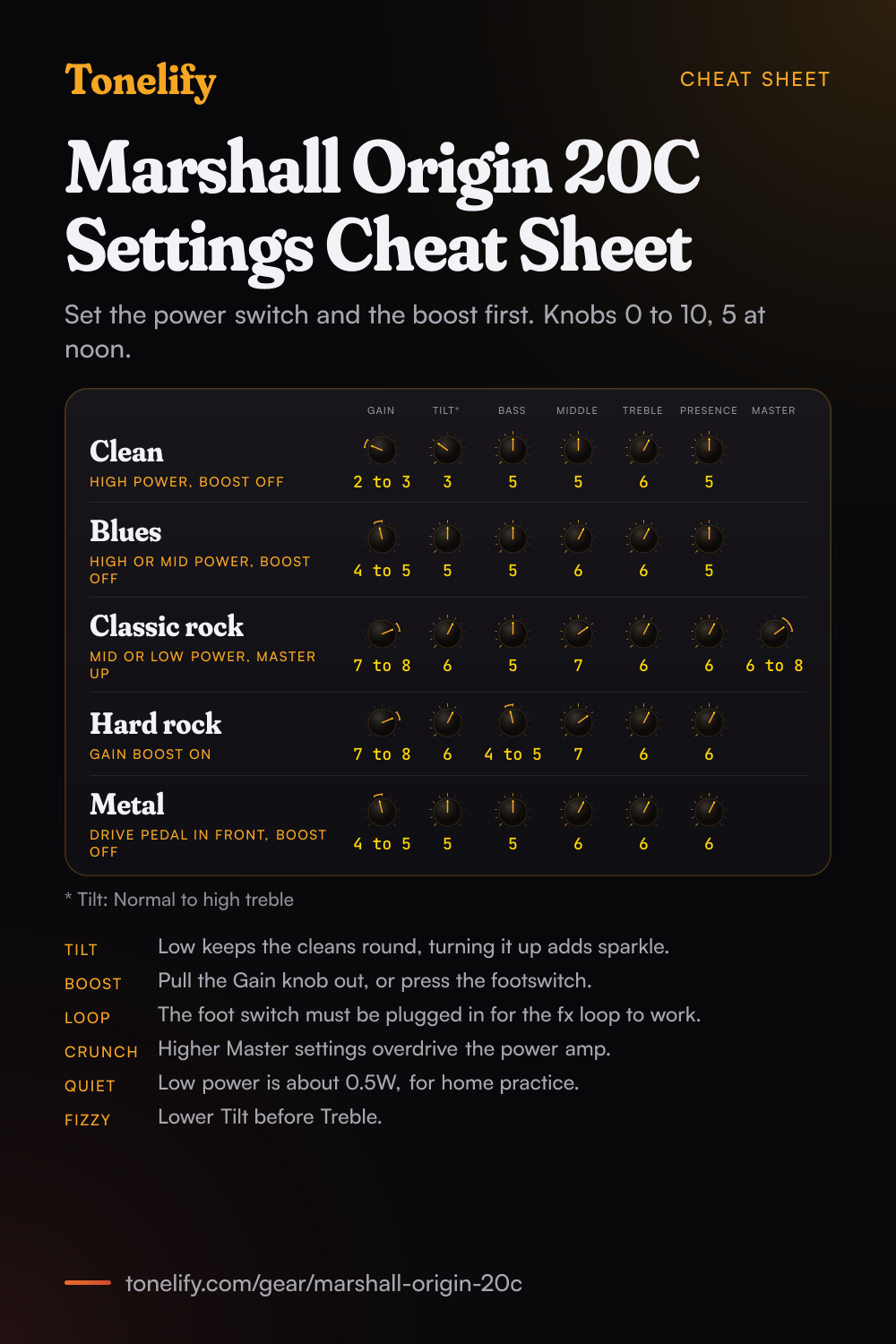
Free download
Printable cheat sheet: PDF and PNG
The clean, blues, classic rock, hard rock and metal settings from this page, together on one sheet with short tips. The PDF prints on white; the PNG is the dark version for your phone.
Starting settings on the Marshall Origin 20C
Positions on a 0 to 10 scale, with 5 at twelve o'clock. They are where to begin, not Marshall's numbers: move one control at a time from here.
Clean
High power, boost off: keep the Gain knob pushed in. Gain 2 to 3, Tilt 3, Bass 5, Middle 5, Treble 6, Presence 5, and set the loudness with Master. Marshall says Tilt adjusts the voice of your Origin from normal to high treble at the input stage, so a low Tilt keeps the cleans round and turning it up adds sparkle. If the sound starts to break up as you raise Master, that is the power amp: Marshall says that at higher settings the power amplifier can be overdriven, so keep Gain low and Master where the room needs it.
- Gain 2 to 3
- Tilt 3
- Bass 5
- Middle 5
- Treble 6
- Presence 5
Edge of breakup and blues
High or Mid power, boost off. Dig in to make it growl and play lighter, or roll back the guitar's volume, to clean it up. Gain 4 to 5, Tilt 5, Bass 5, Middle 6, Treble 6, Presence 5. Tilt halfway sits between the two voices: Marshall's product page says the knob blends from a standard tone to a high treble setting, and that it is derived from the multi-input technology of the 1959SLP and JTM45, condensed into a single knob.
- Gain 4 to 5
- Tilt 5
- Bass 5
- Middle 6
- Treble 6
- Presence 5
Classic rock
Mid or Low power, boost off, Master up, so the power amp does some of the overdriving. Gain 7 to 8, Tilt 6, Bass 5, Middle 7, Treble 6, Presence 6, Master 6 to 8. This is the setting the power switch is for: Marshall says higher Master settings overdrive the power amplifier, giving a classic overdrive sound, and Mid power (about 3W) is set for quieter performance use and recording. Keep Middle up, since a rock rhythm part lives in the mids. At Low power, about 0.5W, the same knobs give the same kind of crunch at home.
- Gain 7 to 8
- Tilt 6
- Bass 5
- Middle 7
- Treble 6
- Presence 6
- Master 6 to 8
Hard rock and lead
Gain boost on: pull the Gain knob out, or press the footswitch. Gain 7 to 8, Tilt 6, Bass 4 to 5, Middle 7, Treble 6, Presence 6. Marshall says pulling the knob activates a gain boost increasing the level of drive in the pre-amp, and the supplied 2-way footswitch, PEDL-90016, does the same from the floor, so set the rhythm sound with the boost off and step on it for the solo. Take Bass down a step when the boost is on, so the low strings stay tight.
- Gain 7 to 8
- Tilt 6
- Bass 4 to 5
- Middle 7
- Treble 6
- Presence 6
Pull the Gain knob out, or press the footswitch, for the boost.
Metal
Drive pedal into the Input, boost off. Gain 4 to 5, Tilt 5, Bass 5, Middle 6, Treble 6, Presence 6, with the pedal doing the distortion. The Origin has one channel and was built as a lower-gain amp: MusicRadar's hands-on described the range as aiming to capture Marshall's early EL34 magic while retaining headroom for pedal users. An amp set just short of breakup keeps a high-gain pedal tight. If it fizzes, lower Tilt before Treble, since Tilt is where the high treble comes in.
- Gain 4 to 5
- Tilt 5
- Bass 5
- Middle 6
- Treble 6
- Presence 6
The pedal does the distortion; the amp stays just short of breakup.
Playing quietly at home
Set the Output Level switch to Low. Marshall gives about 0.5W at Low, for home practice, and about 3W at Mid, against 20W at High. It calls the system Powerstem and says it reduces the voltage rails around the power amplifier, unlike the traditional pentode and triode reduction methods, without altering the sonic character. Use the five settings above as they are, and bring Master up further than you would at High power.
Chasing one song? Name it and the matcher writes that song's settings for the Marshall Origin 20C.
What controls does the Marshall Origin 20C have?
The Marshall Origin 20C has 8 controls on its front panel: Gain, Pull Boost, Tilt, Bass, Middle, Treble, Master and Presence.
Marshall Origin 20C specifications
- Power
- 20W, with 3W and 0.5W settings
- Speaker
- 1x10" Celestion VT-Junior
- Front panel
- Gain, Pull Boost, Tilt, Bass, Middle, Treble, Master, Presence
- Released
- 2018
What the Marshall Origin 20C panel means when you dial it in
20W, with 3W and 0.5W settings through a 1x10" Celestion VT-Junior. At that rating the power section starts working early, so the loudness knob is part of the tone setting rather than separate from it. It has a presence control, so the top end above the treble band is set separately from the tone stack. That is the control to reach for when a setting sounds close but harsh. Gain and master volume are separate, so the preamp can be driven hard at a volume that is liveable. Where a tone sits between the two is part of the answer, not a detail.
Marshall Origin 20C questions
What does the Tilt knob do on the Marshall Origin 20C?
Marshall says it adjusts the voice of your Origin from normal to high treble at the input stage. Its product page explains where it comes from: the multi-input technology found in classic Marshalls like the 1959SLP and JTM45, condensed into a single, easily controlled knob that blends from a standard tone to a high treble setting. Turn it down for a rounder sound and up for a brighter, more cutting one; if a gained-up sound fizzes, lower Tilt before Treble.
How do you turn on the gain boost on the Origin 20C?
Pull the Gain knob out. Marshall says pulling the control knob activates a gain boost increasing the level of drive in the pre-amp, and that it can be operated using a 2-way foot switch, PEDL-90016. That footswitch comes in the box, and it also turns the effects loop on and off.
Why is the effects loop not working on my Origin 20C?
Plug in the footswitch. Marshall's support page for the Origin20 Combo gives this as the fix: the foot switch must be plugged in for the fx loop to work. The loop is a single series loop, and the supplied 2-way footswitch, PEDL-90016, turns it on and off.
What do High, Mid and Low power do on the Origin 20C?
The Output Level switch sets the output power. Marshall gives the maximum, 20W, at High; about 3W at Mid, set for quieter performance use and recording; and about 0.5W at Low, for home practice. Marshall calls this Powerstem and says it works by reducing the voltage rails around the power amplifier, rather than the traditional pentode and triode methods.
How many channels does the Marshall Origin 20C have?
One. Marshall's specifications list 1 channel, and Gearnews described the Origin range at its launch as single-channel all-valve amps. The second sound comes from the gain boost: pull the Gain knob or use the supplied footswitch to switch it in, which is how this page's hard rock and lead setting works.
Can you record with the Origin 20C or use it with headphones?
For recording, the DI output on the back connects to an external recording device or sound desk, with added loudspeaker emulation. Marshall's support page says you can unplug the internal speaker or not have a speaker connected when using the emulated line out, so you can record silently. Marshall lists no headphone socket: the outputs are the three speaker jacks and the DI.
Do the Origin 20C's valves need biasing when you replace them?
No. Marshall's support page says the amplifier is cathode bias, meaning the power valves do not need to be biased when replaced. The amp has two EL34 power valves, and three ECC83s in front of them: two in the preamp and one as the phase splitter.
What speaker is in the Origin 20C?
A 10-inch Celestion. Marshall's quick start guide and its support page call it a Celestion V type 10" speaker, and the product page names the model: the Celestion VT-Junior, 16 ohms and 50W, which it describes as being like its larger V-Type counterpart. It plugs into the amp's 16 Ohm output.
Can you connect an extension cabinet to the Origin 20C?
There are three speaker jacks. On the combo, the 16 Ohm output holds the internal speaker. The two 8 Ohm outputs take one 8-ohm cabinet in socket 2, or a pair of 16-ohm cabinets in sockets 2 and 3. Marshall warns that connecting a cabinet to the wrong socket may damage your amplifier, and to use a proper speaker cable, never a screened (shielded) guitar cable.
Is the Origin 20C good with pedals?
It was designed with them in mind. MusicRadar's hands-on at launch described the Origin range as lower-gain amps that aim to capture Marshall's early EL34 magic while retaining headroom for pedal users, and its demo ran drive pedals into the 20H. Put drives and fuzzes into the Input, and delay and reverb in the effects loop, remembering that the loop only works with the footswitch plugged in.
How do you switch on a Marshall Origin 20C?
Marshall's set-up steps: make sure the power switch is off, connect the mains lead to the amp and then the wall, set the volume controls on the front panel to zero, and plug in your guitar. Select high, mid or low power, turn the front panel switch on and wait a couple of minutes, then turn the volume up to your preferred level.
When did the Marshall Origin 20C come out?
Marshall announced the Origin range at the NAMM Show in January 2018, as Gearnews reported on 25 January 2018: 20-watt and 50-watt heads and combos and a 5-watt combo, each with an effects loop and an emulated speaker output for recording. The 20-watt combo's UK list price at launch was GBP 459.
What are the best Marshall Origin 20C settings for metal?
Use a drive pedal into the Input with the amp set just short of breakup: Gain 4 to 5, Tilt 5, Bass 5, Middle 6, Treble 6 and Presence 6, boost off. These are starting points, not Marshall's numbers. On its own, with the boost on and Gain high, the amp reaches hard rock rather than modern metal, which is why the pedal does the distortion here.
Is there a printable Marshall Origin 20C settings cheat sheet?
Yes. The cheat sheet on this page puts all five starting settings on one page, from clean to metal with a pedal, each with its power setting and boost, and short tips under them. Download the PDF to print it on white, or save the PNG to your phone.
Does Tonelify support the Marshall Origin 20C?
Yes, and its front panel is stored, so settings only ever reference controls this guitar amp has: Gain, Pull Boost, Tilt, Bass, Middle, Treble, Master, Presence. You will not be told to set a knob that is not there.
Sources
Panel, specifications and dates checked against these on .
- Marshall: Origin 20 and Origin 50 quick start guide (PDF), linked by Marshall as the Origin20C user manual
- Marshall: Origin20 Combo product page and specifications
- Marshall: Support for Origin20 Combo, common questions
- Marshall support: Origin20 Combo, the effects loop is not working
- Gearnews: NAMM 2018, Marshall Origin amp series, back to basics (25 January 2018)
- MusicRadar: Marshall Origin 20 hands-on demo (2 May 2018)
More Marshall gear
Similar amps from other makers
Settings for the song you are chasing
Name a song and Tonelify reads the documented rig behind the recording, then writes the settings for the controls the Marshall Origin 20C has. A first plan starts with 7 days free, $0 today.