Get the style
Worship guitar tone: amp settings, delay and reverb
Updated 7 min read3 knob panels6 sources
For a worship guitar tone, start with a clean amp at the edge of breakup: Tonelify's starting point is Gain 4, Bass 4, Middle 6, Treble 6 and Reverb 2, with the Gain set so light strumming stays clean and digging in adds grit. Then add a dotted-eighth delay, 375 ms at 120 BPM, with the repeat about as loud as the note you played and the feedback low enough that it dies after 1 or 2 repeats. That is the rhythmic setting Worship Artistry's Jason Houtsma describes.
A low-gain overdrive does the builds, and a big reverb or a volume swell fills the quiet parts. Guitar.com describes the style as swells and immersive reverbs and delays, with drives that lean towards the lower-gain side. On a Boss Katana, select Crunch at Gain 2, Bass 5, Middle 6 and Treble 6, with Hall Reverb about 4, Digital Delay set with the TAP button and Blues Drive on the Booster for the loud parts.
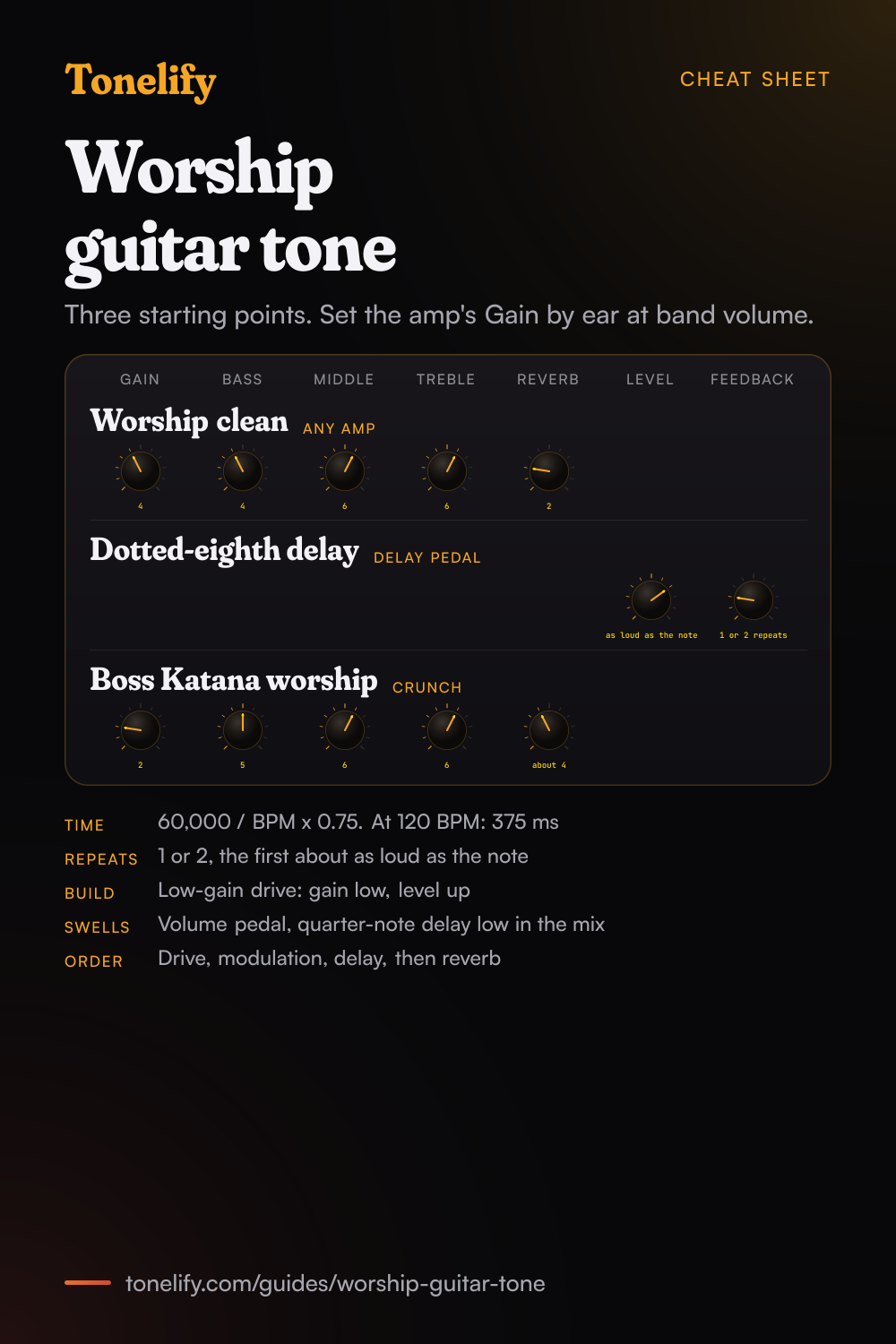
Free download
Printable cheat sheet: PDF and PNG
The worship clean, dotted-eighth delay and boss katana worship settings from this guide, together on one sheet with short tips. The PDF prints on white; the PNG is the dark version for your phone.
What makes a worship guitar tone
Guitar.com describes praise and worship guitar tone as one that makes use of swells and immersive reverbs and delays, often through stereo pedals.[1] The drive is there, but the popular pedals in the scene tend towards the lower-gain side, with a transparent character, and it notes that praise and worship tones are not often heavily modulated.[1]
So the sound is built in layers. A clean amp sits just at the edge of breakup. A low-gain overdrive comes in for the louder parts. A delay, often a dotted eighth, makes single notes into a pattern, and a long reverb or a volume swell turns chords into a pad.
Amp settings for worship
Start the amp at Gain 4, Bass 4, Middle 6, Treble 6 and Reverb 2, with the volume where the band will hear you. Then set the Gain by ear at that volume: strum lightly and it should stay clean, dig in and it should start to break up. That edge is the point of this sound, because the drive pedals and your picking hand push it over.
Keep the amp's own reverb low. The delay and the reverb pedal or effect do the ambience, and the amp's reverb on top of them washes the notes together. Bass sits under the middle so the guitar leaves room for the bass and the keys.
On an amp with a separate master volume, set the Master for the room first and then the Gain for the breakup, as Tonelify's gain and master guide sets out.
- Gain 4
- Bass 4
- Middle 6
- Treble 6
- Reverb 2
Gain set by ear at band volume: clean when you strum lightly, breaking up when you dig in.
The dotted-eighth delay
Divide 60,000 by the song's BPM for a quarter note in milliseconds, and take three quarters of it for a dotted eighth. At 120 BPM that is 500 ms for the quarter and 375 ms for the dotted eighth.
For the pronounced rhythmic sound, Worship Artistry's Jason Houtsma sets the mix so the delay is just as loud as the note you played, and keeps the feedback short so it trails off after only 1 or 2 repeats.[2] Set the feedback longer and the repeats pile up and the sound turns muddy. On the pedal that reads Level as loud as the note and Feedback 1 or 2 repeats, set by ear. Houtsma also calls the dotted eighth the most challenging delay to get right,[2] so set it from the song's tempo rather than by feel.
For swells and long, slow parts, Houtsma keeps a quarter-note delay somewhat low in the mix so it trails off by the end of a measure.[2]
- Level as loud as the note
- Feedback 1 or 2 repeats
Time: three quarters of the song's quarter note, 375 ms at 120 BPM. Set the level by ear.
| Tempo | Quarter | Dotted eighth | Eighth |
|---|---|---|---|
| 60 BPM | 1000 ms | 750 ms | 500 ms |
| 68 BPM | 882 ms | 662 ms | 441 ms |
| 72 BPM | 833 ms | 625 ms | 417 ms |
| 76 BPM | 789 ms | 592 ms | 395 ms |
| 120 BPM | 500 ms | 375 ms | 250 ms |
| 130 BPM | 462 ms | 346 ms | 231 ms |
| 140 BPM | 429 ms | 321 ms | 214 ms |
Reverb, shimmer and swells
The reverb is where the pad comes from: a long hall, or an ambient type, behind the delay. BOSS describes the RV-6's SHIMMER mode as a reverb distinctive for its sparkling high-frequency range, wrapped in spacious overtones.[3] Guitar.com singles out the Strymon BigSky, where its ambient types, Bloom, Chorale and above all Cloud, have found the most favour.[1]
Swells take the attack off each note, so a chord fades in like a pad. A volume pedal does it with your foot: roll it back, play the chord, then bring it up. Guitar.com points out that the Dunlop Volume (X) Mini can double as an expression pedal. Without one, BOSS's SLOW GEAR produces a volume-swell effect that BOSS calls a violin-like sound,[6] and it is one of the FX types in BOSS Tone Studio for KATANA Gen3.
Worship settings on a Boss Katana
Select Crunch and set Gain 2, Bass 5, Middle 6 and Treble 6, with Reverb about 4 on Hall Reverb, orange on a MkII as shipped. On a Katana 100, set Presence to 5. BOSS describes Crunch as a fat crunch sound that faithfully responds to the nuances of your picking, and with the Gain at 2 it sits at the edge, clean when you play softly.
Switch in Digital Delay, green in bank A on a MkII as shipped, and press TAP two or more times: BOSS says the delay time is set to the interval between presses,[4] which gives a quarter note when you tap the beat. For a dotted eighth, type the time in milliseconds into BOSS Tone Studio, where the delay time runs from 1 to 2000 ms.[6]
For the build, switch in Blues Drive on the Booster, green in bank A on a MkII as shipped, which BOSS describes as a crunch sound of the BOSS BD-2.[6] Keep its knob low: it is there to push the amp, not to turn it into a rock sound. Store the soft sound on CH1 and the build on CH2. The Katana has no shimmer reverb type, so for that sound put a shimmer pedal in front of it.
- Gain 2
- Bass 5
- Middle 6
- Treble 6
- Reverb about 4
Hall Reverb, Digital Delay set with TAP, Blues Drive low on CH2 for the build. Presence 5 on a Katana 100.
Pedal order for a worship board
The usual order holds: tuner, then compressor and drives, then modulation, then delay and reverb last, so the repeats and the reverb tail carry the driven sound rather than being distorted by it. Tonelify's pedal order guide sets out why.
Two things are particular to worship boards. Guitar.com notes that many run stereo pedals,[1] which only pays off with two amps or a stereo PA feed. And a delay before the reverb gives repeats that sit inside the reverb's space, which is the pad sound, rather than a reverb that is repeated.
When it sounds wrong
Muddy, with the notes running together: shorten the delay's feedback to 1 or 2 repeats, and turn the amp's reverb down when the reverb pedal is on.
The delay fights the band: tap it again on the beat, or set the milliseconds from the song's BPM. A dotted eighth that is out of time is worse than none.
Too distorted on the builds: lower the drive's gain and raise its level. The drives in this style push a clean amp rather than distort it.
Lost in the mix: raise Middle a step before anything else. Keys and pads cover the lows and the very top.
Common questions
What amp settings are best for worship guitar?
Start at Gain 4, Bass 4, Middle 6, Treble 6 and Reverb 2, then set the Gain by ear at band volume: clean when you strum lightly, breaking up when you dig in. Keep the amp's reverb low and let the delay and reverb effects do the ambience. These are Tonelify's starting points, not a single correct setting.
What is the delay setting for worship guitar?
A dotted eighth: divide 60,000 by the BPM and take three quarters, 375 ms at 120 BPM. For the rhythmic sound, Worship Artistry's Jason Houtsma sets the repeat about as loud as the note and the feedback short enough for 1 or 2 repeats. For swells, a quarter-note delay kept low in the mix.
How do you work out a dotted-eighth delay time?
Divide 60,000 by the song's BPM for a quarter note in milliseconds, then multiply by 0.75. At 120 BPM that is 500 ms for the quarter and 375 ms for the dotted eighth; at 72 BPM, 833 and 625 ms.
What overdrive do worship guitarists use?
Low-gain ones. Guitar.com says the popular drive pedals in the scene tend towards the lower-gain side and a transparent character, and calls the Paul Cochrane Timmy a favourite of praise and worship guitarists for its transparent character and edge of breakup sound. Use the drive to push a clean amp on the builds, with its gain low and its level up.
What reverb is best for worship guitar?
A long hall or an ambient type, set behind the delay. BOSS's RV-6 has a SHIMMER mode it describes as sparkling in the high frequencies, and Guitar.com notes that the Strymon BigSky's ambient types, Bloom, Chorale and Cloud, are where it has found the most favour. Keep the amp's own reverb low when one is on.
What are the best Boss Katana 50 MkII settings for worship?
Crunch at Gain 2, Bass 5, Middle 6 and Treble 6, with Hall Reverb about 4, Digital Delay set with the TAP button, and Blues Drive low on the Booster for the builds, stored on CH2. On a Katana 100, add Presence 5. For a dotted eighth, type the time into BOSS Tone Studio.
Does the Boss Katana have a shimmer reverb?
No. None of the reverb types in BOSS's Katana manuals is a shimmer. For that sound, put a shimmer pedal such as BOSS's RV-6 in front of the amp. BOSS Tone Studio for KATANA Gen3 does add SLOW GEAR for volume swells.
How do you do volume swells on guitar?
With a volume pedal: roll it back, play the note or chord, then bring the pedal up so it fades in without its attack. A quarter-note delay low in the mix and a long reverb turn the swells into a pad. Without a pedal, BOSS's SLOW GEAR effect produces the swell automatically.
Do you need a stereo rig for worship guitar?
No. Guitar.com notes that many praise and worship rigs use stereo pedals, but it pays off only with two amps or a stereo feed to the PA. A single amp with the delay and reverb in mono gives the same parts and the same settings.
Why does my worship tone sound muddy?
Usually too many repeats or too much reverb at once. Cut the delay's feedback to 1 or 2 repeats, turn the amp's reverb down when a reverb pedal is on, and check that the delay is in time with the song. Raising Middle a step also helps the guitar cut past the keys.
Is there a printable worship guitar settings cheat sheet?
Yes. The cheat sheet on this page puts the worship clean amp, the dotted-eighth delay and the Boss Katana settings on one page, with the delay formula, the swell and the build under them. Download the PDF to print it on white, or save the PNG to your phone.
Sources
The numbers in brackets in the text point to this list.
- Guitar.com: the best praise and worship guitar pedals, by Cillian Breathnach (15 June 2023)
- Worship Artistry: how to choose the right delay setting for your guitar, by Jason Houtsma
- BOSS: RV-6 owner's manual (PDF)
- BOSS: KATANA Mk II Owner's Manual (PDF)
- BOSS: KATANA Gen 3 Reference Manual (PDF)
- BOSS: Using BOSS TONE STUDIO for KATANA Gen3, computer (PDF)
Gear in this guide
Settings for your own amp
This guide covers what is true of every rig. For a specific song on a specific amp, Tonelify reads the documented chain behind the recording and returns gain, bass, middle, treble and presence values for the controls your amp actually has. A first plan starts with 7 days free, $0 today.