
Boss GT-10 presets and settings
GT-10: BOSS's owner's manual (2008): 39 COSM preamp types in 12 groups plus Custom/Through, Gain 0-120, tone 0-100, Gain Sw on MIDDLE, 38 s mono phrase loop, 400 patches, 9 V 800 mA, 4.9 kg.
⚡ Match a tone on this unitHow do you dial in a specific tone on a Boss GT-10?
A multi-effects unit gives you the whole chain in one box, which means the order of the blocks is as much of the answer as the values inside them. Settings for the Boss GT-10 name the amp model, the block order and the parameters together, rather than handing you numbers with no chain to put them in.
Name the song you are chasing in the tone matcher and Tonelify returns the settings for this exact multi-effects unit, not the settings the original artist used. Those are two different things: the recording was made on gear most players do not own.
Free download
Printable cheat sheet: PDF and PNG
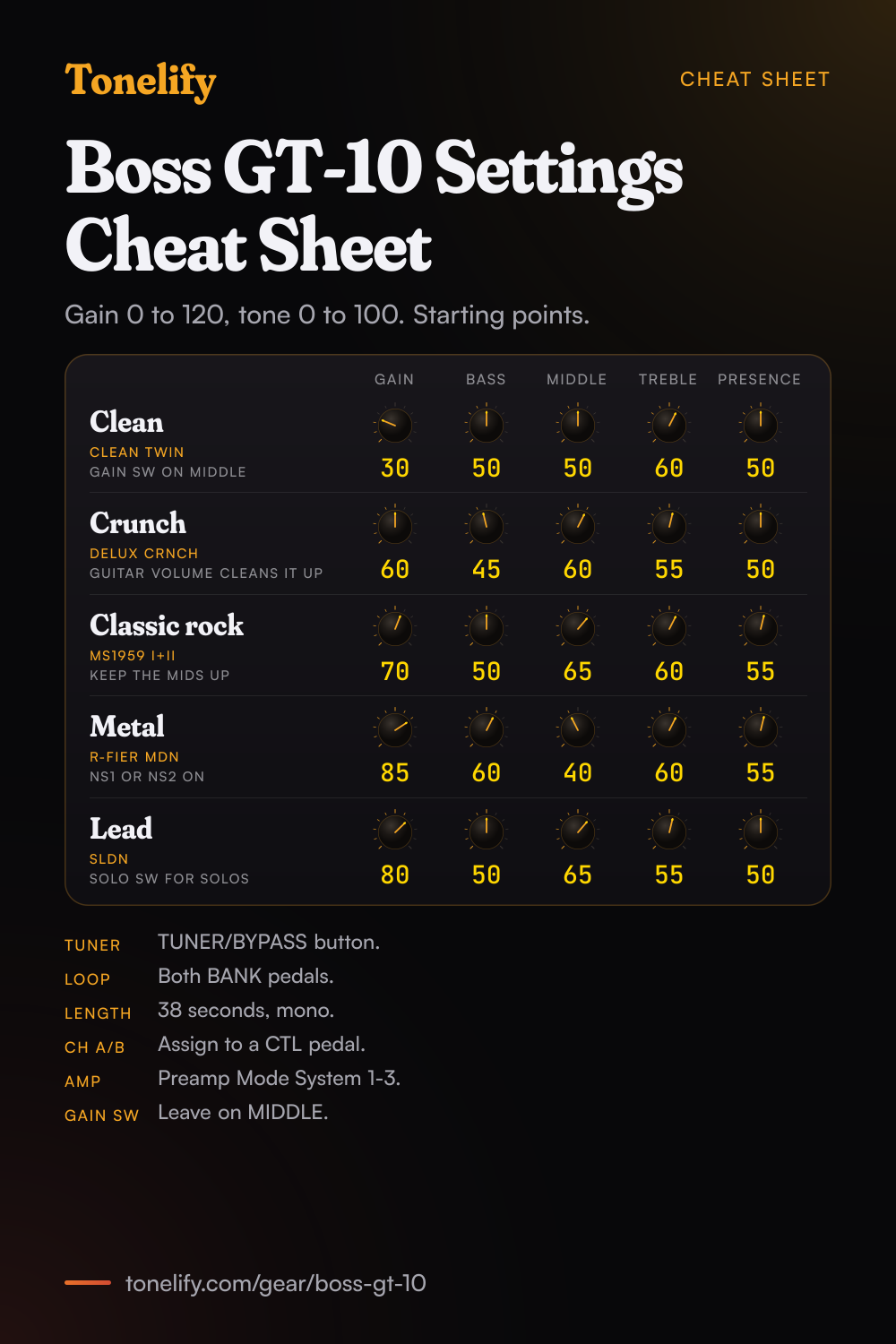
The clean, crunch, classic rock, metal and lead settings from this page, together on one sheet with short tips. The PDF prints on white; the PNG is the dark version for your phone.
Starting settings on the Boss GT-10
Values as the unit's screen shows them, on its own scale; each drawn knob shows that value's share of the range. They are where to begin, not Boss's numbers: pick the amp model first, then move one control at a time from here.
Clean
Clean TWIN, BOSS's model of a Fender Twin Reverb. Gain 30, Bass 50, Middle 50, Treble 60, Presence 50. Gain runs from 0 to 120 and the tone controls from 0 to 100. Leave Gain Sw on MIDDLE: BOSS built each type's sound around it. JC-120, the Roland JC-120, is the other classic clean.
- Gain 30
- Bass 50
- Middle 50
- Treble 60
- Presence 50
Crunch and blues
DELUX Crnch, BOSS's model of a Fender Deluxe Reverb. Gain 60, Bass 45, Middle 60, Treble 55, Presence 50. Roll the guitar's volume back to clean it up. Blues and BOSS Crunch are BOSS's own crunch voices.
- Gain 60
- Bass 45
- Middle 60
- Treble 55
- Presence 50
Classic rock
MS1959 I+II, the Marshall 1959 with inputs I and II in parallel, which BOSS says gives a stronger low end than input I alone. Gain 70, Bass 50, Middle 65, Treble 60, Presence 55. Keep the mids up: rock guitar sits in the midrange.
- Gain 70
- Bass 50
- Middle 65
- Treble 60
- Presence 55
Metal
R-FIER Mdn, the channel 2 modern mode of a MESA/Boogie Dual Rectifier. Gain 85, Bass 60, Middle 40, Treble 60, Presence 55, with NS1 or NS2, the noise suppressor, on. 5150 Drive, the lead channel of a Peavey EVH 5150, and MS Scoop, a Marshall tweaked for metal, are the other choices.
- Gain 85
- Bass 60
- Middle 40
- Treble 60
- Presence 55
NS1 or NS2 on.
Lead
SLDN, BOSS's model of a Soldano SLO-100. Gain 80, Bass 50, Middle 65, Treble 55, Presence 50, with a delay low behind the notes. Turn Solo Sw on for a tone suited to solos, with its own SoloLevel, or assign a CTL pedal to switch between preamp channels A and B.
- Gain 80
- Bass 50
- Middle 65
- Treble 55
- Presence 50
Chasing one song? Name it and the matcher writes that song's settings for the Boss GT-10.
BOSS GT-10 preamp types
The COSM PREAMP's 39 types in 12 groups, plus Custom, which you build yourself, and Through, which switches the preamp off. Each preamp has Channel A and Channel B. Gain runs from 0 to 120; Bass, Middle, Treble, Presence and Level from 0 to 100.
| Group | Type | Models or describes |
|---|---|---|
| JC CLEAN | BOSS Clean | BOSS: a smooth, warm clean |
| JC CLEAN | JC-120 | The Roland JC-120 |
| JC CLEAN | Jazz Combo | BOSS: a sound suited to jazz |
| JC CLEAN | Full Range | BOSS: flat response, good for acoustic guitar |
| TW CLEAN | Clean TWIN | Fender Twin Reverb |
| TW CLEAN | Pro Crunch | Fender Pro Reverb |
| TW CLEAN | Tweed | Fender Bassman 4x10 combo |
| TW CLEAN | DELUX Crnch | Fender Deluxe Reverb |
| CRUNCH | BOSS Crunch | BOSS: a crunch that keeps picking nuances |
| CRUNCH | Blues | BOSS: a sound suited to blues |
| CRUNCH | Wild Crunch | BOSS: crunch with wild distortion |
| CRUNCH | StackCrunch | BOSS: high gain crunch |
| COMBO | VO Drive | VOX AC-30TB, drive sound |
| COMBO | VO Lead | VOX AC-30TB, lead sound |
| COMBO | VO Clean | VOX AC-30TB, clean sound |
| MATCH | MATCH Drive | Matchless D/C-30, left input |
| MATCH | Fat MATCH | A Matchless with a modified high gain |
| MATCH | MATCH Lead | Matchless D/C-30, right input |
| BG LEAD | BG Lead | MESA/Boogie combo, lead sound |
| BG LEAD | BG Drive | MESA/Boogie with the TREBLE SHIFT switch on |
| BG LEAD | BG Rhythm | MESA/Boogie, rhythm channel |
| MS CLASSIC | MS1959 I | Marshall 1959, input I |
| MS CLASSIC | MS1959 I+II | Marshall 1959, inputs I and II in parallel |
| MS MODERN | MS HiGain | A Marshall with a modified midrange boost |
| MS MODERN | MS Scoop | A Marshall tweaked for metal |
| R-FIER | R-FIER Vnt | MESA/Boogie Dual Rectifier, channel 2 vintage mode |
| R-FIER | R-FIER Mdn | MESA/Boogie Dual Rectifier, channel 2 modern mode |
| R-FIER | R-FIER Cln | MESA/Boogie Dual Rectifier, channel 1 clean mode |
| T-AMP | T-AMP Lead | Hughes & Kettner Triamp, AMP3 |
| T-AMP | T-AMP Crnch | Hughes & Kettner Triamp, AMP2 |
| T-AMP | T-AMP Clean | Hughes & Kettner Triamp, AMP1 |
| HI-GAIN | BOSS Drive | BOSS: a drive with heavy distortion |
| HI-GAIN | SLDN | Soldano SLO-100 |
| HI-GAIN | Lead Stack | BOSS: a high gain lead sound |
| HI-GAIN | Heavy Lead | BOSS: a lead with extreme distortion |
| METAL | BOSS Metal | BOSS: metal for heavy riffs |
| METAL | 5150 Drive | Peavey EVH 5150, lead channel |
| METAL | Metal Lead | BOSS: a lead suited to metal |
| METAL | Edge Lead | BOSS: a sharp lead sound |
BOSS GT-10 specifications
The manual's specifications.
| GT-10 | |
|---|---|
| Patches | 400: 200 user and 200 preset |
| Conversion | 24 bit, 44.1 kHz |
| Inputs | 1/4 inch INPUT, 1 MΩ; EXT LOOP RETURN, 220 kΩ |
| Outputs | 1/4 inch L/MONO and R; stereo 1/4 inch PHONES; EXT LOOP SEND; coaxial DIGITAL OUT |
| Control | AMP CONTROL jack; EXP PEDAL 2/CTL 3,4 jack; MIDI IN and OUT; USB |
| Display | 132 x 64 dot backlit LCD and a 3 character LED |
| Power | 9 V DC, Roland PSB-1U adapter, 800 mA |
| Size | 542 x 272 x 77 mm |
| Weight | 4.9 kg |
Boss GT-10 specifications
- Released
- 2008
Boss GT-10 questions
What is the Boss GT-10?
A floor guitar effects processor from BOSS, with COSM preamps and effects, EZ TONE for building sounds by genre, a 38 second phrase loop and a Parallel Chain that splits the effects into two chains. It has four number pedals, two BANK pedals, two CTL pedals and an expression pedal, holds 400 patches and weighs 4.9 kg. BOSS's owner's manual is dated 2008.
What preamp types does the GT-10 have?
39 COSM preamp types in 12 groups, plus Custom and Through. They model amps from Roland, Fender, VOX, Matchless, MESA/Boogie, Marshall, Hughes & Kettner, Soldano and Peavey, alongside BOSS's own voices. Each patch has two preamp channels, A and B.
What do the GT-10 preamp channel modes do?
Single uses only the selected channel. Dual Mono mixes channels A and B, and Dual L/R sends A to the left output and B to the right. Dynamic switches between A and B with your picking strength, set by Dyna.Sens. In the dual modes, Ch.DlyTim delays channel B by up to 100 ms for a wider sound.
What does Gain Sw do on the GT-10?
It sets three levels of distortion, Low, Middle and High. BOSS built the sound of each preamp type with Gain Sw on Middle, so the manual says to normally leave it there and use the Gain knob, which runs from 0 to 120.
How long is the GT-10 phrase loop?
About 38 seconds, recorded in mono; at 38 seconds it starts playing back by itself. Press both BANK pedals at the same time for recording standby, with the REC/DUB indicator flashing, then record and overdub while it plays. Press both BANK pedals together again to stop the loop and switch Phrase Loop off. You can record dry and add effects on playback.
How do you tune with the GT-10?
Press the TUNER/BYPASS button, or assign the tuner to a CTL pedal. The input is passed straight through while tuning, and the Tuning Guide shows how far off you are within 50 cents. PITCH sets the reference from 435 to 445 Hz, 440 Hz from the factory.
What is EZ TONE on the GT-10?
A way to make tones without knowing the effect parameters. You choose a basic sound by genre, song image or playing style, then move a cursor on the TONE GRID towards SOFT or HARD and for SOLO or for BACKING.
What is Parallel Chain on the GT-10?
A function that splits the effects chain into two independent chains, each with its own order. You can run separate chains on the left and right outputs for a twin guitar sound, or use a Dynamic channel mode to switch chains with your picking.
Can the GT-10 use the same amp in every patch?
Yes. Set Preamp Mode in PLAY OPTION to System 1, 2 or 3 and the GT-10 uses that system preamp in every patch, whatever the patch's own preamp settings. On Patch it uses each patch's preamp.
What connections does the GT-10 have?
Input, L/MONO and R outputs, stereo headphones, an EXT LOOP send and return for an external effect or preamp, an AMP CONTROL jack that switches a guitar amp's channels with each patch, a jack for a second expression pedal or CTL 3 and 4 footswitches, MIDI in and out, USB and a coaxial digital output.
What power supply does the GT-10 need?
The included Roland PSB-1U AC adaptor, 9 V DC; the GT-10 draws 800 mA.
How do you build a patch on the Boss GT-10?
Pick the amp model first, then set its controls, then add the blocks in signal-chain order: drive before the amp, time and modulation after it. A patch built the other way around ends up compensating for the wrong stage. Tonelify returns the model, the order and the parameters together.
Does Tonelify support the Boss GT-10?
Yes. Name it in the tone matcher along with the song you are chasing and the settings come back adapted to it. Gear does not need to be in the catalog for a match to run.
Sources
Panel, specifications and dates checked against these on .
More Boss gear
Similar multi-effects units from other makers
Settings for the song you are chasing
Name a song and Tonelify reads the documented rig behind the recording, then writes the settings for a rig with the Boss GT-10 in it. A first plan starts with 7 days free, $0 today.