
Boss ME-50 presets and settings
Floor multi-effects with a knob for every section, three footswitches and an expression pedal: 22 drive types, 11 modulations, 11 delays and 4 reverbs, 30 patches, no amp modelling. Runs on six AA batteries for about 12 hours.
⚡ Match a tone on this unitHow do you dial in a specific tone on a Boss ME-50?
A multi-effects unit gives you the whole chain in one box, which means the order of the blocks is as much of the answer as the values inside them. Settings for the Boss ME-50 name the amp model, the block order and the parameters together, rather than handing you numbers with no chain to put them in.
Name the song you are chasing in the tone matcher and Tonelify returns the settings for this exact multi-effects unit, not the settings the original artist used. Those are two different things: the recording was made on gear most players do not own.
Free download
Printable cheat sheet: PDF and PNG
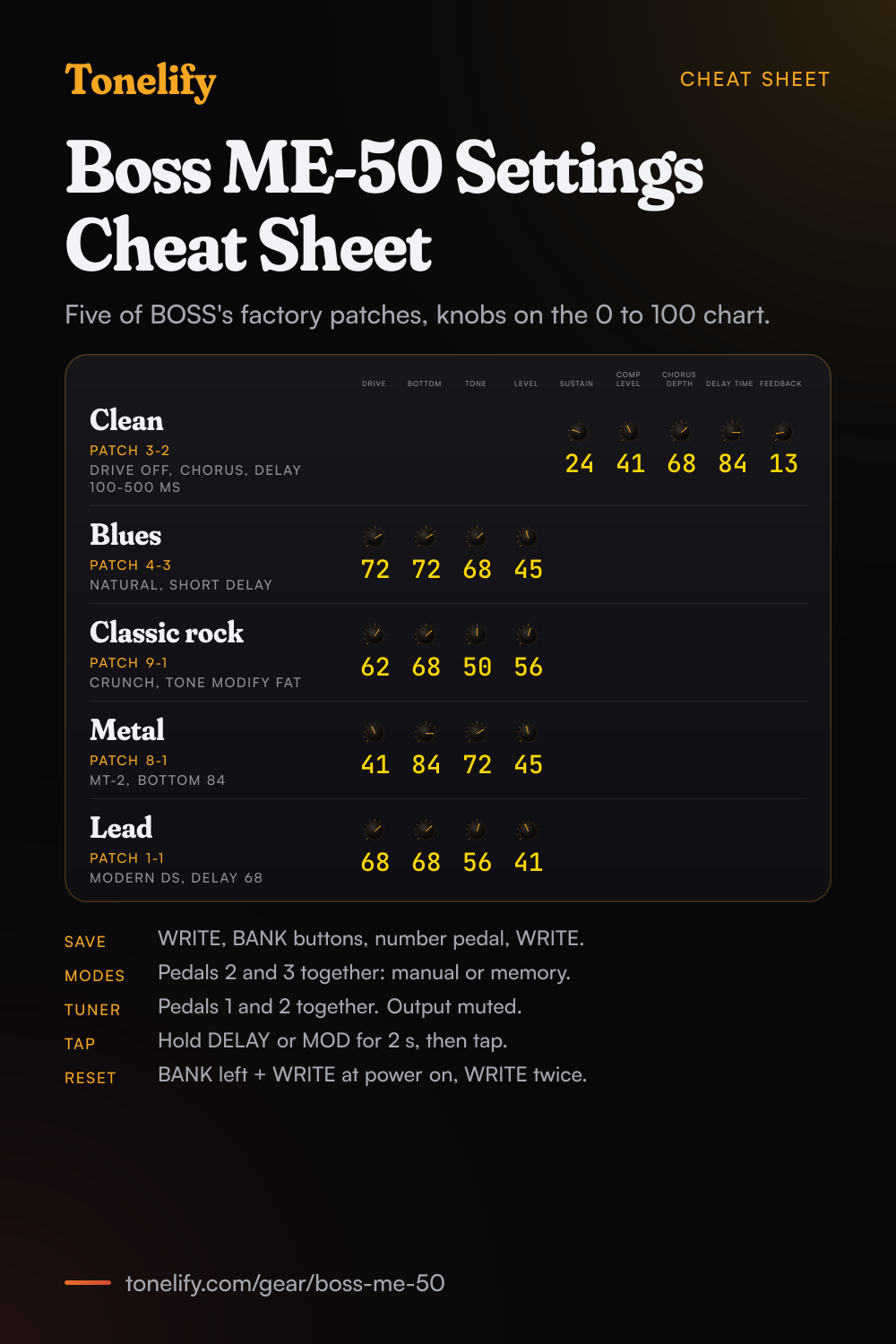
The clean, blues, classic rock, metal and lead settings from this page, together on one sheet with short tips. The PDF prints on white; the PNG is the dark version for your phone.
Starting settings on the Boss ME-50
Values as the unit's screen shows them, on its own scale; each drawn knob shows that value's share of the range. They are where to begin, not Boss's numbers: pick the amp model first, then move one control at a time from here.
Clean
BOSS's patch 3-2, a clean sound effective when used with delay in BOSS's words. Overdrive/Distortion is off. Tone Modify on PRESENCE, the compressor at Sustain 24 and Comp level 41, CHORUS with its Rate at 29, Chorus depth 68 and E.Level 100, and the delay on 100-500 ms with Delay time 84, Feedback 13 and E.Level 68. Reverb is off and NS sits at 20. BOSS's factory chart gives every knob on a 0 to 100 scale; the ME-50's knobs have no numbers, and Tonelify reads the scale as the knob's full turn, so 50 is about 12 o'clock.
- Sustain 24
- Comp level 41
- Chorus depth 68
- Delay time 84
- Feedback 13
Tone Modify on PRESENCE. Delay type 100-500 ms.
Blues
BOSS's patch 4-3, which it calls just right for blues. Overdrive/Distortion on NATURAL, the VARIATION version of the OD-1 position, an overdrive BOSS says gives a more natural sounding distortion: Drive 72, Bottom 72, Tone 68, Level 45. A short slapback from the delay on 100-500 ms, Time 24, Feedback 20, E.Level 41, and no reverb or modulation. BOSS's 4-1, a mild lead resembling the BOSS OD-1, is the lighter alternative.
- Drive 72
- Bottom 72
- Tone 68
- Level 45
Delay 100-500 ms: Time 24, Feedback 20, E.Level 41.
Classic rock
BOSS's patch 9-1, the hard rock sound of the '70s. Overdrive/Distortion on CRUNCH, a lustrous crunch with an element of amp distortion in BOSS's words: Drive 62, Bottom 68, Tone 50, Level 56. Tone Modify on FAT for a boosted midrange, the compressor barely on at Sustain 3 and Level 50, a light CHORUS at 29, 24 and 19, delay on 100-500 ms at Time 68, Feedback 24, E.Level 19, and reverb just into ROOM at 5. BOSS's 3-1, stack amp style distortion, uses STACK at Drive 34, and 7-2, its British rock sound of the '60s, has CRUNCH at 50 across the board.
- Drive 62
- Bottom 68
- Tone 50
- Level 56
Tone Modify on FAT. Reverb at ROOM 5.
Metal
BOSS's patch 8-1, an extreme distortion sound perfect for heavy metal. Overdrive/Distortion on MT-2, BOSS's model of its own MT-2 Metal Zone: Drive 41, Bottom 84, Tone 72, Level 45. A CHORUS at 34, 50 and 13 adds a little width, there is no delay or reverb, and NS stays at 20. BOSS warns that a high noise suppressor threshold can leave no sound when you play with the guitar's volume down.
- Drive 41
- Bottom 84
- Tone 72
- Level 45
CHORUS 34, 50, 13. NS at 20.
Lead
BOSS's patch 1-1, a lead distortion sound with sustain. Overdrive/Distortion on MODERN DS, the sound of a large high gain amp in BOSS's words: Drive 68, Bottom 68, Tone 56, Level 41. Delay on 100-500 ms with Time 68, Feedback 19 and E.Level 56 for repeats behind the notes, no modulation or reverb. To match the delay to the song, hold the DELAY pedal for two seconds and tap it in time. BOSS's 2-1, a solid drive for lead, uses RAT at Drive 84 instead.
- Drive 68
- Bottom 68
- Tone 56
- Level 41
Delay 100-500 ms: Time 68, Feedback 19, E.Level 56.
Chasing one song? Name it and the matcher writes that song's settings for the Boss ME-50.
Boss ME-50 factory patches and drive settings
The 30 factory patches, in banks 1 to 9 and 0 with three patches each. Knob values are BOSS's, on the 0 to 100 scale its chart uses; Master Level is 50 on all of them.
| Patch | BOSS's description | Tone Modify | Compressor | Overdrive/Distortion |
|---|---|---|---|---|
| 1-1 | Lead distortion sound with sustain. | Off | Off | MODERN DS: Drive 68, Bottom 68, Tone 56, Level 41 |
| 1-2 | Loud rock Patch effective with low sound. | Presence | Off | LOUD: Drive 50, Bottom 72, Tone 62, Level 45 |
| 1-3 | Persistent twin lead sound. | Fat | Sustain 13, Level 34 | MODERN OD: Drive 100, Bottom 62, Tone 62, Level 41 |
| 2-1 | Solid drive sound, perfect for lead. | Fat | Off | RAT: Drive 84, Bottom 72, Tone 62, Level 41 |
| 2-2 | Crunch sound with particularly rough distortion. | Off | Sustain 5, Level 50 | DST+: Drive 29, Bottom 68, Tone 62, Level 50 |
| 2-3 | Organ style Patch that uses the ROTARY effect. | Off | Off | OD-2: Drive 24, Bottom 68, Tone 68, Level 68 |
| 3-1 | Patch with stack amp style distortion. | Fat | Off | STACK: Drive 34, Bottom 50, Tone 50, Level 50 |
| 3-2 | Clean sound effective when used with delay. | Presence | Sustain 24, Level 41 | Off |
| 3-3 | Patch that provides a wah effect when the pedal is used. | Off | Off | LEAD: Drive 50, Bottom 68, Tone 68, Level 45 |
| 4-1 | Mild lead sound resembling that of the BOSS OD-1. | Off | Sustain 29, Level 50 | OD-1: Drive 68, Bottom 62, Tone 68, Level 45 |
| 4-2 | Overdrive sound with particular midrange quality. | Off | Off | MODERN OD: Drive 80, Bottom 72, Tone 72, Level 45 |
| 4-3 | Patch that is just right for Blues. | Off | Off | NATURAL: Drive 72, Bottom 72, Tone 68, Level 45 |
| 5-1 | Lead sound with smooth distortion. | Off | Off | LEAD: Drive 62, Bottom 72, Tone 56, Level 50 |
| 5-2 | Patch that is perfect for use with country music. | Tight | Off | OD-2: Drive 29, Bottom 56, Tone 62, Level 50 |
| 5-3 | Jazz guitar sound. Effective when used with a front pickup. | Hollow | Sustain 5, Level 50 | Off |
| 6-1 | Overdrive sound with deep distortion. | Off | Off | OD-1: Drive 100, Bottom 72, Tone 72, Level 41 |
| 6-2 | Patch combining crunch sound with spatial effects. | Off | Off | CRUNCH: Drive 29, Bottom 72, Tone 72, Level 50 |
| 6-3 | Wah sound that is perfect for rhythm cutting. | Off | Sustain 13, Level 50 | NATURAL: Drive 19, Bottom 50, Tone 56, Level 68 |
| 7-1 | Sound with the depth of chorus added, good for lead. | Off | Off | LEAD: Drive 72, Bottom 77, Tone 62, Level 45 |
| 7-2 | The British rock sound of the '60s. | Off | Off | CRUNCH: Drive 50, Bottom 50, Tone 50, Level 50 |
| 7-3 | A fantastic clean sound that uses a phaser effect. | Presence | Sustain 62, Level 34 | Off |
| 8-1 | Extreme distortion sound, perfect for heavy metal. | Off | Off | MT-2: Drive 41, Bottom 84, Tone 72, Level 45 |
| 8-2 | Patch using the UNI-V for a particularly heavy twisting effect. | Off | Off | STACK: Drive 72, Bottom 62, Tone 50, Level 45 |
| 8-3 | Acoustic guitar sound. | Acoustic | Sustain 3, Level 62 | Off |
| 9-1 | Hard rock sound of the '70s. | Fat | Sustain 3, Level 50 | CRUNCH: Drive 62, Bottom 68, Tone 50, Level 56 |
| 9-2 | Sound for rhythm cutting combining COMPRESSOR and PHASER. | Tight | Sustain 24, Level 50 | NATURAL: Drive 8, Bottom 50, Tone 50, Level 68 |
| 9-3 | Synth sound that uses square wave. Good for use with tapping. | Mild | Off | SQUARE: Drive 50, Bottom 62, Tone 50, Level 50 |
| 0-1 | '60s surf rock sound. | Presence | Off | BD-2: Drive 29, Bottom 62, Tone 62, Level 50 |
| 0-2 | Patch that lets you use the pedal to raise the pitch up to one octave. | Off | Off | Hi GAIN: Drive 62, Bottom 62, Tone 50, Level 45 |
| 0-3 | Synth sound combining vibrato and slow echo. | Off | Off | OCT FUZZ: Drive 62, Bottom 77, Tone 50, Level 34 |
Boss ME-50 factory patches: modulation, delay, reverb and pedal
The rest of each factory patch. Modulation values are Rate, Depth and E.Level, in that order. Reverb is one knob, so the number is how far into that range it sits.
| Patch | Modulation | Delay | NS threshold | Reverb | Pedal |
|---|---|---|---|---|---|
| 1-1 | Off | 100-500 ms: Time 68, Feedback 19, E.Level 56 | 20 | Off | Volume |
| 1-2 | Off | Off | 20 | Off | Volume |
| 1-3 | HARMONIST: 0, 40, 30 | 100-500 ms: Time 94, Feedback 24, E.Level 34 | 20 | HALL 5 | Volume |
| 2-1 | Off | 100-500 ms: Time 72, Feedback 29, E.Level 50 | 20 | HALL 18 | Volume |
| 2-2 | Off | Off | 20 | Off | Volume |
| 2-3 | ROTARY: 80, 50, 50 | Off | 20 | SPRING 10 | Volume |
| 3-1 | ST CHORUS 1: 13, 84, 29 | 100-500 ms: Time 84, Feedback 13, E.Level 13 | 20 | Off | Volume |
| 3-2 | CHORUS: 29, 68, 100 | 100-500 ms: Time 84, Feedback 13, E.Level 68 | 20 | Off | Volume |
| 3-3 | Off | 100-500 ms: Time 72, Feedback 24, E.Level 68 | 30 | HALL 10 | Expression: WAH |
| 4-1 | ST CHORUS 1: 24, 62, 24 | 400-2000 ms: Time 68, Feedback 24, E.Level 24 | 20 | Off | Volume |
| 4-2 | CHORUS: 34, 19, 29 | Off | 20 | Off | Volume |
| 4-3 | Off | 100-500 ms: Time 24, Feedback 20, E.Level 41 | 20 | Off | Volume |
| 5-1 | Off | 100-500 ms: Time 77, Feedback 24, E.Level 41 | 30 | HALL 10 | Volume |
| 5-2 | Off | 100-500 ms: Time 3, Feedback 29, E.Level 62 | 20 | Off | Volume |
| 5-3 | Off | 100-500 ms: Time 84, Feedback 19, E.Level 24 | 20 | MOD | Volume |
| 6-1 | Off | 25-125 ms: Time 68, Feedback 34, E.Level 50 | 30 | Off | Volume |
| 6-2 | ST CHORUS 1: 24, 68, 68 | 100-500 ms: Time 90, Feedback 24, E.Level 50 | 20 | HALL 20 | Volume |
| 6-3 | Off | Off | 20 | ROOM 5 | Expression: WAH |
| 7-1 | CHORUS: 41, 56, 20 | 100-500 ms: Time 68, Feedback 24, E.Level 62 | 30 | Off | Volume |
| 7-2 | TREMOLO: 62, 24, 50 | Off | 20 | SPRING 5 | Volume |
| 7-3 | PHASER: 84, 34, 29 | SLOW ECHO: Time 68, Feedback 29, E.Level 68 | 20 | MOD 20 | Volume |
| 8-1 | CHORUS: 34, 50, 13 | Off | 20 | Off | Volume |
| 8-2 | UNI-V: 62, 68, 50 | ANALOG: Time 84, Feedback 29, E.Level 50 | 50 | HALL 8 | Volume |
| 8-3 | ST CHORUS 1: 29, 50, 13 | Off | 20 | HALL 5 | Volume |
| 9-1 | CHORUS: 29, 24, 19 | 100-500 ms: Time 68, Feedback 24, E.Level 19 | 20 | ROOM 5 | Volume |
| 9-2 | PHASER: 50, 50, 0 | Off | 20 | ROOM 8 | Volume |
| 9-3 | CHORUS: 29, 29, 100 | ANALOG: Time 62, Feedback 24, E.Level 50 | 50 | HALL 10 | Volume |
| 0-1 | Off | Off | 20 | SPRING 18 | Volume |
| 0-2 | Off | 100-500 ms: Time 84, Feedback 13, E.Level 50 | 50 | Off | Expression: +1 OCTAVE |
| 0-3 | VIBRATO: 56, 56, 50 | SLOW ECHO: Time 13, Feedback 50, E.Level 84 | 50 | Off | Expression: PRESENCE |
Boss ME-50 overdrive and distortion types
22 types: 11 on the TYPE knob, and 11 more on the same positions with VARIATION lit. BOSS names the pedal behind each of the first 11.
| TYPE knob | What BOSS says it models | With VARIATION | What it is |
|---|---|---|---|
| OD-1 | BOSS OD-1 | Natural | Overdrive with a more natural distortion |
| OD-2 | BOSS OD-2 | Crunch | A crunch with an element of amp distortion |
| BD-2 | BOSS BD-2 | Lead | Overdrive smoothness with deep distortion |
| DS-1 | BOSS DS-1 | Loud | A heavy distortion with a boosted low end |
| MT-2 | BOSS MT-2 | Metal | An intense, radical distortion |
| Scream | Ibanez TS-808 Tube Screamer | Modern OD | Overdrive with a special midrange |
| DST+ | MXR Distortion+ | Stack | A fat sound with a stack amp's distortion |
| GUV | Marshall Guv'nor | Hi Gain | Overdrive through a stack amp |
| RAT | Pro Co RAT | Modern DS | A large high-gain amp |
| Muff | Electro-Harmonix Big Muff Pi | Square | A synth square wave |
| Face | Fuzz Face | Oct Fuzz | Fuzz with octave harmonics |
Boss ME-50 effect sections
Every section has its own knobs on the panel, so there are no menus.
| Section | Types and controls |
|---|---|
| Tone Modify | Fat, Presence, Mild, Tight and Enhance EQ curves; three pickup changes (single coil to humbucker, humbucker to two single coils, humbucker to a half tone); Hollow and Acoustic |
| Compressor | Sustain and Level; turn Sustain to OFF to bypass it |
| Overdrive/Distortion | 22 types, 11 on the TYPE knob and 11 more with VARIATION lit, with Drive, Bottom, Tone and Level |
| Modulation | Chorus, ST Chorus 1, ST Chorus 2, Phaser, Flanger, Harmonist, Tremolo, Pan, Vibrato, Uni-V and Rotary |
| Delay | 0-30 ms, 25-125 ms, 100-500 ms, 400-2000 ms, Analog, Slow Echo, Pan, Space Pan, Reverse, Hold and Tap |
| Noise suppressor | One Threshold knob; OFF bypasses it |
| Reverb | One knob sweeping Room, Hall, Spring and Mod, more effect further round each range |
| Expression pedal | Volume, or Wah, Resonance, Voice, Ring Mod, +1 Octave or -1 Octave |
Boss ME-50 footswitch and button shortcuts
Three footswitches, an expression pedal and the BANK and WRITE buttons.
| Press | What it does |
|---|---|
| OD/DS, MOD or DELAY pedal (manual mode) | Turns that effect on or off |
| Pedals 2 + 3 together | Switches between manual mode and memory mode |
| Pedal 1, 2 or 3 (memory mode) | Calls up patch 1, 2 or 3 in the current bank |
| BANK buttons, then a number pedal | Changes bank; the sound changes when you press the pedal |
| Pedals 1 + 2 together | Tuner, with the output muted |
| Hold the MOD or DELAY pedal for 2 s | Tap in the modulation rate or delay time |
| Pedal toe pushed hard | Switches the expression pedal between volume and the effect chosen on its knob |
| Hold BANK left + WRITE at power on | Factory reset, then WRITE twice |
| Hold BANK right + WRITE at power on | Expression pedal calibration |
Boss ME-50 questions
What is the Boss ME-50?
A floor multi-effects pedal built like a row of stompboxes: every effect section has its own knobs, with three footswitches and an expression pedal, and no menus. BOSS says it focuses on effects such as COSM overdrive and distortion rather than amp modelling, so it is meant to go into a guitar amp. It stores 30 patches, runs on six AA batteries for about 12 hours on alkalines, and weighs 3.15 kg with batteries. BOSS lists it as discontinued.
What are the best Boss ME-50 settings?
BOSS's own factory patches are the best documented starting points, because its manual prints every knob value for all 30. The panels on this page are five of them: 3-2 for clean, 4-3 for blues, 9-1 for '70s hard rock, 8-1 for metal and 1-1 for lead. All 30 are in the tables below, with drive, modulation, delay and reverb values.
What do the numbers in the ME-50 factory settings mean?
BOSS's chart gives each knob a value from 0 to 100. The ME-50's knobs have no numbers and its display shows one character, so the value can't be read off the unit. Tonelify reads 0 to 100 as the knob's full turn, so 50 is about 12 o'clock. On a stored patch, a knob only takes over once you turn it past the stored value.
Does the Boss ME-50 have amp models?
No. BOSS says the ME-50 focuses on multi-effects rather than amp modelling and is designed to work with your amplifier. Some of its 22 drive types are voiced like amps: STACK adds a stack amp's distortion, Hi GAIN is overdrive through a stack amp, and MODERN DS is a large high-gain amp.
What distortion pedals are in the Boss ME-50?
The TYPE knob has models of the BOSS OD-1, OD-2, BD-2, DS-1 and MT-2, the Ibanez TS-808 Tube Screamer, MXR Distortion+, Marshall Guv'nor, Pro Co RAT, Electro-Harmonix Big Muff and Fuzz Face. With VARIATION lit, the same positions give 11 more: Natural, Crunch, Lead, Loud, Metal, Modern OD, Stack, Hi Gain, Modern DS, Square and Oct Fuzz. BOSS says these come from the OD-20 Drive Zone.
How do you save a patch on the Boss ME-50?
Press WRITE, choose the bank with the BANK buttons and the patch with number pedal 1, 2 or 3, and press WRITE again. It works from manual or memory mode, saves the knobs, Master Level and pedal settings, and replaces what was in that patch. If you don't write, the sound is lost when you switch patches or turn off.
What is the difference between manual and memory mode on the ME-50?
In manual mode, the power-up default, the sound is whatever the knobs are set to and the three pedals switch overdrive, modulation and delay on and off; a dot shows in the display. In memory mode the pedals call up the three patches in the current bank. Press pedals 2 and 3 together to switch. To edit a patch, call it up and press EDIT/EXIT.
How do you use the tuner on the Boss ME-50?
Press pedals 1 and 2 together. The output is muted while you tune, and the reference pitch can be set from 435 to 445 Hz with the TUNER PITCH buttons; leave tuner mode before switching off or a changed pitch is not saved. Press EDIT/EXIT or pedals 1 and 2 again to go back.
How does the expression pedal work on the ME-50?
Push the toe down hard to switch between volume and expression. In expression mode the pedal controls the effect on its knob: Wah, Resonance, Voice, Ring Mod, +1 Octave or -1 Octave. BOSS says Resonance with the drive on SQUARE sounds like a synthesizer. If the pedal stops switching or won't cut the volume fully, recalibrate it: hold BANK right and WRITE while turning on.
Does the Boss ME-50 have a looper?
Only a short one: the delay's HOLD type records up to 2 seconds while you hold the DELAY pedal, then loops it, and you can overdub by recording again. Stopping playback erases it.
Does the Boss ME-50 have tap tempo?
Yes. The delay's TAP type sets a dotted eighth note from the tempo you tap on the DELAY pedal, from 46.5 to 1500 ms. On the other delay types, hold the DELAY pedal for two seconds and tap; hold the MOD pedal the same way to tap the modulation rate, for every type except Harmonist.
How do you factory reset the Boss ME-50?
Turn it off, hold BANK left and WRITE while turning it on, and an F appears. Press WRITE twice. This restores all 30 patches and the tuner pitch, and the unit returns to manual mode. Don't turn it off while the reset runs.
What power does the Boss ME-50 need?
9V DC from a BOSS PSA series adaptor, sold separately, or six AA batteries. BOSS gives about 12 hours on alkalines and 3.5 hours on carbon batteries, with a current draw of 120 mA.
Can you add a footswitch to the Boss ME-50?
Yes, one BOSS FS-5U on the FOOT SW jack. In manual mode it switches Tone Modify on and off, and in memory mode it steps up through the banks. With two FS-5Us on a PCS-31 cable, the second one switches the compressor, or steps the banks down.
How do you build a patch on the Boss ME-50?
Pick the amp model first, then set its controls, then add the blocks in signal-chain order: drive before the amp, time and modulation after it. A patch built the other way around ends up compensating for the wrong stage. Tonelify returns the model, the order and the parameters together.
Does Tonelify support the Boss ME-50?
Yes. Name it in the tone matcher along with the song you are chasing and the settings come back adapted to it. Gear does not need to be in the catalog for a match to run.
Sources
Panel, specifications and dates checked against these on .
- BOSS: ME-50 Owner's Manual (PDF)
- BOSS: ME-50 product page, features and specifications
- BOSS: ME-50 owner's manuals
The manual and product page were read on 17 November 2026. The panel values are BOSS's own factory patches from the manual's Factory Settings chart; reading 0 to 100 as the knob's full turn is Tonelify's.
More Boss gear
Similar multi-effects units from other makers
Settings for the song you are chasing
Name a song and Tonelify reads the documented rig behind the recording, then writes the settings for a rig with the Boss ME-50 in it. A first plan starts with 7 days free, $0 today.