
Dunlop Cry Baby GCB95 settings
⚡ Match a tone on this pedal- Treadle sweep
How do you dial in a specific tone on a Dunlop Cry Baby GCB95?
The Dunlop Cry Baby GCB95 works on the note as the guitar plays it, so it usually goes at the front of the chain, before any drive. Placed after the drive, a wah sweeps across the distortion instead of shaping what goes into it. Settings here come with that position as well as the knob values.
Name the song you are chasing in the tone matcher and Tonelify returns the settings for this exact pedal, not the settings the original artist used. Those are two different things: the recording was made on gear most players do not own.
Settings for this unit only ever use controls it actually has, because its front panel is stored in our gear database. You will not be told to set a knob that is not on the unit.
Free download
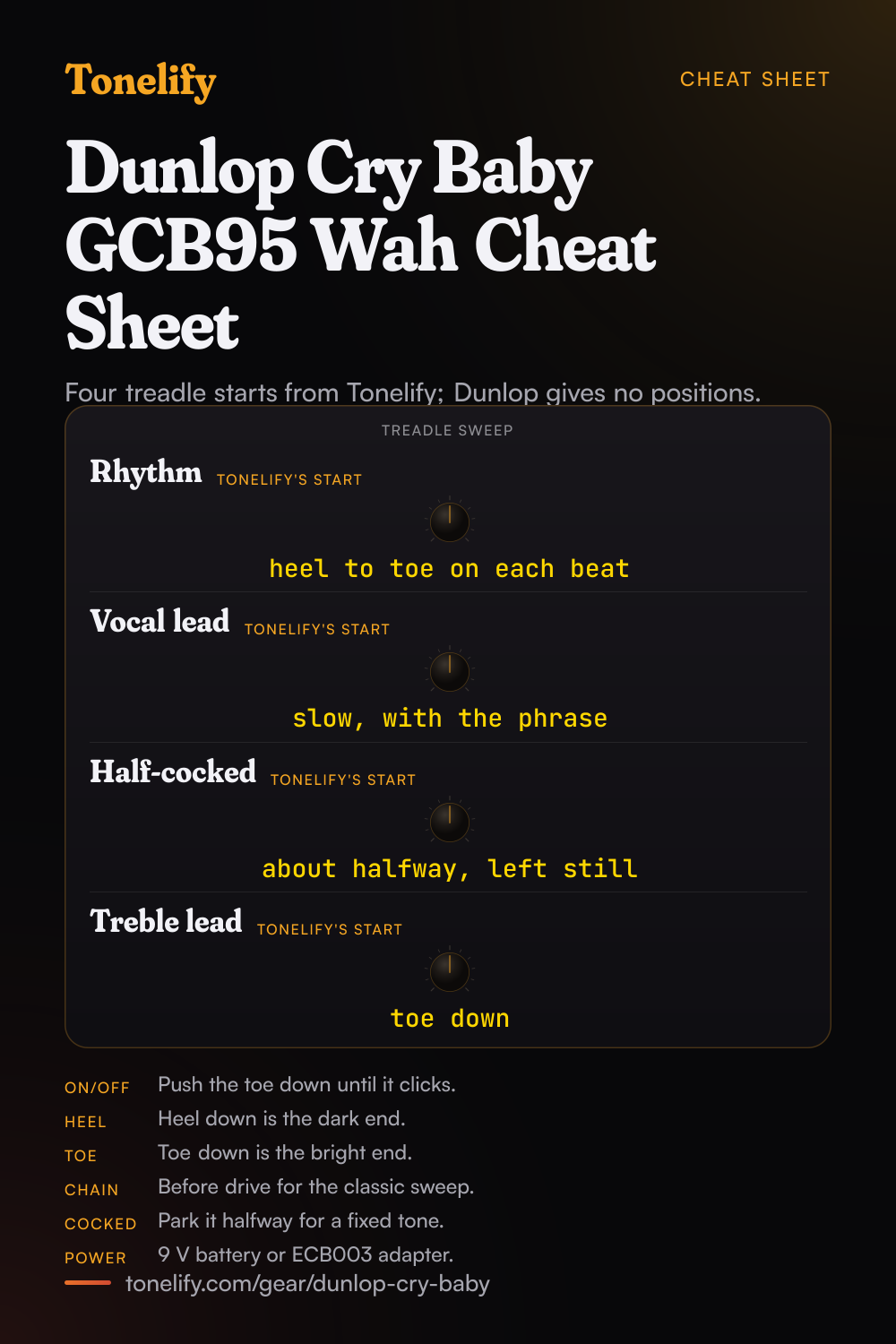
Printable cheat sheet: PDF and PNG
The rhythm, vocal lead, half-cocked and treble lead settings from this page, together on one sheet with short tips. The PDF prints on white; the PNG is the dark version for your phone.
Starting settings on the Dunlop Cry Baby GCB95
Positions as clock times, since the knobs carry no numbers: 12:00 is the middle of the travel. They are where to begin, not Dunlop's numbers: move one control at a time from here.
Rhythm wah
Treadle sweep heel to toe on each beat. This one is Tonelify's, not Dunlop's: Dunlop's manual only says that by rocking your foot back and forth on the pedal, you change the effect instantaneously. For funk and rhythm parts, rock the treadle in time with the strumming hand, heel down on one beat and toe down on the next. Keep the sweep even before making it fancy.
- Treadle sweep heel to toe on each beat
Tonelify's starting point, not Dunlop's.
Vocal lead wah
Treadle sweep slow, with the phrase. This one is Tonelify's, not Dunlop's. On a lead, move the treadle with the notes rather than with the beat: heel down as a note starts, rolling toward the toe as it rings, so the note opens up like a voice. Dunlop's product page says the GCB95 has a more aggressive and accentuated wah sound, so small movements already make a big change.
- Treadle sweep slow, with the phrase
Tonelify's starting point, not Dunlop's.
Half-cocked wah
Treadle sweep about halfway, left still. This one is Tonelify's, not Dunlop's. Turn the pedal on, set the treadle somewhere in the middle and stop moving it: the wah becomes a fixed, nasal midrange filter, a sound many rock players use for riffs and solos. Move it a little toward the heel for a darker version and toward the toe for a sharper one.
- Treadle sweep about halfway, left still
Tonelify's starting point, not Dunlop's.
Treble lead
Treadle sweep toe down. This one is Tonelify's, not Dunlop's. With the toe all the way down the GCB95 sits at the bright end of its range, which cuts through a band on a solo. Dunlop's manual lists a maximum gain of +19 dB toe down and +19.5 dB heel down, so the level stays close across the sweep; the change you hear is the tone, not the volume.
- Treadle sweep toe down
Tonelify's starting point, not Dunlop's.
Chasing one song? Name it and the matcher writes that song's settings for the Dunlop Cry Baby GCB95.
Cry Baby wahs compared
Dunlop makes many Cry Baby wahs. These are the ones closest to the GCB95, with Dunlop's own descriptions.
| Model | What Dunlop says |
|---|---|
| GCB95 Standard (this page) | Straight-up, no-frills wah with an aggressive modern sound |
| GCB95F Classic | Lower frequency range for a darker tone, softer response |
| 95Q | Based on the GCB95, adds Q control, boost and auto-return switching |
| 535Q Multi-Wah | Six-frequency range selector, Q control and switchable boost |
| CBM95 Mini | Three frequency ranges in half the size, true bypass |
| CBJ95 Junior | High, mid and low voices, 8 inches long for pedalboards |
What controls does the Dunlop Cry Baby GCB95 have?
The Dunlop Cry Baby GCB95 has one control: Treadle sweep.
Dunlop Cry Baby GCB95 specifications
- Front panel
- Treadle sweep
- Released
- 1982
What the Dunlop Cry Baby GCB95 panel means when you dial it in
Its controls are Treadle sweep, and settings for this pedal are written against those names rather than a generic level, tone and gain.
Dunlop Cry Baby GCB95 questions
How do you turn on a Cry Baby wah?
Push the toe of the pedal all the way down. Dunlop's manual says to push the toe of the pedal down until you feel a click, and to do the same to turn it off.
How do you use a Cry Baby wah pedal?
Rock the treadle while you play. Dunlop's manual says that by rocking your foot back and forth on the pedal, you change the effect instantaneously. Heel down is the dark end, toe down the bright end. Start by rocking it in time with a strummed rhythm, then try slower sweeps with single notes.
What is the Cry Baby GCB95?
Dunlop's standard Cry Baby wah. Dunlop's product page says it features the legendary Fasel inductor, a focused high end and an aggressive wah sound, and a Hot Potz potentiometer tested to one million cycles.
When did the Cry Baby come out?
Dunlop's product page says the Cry Baby hit the scene in 1966, used by players such as Jimi Hendrix and Eric Clapton. Dunlop's article on the Cry Baby's evolution dates the first Cry Baby to 1967, made by the Thomas Organ Company. Dunlop bought the original tooling in 1982 and introduced the GCB95 that year, raising the frequency range for a more up front, aggressive sound. The red Fasel inductor went in in 2004.
What is the difference between the GCB95 and the GCB95F Classic?
Dunlop's Cry Baby guide says the GCB95F Classic Wah takes the modern circuitry of the GCB95 and modifies it toward early Cry Baby pedals, with a lower frequency range for a darker tone and a softer response for a subtler effect.
Should I get the GCB95, the 95Q or the 535Q?
Dunlop's guide says the 95Q is based on the GCB95 with added controls: a Q control from sharp to smooth, adjustable boost up to +16dB and auto-return switching. The 535Q Multi-Wah adds a six-frequency range selector, Q control and switchable boost. The GCB95 is for players who want a straight-up, no-frills wah.
What is a half-cocked wah?
A wah pedal left on with the treadle parked part of the way down, so it works as a fixed midrange filter rather than a sweep. It is a playing technique, not a feature Dunlop describes, and any Cry Baby can do it. The Half-cocked panel above has Tonelify's start.
Where does the Cry Baby go in the pedal chain?
Tonelify's advice, not Dunlop's: first or near the start, before drive pedals, for the classic vocal sweep. After a distortion pedal the sweep sounds more extreme and cutting. Try both.
What power does the Cry Baby GCB95 need?
One 9 V battery, reached from the bottom of the pedal, a Dunlop ECB003 AC adapter (ECB003E in Europe) or a Dunlop DCB10 DC Brick, per Dunlop's manual. The manual lists a current draw of 900 microamps.
What does the Cry Baby GCB95 cost?
Dunlop's product page listed the GCB95 at $99.99 when Tonelify read it on 7 November 2026.
What are the GCB95's specs?
Input impedance 800 k ohm and output impedance 10 k ohm, per Dunlop's manual. It lists filter parameters of 350 to 450 Hz low pass and 1.5 to 2.5 kHz high pass, and a maximum gain of +19.5 dB heel down and +19 dB toe down.
Where does the Dunlop Cry Baby GCB95 go in the signal chain?
Usually first, or close to it: straight after the guitar and before any drive pedal. It reads the note as the guitar plays it, and it does that most reliably on the plain guitar signal. The drive then shapes what this pedal has already done, rather than the other way round.
Does Tonelify support the Dunlop Cry Baby GCB95?
Yes, and its front panel is stored, so settings only ever reference controls this pedal has: Treadle sweep. You will not be told to set a knob that is not there.
Sources
Panel, specifications and dates checked against these on .
- Dunlop: GCB95 Original Cry Baby manual (PDF)
- Dunlop: Cry Baby Standard Wah product page
- Dunlop: The Evolution of the Cry Baby Wah at Dunlop
- Dunlop: Range of Expression, Find Your Cry Baby Wah
Turning it on, power and specs are from Dunlop's manual; the description, price and launch year are from Dunlop's product page; the GCB95 history and the other models are from Dunlop's articles. Every treadle panel and the chain advice are Tonelify's, not Dunlop's.
More Dunlop gear
Similar pedals from other makers
Settings for the song you are chasing
Name a song and Tonelify reads the documented rig behind the recording, then writes the settings for a rig with the Dunlop Cry Baby GCB95 in it. A first plan starts with 7 days free, $0 today.