
MXR Phase 90 settings
⚡ Match a tone on this pedal- Speed
How do you dial in a specific tone on a MXR Phase 90?
Time and modulation effects sit at a specific point in a chain and change character completely if they move. Settings for the MXR Phase 90 come with the position in the signal path, not just the knob values, because a delay in front of a driven amp and the same delay in a loop are two different sounds.
Name the song you are chasing in the tone matcher and Tonelify returns the settings for this exact pedal, not the settings the original artist used. Those are two different things: the recording was made on gear most players do not own.
Settings for this unit only ever use controls it actually has, because its front panel is stored in our gear database. You will not be told to set a knob that is not on the unit.
Free download
Printable cheat sheet: PDF and PNG
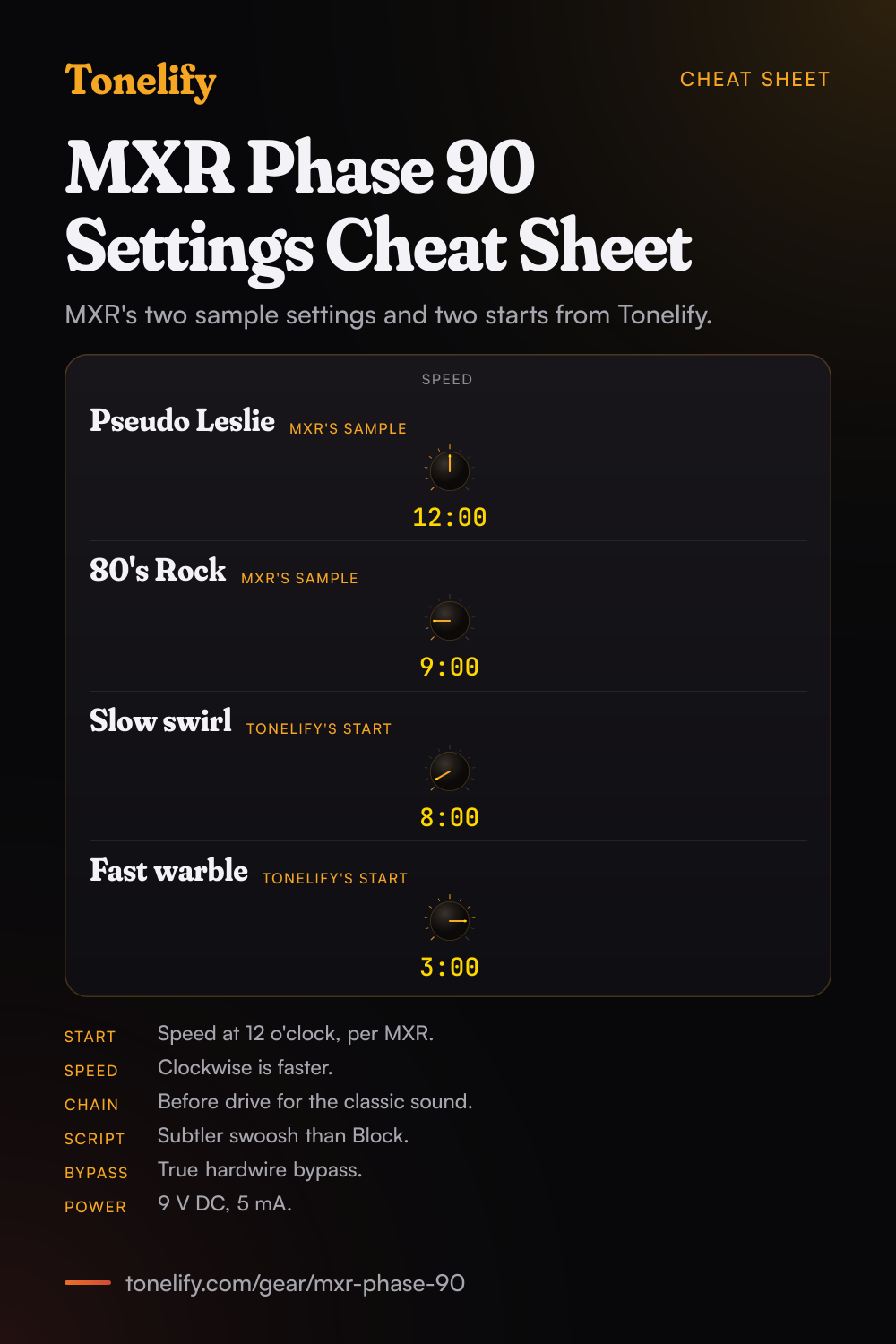
The pseudo leslie, 80's rock, slow swirl and fast warble settings from this page, together on one sheet with short tips. The PDF prints on white; the PNG is the dark version for your phone.
Starting settings on the MXR Phase 90
Positions as clock times, since the knobs carry no numbers: 12:00 is the middle of the travel. They are where to begin, not MXR's numbers: move one control at a time from here.
MXR's start and Pseudo Leslie
Speed 12:00. MXR's manual says to start with the Speed control at 12 o'clock, and its Pseudo Leslie sample setting draws the knob in the same place. The manual says to turn Speed clockwise for a faster phase effect or counterclockwise for a slower one. MXR names the noon setting after the Leslie, the spinning speaker cabinet, and it suits chords.
- Speed 12:00
MXR's manual: start at 12 o'clock; the Pseudo Leslie sample is drawn there too.
MXR's Classic 80's Rock
Speed 9:00. This is the Classic 80's Rock sample setting drawn in MXR's manual, with the knob pointing straight left. The slower sweep moves under a distorted rhythm part without getting in the way of the riff. Tonelify's tip: put the Phase 90 before the drive so the swoosh sits inside the distortion.
- Speed 9:00
Drawn in MXR's manual.
Slow swirl
Speed 8:00. This one is Tonelify's, not MXR's. Below the Classic 80's Rock setting, one sweep takes several beats, which suits held chords and slow clean parts. Dunlop's product page says the Phase 90 goes from subtle, spatial shimmer to all-out high velocity swooshing with the twist of a knob; this is the subtle end.
- Speed 8:00
Tonelify's starting point, not MXR's.
Fast warble
Speed 3:00. This one is Tonelify's, not MXR's. Past the Pseudo Leslie setting the sweep turns into a fast warble that works for short bursts and lead lines rather than whole songs. MXR's manual describes the pedal as adding shimmery velocity to lead licks and a thick swoosh to chords. If it sounds seasick, turn Speed back toward noon.
- Speed 3:00
Tonelify's starting point, not MXR's.
Chasing one song? Name it and the matcher writes that song's settings for the MXR Phase 90.
Phase 90 versions compared
Dunlop sells three versions of the Phase 90. Every value here is from Dunlop's product pages and its Phase 95 article.
| Version | What Dunlop says | Power | Price |
|---|---|---|---|
| M101 Phase 90 | The standard version, with an LED and AC jack | Battery or 9 V adapter | $99.99 |
| Script Phase 90 | The original Script sound with an LED and AC jack | Battery or 9 V adapter | $139.99 |
| '74 Vintage Phase 90 | Hand-wired reissue with hand-matched FETs, no LED | Battery only | $159.99 |
What controls does the MXR Phase 90 have?
The MXR Phase 90 has one control: Speed.
MXR Phase 90 specifications
- Front panel
- Speed
- Released
- 1972
What the MXR Phase 90 panel means when you dial it in
Its controls are Speed, and settings for this pedal are written against those names rather than a generic level, tone and gain.
MXR Phase 90 questions
What is the best setting for the MXR Phase 90?
Start with Speed at 12 o'clock, as MXR's manual says, which is also its Pseudo Leslie sample. For a slower rock rhythm sound, the manual's Classic 80's Rock sample sets Speed at 9 o'clock.
What does the Phase 90's knob do?
It sets the speed. MXR's manual says the Speed knob controls the overall effect rate: clockwise for a faster phase effect, counterclockwise for a slower one. The footswitch turns the effect on and off, and a red LED shows when it is on.
What is the difference between a Script and a Block Phase 90?
Dunlop's Phase 95 article says that as MXR moved from script logo to block logo housings, its engineers added a feedback resistor to the circuit. The first circuit, now called Script, has a subtle and more subdued swoosh; the Block circuit has a dirtier, more pronounced phasing sound. The article adds that some early Block housings hold the Script circuit, so the logo alone is not proof.
Which Phase 90 versions does MXR make?
Dunlop lists the standard M101 Phase 90, the Script Phase 90 with an LED and AC jack, and the '74 Vintage Phase 90, a hand-wired reissue that runs on a battery only. The Phase 95 is a mini pedal with both the Phase 45 and Phase 90 sounds. The table below has the details.
Should the Phase 90 go before or after distortion?
Tonelify's advice, not MXR's: before a drive pedal or a dirty amp for the classic swoosh inside the distortion, after it for a stronger, more obvious sweep. Try both; the pedal has one knob, so the placement is the biggest change you can make.
Who used the MXR Phase 90?
Dunlop's Phase 95 article names Jimmy Page, David Gilmour and Eddie Van Halen, and says MXR set the standard for phase pedals with the Phase 90 in 1972. It was designed by engineer Keith Barr.
Is the Phase 90 true bypass?
Yes. MXR's manual lists true hardwire bypass and its description says true bypass.
What power does the Phase 90 need?
9 V DC at 5 mA, per MXR's manual, from one 9-volt battery under the bottom plate, a 9-volt adapter such as the Dunlop ECB003, or a DC Brick power supply.
Can I use the Phase 90 on bass or keyboards?
Yes. MXR's manual says it works well with bass, keyboards and even vocals.
What does the Phase 90 cost?
Dunlop's product page listed the M101 Phase 90 at $99.99 when Tonelify read it on 7 November 2026.
What are the Phase 90's specs?
Input impedance 1 M ohm, output impedance 10 k ohm, nominal level -20 dBV in and out, and a noise floor of -96 dBV, per MXR's manual.
Where does the MXR Phase 90 go in the signal chain?
After the drive stage. Running a time or modulation effect into a distorted input smears the repeats into the distortion instead of layering them over it, which is why this kind of pedal usually belongs in an effects loop where the amp has one.
Does Tonelify support the MXR Phase 90?
Yes, and its front panel is stored, so settings only ever reference controls this pedal has: Speed. You will not be told to set a knob that is not there.
Sources
Panel, specifications and dates checked against these on .
- MXR: M101 Phase 90 manual (PDF)
- Dunlop: MXR Phase 90 product page
- Dunlop: MXR Script Phase 90 product page
- Dunlop: MXR '74 Vintage Phase 90 product page
- Dunlop: Enter the Next Phase, the MXR Phase 95
The noon start, the two sample settings, power, bypass and specs are from MXR's manual; prices and version details are from Dunlop's product pages; Script vs Block and the history are from Dunlop's Phase 95 article. The slow swirl and fast warble panels and the chain advice are Tonelify's, not MXR's.
More MXR gear
Similar pedals from other makers
Settings for the song you are chasing
Name a song and Tonelify reads the documented rig behind the recording, then writes the settings for a rig with the MXR Phase 90 in it. A first plan starts with 7 days free, $0 today.