
Boss ME-70 presets and settings
Knob-per-parameter floor unit with four footswitches and an expression pedal. Six COSM preamp types plus EQ, sections for COMP/FX, OD/DS, MODULATION, DELAY and REVERB, a 38 second phrase loop, 36 user and 36 preset patches, and six AA batteries or a PSA adaptor.
⚡ Match a tone on this unitHow do you dial in a specific tone on a Boss ME-70?
A multi-effects unit gives you the whole chain in one box, which means the order of the blocks is as much of the answer as the values inside them. Settings for the Boss ME-70 name the amp model, the block order and the parameters together, rather than handing you numbers with no chain to put them in.
Name the song you are chasing in the tone matcher and Tonelify returns the settings for this exact multi-effects unit, not the settings the original artist used. Those are two different things: the recording was made on gear most players do not own.
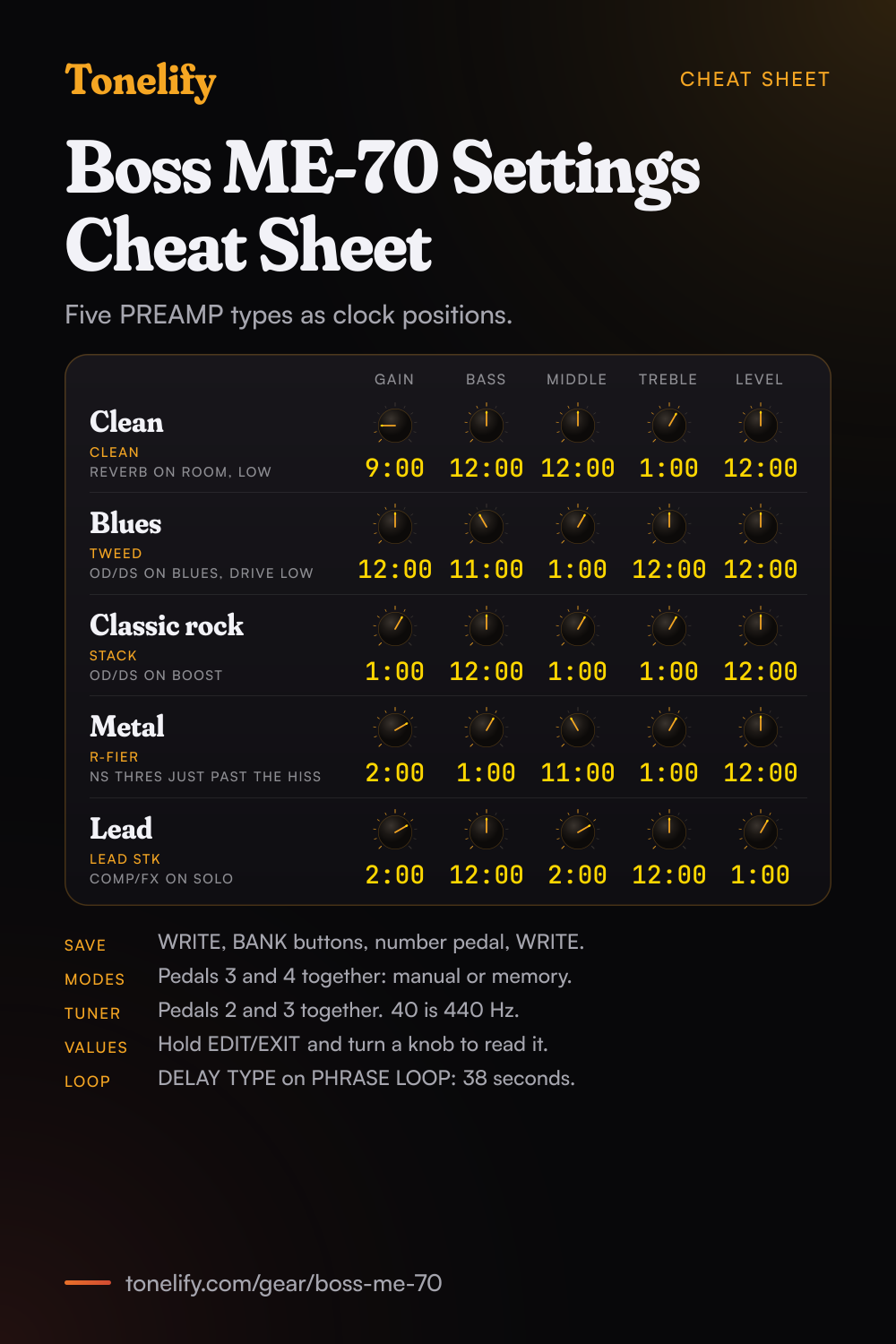
Free download
Printable cheat sheet: PDF and PNG
The clean, blues, classic rock, metal and lead settings from this page, together on one sheet with short tips. The PDF prints on white; the PNG is the dark version for your phone.
Starting settings on the Boss ME-70
Positions as clock times, since the knobs carry no numbers: 12:00 is the middle of the travel. They are where to begin, not Boss's numbers: pick the amp model first, then move one control at a time from here.
Clean
CLEAN, position 2 on the PREAMP TYPE knob, which BOSS calls a clean sound that is smooth and warm. Gain 9:00, Bass 12:00, Middle 12:00, Treble 1:00, Level 12:00. BOSS prints no number scale on the ME-70's knobs, so these are clock positions; hold EDIT/EXIT and turn a knob to see its value on the display. Add REVERB on ROOM with a low setting for air. For a crisper clean from a humbucker, COMP/FX has Hum>Single, which BOSS says changes a humbucker sound to a single-coil sound. Preset 1-4, a clean sound for arpeggio in BOSS's words, and 2-4, a tight clean for rhythm, are the factory cleans.
- Gain 9:00
- Bass 12:00
- Middle 12:00
- Treble 1:00
- Level 12:00
REVERB on ROOM, low, for air.
Edge of breakup and blues
TWEED, a crunch sound like that of a Fender Bassman in BOSS's words. Gain 12:00, Bass 11:00, Middle 1:00, Treble 12:00, Level 12:00. At this Gain the sound cleans up as you play softer. COMBO, a crunch reminiscent of a VOX combo amp, is the brighter alternative. For more push, step on OD/DS with its TYPE on BLUES, the overdrive BOSS says faithfully reproduces the nuances of picking, and keep its DRIVE low so the preamp does the rest. Preset 1-3 is BOSS's crunch for blues.
- Gain 12:00
- Bass 11:00
- Middle 1:00
- Treble 12:00
- Level 12:00
OD/DS on BLUES, its DRIVE low, for more push.
Classic rock
STACK, which BOSS describes as reminiscent of 1970s Marshall amps. Gain 1:00, Bass 12:00, Middle 1:00, Treble 1:00, Level 12:00. Keep MIDDLE past noon: a rhythm part needs the mids to sit with a band. If you want more gain on the same amp, OD/DS on BOOST is a gain booster that BOSS says works well for creating distortion with a COSM preamp. Preset 3-1, BOSS's drive sound for 70s hard rock, and 8-3, hard rock with PHASER, start from this kind of sound.
- Gain 1:00
- Bass 12:00
- Middle 1:00
- Treble 1:00
- Level 12:00
OD/DS on BOOST for more gain from the same amp.
Metal
R-FIER, BOSS's model of a Mesa/Boogie Dual Rectifier. Gain 2:00, Bass 1:00, Middle 11:00, Treble 1:00, Level 12:00. Raise NS THRES with its buttons until the hiss between riffs is gone and no further: BOSS warns that a setting higher than necessary can leave no sound when you play quietly. For a tighter attack, put OD/DS on BOOST with little DRIVE in front of the preamp. METAL in OD/DS is a distortion that BOSS says emphasizes the midrange and CORE one that cuts it. BOSS's metal presets are 2-1, good for riffs, 5-1 for 80s metal, and 3-2 for single-coil pickups.
- Gain 2:00
- Bass 1:00
- Middle 11:00
- Treble 1:00
- Level 12:00
NS THRES only as high as the hiss needs.
Lead
LEAD STK, BOSS's high-gain lead sound. Gain 2:00, Bass 12:00, Middle 2:00, Treble 12:00, Level 1:00. Turn on COMP/FX with TYPE on SOLO, which BOSS says produces the optimal sound for solo playing in combination with OD/DS or PREAMP, and add DELAY on 100-990ms for the repeats behind the notes. TAP lets you set the delay to the song by pressing the DELAY pedal in time. Preset 1-2, a well sustained distortion for solos, is BOSS's own lead.
- Gain 2:00
- Bass 12:00
- Middle 2:00
- Treble 12:00
- Level 1:00
COMP/FX on SOLO, DELAY on 100-990ms.
Chasing one song? Name it and the matcher writes that song's settings for the Boss ME-70.
Boss ME-70 amp list
The PREAMP section's TYPE knob has eight positions: OFF, EQ and six COSM preamp types. The five knobs beside it are GAIN, BASS, MIDDLE, TREBLE and LEVEL on a preamp type; on EQ they become a four-band equalizer, LOW, LOW-MID, HIGH-MID and HIGH, with LEVEL. BOSS's product page says the section is derived from the GT-10 and the Legend series.
| No. | Preamp type | What BOSS says it is |
|---|---|---|
| 0 | OFF | Turns preamp modelling off |
| 1 | EQ | A four-band parametric equalizer |
| 2 | CLEAN | A clean sound that is smooth and warm |
| 3 | COMBO | A crunch sound reminiscent of a VOX combo amp |
| 4 | TWEED | A crunch sound like that of a Fender Bassman |
| 5 | STACK | A sound reminiscent of 1970s Marshall amps |
| 6 | LEAD STK | A high-gain lead sound |
| 7 | R-FIER | Mesa/Boogie Dual Rectifier |
Boss ME-70 effects list
Each section has its own TYPE knob and its own knobs, and COMP/FX, OD/DS, MODULATION and DELAY each have a pedal that turns them on and off. PREAMP and REVERB have no pedal of their own: TYPE on OFF turns the preamp off, and an optional FS-5U or FS-6 footswitch switches both in manual mode. The noise suppressor is one setting, NS THRES, set with the NS THRES/BANK buttons, where 0 turns it off.
- COMP/FX (8 types)
- COMP, T.WAH UP, T.WAH DOWN, SLOW GEAR, DEFRETTER, Single>Hum, Hum>Single, SOLO
- OD/DS (10 types)
- BOOST, NATURAL, OD-1 (BOSS OD-1), BLUES, DIST, CLASSIC, MODERN, METAL, CORE, FUZZ
- MODULATION (10 types)
- CHORUS, PHASER, FLANGER, ROTARY, UNI-V (Uni-Vibe), TREMOLO, VIBRATO, HARMONIST, OCTAVE, DELAY (a second delay, 10 to 990 ms)
- DELAY (10 types)
- 1-99ms, 100-990ms, 1000-6000ms, ANALOG, MODULATE, REVERSE, CHO + DELAY, MOMENTARY, TAP, PHRASE LOOP (38 seconds)
- PREAMP (8 positions)
- OFF, EQ and the six types in the amp list above
- REVERB (2 types)
- ROOM (0. to 49.), HALL (0. to 49.)
- PEDAL FX (6 types)
- WAH, VOICE, +1 OCTAVE, -1 OCTAVE, MOD RATE, DELAY LEV
- Also on the unit
- NS THRES (noise suppressor, 0 is off), Volume on the expression pedal, EZ TONE, Tuner, AUX IN
Boss ME-70 preset list
The 36 presets sit in nine read-only preset banks, P1 to P9, four patches each, one on each number pedal; BOSS numbers them 1-1 to 9-4. Nine user banks, U1 to U9, hold your own 36. Pick the bank with BANK and the patch with a number pedal. BOSS gives each preset a description rather than a name, and marks the pickup it suits: S for single coils, H for humbuckers.
| Preset | What BOSS says it is | Pickup |
|---|---|---|
| 1-1 | Rough distortion sound, good for backing | S/H |
| 1-2 | Well sustained distortion sound, good for solos | S/H |
| 1-3 | Crunch sound suitable for blues | S/H |
| 1-4 | Clean sound for arpeggio | S/H |
| 2-1 | Metal sound good for riffs | H |
| 2-2 | Fuzz sound of the 60s with UNI-V; the expression pedal sets the UNI-V speed | S |
| 2-3 | Crunch sound, good for chord strokes | S/H |
| 2-4 | Tight, clean sound, good for rhythm | S/H |
| 3-1 | Drive sound for 70s hard rock | S/H |
| 3-2 | Metal sound, good for single-coil pickups | S |
| 3-3 | Rotary sound of the 70s; the expression pedal sets the ROTARY speed | S/H |
| 3-4 | Jazz sound, suitable for neck pickup | H |
| 4-1 | Sweet drive sound for latin rock; the expression pedal sets the DELAY level | H |
| 4-2 | A whimsical sound suited to 1970s progressive rock | S |
| 4-3 | Tremolo sound, good for 60s surf rock | S |
| 4-4 | Clean sound with T.WAH for funk | S |
| 5-1 | Distortion sound for 80s metal | H |
| 5-2 | Raises the pitch by an octave as you work the expression pedal; for single-note phrases | S/H |
| 5-3 | Crunch sound with COMPRESSOR for solos | S |
| 5-4 | Phaser sound, good for rhythm | S/H |
| 6-1 | Drive sound, good for punk rock | S/H |
| 6-2 | Twin-lead-like distortion for single-note phrases in A minor (C major) | S/H |
| 6-3 | 90s alternative-rock sound | S/H |
| 6-4 | Clean sound with pedal wah, good for rhythm | S/H |
| 7-1 | Mild lead sound for jazz-fusion | S/H |
| 7-2 | An effect like a talk box when you work the pedal | S/H |
| 7-3 | Slap-back echo sound for country | S |
| 7-4 | Clean tone for 60s Liverpool sound | S |
| 8-1 | Heavy distortion combined with the sound an octave lower | H |
| 8-2 | Wild distortion with FLANGER | H |
| 8-3 | Hard rock sound with PHASER | H |
| 8-4 | Changes a single-coil sound to a clean humbucker sound | S |
| 9-1 | For solos that combine PEDAL WAH and DISTORTION | S/H |
| 9-2 | Synth-like sound using SLOW GEAR | S |
| 9-3 | Crunch with a dotted eighth note delay; the number pedals change the delay time | S |
| 9-4 | Fretless guitar sound | S |
Boss ME-70 specifications
- Released
- 2008
Boss ME-70 questions
What amps are in the Boss ME-70?
Six COSM preamp types on the PREAMP section's TYPE knob: CLEAN (smooth and warm), COMBO (a crunch reminiscent of a VOX combo amp), TWEED (a crunch like a Fender Bassman), STACK (reminiscent of 1970s Marshall amps), LEAD STK (a high-gain lead sound) and R-FIER (a model of a Mesa/Boogie Dual Rectifier). The knob's other positions are OFF and EQ, a four-band parametric equalizer. BOSS's product page says the section is derived from the GT-10 and its Legend series.
How many patches does the Boss ME-70 have?
72: 36 user patches and 36 presets. They sit in banks of four, one patch on each number pedal, with nine user banks, U1 to U9, that you can write to and nine preset banks, P1 to P9, that are read-only. BOSS's preset list describes each preset rather than naming it, from 1-1, a rough distortion for backing, to 9-4, a fretless guitar sound.
How do you save a patch on the ME-70?
Press WRITE and the pedal indicators flash. Choose the user bank with the BANK buttons and the patch with a number pedal, 1 to 4, then press WRITE again. EDIT/EXIT cancels. Writing replaces whatever was in that patch, and until you write, turning the power off or changing patch loses the sound. To copy a patch, call it up and write it to a different number.
What is the difference between manual mode and memory mode on the ME-70?
In manual mode the sound is wherever the front-panel knobs are, like a row of pedals. Memory mode recalls the saved patches. Press number pedals 3 and 4 together to switch between them; in manual mode a dot lights at the bottom right of the display, and in memory mode the display shows the bank number. To change a saved patch, call it up and press EDIT/EXIT: Ed appears and the knobs work again.
What is EZ TONE on the Boss ME-70?
A set of ready settings for each effect type. Press EZ TONE, then turn an effect's TYPE knob, and BOSS's settings for that type load at once; you fine-tune from there with the effect's knobs. You can save your own version over the factory one: hold EZ TONE, press WRITE, pick the section with the BANK buttons and press WRITE again.
Why do the ME-70's knobs not match the sound?
After you call up a patch or an EZ Tone, the stored values and the knob positions can differ. Hold EDIT/EXIT and turn a knob to see its real value on the display. A setting in manual mode, EDIT/EXIT held with the COMP pedal, decides what a knob does when you move it: n0, the factory setting, jumps to the knob's position, and n1 waits until you turn past the stored value.
How do you use the tuner on the ME-70?
Press number pedals 2 and 3 together; press them again to leave. Play one open string and tune until the note shows and both tuning guide indicators light. The reference pitch runs from 35 to 45 on the display, 435 to 445 Hz, set with the NS THRES/BANK buttons, and it ships at 40, which is 440 Hz. The tuner bypasses every effect, and the expression pedal still sets the volume.
How long is the looper on the Boss ME-70?
38 seconds. Turn the DELAY section's TYPE knob to PHRASE LOOP, press the DELAY pedal to record and again to play it back, and repeat to overdub. The DELAY E. LEVEL knob sets the loop's volume, and two presses within a second stop it. The loop is deleted when playback stops, when you turn the TYPE knob or when you switch off.
What does the expression pedal do on the ME-70?
It is a volume pedal until you press its toe down firmly; then it runs the effect chosen with the PEDAL FX knob and the PEDAL FX indicator lights. The six choices are WAH, VOICE, which simulates a human voice, +1 OCTAVE, -1 OCTAVE, MOD RATE and DELAY LEV. For MOD RATE the MODULATION section's RATE knob sets the top of the range, and for DELAY LEV the DELAY section's E. LEVEL knob does.
Can you use the Boss ME-70 with headphones?
Yes. Plug them into the REC OUT/PHONES jack, which turns on a built-in guitar amp simulator so the sound works without an amp. The simulator is applied to the Gt. AMP OUTPUT jacks as well, so unplug the headphones when you play through a guitar amp. AUX IN mixes a music player into the output to play along.
What footswitch works with the ME-70?
A BOSS FS-5U or FS-6. In manual mode it switches the PREAMP and REVERB sections on and off; in memory mode it steps the bank up and down. Set the FS-5U's POLARITY switch, or the FS-6's MODE and POLARITY switches, as the manual shows.
Does the ME-70 run on batteries?
Yes, on six AA batteries, or on a BOSS PSA series AC adaptor sold separately. BOSS recommends keeping batteries in even on the adaptor, so the unit keeps playing if the adaptor's cord comes out. It draws 130 mA and weighs 3.5 kg with batteries.
What are the best Boss ME-70 settings for metal?
Start with R-FIER at Gain 2:00, Bass 1:00, Middle 11:00, Treble 1:00 and Level 12:00, and set NS THRES just high enough to stop the hiss. These are starting points rather than BOSS's numbers, since BOSS prints no knob values. Preset 2-1, BOSS's metal sound for riffs, is the factory version to compare against.
Is the Boss ME-70 discontinued?
Yes. BOSS's product page lists the ME-70 as discontinued, and its Owner's Manual dates from 2008. BOSS still hosts the manual and the product page with the preset demos.
How do you build a patch on the Boss ME-70?
Pick the amp model first, then set its controls, then add the blocks in signal-chain order: drive before the amp, time and modulation after it. A patch built the other way around ends up compensating for the wrong stage. Tonelify returns the model, the order and the parameters together.
Does Tonelify support the Boss ME-70?
Yes. Name it in the tone matcher along with the song you are chasing and the settings come back adapted to it. Gear does not need to be in the catalog for a match to run.
Sources
Panel, specifications and dates checked against these on .
- BOSS: ME-70 Owner's Manual (PDF)
- BOSS: ME-70 product page, features and specifications
- BOSS: ME-70 owner's manuals
The manual is the English Owner's Manual BOSS's owner's manuals page links, read on 16 November 2026. BOSS prints no numbers on the ME-70's knobs and publishes no values for its presets, so the five panels are starting points as clock positions.
More Boss gear
Similar multi-effects units from other makers
Settings for the song you are chasing
Name a song and Tonelify reads the documented rig behind the recording, then writes the settings for a rig with the Boss ME-70 in it. A first plan starts with 7 days free, $0 today.